

Last updated: August 23, 2026

Quick Answer
An HOA special assessment is a one-time charge levied on homeowners beyond regular monthly dues, and skipping it is not a low-stakes decision. Unpaid special assessments can result in an HOA placing a lien on your property, and in most U.S. states, that lien can lead to foreclosure, even if your mortgage is current. The timeline and process vary by state and by what your HOA's governing documents allow, but the foreclosure risk is real and well-documented.
Key Takeaways
- An HOA special assessment is a separate, one-time charge used to cover unexpected or large expenses not covered by reserve funds
- HOAs can place a lien on your home for unpaid special assessments, and that lien can trigger foreclosure in most states
- Special assessments have no universal dollar cap; the amount depends on the project cost, number of units, and any limits written into the HOA's CC&Rs
- Ignoring a special assessment notice does not make it go away, late fees, interest, and legal costs stack on top of the original balance
- Homeowners generally have the right to dispute a special assessment, request a payment plan, or challenge the process if proper procedures were not followed
- Special assessments are rarely covered by standard homeowners insurance, though a specific policy endorsement called "loss assessment coverage" can help
- Sellers must typically disclose pending or recently passed special assessments; buyers should check for them before closing
- Underfunded HOA reserves are the single biggest driver of surprise special assessments
What Is an HOA Special Assessment
An HOA special assessment is a charge billed to homeowners in addition to regular monthly or annual dues. It is not a recurring fee. It is a one-time (or multi-installment) charge that an HOA board passes when the association needs money for something the reserve fund cannot cover.
Think of it this way: your HOA collects dues every month. A portion of those dues goes into a reserve fund, which is supposed to cover big future repairs like roof replacements, parking lot resurfacing, or elevator overhauls. When the reserve fund runs dry or a surprise expense hits, the HOA bills every homeowner directly. That bill is the special assessment.
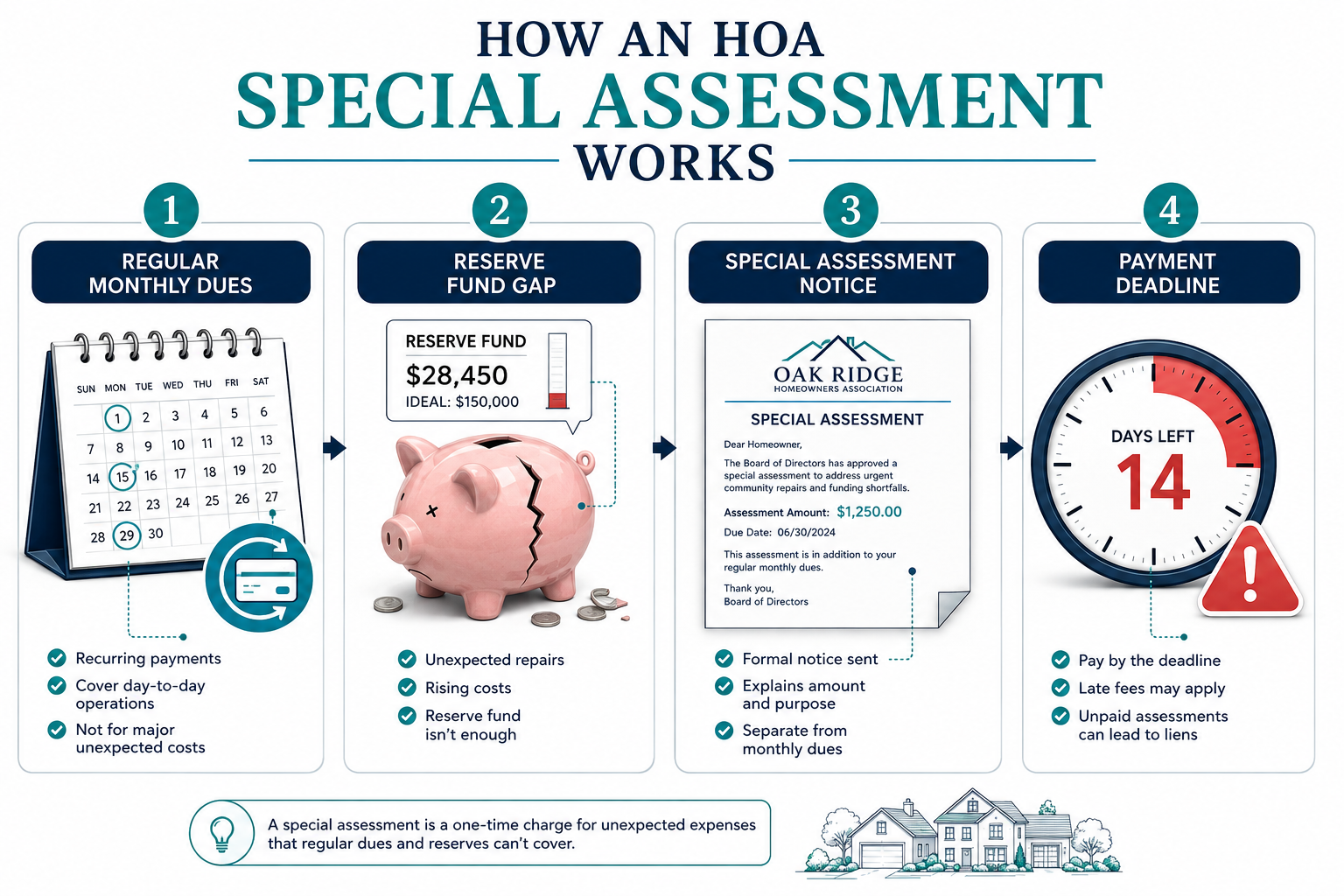
Special assessments are authorized by the HOA's governing documents, specifically the CC&Rs (Covenants, Conditions, and Restrictions) and bylaws. Those documents spell out how the board can levy a special assessment, whether owners get to vote on it, and whether there are any dollar limits. If your HOA's CC&Rs cap a special assessment at $1,000 per unit without a homeowner vote, a board cannot unilaterally charge $5,000 without going back to the membership first.
This is worth understanding before you buy into any HOA community. For a broader look at what HOA membership actually means for buyers, the truth about HOAs, benefits and challenges every buyer should know is a solid starting point.
HOA Special Assessment: Skip It and They Can Foreclose, Here Is How It Works
Yes, an HOA can foreclose on your home if you do not pay a special assessment. This surprises a lot of homeowners because they assume foreclosure only happens when a mortgage goes unpaid. The HOA foreclosure process is separate from your mortgage lender entirely.
Here is the sequence that plays out when a special assessment goes unpaid:
- Assessment is levied. The HOA board passes the special assessment and sends formal notice to all homeowners with a due date.
- Payment deadline passes. If you do not pay, late fees and interest begin accruing. Most HOA governing documents allow interest rates between 8% and 18% annually on unpaid balances.
- HOA files a lien. The association records a lien against your property with the county. This lien is now attached to the title of your home.
- Collection escalates. The HOA may turn the account over to a collections attorney. Legal fees get added to your balance.
- Foreclosure is initiated. In most states, an HOA can move to foreclose on that lien if the balance remains unpaid past a threshold. Some states require judicial foreclosure (going through a court). Others allow non-judicial foreclosure, which moves faster.
The critical point: your mortgage lender does not protect you here. A first-mortgage lender has a senior lien position in most states, but HOA super-lien states (including Nevada, Colorado, Washington, and about 20 others) give the HOA's lien priority over the first mortgage for a limited number of months of unpaid assessments. That means an HOA can foreclose and potentially wipe out a lender's interest in the property.
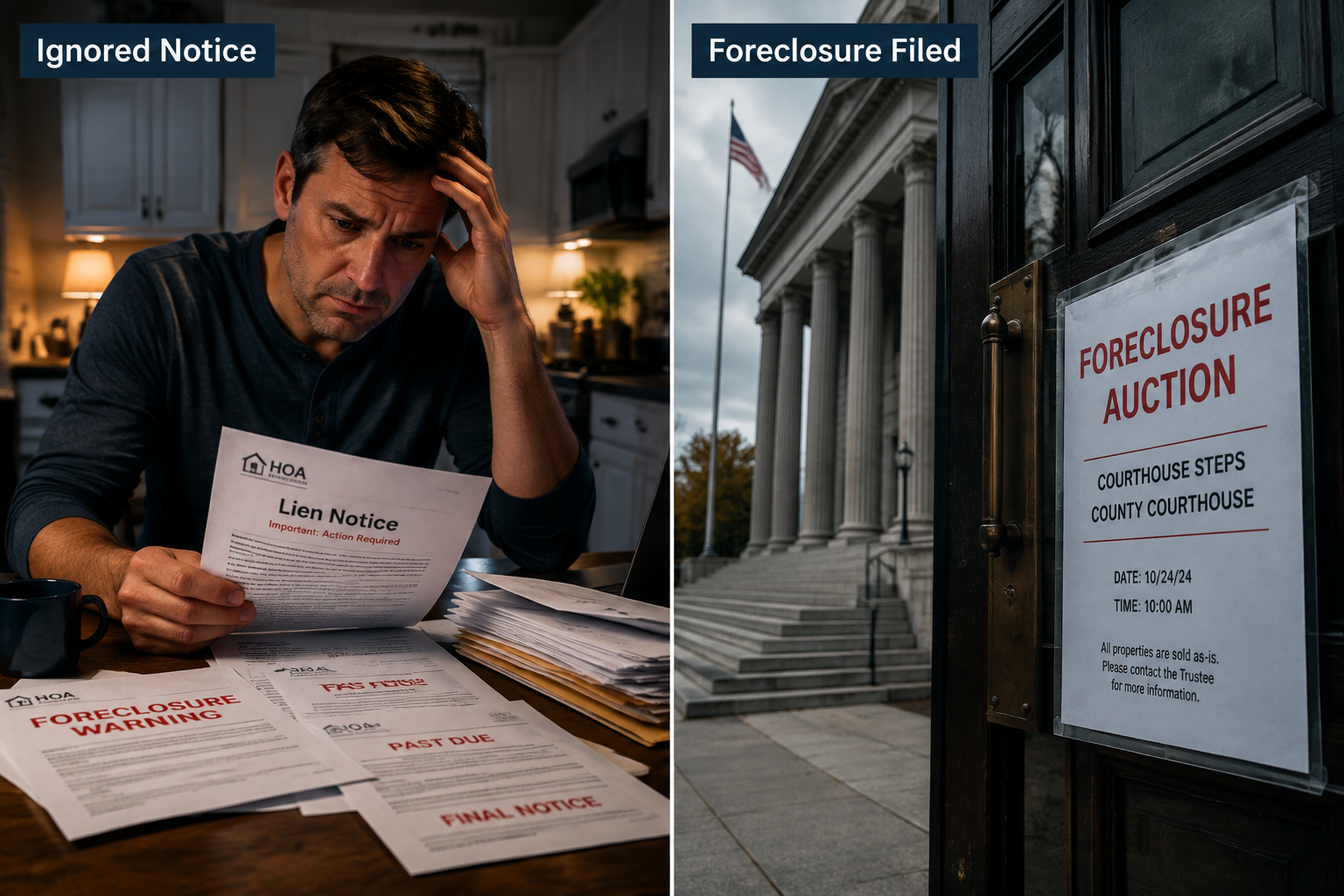
How long before an HOA can foreclose? There is no single national answer. Most HOAs must follow a notice and cure period before filing a lien, typically 30 to 90 days. After the lien is recorded, the timeline to foreclosure varies by state law and the HOA's own procedures, ranging from a few months to over a year. The faster-moving non-judicial states can move from lien to foreclosure sale in as little as 90 to 120 days after the lien is filed.
The safest assumption: do not test the timeline. An HOA lien on your property also makes it nearly impossible to refinance or sell until the balance is cleared.
What Triggers an HOA Special Assessment and How Much Can It Be
Special assessments are triggered when the HOA's reserve fund cannot cover a necessary expense. The most common reasons include:
- Structural repairs, roof replacement, foundation work, parking structure repairs
- Insurance shortfalls, when a claim payout does not cover the full repair cost
- Legal judgments, if the HOA loses a lawsuit and owes damages
- Code compliance, building code violations that require expensive remediation
- Condo milestone inspections, Florida's Senate Bill 4-D (2022) now requires milestone inspections for condos three stories or higher at 30 years of age (25 years if near the coast), and structural integrity reserve studies. The fallout from Surfside has driven massive special assessments across Florida, with some condo owners receiving bills of $50,000 to $150,000 or more per unit
- Deferred maintenance, years of underfunded HOA reserves catching up all at once
How much can an HOA special assessment be? There is no federal cap and no standard state cap. The amount depends entirely on the cost of the project divided by the number of units, minus whatever the reserve fund can contribute. A small HOA with 20 units facing a $400,000 roof replacement could levy $20,000 per unit. A large condo association with 200 units facing the same bill would charge $2,000 per unit.
Some HOA CC&Rs cap special assessment amounts. A common threshold is $1,000 to $1,500 per unit per year without requiring a homeowner vote. Above that cap, owners typically must approve the assessment by a majority or supermajority vote. If your CC&Rs do not include a cap, the board has broader authority to levy whatever the project requires.
The condo market has felt this acutely in 2026. Rising insurance costs, aging infrastructure, and post-Surfside inspection mandates have combined to create a wave of large special assessments in Florida, California, and other high-density markets. This is part of why the condo market slump in 2026 and rising HOA fees has pushed buyers toward detached homes.
Special Assessment vs Regular Dues: What Is the Difference
Regular HOA dues are recurring charges, monthly, quarterly, or annually, budgeted in advance to cover operating expenses and reserve contributions. Special assessments are non-recurring charges for costs that fall outside the normal budget.
| Feature | Regular Dues | Special Assessment |
|---|---|---|
| Frequency | Recurring (monthly/annual) | One-time or installment-based |
| Purpose | Operating costs, reserve contributions | Unexpected or large capital expenses |
| Board authority | Set annually in budget | Requires CC&R authorization; may need owner vote |
| Advance notice | Budget approved yearly | Separate notice required |
| Foreclose risk if unpaid | Yes | Yes |
| Tax deductibility | Generally not for primary residence | Generally not for primary residence; may apply to rentals |
The key practical difference: regular dues are predictable. A special assessment is not. An HOA reserve study is supposed to prevent surprise assessments by projecting future repair costs and ensuring the reserve fund stays funded. When an HOA skips or ignores its reserve study, or when the board consistently underfunds reserves to keep dues artificially low, a large special assessment becomes almost inevitable.
Underfunded HOA reserves are the real villain in most special assessment stories. An HOA reserve study is a professional analysis that estimates the remaining useful life and replacement cost of every major common element. When that study shows the reserves are only 30% or 40% funded, the gap has to come from somewhere. That somewhere is usually a special assessment.
What Happens If You Ignore an HOA Special Assessment Notice
Ignoring an HOA special assessment notice does not pause the process. The debt grows, and the HOA's legal options expand with time.
Here is what typically happens in sequence:
- Day 1 to 30: Notice is sent. No payment received. Late fees begin accruing.
- Day 30 to 60: Second notice or demand letter issued. Interest compounds on the unpaid balance.
- Day 60 to 90: HOA may refer the account to a collections attorney. Attorney fees are added to your balance.
- Day 90+: HOA records a lien against your property. Your title is now clouded.
- After lien filing: HOA can pursue foreclosure, depending on state law and the dollar threshold in the governing documents.
Some HOAs have minimum balance thresholds before they will initiate foreclosure, $1,800 is a common floor in states that have enacted consumer protections. But many HOAs have no such floor in their governing documents, and state law does not always require one.
The practical damage beyond foreclosure risk: an HOA lien shows up in a title search. You cannot sell or refinance the property without satisfying the lien first. If you are planning to sell, that lien becomes a negotiating problem at the closing table.
Can You Dispute an HOA Special Assessment
Yes, homeowners can dispute a special assessment, and there are legitimate grounds to do so. The dispute process varies by state and by what the governing documents allow, but the general approach follows these steps:
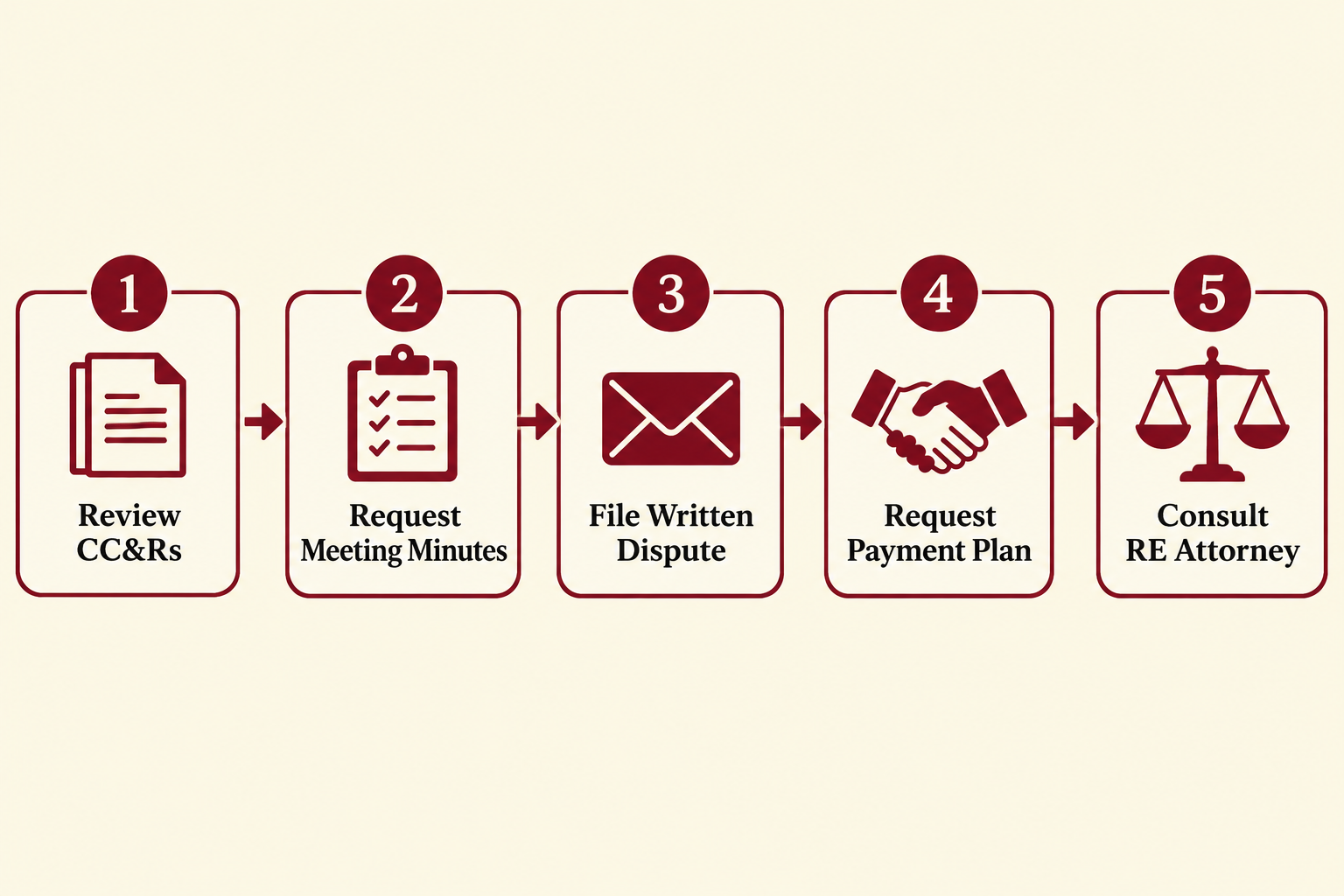
Step 1: Review the CC&Rs. Check whether the board followed the proper authorization procedure. Did the assessment exceed the cap that requires a homeowner vote? Was the vote conducted properly?
Step 2: Request meeting minutes. The board must document how and why the assessment was approved. If the minutes are incomplete or the vote was procedurally flawed, that is grounds for a challenge.
Step 3: Request the reserve study and financial records. If the HOA claims the reserves are depleted, you have the right to see the documentation. An HOA that cannot produce a current reserve study or audited financials has a transparency problem.
Step 4: File a written dispute. Most HOA governing documents require a formal written dispute process before you can escalate. Send a certified letter outlining your specific objections.
Step 5: Attend the hearing. Most HOAs must offer a hearing before taking collection action. Show up, bring documentation, and make your case on the record.
Step 6: Consult a real estate attorney. If the board violated the CC&Rs or state law in levying the assessment, an attorney can file for injunctive relief to halt collection while the dispute is resolved.
One important note: disputing an assessment does not automatically pause the collection timeline in most states. Pay under protest if necessary to protect your credit and title while the dispute works through the process.
HOA Special Assessment Payment Plan Options
Most HOAs will negotiate a payment plan for homeowners who cannot pay a large special assessment in a lump sum. This is not guaranteed, but it is common, especially for assessments above $5,000.
To request a payment plan:
- Submit a written request to the HOA board before the due date if possible
- Propose a specific schedule (monthly installments over 12 to 24 months is a typical starting point)
- Offer to pay interest on the deferred balance; this makes the request more credible to the board
- Get the agreement in writing and signed by an authorized board officer
Some HOAs build installment options directly into the special assessment notice. Florida law, for example, requires HOAs to offer payment plans for certain large assessments under specific conditions.
If the board refuses a payment plan and the balance is large, a personal loan or HELOC may be worth exploring. Tapping home equity to pay off an HOA lien is not ideal, but it is less damaging than a foreclosure on your record. For homeowners exploring equity-based options, reviewing best HELOC lenders for investment property rates and requirements can give a sense of what that financing looks like.
Is an HOA Special Assessment Tax Deductible
For a primary residence, HOA special assessments are generally not tax deductible. The IRS treats them as personal expenses, the same as regular HOA dues.
There are two exceptions worth knowing:
Rental properties. If the property is a rental, special assessments that cover repairs or maintenance (not capital improvements) may be deductible as a business expense in the year paid. Assessments that fund capital improvements must typically be depreciated over time rather than deducted immediately. A tax professional should confirm the treatment for your specific situation.
Home office deduction. If you use part of your home exclusively for business and claim a home office deduction, a proportional share of HOA fees and assessments may be deductible. This is a narrow exception and requires careful documentation.
The tax treatment of real estate costs can get complicated fast. For a broader look at how real estate investment taxes work, the real estate investment taxes guide covers the key concepts.
Can You Sell Your House With an Unpaid HOA Special Assessment
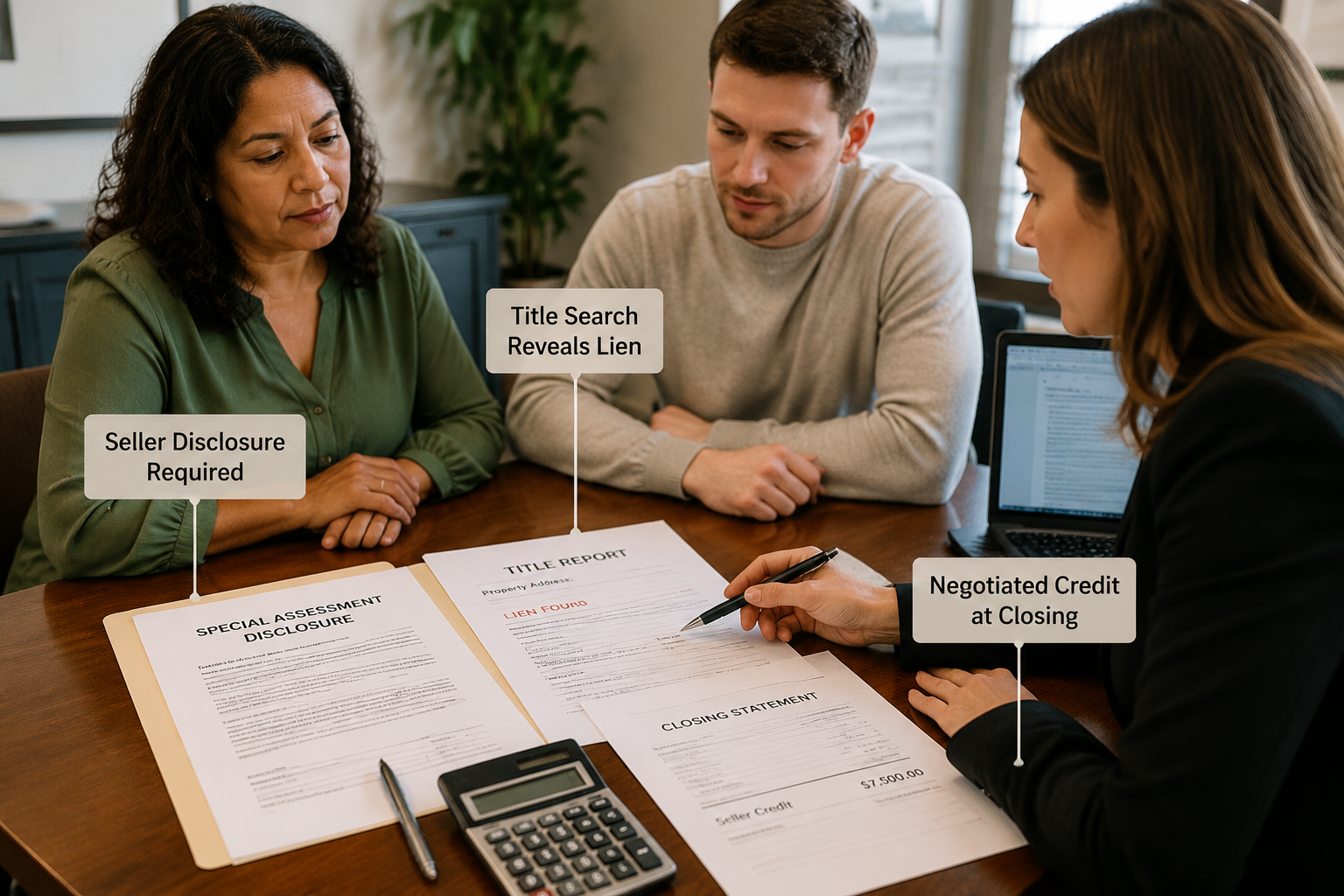
You can sell a house with an unpaid HOA special assessment, but the lien must be resolved before or at closing. A title company will catch the lien during the title search and will not issue a clear title policy until the balance is satisfied.
In practice, there are three ways this plays out:
Seller pays at closing. The most common outcome. The lien balance (plus any accrued interest and fees) is deducted from the seller's proceeds at closing.
Buyer negotiates a credit. If the assessment was recently levied and has not yet become a lien, a buyer may accept a price reduction or closing cost credit in exchange for taking on the payment obligation. This requires disclosure and explicit agreement in the purchase contract.
Sale falls through. If the lien balance is large enough to exceed the seller's equity, the deal cannot close without additional funds from the seller.
Do you have to disclose a special assessment when selling? Yes, in virtually every state. Most state disclosure laws require sellers to disclose known pending or recently passed special assessments. Failing to disclose is a material misrepresentation that can expose a seller to post-closing legal liability.
Buying a condo with a pending special assessment deserves extra attention. If a special assessment has been approved but not yet billed, it may not show up as a lien yet. Buyers should request the HOA's meeting minutes for the past 12 to 24 months, the current reserve study, and a written statement from the HOA confirming no pending assessments. A seller who knows an assessment is coming and does not disclose it is creating a serious legal problem.
For buyers evaluating a condo or HOA property in 2026, the U.S. home buyers market trends in 2026 provides useful context on what the broader market looks like right now.
Does Homeowners Insurance Cover an HOA Special Assessment
Standard homeowners insurance does not cover HOA special assessments. A special assessment is a financial obligation to your HOA, not a physical loss to your property, so it falls outside the scope of a standard HO-3 policy.
There is one policy endorsement that can help: loss assessment coverage. This is an add-on to a standard homeowners policy (or condo unit owner's policy) that covers your share of a special assessment when the assessment arises from a covered peril, typically a sudden, accidental event like a fire or storm that damages common areas.
Loss assessment coverage does not cover:
- Assessments for deferred maintenance or underfunded reserves
- Assessments for structural inspections or code compliance
- Assessments resulting from HOA lawsuits unrelated to a covered peril
- The full amount of any assessment above the policy limit (typical limits are $1,000 to $50,000 depending on the endorsement)
Condo owners in particular should check whether their unit owner's policy includes loss assessment coverage and what the limit is. Given the size of assessments hitting Florida condo owners in 2026, a $5,000 loss assessment limit is not going to move the needle on a $40,000 bill.
How to Avoid HOA Special Assessments Before They Hit
You cannot always avoid a special assessment, but you can dramatically reduce the odds of being blindsided by one.
Before buying into an HOA community:
- Request the most recent HOA reserve study. A reserve fund below 70% funded is a yellow flag; below 50% is a red flag.
- Ask for the last two years of HOA meeting minutes and financial statements. Look for mentions of deferred maintenance, pending litigation, or reserve shortfalls.
- Ask directly: "Has any special assessment been discussed, approved, or anticipated in the last 24 months?"
- Review the CC&Rs for the special assessment authorization process and any dollar caps.
- Check whether the HOA has pending litigation. A lawsuit loss can trigger a large, fast assessment.
After you own:
- Attend HOA meetings or at minimum review the minutes. Boards that are heading toward a special assessment rarely hide it entirely, the signs are in the minutes months before the vote.
- Vote for board members who prioritize reserve funding over artificially low dues.
- Advocate for annual reserve study updates. An HOA that has not updated its reserve study in five years is flying blind.
The single best protection is buying into an HOA that is well-run and fully funded. That requires doing the homework before you sign the purchase contract, not after. For buyers comparing property types, the single-family homes, condos, or townhouses comparison breaks down the structural differences that affect HOA exposure.
FAQ
What is an HOA special assessment in simple terms?
It is a one-time charge from your homeowners association that covers a large or unexpected expense the regular dues and reserve fund cannot handle. You pay it on top of your normal monthly or annual HOA fees.
Can an HOA foreclose on your home just for an unpaid special assessment?
Yes. In most U.S. states, an HOA can place a lien on your property for unpaid assessments and then foreclose on that lien if the debt remains unpaid. This can happen even if your mortgage is current.
How long does an HOA have before it can foreclose?
There is no single national timeline. Most HOAs must provide 30 to 90 days of notice and a cure period before recording a lien. After the lien is filed, foreclosure timelines range from 90 days to over a year depending on state law and whether the state requires judicial foreclosure.
Do homeowners get to vote on a special assessment?
It depends on the HOA's CC&Rs and the size of the assessment. Many governing documents allow the board to levy small assessments without a homeowner vote, but require a majority or supermajority vote for larger amounts. Check your specific CC&Rs for the threshold.
Can you negotiate a payment plan for an HOA special assessment?
Yes, most HOAs will consider a payment plan, especially for large assessments. Submit a written request before the due date, propose a specific installment schedule, and offer to pay interest on the deferred balance. Get any agreement in writing.
Is a special assessment the same as an HOA fine?
No. A special assessment is a charge levied on all owners to fund a shared expense. A fine is a penalty assessed against a specific owner for a rules violation. Both can lead to liens if unpaid, but they arise from different situations.
Does a pending special assessment have to be disclosed when selling?
Yes. Most state disclosure laws require sellers to disclose known pending or recently approved special assessments. Failing to disclose can expose the seller to post-closing legal claims.
What is a condo milestone inspection assessment?
It is a special assessment triggered by Florida's post-Surfside legislation requiring structural inspections of condos three stories or higher. When the inspection identifies structural repairs, the cost is typically passed to owners as a special assessment. These have ranged from a few thousand dollars to over $100,000 per unit in some Florida buildings.
Can I fight an HOA special assessment?
Yes. Grounds for a valid dispute include: the board exceeded the CC&R cap without a required homeowner vote, proper notice procedures were not followed, or the assessment was levied for an improper purpose. A real estate attorney can help evaluate whether the procedural requirements were met.
Does homeowners insurance pay for HOA special assessments?
Standard homeowners insurance does not. A loss assessment coverage endorsement can cover your share of an assessment that results from a covered peril (like fire or storm damage to common areas), but it does not cover assessments for deferred maintenance, reserve shortfalls, or code compliance.
What is an underfunded HOA reserve and why does it matter?
An underfunded HOA reserve means the association has not saved enough money to cover the projected cost of future repairs. When a major repair is needed and the reserve is short, the gap is filled by a special assessment. A reserve study showing funding below 50% to 70% is a warning sign for buyers.
Can buying a condo with a pending special assessment be a problem?
Absolutely. A pending assessment that has not yet been billed may not appear as a lien on the title search. Buyers should request HOA meeting minutes for the past 24 months and a written statement from the HOA confirming no assessments are pending before closing.
Conclusion
An HOA special assessment is not a suggestion, and skipping it is not a neutral choice. The path from missed payment to HOA lien on property to foreclosure is well-established in most states, and it moves faster than most homeowners expect.
The best defense is information gathered before you buy. Request the reserve study, read the meeting minutes, and understand what the CC&Rs say about special assessment limits and voting requirements. If you already own in an HOA community and a special assessment lands in your mailbox, respond quickly. Request a payment plan if you need one, dispute the process if the board violated its own rules, and talk to a real estate attorney before the lien is filed.
For buyers currently evaluating HOA properties, the home tax assessed value vs. market value differences article is also worth reading to understand the full picture of property-related financial obligations. And if you are weighing whether to sell a property with HOA exposure, the home sellers pricing strategies for 2026 playbook covers how to position a property honestly in a market where buyers are paying close attention to carrying costs.
The HOA special assessment situation is severe in 2026, particularly in condo markets. Thorough due diligence before you buy is the only reliable way to avoid a bill that nobody warned you about. Reserve study changes take time to show up, but do not wait to ask the questions.