

Last updated: August 23, 2026

Quick Answer
An earnest money deposit is a good faith payment made by a buyer when submitting a purchase offer on a home. At the current U.S. median home price of $434,100, a standard 1% to 3% earnest deposit puts between $4,341 and $13,023 at real risk the moment you sign. Whether you get that money back depends almost entirely on which contingencies you included, which deadlines you met, and whether you understand the rules before you waive them.
Key Takeaways
- The earnest money deposit (also called EMD real estate professionals shorthand, or a good faith deposit) is typically 1% to 3% of the purchase price, paid within 1 to 3 business days of offer acceptance
- At the 2026 U.S. median home price of $434,100, a 3% earnest deposit equals roughly $13,023 in cash that leaves your account immediately
- Earnest money is NOT the same as a down payment; it is a smaller, earlier payment that gets credited toward your down payment or closing costs at the end
- The deposit is held by a neutral third party (escrow company, title company, or real estate broker) until closing or cancellation
- You get your earnest money back if you cancel inside a valid contingency window; you lose it if you cancel outside one or simply change your mind
- Sellers can legally keep your earnest deposit if you back out without a contractual reason
- Contingencies covering financing, inspection, and appraisal are your three main financial shields
- Most states have no legally mandated minimum earnest amount, but competitive markets push buyers toward 2% to 5% or higher
- What happens to earnest money at closing is simple: it gets applied directly to your down payment or closing costs
What Is an Earnest Money Deposit and How Much Do You Need
An earnest money deposit is a cash payment a buyer submits alongside or shortly after a purchase offer to show the seller they are serious. It is the real estate equivalent of putting your money where your mouth is.
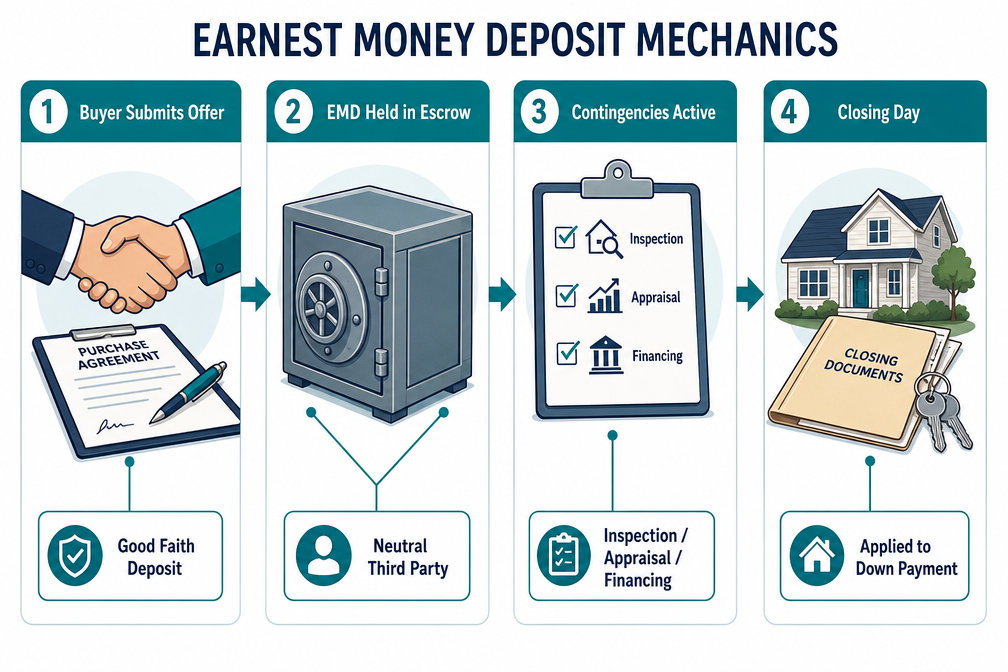
The earnest money meaning in plain terms: you are telling the seller, "I am not just browsing. I am committed enough to put real money on the line right now." Without it, sellers have little reason to take their home off the market while you run inspections and wait for loan approval.
How much earnest money is typical in 2026:
- Standard range: 1% to 3% of the purchase price in most U.S. markets
- Competitive markets (parts of California, Texas metros, South Florida): 3% to 5% or higher
- New construction purchases: builders often require a flat fee ranging from $1,000 to $10,000 or more
- Luxury properties: 5% to 10% is not unusual
At the current median U.S. home price of $434,100, here is what those percentages look like in real dollars:
| EMD Percentage | Dollar Amount at $434,100 |
|---|---|
| 1% | $4,341 |
| 2% | $8,682 |
| 3% | $13,023 |
| 5% | $21,705 |
The earnest fee is typically due within 1 to 3 business days after the seller accepts your offer. It goes directly into escrow, not to the seller. That distinction matters enormously and is covered below.
Earnest Money Deposit: The $13,000 You Can Actually Lose Explained Fully
Yes, you can lose every dollar of your earnest money deposit. This is not a scare tactic. It is a contractual reality that catches buyers off guard every single day.
The earnest money definition in a purchase contract is straightforward: it is liquidated damages. That is legal language for "if the buyer backs out without a valid reason, the seller keeps this as compensation for taking the home off the market." Sellers lose real money when a deal falls apart. They may have turned down other offers, paid for inspections of their own, and delayed their own move. The earnest deposit is the buyer's financial skin in the game.
The three most common ways buyers lose their earnest money:
- Backing out after all contingencies have been removed or expired
- Missing a contingency deadline (like a 10-day inspection window) and then trying to cancel
- Simply changing their mind with no contractual basis to exit
The good news is that losing your earnest money is almost always avoidable if you understand what protects you before you sign.
Earnest Money Deposit vs Down Payment: What Is the Difference
These are two separate payments that serve different purposes, and mixing them up causes real confusion during the buying process.
Earnest money deposit: paid upfront at offer acceptance, typically 1% to 3% of the purchase price, held in escrow, and applied toward your total purchase costs at closing.
Down payment: paid at closing, typically 3% to 20% or more of the purchase price, goes directly to the lender as equity in the home.
Think of it this way. The earnest deposit is a placeholder. The down payment is the real thing. The earnest money you paid in week one gets credited back to you at closing, reducing what you owe out of pocket on closing day.
If you are putting 10% down on a $434,100 home, that is $43,410 due at closing. If you already paid a $8,682 earnest deposit (2%), you bring $34,728 to the closing table instead. The earnest money meaning here is that it counts, it just counts later.
For a deeper look at how loan types affect your down payment requirements, see our breakdown of FHA loan vs conventional loan options and which one actually saves you more money.
Can a Seller Keep Your Earnest Money Deposit
Yes, absolutely. A seller can legally keep your earnest deposit if you breach the purchase contract.

The most common scenarios where sellers keep the money:
- Buyer backs out after the inspection contingency window closed without canceling
- Buyer's financing falls through but they had already removed the financing contingency
- Buyer simply changed their mind with no contractual exit clause available
- Buyer missed a critical deadline spelled out in the contract
When a seller cannot keep your earnest money:
- The home failed to appraise and you have an active appraisal contingency
- Your loan was denied and you have an active financing contingency
- The inspection revealed serious defects and you canceled within the inspection period
- The seller failed to disclose known material defects
- The seller could not deliver clear title
The contract language in your state and the specific contingencies you negotiated determine everything. This is why your real estate agent and attorney review matters so much before you sign.
When Do You Get Your Earnest Money Deposit Back
You get your earnest money back when you cancel the purchase contract within a valid contingency window or when the seller breaches the agreement.
The three standard contingencies that protect your deposit:
1. Financing contingency (also called a mortgage contingency)
If your loan is denied, you can cancel and receive a full refund. Most financing contingencies run 21 to 30 days. Miss that window and you may lose protection even if your loan later falls apart.
2. Inspection contingency
Gives you the right to have the home professionally inspected and cancel (or renegotiate) if you find issues. Typically 7 to 14 days. After that window closes, you own whatever the inspector finds.
3. Appraisal contingency
If the home appraises below the purchase price, this contingency lets you renegotiate or walk away with your deposit intact. More on this below.
Earnest money deposit refund timeline:
After a valid cancellation, most escrow companies release funds within 1 to 5 business days once both parties sign a cancellation agreement. If the seller disputes the cancellation, the funds stay frozen until the dispute is resolved, which can take weeks or require mediation.
What Happens to Earnest Money If the Deal Falls Through
What happens to earnest money at closing versus what happens when a deal falls through are two completely different outcomes.
If the deal closes: the earnest deposit is applied as a credit toward your down payment or closing costs. You do not get a separate check. It just reduces what you owe.
If the deal falls through with valid contingencies: the escrow holder releases the funds back to the buyer, usually within a few business days after both parties sign a mutual cancellation.
If the deal falls through without valid contingencies: the seller typically claims the earnest deposit. The buyer can dispute this, but the contract language usually favors the seller in clear breach situations.
If there is a dispute: the escrow holder holds the funds and does nothing until both parties agree in writing or a court or arbitrator decides. Disputed earnest money can sit in escrow for months.
How to Protect Your Earnest Money Deposit
Protecting your earnest deposit comes down to four non-negotiable habits.
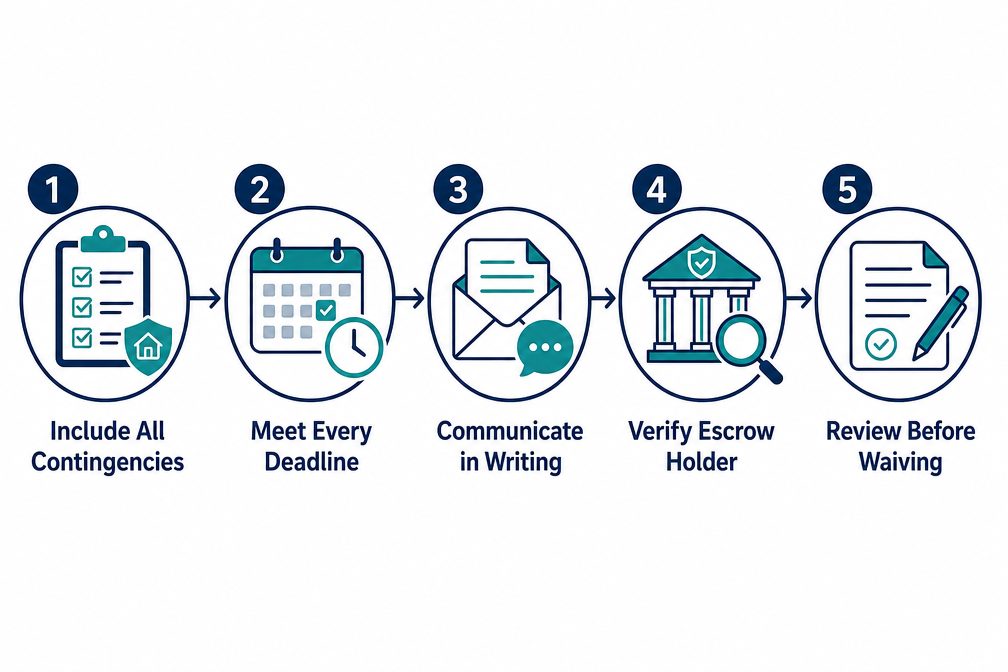
Step 1: Include all three major contingencies
Do not waive your inspection, financing, or appraisal contingency unless you have a specific strategic reason and fully understand the financial exposure. In a hot market, some buyers waive contingencies to win. That is a real risk, not a paperwork formality.
Step 2: Track every deadline obsessively
Your contract has specific dates for each contingency. Missing a 10-day inspection deadline by even one day can void your protection. Put every deadline in your phone calendar with 48-hour alerts.
Step 3: Communicate everything in writing
If you need an extension on a contingency, request it in writing before the deadline, not after. Verbal agreements mean nothing in a real estate contract dispute.
Step 4: Verify who holds the earnest money
The deposit should go to a licensed escrow company, title company, or the listing brokerage's trust account. Never wire earnest money directly to the seller. Wire fraud targeting real estate transactions is a documented and growing problem. Always verify wiring instructions by calling the escrow company directly using a phone number you looked up independently, not one from an email.
Step 5: Read before you waive
When your agent asks you to sign a contingency removal form, that is the moment your financial protection ends. Read it. Ask what you are giving up. This is such a good habit, it should be non-negotiable.
For sellers building pricing strategy alongside buyer contingency negotiations, our 2026 home sellers pricing strategies playbook covers how sellers think about these situations from the other side of the table.
What Happens to Earnest Money at Closing
At closing, your earnest money deposit does not disappear and it does not come back to you as a separate refund. It gets credited directly on your closing disclosure statement, reducing the total cash you need to bring to the table.
Your closing disclosure will show a line item like "Earnest Money Deposit" as a credit on the buyer's side. If you paid $13,023 in earnest money and your total closing costs plus down payment add up to $55,000, you bring $41,977 to closing instead.
This is one of the most impactful things first-time buyers miss when budgeting. The earnest deposit is part of your total purchase cash, not an extra cost on top of it.
What If the Appraisal Comes In Low: Earnest Money Rules
A low appraisal is one of the most common deal-killers in real estate, and your earnest money exposure depends entirely on whether you have an appraisal contingency in place.
With an appraisal contingency: if the home appraises below the purchase price, you have options. You can renegotiate the price with the seller, pay the difference in cash (called covering the appraisal gap), or cancel the contract and receive your full earnest deposit back.
Without an appraisal contingency: you are contractually obligated to close at the agreed price regardless of what the appraisal says. If your lender will not fund the gap and you cannot cover it yourself, you may be forced to cancel without a contractual exit, which means the seller can claim your earnest deposit.
Example: You offer $450,000 on a home. The appraisal comes in at $430,000. Your lender will only finance based on the appraised value. Without an appraisal contingency, you need to bring an extra $20,000 to close or potentially lose your earnest money.
In competitive markets, some buyers waive the appraisal contingency to make their offer more attractive. If you go that route, make sure you have the cash reserves to cover a potential gap before you sign.
Earnest Money Deposit Requirements by State
Most U.S. states do not set a legally required minimum earnest money amount. The amount is negotiated between buyer and seller and written into the purchase contract.

What actually drives the amount in practice:
- Local market customs (ask your agent what is standard in that specific zip code)
- How competitive the market is (multiple-offer situations push EMD higher)
- The purchase price (higher-priced homes typically see higher EMD amounts)
- Seller preferences (some sellers specifically request a higher deposit)
State-level nuances worth knowing:
- Some states (including California) have specific contract language about what constitutes a valid liquidated damages clause for earnest money
- Texas uses a standard TREC contract with specific earnest money rules and an option fee system separate from the EMD
- New York real estate transactions often involve larger deposits and attorney review periods
- Florida contracts have specific timelines for escrow deposit and dispute resolution
Always work with a licensed real estate agent or attorney in your specific state. The rules vary enough that generalizing can cost you money.
Earnest Money Deposit for First-Time Home Buyers
First-time buyers face a specific challenge with earnest money: they often do not have much liquid cash sitting around, and the deposit requirement hits before they have even been fully approved for a mortgage.
What first-time buyers need to know:
- The earnest deposit typically needs to be in your bank account and ready to wire within 1 to 3 business days of offer acceptance
- It must come from a documented, acceptable source (your own savings, a gift with a gift letter, etc.)
- Lenders will ask where the money came from, so keep records
Common first-time buyer mistakes with earnest money:
- Assuming the deposit is refundable no matter what (it is not)
- Wiring money without verifying the recipient independently
- Not reading contingency deadlines carefully
- Removing contingencies under pressure without understanding the financial exposure
If you are a first-time buyer still figuring out the full financing picture, our guide on FHA loan vs conventional loan comparisons is a solid starting point for understanding how your loan type affects your overall cash requirements.
Do You Need an Earnest Money Deposit for Every Offer
No, there is no universal legal requirement to include an earnest money deposit with every offer. But in practice, submitting an offer without one in most U.S. markets is a fast way to get your offer ignored.
When you might skip the EMD:
- Some new construction contracts use a different deposit structure
- Certain foreclosure or bank-owned property purchases have their own rules
- Some sellers in very slow markets may accept an offer without one
When skipping it hurts you:
- In any competitive market, an offer without earnest money signals low commitment
- Sellers and listing agents use the deposit amount as a proxy for how serious and financially prepared the buyer is
- A higher earnest deposit can actually help your offer win in a multiple-offer situation even if your price is not the highest
The earnest money real estate professionals see most often in competitive 2026 markets runs 2% to 3% minimum. Anything below 1% on a standard residential purchase will raise eyebrows.
Valid Reasons to Lose Earnest Money in Real Estate
There are specific, documented reasons a buyer legitimately forfeits their earnest deposit. These are not gray areas.
You will likely lose your earnest money if:
- You back out after all contingencies are removed with no new contractual basis to cancel
- You miss a contingency deadline and then try to use that contingency to cancel
- You fail to secure financing but had already removed the financing contingency
- You simply decide you do not want the house anymore after the contingency period ends
- You fail to close on the agreed date without a valid extension in writing
Situations that are more contested:
- Seller refuses to make repairs agreed to in writing after inspection (document everything)
- Title issues that were not disclosed (consult an attorney)
- HOA documents reveal restrictions that materially affect your use of the property (check if your contract includes an HOA review contingency)
The earnest deposit is strong protection when used correctly. When ignored, it becomes the most expensive lesson in real estate.
FAQ
What is earnest money in real estate?
Earnest money (also called a good faith deposit or earnest fee) is a cash payment made by a buyer when submitting a purchase offer. It signals serious intent and is held in escrow until closing or cancellation. It is not paid to the seller directly.
Is earnest money refundable?
Yes, if you cancel within a valid contingency window (inspection, financing, or appraisal). No, if you cancel outside those windows or without a contractual basis. Whether earnest money is refundable depends entirely on when and why you cancel.
Who holds the earnest money deposit?
A neutral third party holds the earnest money deposit: typically an escrow company, title company, or the listing broker's trust account. Never wire earnest money directly to the seller.
How much earnest money should I put down?
In most U.S. markets in 2026, 1% to 3% of the purchase price is standard. In competitive markets, 3% to 5% or more may be expected. Ask your real estate agent what is customary in the specific area where you are making an offer.
What is the difference between earnest money and a down payment?
Earnest money is paid upfront at offer acceptance and is a smaller amount (1% to 3%). A down payment is paid at closing and is typically 3% to 20% or more. The earnest deposit gets credited toward your total closing costs or down payment at the end.
Can a seller keep my earnest money if they back out?
Generally no. If the seller cancels the contract without a valid reason, you are entitled to your earnest deposit back, and in some states you may have additional legal remedies. The seller keeping your money is only valid when the buyer breaches the contract.
What happens to earnest money at closing?
It gets applied as a credit on your closing disclosure, reducing the total cash you need to bring to closing. You do not receive a separate refund check.
How long does it take to get earnest money back after a cancellation?
Typically 1 to 5 business days after both parties sign a mutual cancellation agreement. If the seller disputes the cancellation, the funds stay in escrow until the dispute is resolved, which can take weeks.
What is an EMD in real estate?
EMD stands for earnest money deposit. Real estate agents and transaction coordinators use this shorthand in contracts, emails, and MLS status notes.
Can I use a personal check for my earnest money deposit?
Some sellers accept personal checks, but many require a cashier's check or wire transfer. Confirm the accepted payment method with the listing agent before your offer is submitted.
What if I change my mind after removing all contingencies?
You will almost certainly lose your earnest deposit. Once contingencies are removed and you cancel without a new contractual basis, the seller has the legal right to claim the deposit as liquidated damages.
Does earnest money count toward my down payment?
Yes. The earnest money deposit is credited toward your total purchase costs at closing, which includes your down payment and closing costs. It reduces what you owe on closing day.
Conclusion
The earnest money deposit is not a formality. At the 2026 median home price of $434,100, a 3% good faith deposit puts $13,023 in a position where you could walk away with nothing if you are not paying attention. The rules are not complicated once you know them, but nobody explains them until after the wire has already gone out.
Your action steps before submitting any offer:
- Confirm the standard earnest deposit amount in your specific market with your agent before writing the offer
- Verify the escrow holder's wiring instructions by phone using a number you independently verified, not one from an email
- Put every contingency deadline in your calendar with a 48-hour alert
- Read every contingency removal form before you sign it and ask your agent what protection you are giving up
- Budget for the earnest deposit as part of your total cash needed, not as an extra cost on top
If you are a seller trying to understand how earnest money fits into your pricing and negotiation strategy, our 2026 home sellers pricing strategies playbook covers the full picture. And if you ran into spring home selling mistakes that cost real money, the earnest money section in that piece is worth a read too.
Real estate transactions move fast and the paperwork is dense. The buyers who protect themselves are the ones who slow down, read the deadlines, and ask the questions before the ink dries. Be patient, but make sure your deposit is protected while you wait.