
Last updated: August 23, 2026

Quick Answer: The core difference in short sale vs foreclosure comes down to who controls the process and what it costs you afterward. A short sale is a voluntary, lender-approved sale where the home sells for less than what is owed. Foreclosure is the lender taking the property back after missed payments, either through the courts or a trustee process. Both hurt your credit and both can leave you with a tax bill, but foreclosure hits harder on every financial metric that determines when you can buy again.
Key Takeaways
- A short sale typically drops your credit score 100 to 150 points; foreclosure typically drops it 150 to 200 points or more, depending on your starting score.
- Foreclosure stays on your credit report for 7 years; a short sale may appear as "settled for less than owed" and carries a shorter psychological shadow on new lenders.
- The mortgage waiting period after foreclosure is 7 years for a conventional loan; after a short sale with no late payments, it can be as short as 2 years.
- Both events can trigger a deficiency judgment if the state allows it, meaning the lender can sue you for the unpaid balance.
- The IRS can treat forgiven mortgage debt as taxable income under certain conditions, though the Mortgage Forgiveness Debt Relief Act has historically provided exclusions for primary residences.
- A short sale requires lender approval and typically takes 3 to 6 months to close; foreclosure timelines range from 3 months to over 2 years depending on judicial vs non-judicial foreclosure rules in your state.
- Buyers purchasing a short sale home get a property that is usually in better condition than a bank-owned foreclosure and comes with a cleaner title process.
- Consulting a HUD approved housing counselor before deciding between a short sale and foreclosure is free and can change the outcome significantly.
What Is the Difference Between a Short Sale and Foreclosure
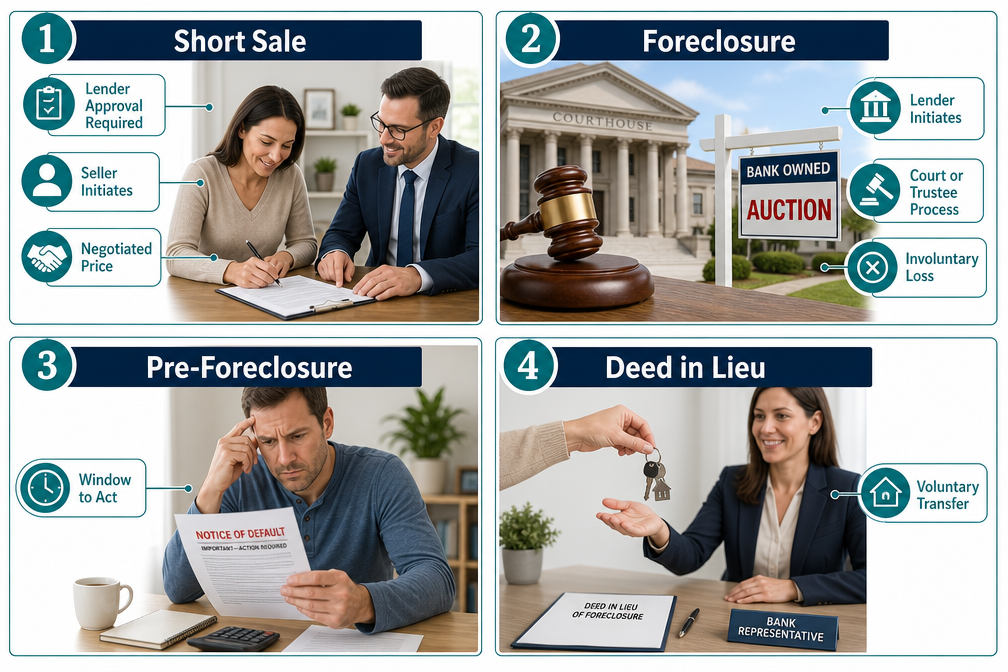
The difference between a short sale and foreclosure is straightforward: a short sale is something you choose, and foreclosure is something that happens to you.
In a short sale, you sell your home for less than the mortgage balance with your lender's written approval. The lender agrees to accept the lower payoff and release the lien. You are still the seller, you still negotiate, and you still have some control over the timeline and outcome.
Foreclosure is the lender's legal remedy when you stop making payments. They initiate a process to take ownership of the property and sell it to recover the debt. You lose control of the timeline, the sale price, and often the condition of the property you leave behind.
A third option sits between the two: a deed in lieu of foreclosure, where you voluntarily hand the keys to the lender without going through a full foreclosure process. It avoids the public auction but carries similar credit consequences to foreclosure in most cases.
Pre-foreclosure vs foreclosure is also worth separating. Pre-foreclosure is the period after your first missed payment and before the lender completes the legal process. That window, which can last months, is exactly when a short sale is still on the table.
Short Sale vs Foreclosure: One Costs You the Next House More Than the Other
The reason short sale vs foreclosure matters so much is not just about the house you are losing. It is about the house you want to buy next.
Lenders treat these two events very differently when evaluating a new mortgage application. Fannie Mae and Freddie Mac guidelines, which govern most conventional loans, draw a hard line between the two.
Conventional loan waiting periods:
| Event | Waiting Period (Standard) | Waiting Period (Extenuating Circumstances) |
|---|---|---|
| Short sale | 4 years | 2 years |
| Short sale with no late payments | 2 years | 2 years |
| Foreclosure | 7 years | 3 years |
| Deed in lieu of foreclosure | 4 years | 2 years |
FHA loan waiting periods:
| Event | Waiting Period |
|---|---|
| Short sale | 3 years |
| Short sale with no late payments | May qualify sooner |
| Foreclosure | 3 years |
VA loan waiting periods:
| Event | Waiting Period |
|---|---|
| Short sale | 2 years |
| Foreclosure | 2 years |
The numbers above are based on published agency guidelines as of 2026. Individual lenders may impose stricter overlays on top of these minimums. The gap between a 2-year wait and a 7-year wait is not abstract. At a median home price of $434,100 in July 2026, five extra years of renting while prices continue climbing is a real financial cost that never shows up in the headline comparison.
How Does a Short Sale Affect Your Credit Score Compared to Foreclosure
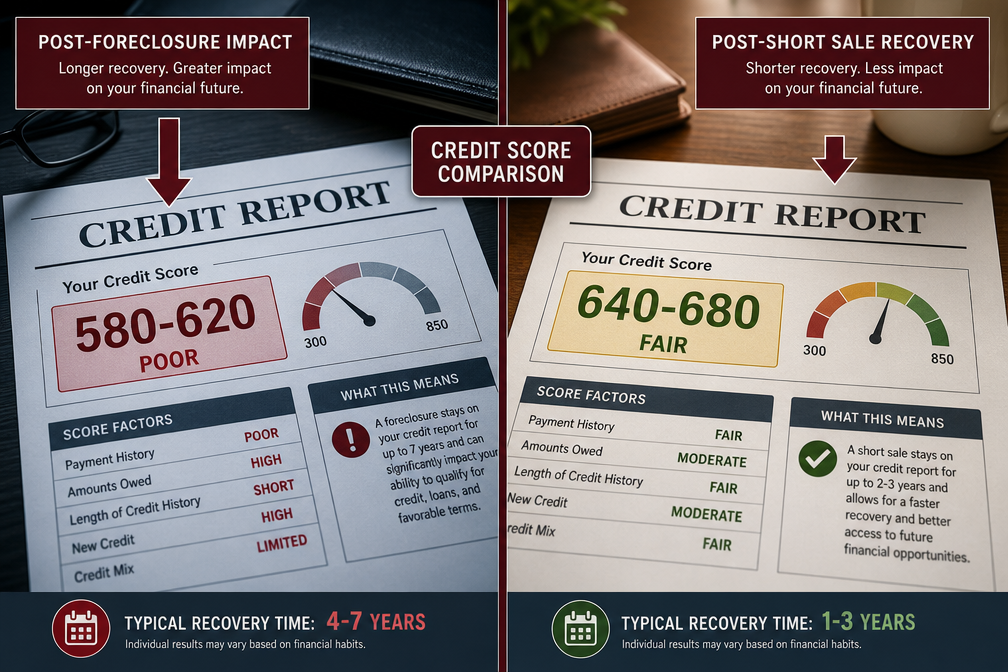
A short sale typically causes a credit score drop of 100 to 150 points. A foreclosure typically causes a drop of 150 to 200 points or more. Both are serious, but the gap matters when you are trying to qualify for a mortgage again.
The exact damage depends on your starting score. Someone with a 780 score who goes through foreclosure may land near 580. Someone who completes a short sale from the same starting point may land closer to 630. That 50-point difference is the difference between qualifying for an FHA loan and not qualifying for anything.
Short sale credit score impact is also influenced by whether you had late payments before the sale closed. If you managed to complete a short sale without any 30, 60, or 90-day late marks, the credit damage is significantly lower. Many homeowners do not know this is even possible, but some lenders will approve a short sale for a borrower who is current on payments but can document a genuine hardship, such as a job relocation or divorce.
Foreclosure credit score impact is almost always accompanied by months of missed payments, which means the credit report shows both the foreclosure itself and a string of delinquencies. That combination is what makes the recovery so slow.
How long does a foreclosure stay on your credit: a foreclosure remains on your credit report for 7 years from the date of the first missed payment that led to it. A short sale typically reports as "settled" or "paid for less than full balance" and while it stays on the report for 7 years as well, it reads differently to underwriters than a foreclosure entry.
What Are the Tax Consequences of a Short Sale Versus Foreclosure
Both a short sale and a foreclosure can trigger a tax bill, and this is the part most people get blindsided by.
When a lender forgives the remaining balance after a short sale or takes a loss through foreclosure, the IRS may treat that forgiven amount as ordinary income. This is called cancellation of debt income, and it is reported on a 1099-C form.
The Mortgage Forgiveness Debt Relief Act has historically excluded forgiven debt on a primary residence from federal taxable income, up to $2 million. Congress has extended this provision multiple times. As of 2026, consult a CPA or tax attorney to confirm current status, because this exclusion is not permanent law and its availability in any given tax year depends on whether Congress has renewed it.
For foreclosure specifically, there is a second potential tax issue: if the lender sells the property at auction for less than the fair market value, the IRS may calculate a "phantom gain" based on the difference between your original cost basis and the amount the lender credited toward the debt. This is more common with non-recourse loans and investment properties.
Short sale vs foreclosure tax treatment for investment properties is more complex. Primary residence exclusions do not apply to rentals or second homes, meaning the forgiven debt is more likely to be fully taxable. This is a critical distinction for the small landlord or investor who is underwater on a rental.
Working with a HUD approved housing counselor before making any decision can help you understand the tax exposure before it becomes a surprise.
Can Lenders Come After You for Deficiency After a Short Sale or Foreclosure
Yes, in many states they can, and whether they will depends on the state, the loan type, and what you negotiated.
A deficiency judgment after foreclosure is a court order requiring you to pay the difference between what the home sold for at auction and what you owed on the mortgage. If you owed $350,000 and the home sold at auction for $270,000, the lender can potentially sue you for the $80,000 difference in states that allow it.
Anti-deficiency states like California, Arizona, and several others limit or prohibit deficiency judgments on purchase money mortgages for primary residences. But refinances, HELOCs, and investment properties often fall outside those protections even in anti-deficiency states.
For short sales, the key is negotiating a deficiency waiver as part of the lender's approval letter. A well-negotiated short sale approval letter will explicitly state that the lender accepts the short payoff as full satisfaction of the debt and waives any right to pursue the deficiency. Without that language in writing, you remain exposed.
This is exactly why having a real estate attorney review the short sale approval letter before closing is not optional. The difference between "accepted as partial satisfaction" and "accepted as full satisfaction" in that letter is the difference between walking away clean and receiving a lawsuit two years later.
For a deeper look at what sellers pay during a distressed sale, see our breakdown of seller closing costs explained and how to cut them.
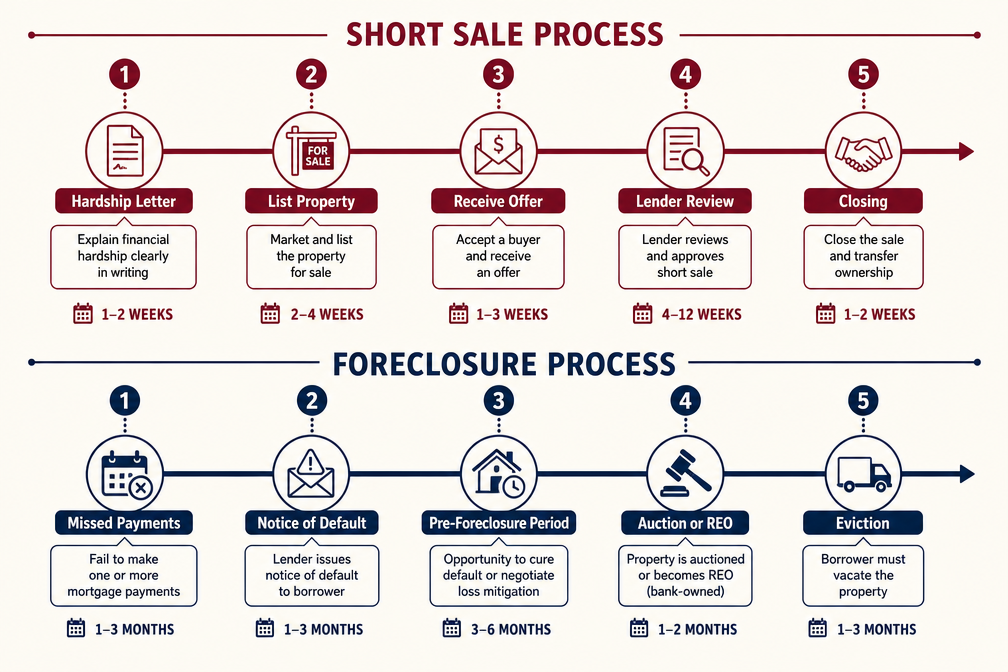
How Long Does the Short Sale Process Take Versus Foreclosure
A short sale typically takes 3 to 6 months from listing to closing. Foreclosure timelines range from 3 months to over 2 years.
Short sale process steps:
- Document your financial hardship (hardship letter, bank statements, tax returns, pay stubs)
- List the property with an agent experienced in distressed sales
- Receive and accept an offer from a buyer
- Submit the offer package to the lender for approval
- Lender review period, which averages 30 to 120 days depending on the servicer
- Receive lender approval letter with deficiency terms
- Close escrow
The longest part of the short sale process is step 5. Some servicers are efficient. Others are so bogged down in bureaucracy that files sit for months without movement. Having an agent who has closed short sales before, not just listed them, is the difference between a deal that closes and one that falls apart while the buyer walks.
Judicial vs non-judicial foreclosure is the biggest variable in foreclosure timelines. In judicial foreclosure states like Florida, New York, and New Jersey, the lender must file a lawsuit and get a court judgment before selling the property. That process can take 18 months to over 2 years. In non-judicial foreclosure states like California, Texas, and Georgia, the lender follows a trustee process outside of court, and the entire timeline from notice of default to auction can be as short as 90 to 120 days.
Do you lose your house faster with foreclosure or short sale? In non-judicial states, foreclosure can move faster than a short sale. In judicial states, you may have well over a year in the home after stopping payments. That timeline is not a strategy, though. Every month in pre-foreclosure without a plan damages your credit and reduces your options.
Does a Short Sale Hurt Your Credit Less Than Foreclosure
Yes, a short sale generally causes less credit damage than foreclosure, but the gap is not as wide as most people hope.
The real advantage of a short sale on your credit is not the point drop at the time of the event. It is the faster recovery curve and the shorter mortgage waiting period that follows. A borrower who completes a short sale without prior late payments can potentially qualify for a conventional mortgage in 2 years. A borrower who goes through foreclosure waits 7 years under standard guidelines.
That said, if you have already missed 6 months of payments trying to negotiate a short sale, your credit has already taken most of the damage. The foreclosure itself adds relatively little to a report that already shows multiple delinquencies.
The credit advantage of a short sale is most impactful when you act early, before the late payments stack up. Waiting until you are 6 months behind to start the short sale process gives up most of that advantage.
For homeowners weighing their options, our guide on preparing your home for sale in 2026 covers the pre-listing steps that still apply even in a distressed sale scenario.
How Much Does a Short Sale Cost the Seller in Fees
In most cases, the seller pays little to nothing out of pocket in a short sale. The lender absorbs the shortfall.
Here is what typically happens with costs in a short sale:
- Real estate agent commission: Paid from sale proceeds, approved by the lender as part of the short sale package. The lender sets the acceptable commission, typically 5% to 6%.
- Closing costs: The lender usually approves the seller's standard closing costs to be paid from proceeds.
- Seller out-of-pocket: Often zero, because there are no proceeds left after the lender's payoff and approved costs.
- Potential cost: If the lender does not waive the deficiency, the unpaid balance becomes a future liability.
The hidden cost of a short sale is not fees. It is the forgiven debt that may become taxable income, as covered in the tax section above. A $60,000 deficiency waiver could translate into a significant tax bill if the primary residence exclusion is not available.
For comparison, our article on how to calculate home buyer closing costs using AI tools walks through the full cost math on the buying side, which is useful context if you are planning your next purchase after a distressed sale.
Is a Short Sale Better Than Letting Your House Go Into Foreclosure
For most homeowners, yes. A short sale is better than foreclosure in almost every financial metric that matters for your future: credit recovery, mortgage waiting period, tax exposure, and emotional control over the process.
The exceptions are narrow but real:
- If you are in a judicial foreclosure state and need 18 to 24 months of free housing to rebuild savings, foreclosure's longer timeline has a practical value.
- If your lender refuses to waive the deficiency in the short sale approval letter and your state allows deficiency judgments on foreclosures too, the credit difference may not justify the effort of a short sale.
- If the property is an investment property and the tax consequences of forgiven debt are severe, the math changes.
Common mistakes people make choosing between short sale and foreclosure:
- Waiting too long to contact the lender, losing the pre-foreclosure window entirely
- Assuming a short sale automatically wipes out the deficiency without getting it in writing
- Not consulting a HUD approved housing counselor, who can review your specific loan and state laws for free
- Choosing foreclosure because the short sale process feels complicated, then spending 7 years unable to buy again
- Ignoring the tax consequences of either option until after the fact
- Hiring an agent who has never closed a short sale to list a short sale
- Buyers assuming a short sale home is a guaranteed discount without accounting for the longer closing timeline and as-is condition
If you are a buyer considering a distressed property purchase, our guide on negotiation power moves that save thousands on your next home covers the leverage points that actually matter in a distressed sale negotiation.
What Buyers Need to Know About Buying a Short Sale Home
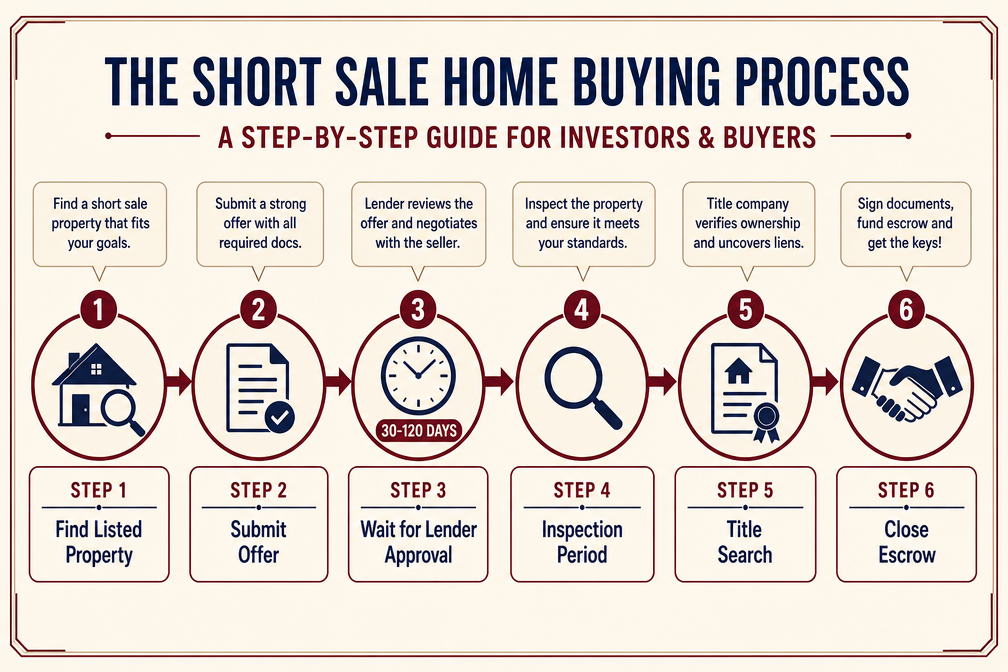
Buying a short sale home means buying a property where the seller's lender must approve the sale price. The buyer is not just negotiating with the seller; they are waiting for a bank to say yes.
What makes buying a short sale different:
- The property is usually owner-occupied and in better condition than a bank-owned REO foreclosure
- Title is typically cleaner than a foreclosure auction purchase
- The timeline is unpredictable. Lender approval can take 30 days or 4 months
- The price is not always the discount buyers expect. Lenders review comparable sales and will reject offers they consider too low
- Contingencies matter. Get a full inspection. Short sales are sold as-is in most cases, but you can still walk away during inspection
- The lender may counter the offer, not the seller
For investors specifically, the impactful question is whether the discount justifies the holding cost of waiting for approval. If you are financing the purchase, you are paying for a rate lock extension or risking a rate change during a 90-day lender review. Our breakdown of hard money lenders for beginners and the real cost of borrowing is worth reading if you are using bridge financing to buy distressed properties.
If you are a first-time investor evaluating distressed properties, our first-time investor guide to property management costs and benefits covers what comes after you close.
Frequently Asked Questions
What is the main difference between a short sale and foreclosure?
A short sale is a voluntary sale where the homeowner sells for less than the mortgage balance with lender approval. Foreclosure is the lender taking the property back through a legal process after missed payments. The homeowner controls a short sale; the lender controls a foreclosure.
Does a short sale hurt your credit less than foreclosure?
Generally yes. A short sale typically drops your score 100 to 150 points; foreclosure typically drops it 150 to 200 points or more. The bigger advantage is the shorter mortgage waiting period after a short sale.
How soon can you get a mortgage after a short sale versus foreclosure?
After a short sale with no prior late payments, you may qualify for a conventional loan in 2 years. After foreclosure, the standard waiting period is 7 years for a conventional loan. FHA and VA loans have shorter waiting periods for both events.
Can a lender still come after you for money after a short sale?
Yes, unless the short sale approval letter explicitly waives the deficiency. Always get the deficiency waiver in writing before closing. Without it, the lender retains the right to sue you for the unpaid balance in states that allow deficiency judgments.
What is pre-foreclosure vs foreclosure?
Pre-foreclosure is the period between your first missed payment and the completed foreclosure process. It is the window where a short sale is still possible. Once the foreclosure is completed and the property is sold at auction or becomes REO, the short sale option is gone.
What is a deed in lieu of foreclosure?
A deed in lieu is when you voluntarily transfer the property title to the lender to avoid foreclosure. It avoids the public auction but carries similar credit consequences to foreclosure. Some lenders prefer it because it is faster and cheaper than a full foreclosure.
What is judicial vs non-judicial foreclosure?
Judicial foreclosure requires the lender to file a lawsuit and get a court judgment before selling the property. Non-judicial foreclosure uses a trustee process outside of court. Judicial states have much longer timelines, sometimes 18 to 24 months. Non-judicial states can complete the process in 90 to 120 days.
What does a HUD approved housing counselor do?
A HUD approved housing counselor is a free or low-cost resource who reviews your mortgage, your state's foreclosure laws, and your financial situation to help you understand all your options, including loan modification, short sale, deed in lieu, and foreclosure. They do not work for the lender and have no financial interest in which option you choose.
Are there tax consequences to a short sale?
Yes. The lender may issue a 1099-C for the forgiven debt, which the IRS can treat as taxable income. The Mortgage Forgiveness Debt Relief Act has historically excluded forgiven debt on primary residences, but this exclusion is not permanent. Consult a CPA before closing a short sale.
How long does a foreclosure stay on your credit report?
A foreclosure stays on your credit report for 7 years from the date of the first missed payment that led to it. A short sale also stays for 7 years but typically reports differently and is viewed more favorably by mortgage underwriters.
Is buying a short sale home a good deal for investors?
It can be, but the discount is not guaranteed. Lenders review comparable sales and reject lowball offers. The bigger risk for investors is the timeline. Lender approval can take 30 to 120 days, which adds holding cost and rate lock uncertainty to any deal analysis.
What is the short sale process timeline?
From listing to closing, a short sale typically takes 3 to 6 months. The lender review period alone averages 30 to 120 days. Having an experienced agent who knows how to package and submit the short sale file to the servicer is the single biggest factor in how fast that review moves.
Conclusion
Short sale vs foreclosure is not a close call for most homeowners. A short sale preserves more of your credit, cuts the mortgage waiting period from 7 years to as few as 2, gives you control over the process, and leaves a cleaner paper trail for the next lender who reviews your file.
The catch is that a short sale requires effort, time, and the right team. You need an agent who has actually closed short sales, an attorney who reads the approval letter before you sign anything, and ideally a HUD approved housing counselor who can walk you through your state's deficiency and tax rules before you commit to a path.
For buyers and investors, a short sale home offers a cleaner title and a better-condition property than most foreclosure auctions, but patience is the price of entry. That 30 to 120-day lender review window is real, and it needs to be priced into your deal analysis.
Actionable next steps:
- If you are behind on payments, contact a HUD approved housing counselor at 800-569-4287 (HUD's free referral line) before missing another payment
- If you are considering a short sale, pull your credit report now so you know your starting score and can track the impact accurately
- If you are a buyer evaluating a short sale listing, ask the listing agent for the lender's name and servicer, and ask whether a short sale package has already been submitted
- If you are an investor, run the full holding cost math including a 90-day lender review before submitting an offer below list price
- Consult a CPA about the tax consequences of forgiven debt before any distressed sale closes, not after
Credit recovery takes time. The timeline is longer than most people want, but the gap between a 2-year wait and a 7-year wait is worth every step of the short sale process.