


Last updated: August 23, 2026

Quick Answer
Knowing how to win a property tax appeal with three documents comes down to this: a comparable sales report, a certified independent appraisal, and dated photographs of your property's defects. These three pieces of property tax appeal evidence, presented clearly and on time, give a review board everything it needs to lower your assessed value. Most homeowners who lose appeals fail not because their case was weak, but because they showed up without organized documentation.
Key Takeaways
- The three documents that win most property tax appeals are comparable sales data, an independent appraisal, and photographs of property defects
- Assessed value and market value are not the same thing, and the gap between them is your argument
- Every county sets its own property tax appeal deadline, typically 30 to 90 days after the assessment notice arrives
- An informal review with the assessor's office often resolves the issue before a formal hearing is ever needed
- A successful appeal can reduce your annual tax bill by hundreds to thousands of dollars depending on your market
- You do not need a lawyer to file a property tax appeal, though a property tax consultant on contingency can be worth it for high-value properties
- Comparable sales for a tax appeal should be from the same neighborhood, similar square footage, and sold within 12 months of your assessment date
- If you lose, most jurisdictions allow you to appeal again the following year or escalate to a state-level board
- Overassessment is more common than most homeowners realize, particularly after rapid appreciation cycles
How Do I Know If My Property Is Overassessed
Your property is likely overassessed when the assessed value is higher than what you could actually sell the home for today. The simplest check: pull three to five recent sales of similar homes in your neighborhood and compare those sale prices to your assessed value. If the assessed value sits above those comparable sales prices, you have a reasonable case.
Most jurisdictions assess property at a fixed percentage of market value, sometimes called the assessment ratio. If your county assesses at 80% of market value and your home would sell for $350,000, your assessed value should be around $280,000. If it shows $320,000 instead, that gap is your argument.
Three quick ways to check for overassessment:
- Request your property record card from the assessor's office and verify the square footage, bedroom count, and lot size are accurate. Errors here are more common than you'd expect.
- Run a free comparable sales search on Zillow, Redfin, or your county's MLS records for homes sold within the past 12 months within half a mile of yours.
- Check your neighbors' assessments through your county's public property records portal. A uniformity claim, meaning your property is assessed higher than comparable nearby properties, is a separate and valid appeal argument.
What Are the Three Documents Needed to Win a Property Tax Appeal
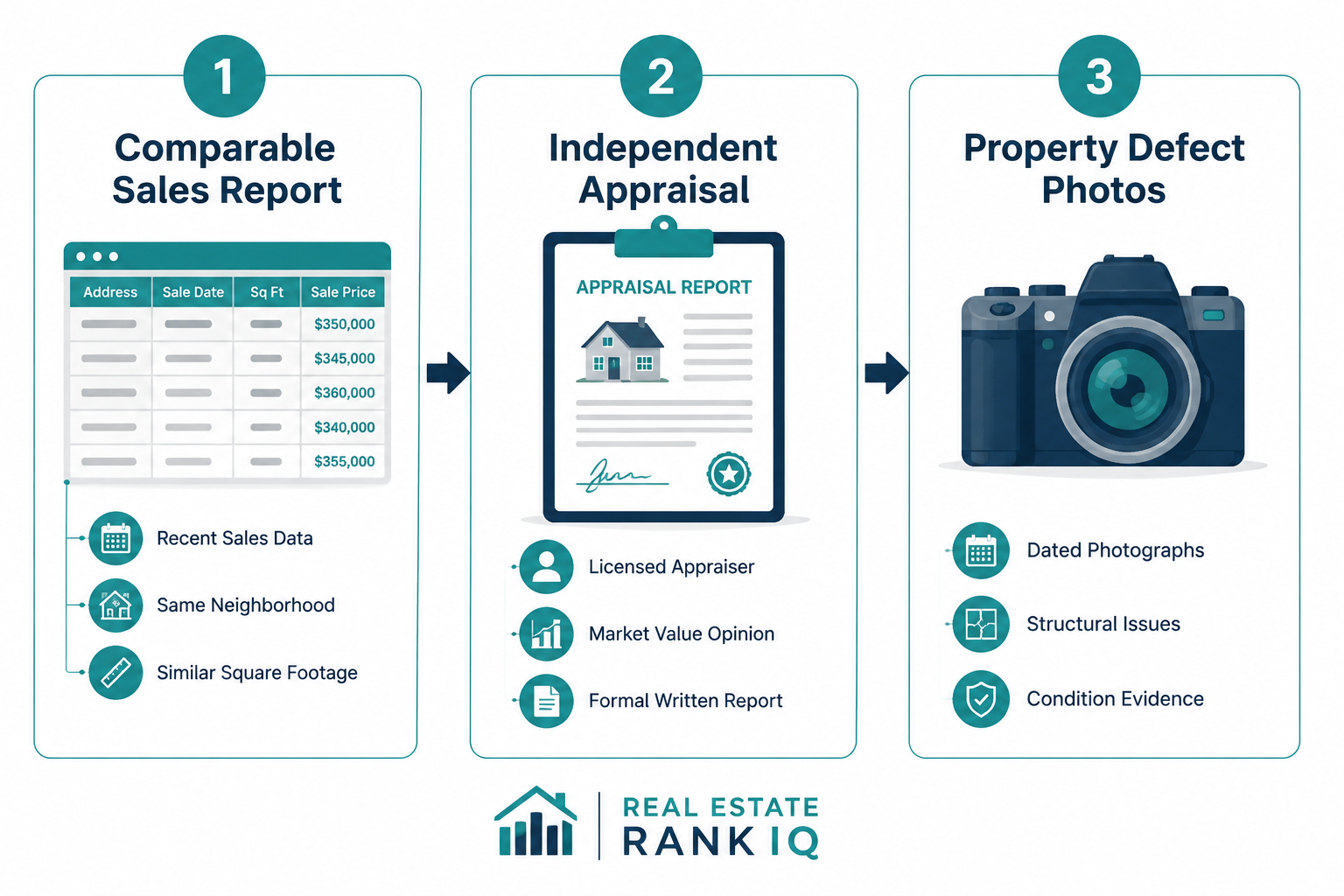
The core of how to win a property tax appeal with three documents rests on a comparable sales report, a certified independent appraisal, and photographic evidence of property defects. Each document attacks the assessment from a different angle, and together they make a case that is difficult to dismiss.
Document 1: Comparable Sales Report
This is your market value argument. Pull sales data for homes similar to yours in size, age, condition, and location that sold within the 12 months before your assessment date. Most assessors use a specific valuation date, so sales after that date carry less weight. Aim for at least three to five comps. If you need help understanding how to find comps for a property tax appeal, your county recorder's website, Zillow's sold listings, and Redfin's sold history are all free starting points.
What makes a strong comp:
- Within one mile of your property (closer is better)
- Within 200 square feet of your home's size
- Similar age, style, and lot size
- Sold within 12 months of the assessment date
- Adjusted for significant differences (a pool, an extra bathroom)
Document 2: Independent Appraisal
A certified independent appraisal for a property tax appeal carries more weight than anything else you can bring to a hearing. A licensed appraiser produces a formal written opinion of your home's market value, and that opinion is backed by their professional license. Expect to pay between $300 and $600 for a residential appraisal in most U.S. markets in 2026. If your potential tax savings over three years exceed that cost, the math works in your favor.
Document 3: Photographs of Property Defects
Photos of property defects for an appeal document conditions the assessor may not have seen or accounted for. A cracked foundation, a failing roof, water intrusion, or outdated systems all reduce market value. Photographs need to be dated and clear. Pair them with repair estimates from licensed contractors for maximum impact.
How to Win a Property Tax Appeal With Three Documents: The Full Process
The appeal process follows a predictable path regardless of which state you're in. Understanding each stage prevents the most common mistakes.
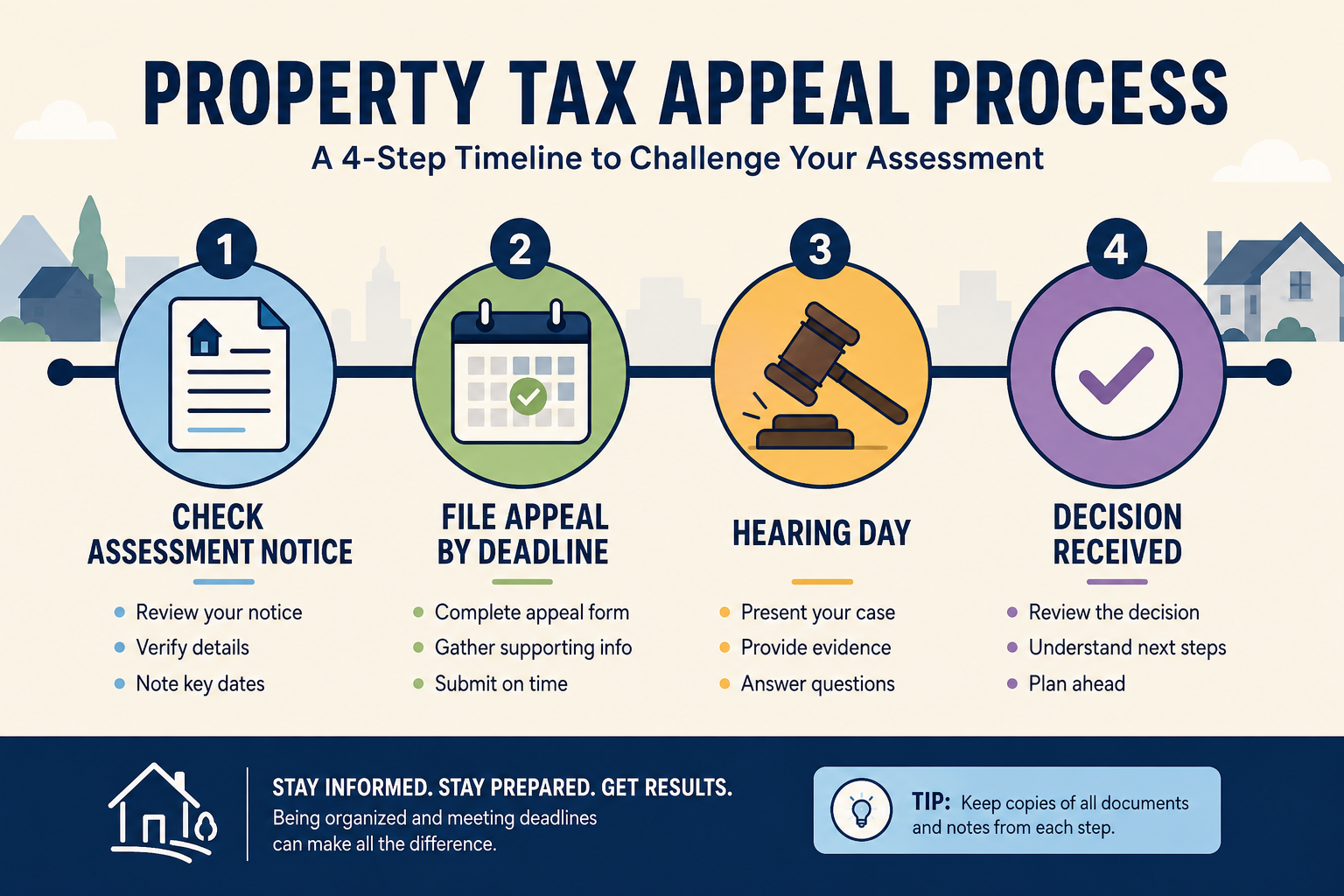
Step 1: Get your assessment notice and read it carefully
Your county mails an assessment notice, usually annually or when a reassessment cycle runs. The notice states your assessed value and, critically, your appeal deadline. That deadline is non-negotiable in most jurisdictions.
Step 2: Request your property record card
Before spending a dollar on an appraisal, pull your property record card from the assessor's office. This document lists the characteristics the assessor used to value your home: square footage, bedroom and bathroom count, lot size, condition rating, and any improvements on record. Errors in this data, a finished basement listed as unfinished or an extra bathroom that doesn't exist, are free and easy wins that don't require a hearing at all.
Step 3: Attempt an informal review first
Most counties offer an informal review process before a formal appeal. This is a conversation with an assessor's staff member where you present your evidence. Informal reviews resolve a significant share of disputes without ever reaching a hearing board. This step costs nothing and preserves your right to file a formal appeal if the informal review doesn't move the needle.
Step 4: File your formal appeal
If the informal review fails, file your formal appeal before the deadline. The filing form is typically available on your county assessor's or appeals board website. Some counties charge a small filing fee, usually under $50. Your property tax appeal letter example should state your parcel number, your current assessed value, the value you believe is correct, and a brief summary of your evidence. Keep it factual and short.
Step 5: Prepare your evidence packet
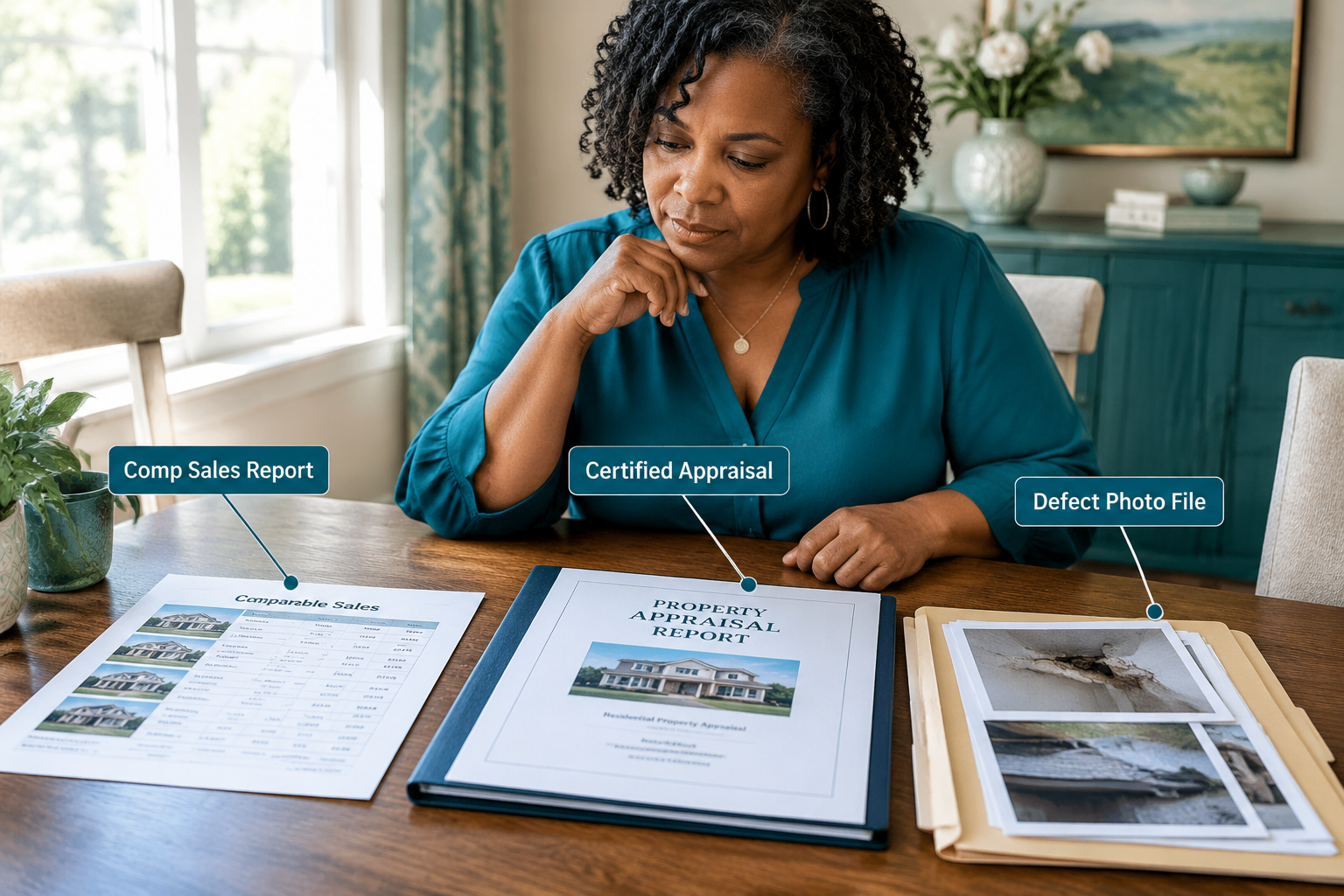
Organize your three documents into a clean packet: comparable sales report first, independent appraisal second, defect photographs with contractor estimates third. Include a one-page cover summary that states your argument plainly. Review boards see dozens of cases per session. The cleaner your presentation, the better.
Step 6: Attend the hearing
At a property tax appeal hearing, you'll typically have five to ten minutes to present your case. Speak to the documents. State the assessed value, state the market value your evidence supports, and explain the gap. Don't argue about your tax bill amount directly. The board only has authority over the assessed value, not the tax rate.
What Counts as Evidence in a Property Tax Appeal
Strong property tax appeal evidence falls into three categories: market evidence, condition evidence, and uniformity evidence.
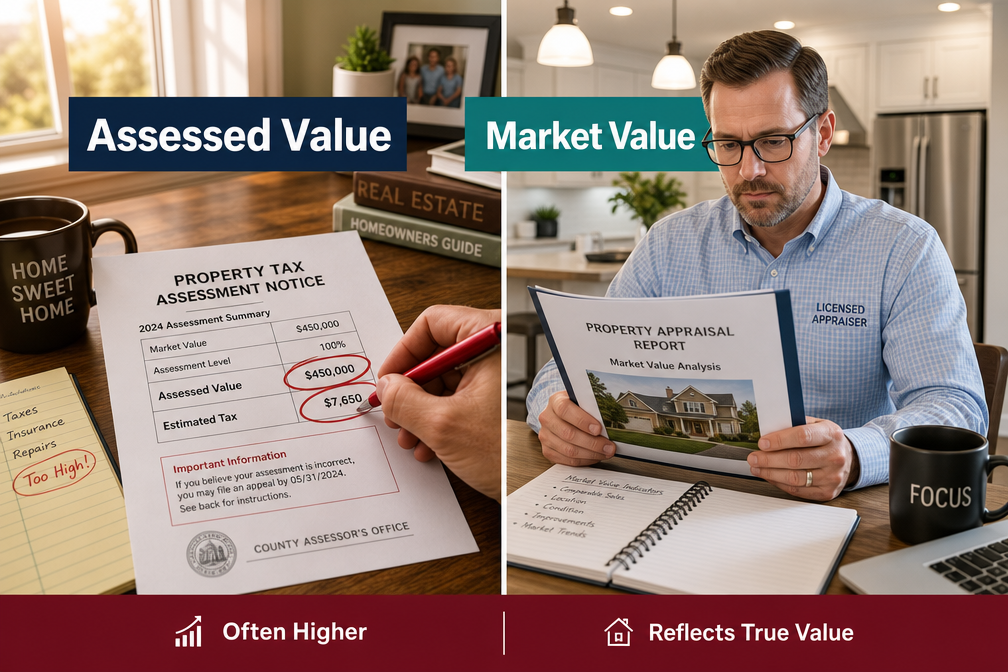
Market evidence is your comparable sales data and independent appraisal. These establish what the market says your home is worth. The assessed value vs. market value gap is the heart of most successful appeals.
Condition evidence is your photographs and contractor estimates. If the assessor rated your home in "good" condition but the roof needs replacement and the HVAC is original from 1987, that condition rating is wrong, and you can prove it.
Uniformity evidence is a comparison of your assessment to similar nearby properties. If your neighbor's home, same size and same street, is assessed at $280,000 while yours sits at $340,000 with no clear justification, that's a uniformity claim. Pull your neighbors' assessments from public records and include them.
What does not count as evidence:
- Your mortgage balance or what you paid for the home
- Your opinion of what the home is worth without supporting data
- Complaints about the tax rate or how the county spends money
- Assessments from prior years without connecting them to current market data
For homeowners who also want to understand how property condition affects overall value, our guide on property value boosters through home renovation and landscaping covers which improvements actually move the needle on market value.
Is There a Deadline for Filing a Property Tax Appeal
Yes, and missing it ends your appeal for that tax year. Property tax appeal deadlines vary by state and county, but most fall between 30 and 90 days after the assessment notice is mailed. Some states set a fixed calendar deadline, such as April 1 or July 31, regardless of when individual notices go out.
How to find your deadline:
- Check your assessment notice directly. The deadline is usually printed on the front page.
- Visit your county assessor's or appeals board website and search for "appeal deadline" or "assessment appeal."
- Call the assessor's office. They are required to tell you.
Missing the deadline by even one day typically means waiting until the next assessment cycle. There are very few exceptions, and they generally require documented proof that you never received the notice.
Can I Appeal My Property Tax Assessment Myself or Do I Need a Lawyer
You do not need a lawyer to file a property tax appeal. The process is designed to be accessible to homeowners without legal representation, and the majority of successful appeals are filed by homeowners acting on their own.
That said, there are situations where professional help makes sense:
Hire a property tax consultant on contingency if:
- Your property is assessed above $750,000 and the potential savings are substantial
- The appeal involves complex commercial or mixed-use elements
- You've already lost an informal review and are heading to a formal board hearing
- The assessor has made a legal argument you don't understand
A property tax consultant on a contingency fee arrangement takes a percentage of your first-year savings, typically 25% to 40%, and charges nothing if the appeal fails. For high-value properties, this is often worth it. For a home assessed at $400,000 with a potential $20,000 reduction, a 33% contingency fee on the first year's savings costs roughly $400 to $600 depending on your tax rate. That's comparable to the cost of an appraisal alone.
Do it yourself if:
- The overassessment is clear from comparable sales alone
- Your property record card has factual errors (square footage, room count)
- You're comfortable organizing documents and speaking briefly at a hearing
If you're also managing investment properties and want to understand how assessment and tax exposure interact with your overall returns, our rental property analysis resources break down the financial side in detail.
How Much Money Can You Save With a Successful Property Tax Appeal
The savings depend on your assessed value reduction and your local tax rate, but real numbers are worth putting on the table. A $50,000 reduction in assessed value in a county with a 1.5% effective tax rate saves $750 per year. Over five years before the next reassessment, that's $3,750 back in your pocket.
In high-tax markets like New Jersey, Illinois, and New York, where effective rates often run 2% or higher, a $100,000 assessment reduction saves $2,000 or more annually. In those markets, even a modest successful appeal pays for an independent appraisal many times over.
According to the National Taxpayers Union Foundation, an estimated 30% to 60% of U.S. properties are overassessed, yet fewer than 5% of homeowners file an appeal in any given year. That gap is wide. Most people are quietly overpaying simply because nobody told them the process exists and is genuinely accessible.
What's the Difference Between a Property Tax Appeal and a Reassessment
A reassessment is initiated by the government. Your county assessor periodically updates property values across the jurisdiction, sometimes annually, sometimes every three to five years depending on state law. You have no control over when a reassessment happens.
A property tax appeal is initiated by you. You're challenging the assessor's valuation of your specific property, arguing that the assessed value does not reflect actual market value or that a factual error inflated the number.
The informal review vs. formal appeal distinction matters here too. An informal review is a pre-appeal conversation with the assessor's office. A formal appeal goes before an independent review board or hearing officer. Both are part of the appeal process, not the reassessment process.
One thing worth knowing: a successful appeal does not lock in your value forever. If the market rises, your assessed value can rise at the next reassessment cycle. The appeal only addresses the current assessment period.
Common Mistakes People Make When Appealing Property Taxes
The most common reason appeals fail is weak or missing evidence. Showing up to a hearing and saying "this feels too high" without documentation gives the board nothing to work with. The assessed value stands unless you prove otherwise.
Other mistakes that sink appeals:
- Missing the deadline. There is no grace period in most jurisdictions. Set a calendar reminder the day your assessment notice arrives.
- Using the wrong comps. Comparable sales for a tax appeal need to match your property closely. Using a sale from a different school district or a home 800 square feet larger than yours weakens the argument.
- Arguing about the tax rate. The appeal board controls assessed value, not the millage rate. Complaining about your tax bill amount is off-topic and wastes your time.
- Skipping the informal review. Many assessors will adjust an obvious error without a formal hearing. Skipping straight to the formal process costs time and sometimes money.
- Ignoring a property tax assessment error on the record card. If the assessor has your home listed as 2,400 square feet when it's 1,900 square feet, that single correction can resolve the entire dispute before any hearing.
- Presenting disorganized evidence. A board reviewing 40 cases in a day responds better to a clean, labeled packet than to a stack of loose printouts.
What Happens If I Lose My Property Tax Appeal
Losing a formal appeal does not close the door permanently. Most jurisdictions allow you to file again in the next assessment year, particularly if market conditions change or new comparable sales support your case.
If you believe the board made a legal error, most states allow escalation to a state-level tax court or administrative tribunal. This step typically does require legal representation and is most practical for high-value commercial or residential properties where the tax savings justify the cost.
For the average homeowner, the most practical response to a lost appeal is to document why you lost, gather stronger evidence, and file again when the next assessment cycle opens. If your independent appraisal came in only slightly below the assessed value, the board may have found the gap insufficient. A wider gap in the next cycle, supported by updated comps, often produces a different result.
What If My Property Value Has Actually Increased Since the Assessment
If your home's market value has genuinely risen above the assessed value, an appeal is not in your interest. Filing an appeal draws attention to your property, and while assessors are not supposed to raise your value as a result of an appeal you initiated, the rules vary by state.
Before filing, confirm that the assessed value is actually higher than current market value. In markets where appreciation has been strong, like the 80% of U.S. metros that posted price gains in Q2 2026 according to NAR data, some homeowners assume they're overassessed when the opposite is true. Run the comparable sales check first. If the comps support the assessed value or exceed it, hold off.
For homeowners thinking about how assessed value connects to a future sale, our first-time home sellers guide walks through how buyers and their agents evaluate pricing relative to tax records.
How to File a Property Tax Appeal: Step-by-Step Checklist
Use this checklist to stay organized from notice to hearing:
- Receive assessment notice and record the appeal deadline immediately
- Request your property record card from the assessor's office (free in most counties)
- Check for factual errors in square footage, room count, lot size, and property class
- Pull comparable sales from Zillow sold listings, Redfin, or your county recorder for the past 12 months
- Assess the gap between your comps and your assessed value. If the gap is less than 5%, the savings may not justify the effort.
- Order an independent appraisal if the gap is significant and the cost is justified by potential savings
- Photograph property defects with dates visible and collect contractor repair estimates
- Request an informal review with the assessor's office before filing formally
- File the formal appeal before the deadline if the informal review fails
- Organize your evidence packet with a one-page cover summary, comps, appraisal, and photos
- Attend the hearing with printed copies of all documents for the board
- Follow up on the written decision, which typically arrives within 30 to 90 days
For homeowners who also want to understand how a property's physical condition affects its marketability beyond the tax context, our property inspections resource hub covers what inspectors look for and how those findings translate to value.
Frequently Asked Questions
How long does a property tax appeal take?
Most informal reviews are resolved within two to four weeks. Formal appeals, from filing to written decision, typically take three to six months depending on the county's caseload. Some high-volume urban counties run longer.
What is a uniformity claim in a property tax appeal?
A uniformity claim argues that your property is assessed at a higher rate than comparable nearby properties, even if the assessed value might otherwise be defensible. It's a separate legal argument from a market value argument and can be filed alongside or instead of a market value appeal.
Can I use Zillow's Zestimate as evidence in my appeal?
Zillow's Zestimate is not accepted as formal evidence in most jurisdictions because it is an automated estimate, not a certified appraisal. You can use Zillow's sold listings data to build your comparable sales report, but the Zestimate itself carries no evidentiary weight.
What if the assessor refuses to lower my assessment after an informal review?
File the formal appeal before your deadline. The informal review is optional and non-binding. A refusal at the informal stage does not affect your right to a formal hearing.
Do I need to hire a property tax consultant for a contingency fee?
Not for most residential appeals. A contingency fee arrangement makes sense when the potential savings are large enough that paying 25% to 40% of the first year's savings is still worth it. For a home where the overassessment is modest, doing it yourself with solid comps and an appraisal is usually sufficient.
What is the difference between assessed value and market value?
Market value is what a willing buyer would pay a willing seller in an open market transaction. Assessed value is the figure your county uses to calculate your tax bill, often set as a percentage of market value. When assessed value exceeds market value, you're paying taxes on a number higher than your home is actually worth.
Can filing a property tax appeal cause my taxes to go up?
In most states, an appeal you initiate cannot result in a higher assessed value as a direct consequence of the appeal. A few states do allow the board to raise the value if evidence supports it, so check your state's specific rules before filing.
How do I write a property tax appeal letter?
Keep it brief and factual. State your parcel number, current assessed value, the value you believe is correct, and a one-sentence summary of your evidence. Attach your documentation. The letter does not need to be long to be effective.
Is there a fee to file a property tax appeal?
Most residential appeals have no filing fee or a nominal fee under $50. Some states charge more for formal board hearings, particularly for commercial properties.
What if I bought my home recently for less than the assessed value?
Your purchase price is strong evidence of market value, especially if the sale was arm's length and occurred close to the assessment date. Include your closing disclosure or HUD-1 statement in your evidence packet.
Can I appeal a property tax assessment on a rental property?
Yes. The same process applies to rental properties. If anything, the financial stakes are higher because overassessment directly reduces your net operating income. Our real estate investment property management guide covers how tax exposure fits into the broader picture of managing investment properties.
What happens if I miss the property tax appeal deadline?
In almost all cases, you lose the right to appeal for that tax year and must wait until the next assessment cycle. Document your situation in case a legal exception applies, but don't count on one.
Conclusion
Knowing how to win a property tax appeal with three documents is one of the most impactful financial moves an ordinary homeowner can make, and it's genuinely accessible without a law degree or a big budget. The process is straightforward: check your assessment against current market data, gather your comparable sales report, commission an independent appraisal if the numbers support it, and photograph any defects the assessor didn't account for.
The property tax appeal deadline is the only hard wall in this process. Everything else, the evidence, the hearing, even the outcome, can be worked with. Missing the deadline cannot.
Your next steps:
- Pull your most recent assessment notice today and write the appeal deadline on your calendar
- Request your property record card from your county assessor's office and check it for errors
- Run a comparable sales search for your neighborhood using Zillow or Redfin's sold listings
- If the gap between comps and your assessed value exceeds 5%, contact a licensed appraiser for a quote
- File the informal review first. It costs nothing and resolves more cases than most homeowners expect.
Fresh eyes on your property tax bill could save you real money. Most people leave it alone for years without ever questioning the number. So based on what you now know, there's no reason to keep this information from yourself. The process is there. Use it.