

Last updated: July 20, 2026

Quick Answer: To make a competitive offer on a house that wins, you need more than just the highest number, you need the right combination of price, terms, speed, and seller psychology. In a multiple-offer situation, the winning buyer typically comes in pre-approved, offers strong earnest money, limits contingencies strategically, and closes on the seller's preferred timeline. Price matters, but terms often close the deal.
Key Takeaways
- Pre-approval (not pre-qualification) is non-negotiable before making any offer in a competitive market
- Earnest money of 1-3% signals serious intent; going higher can separate your offer from the pack
- An escalation clause lets you compete without blindly overbidding, use it with a cap you can afford
- Waiving contingencies carries real risk; understand what you're giving up before you sign anything
- Appraisal gap coverage is one of the most powerful tools in a hot market, and most buyers ignore it
- Closing speed matters: sellers often prefer a 21-25 day close over a 45-day one, even for slightly less money
- A personal offer letter can work, but it's not a substitute for strong financial terms
- If your offer gets rejected, ask for specific feedback, then come back stronger on the next one
- Making an offer on a house that has been on the market a long time requires a completely different strategy than bidding on fresh listings
What Makes an Offer Competitive in a Hot Real Estate Market
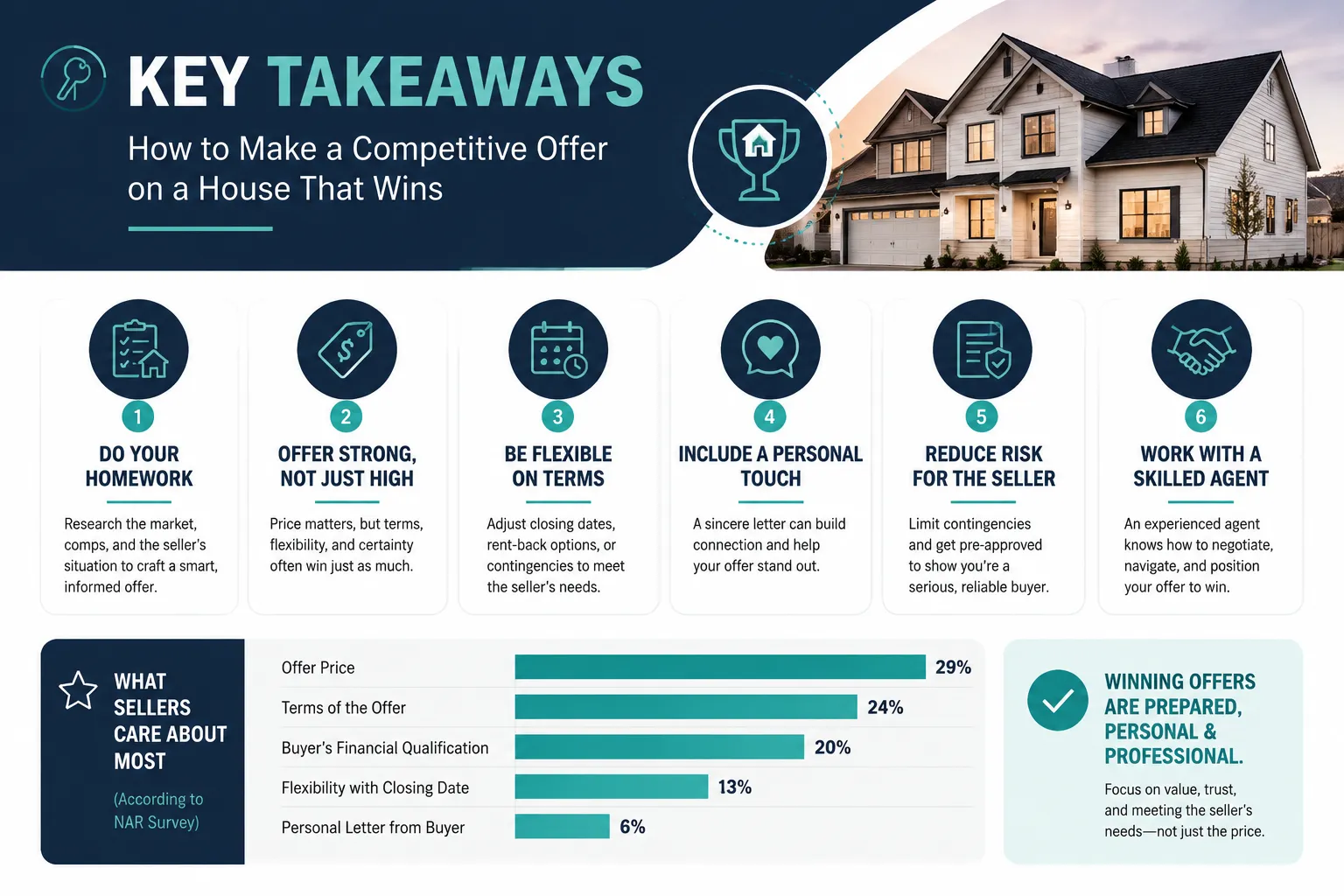
A competitive offer in a hot market is one that removes friction for the seller, financially, logistically, and emotionally. It's not always the highest price. Sellers want certainty: they want to know the deal will close, on time, without drama.
In 2026, with inventory still tight in many U.S. metros, understanding what makes an offer competitive is the difference between getting keys and getting ghosted. Here's what sellers and their agents actually weigh:
- Net proceeds, price minus any seller concessions or credits you're asking for
- Financing confidence, a full pre-approval letter from a known lender beats a pre-qualification every time
- Contingency load, fewer contingencies mean fewer ways the deal can fall apart
- Closing timeline, matching the seller's preferred date is worth thousands in goodwill
- Earnest money, a larger deposit signals you're serious and won't walk away casually
- Appraisal gap coverage, if you're offering above list, showing you'll cover a gap is extraordinary
The rule of thumb for making an offer on a house: price gets you in the room, but terms win the deal.
How to Make a Competitive Offer on a House That Wins
This is the full playbook. Whether you're a first-time buyer or a seasoned investor, knowing how to make a competitive offer on a house that wins comes down to executing these steps in the right order.
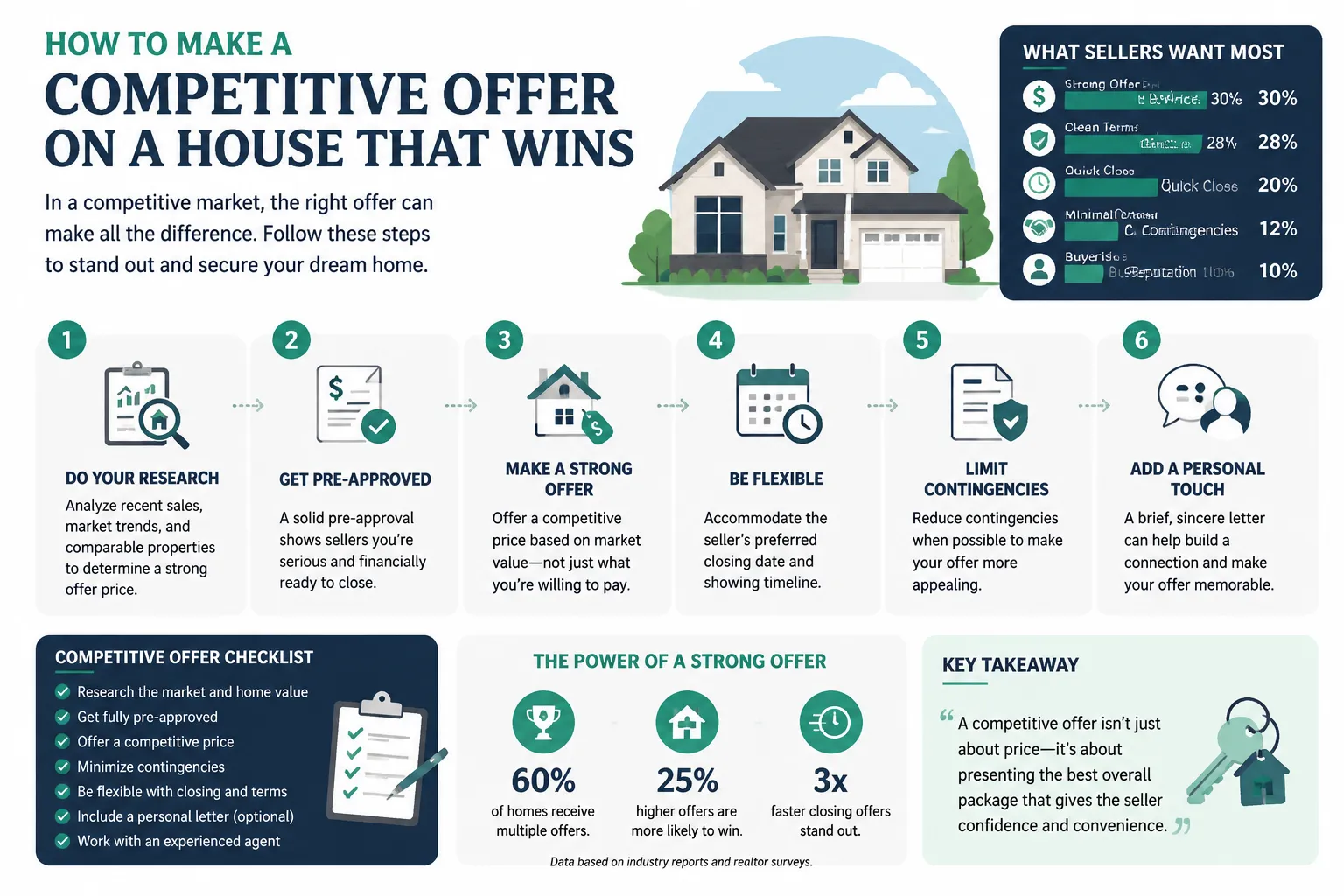
Step 1, Get fully pre-approved before you tour a single home. Not pre-qualified. Pre-approved means a lender has pulled your credit, verified income and assets, and issued a conditional commitment. That letter goes with every offer you write.
Step 2, Know your ceiling before you fall in love. Use a home buyers closing costs calculator to understand your all-in number, not just the purchase price.
Step 3, Run the comps like a broker, not a Zillow user. Look at closed sales from the last 60-90 days within a half-mile radius, same bed/bath count, similar square footage. That's your anchor.
Step 4, Build your offer around the seller's needs. Ask the listing agent: "What's most important to the seller, price, timeline, or certainty?" That answer shapes your entire offer strategy.
Step 5, Write a clean offer. Fewer contingencies, strong earnest money, pre-approval letter attached, and a cover letter if the property has emotional value to the seller.
Step 6, Move fast. In a competitive market, a 24-hour response window can cost you the house. When you find the right property, be ready to submit same day.
Step 7, Let it cook before you see results. Sometimes sellers sit on offers for a deadline. Don't panic and pull your offer. Patience after submission is part of the strategy.
Should I Get Pre-Approved or Pre-Qualified Before Making an Offer
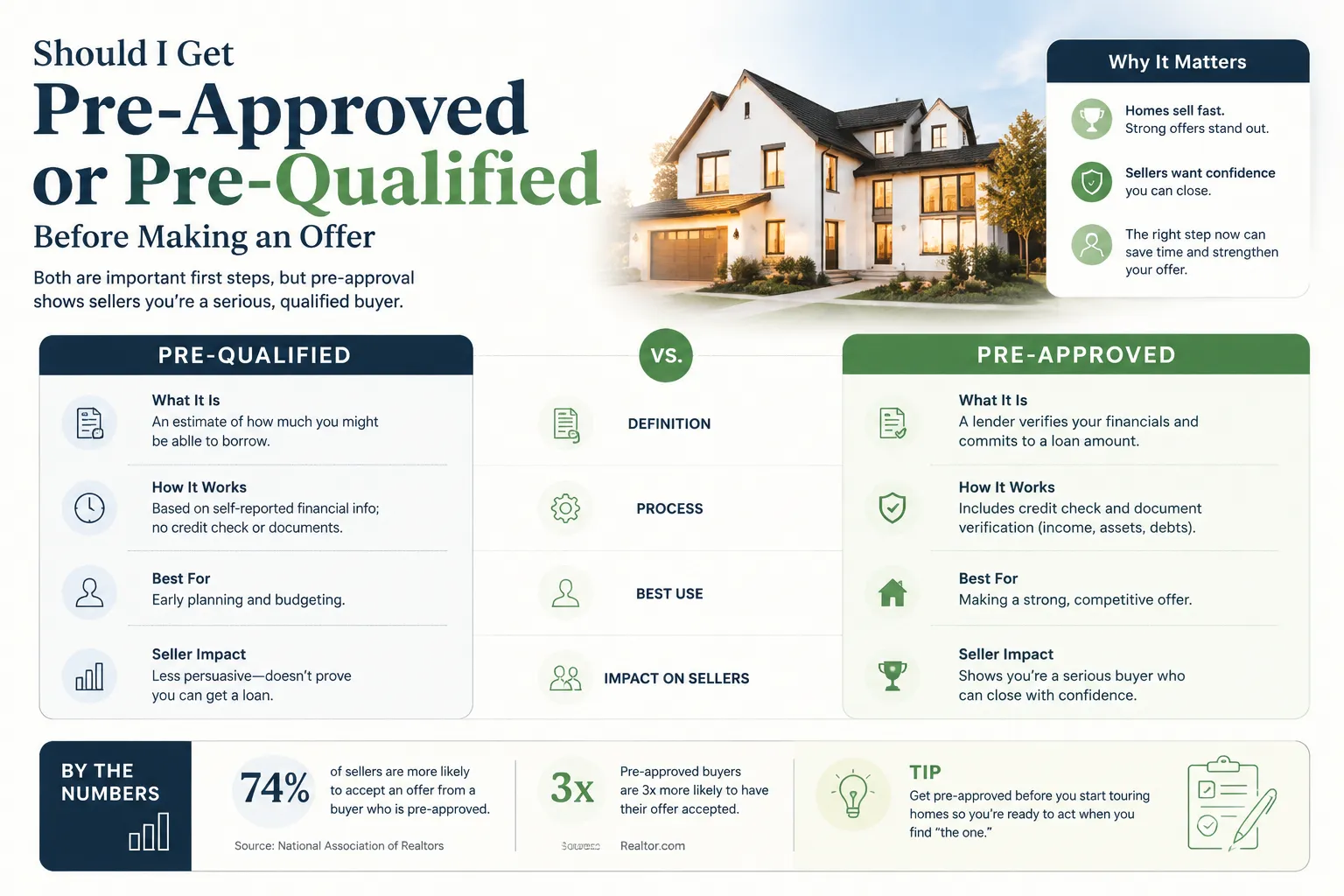
Always get pre-approved. Pre-qualification is a soft estimate based on self-reported information, no credit pull, no document verification. Pre-approval means a lender has actually reviewed your finances and issued a conditional loan commitment.
In a multiple-offer situation, a listing agent will immediately flag a pre-qualification letter as weak. Sellers and their agents know the difference, and a pre-qualification can knock your offer out of consideration before the price is even discussed.
For our full breakdown on financing your purchase the right way, check out the Real Estate Financing Guide: Mortgages, Credit & Down Payments 2026.
Choose pre-approval if: You're actively shopping and ready to make offers within 30-60 days.
Pre-qualification is fine if: You're 6+ months out and just want a ballpark number for budgeting.

How Much Over Asking Price Should I Offer on a House
There's no universal answer, but there is a framework. How much to offer on a house with multiple offers depends on three things: how hot the market is, how long the home has been listed, and what the comps actually support.
A reasonable offer chart by market condition:
| Market Type | Suggested Offer Range |
|---|---|
| Buyer's market (high inventory) | 2-5% below asking |
| Balanced market | At asking to 2% over |
| Seller's market (low inventory) | 3-7% over asking |
| Hot bidding war (multiple offers) | 5-15%+ over asking with gap coverage |
These are estimates based on general market behavior, your specific market and property may vary significantly. Always anchor your offer to actual closed comps, not just the list price.
Making an offer on a house that has been on the market a long time is a completely different situation. If a property has been sitting for 45+ days with no price reduction, there's usually a reason, overpricing, condition issues, or location concerns. In that case, offering at or slightly below asking with a full inspection contingency is fresh strategy and often gets accepted.
If you want to go deeper on how to avoid overpaying, our 10 Spring Filters That Stop You Overpaying guide breaks down exactly what to screen for before you fall in love with a listing.
Is Earnest Money Deposit Amount Important When Bidding on Houses
Yes, earnest money is one of the most underrated tools in a competitive offer. It signals financial commitment and tells the seller you won't walk away over minor issues.
The standard earnest money deposit is 1-3% of the purchase price. In a hot market, going to 3-5%, or even higher in luxury segments, can meaningfully differentiate your offer, especially when the price gap between competing buyers is tight.
What sellers think when they see a large earnest money deposit:
- This buyer is serious
- They're financially strong
- They're less likely to use contingencies as an exit ramp
One important note: earnest money is at risk if you back out without a valid contingency. Know what you're putting up and make sure your contingencies are written clearly to protect it.
What Contingencies Should I Remove to Make My Offer Stronger
Removing contingencies is one of the fastest ways to sweeten an offer on a house, but it comes with real risk. The most commonly waived contingencies in competitive markets are the financing contingency, the appraisal contingency, and sometimes the inspection contingency.
Here's how to think about each one:
Financing contingency, Protects you if your loan falls through. Waiving this is only smart if you have a rock-solid pre-approval and are confident your financing won't change. Cash buyers obviously skip this entirely.
Appraisal contingency, Protects you if the home appraises below your offer price. Waiving it means you'll pay the difference out of pocket. Only waive this if you have the cash reserves to cover a potential gap.
Inspection contingency, This one gets the most attention. Waiving it entirely is aggressive and risky. A smarter middle ground: conduct a pre-offer inspection (if the seller allows it) so you can waive the contingency with actual knowledge of the property's condition. Or use an "information only" inspection clause, you get the inspection but agree not to renegotiate based on findings under a certain dollar threshold.
The rule: Never waive a contingency you can't afford to lose.
Should I Waive Inspection Contingency to Win a Bidding War
Waiving the inspection contingency can win a bidding war, but it's one of the highest-risk moves in real estate. Before you do it, understand exactly what you're giving up: the legal right to walk away or renegotiate based on property condition findings.
When it might make sense:
- The home is newer construction (less likely to have major hidden issues)
- You've done a pre-offer walkthrough with a contractor
- The market is so competitive that keeping the contingency guarantees you lose
- You have cash reserves to absorb unexpected repair costs
When it's a bad idea:
- Older homes (pre-1980) with unknown systems
- Homes with visible deferred maintenance
- Any property where you haven't had eyes on the structure, roof, or foundation
So based on what brokers see in the field: waiving inspections on older homes to win a bidding war is one of the most common buyer regrets. The $500 inspection you skipped can turn into a $25,000 foundation repair you didn't see coming.
What's the Difference Between an Escalation Clause vs Cash Offer
An escalation clause is a provision in your offer that automatically increases your bid by a set increment above any competing offer, up to a maximum cap you define. A cash offer means no financing at all, the buyer brings the full purchase price in liquid funds at closing.
Escalation clause example: "Buyer offers $450,000, and will escalate $2,500 above any bona fide competing offer, up to a maximum of $475,000."
Cash offers are generally stronger than escalation clauses because they eliminate financing risk entirely. Sellers know a cash deal closes faster and with fewer complications. But not everyone has that option.
Escalation clause vs cash offer, when each wins:
- Cash offer wins when the seller prioritizes certainty and speed over maximum price
- Escalation clause wins when you're competing against other financed buyers and want to avoid blindly overbidding
- Escalation clause loses when the seller's agent won't disclose competing offers (some listing agents refuse to trigger escalation clauses)
If you're using an escalation clause, always set a cap you can genuinely afford, including potential appraisal gap coverage. Gate keeping your maximum number from the seller is smart; going over your ceiling is not.
When Is Offering Appraisal Gap Coverage Worth It
Appraisal gap coverage is worth it when you're offering above the likely appraised value and you want to signal to the seller that the deal won't collapse at the appraisal stage. It's one of the most extraordinary tools in a competitive offer, and most buyers don't even know it exists.
Here's how it works: If you offer $480,000 on a home that appraises at $460,000, there's a $20,000 gap. Without gap coverage, your lender will only finance based on the appraised value, and the deal either renegotiates or falls apart. With gap coverage written into your offer, you're committing to pay some or all of that gap out of pocket.
Is it worth it? Run this decision through three filters:
- Do you have the cash reserves to cover the potential gap?
- Do the comps suggest the home is genuinely worth your offer price (or close to it)?
- Is the competition intense enough that the seller needs this reassurance to pick your offer?
If all three are yes, appraisal gap coverage can be the difference between winning and losing. For a deeper look at how to evaluate whether a property is actually worth the price, the HouseCanary vs Skyline AI analysis tools comparison shows you how professionals run these numbers.
How Do I Know If a House Is Worth Going Over Asking Price For
A house is worth going over asking price if the closed comps support a higher value, the property has features that are genuinely scarce in that market, and you've confirmed your financing can handle the gap if the appraisal comes in low.
The framework for how to make a competitive offer on a house without overpaying:
- Pull the last 90 days of closed sales for comparable homes, same neighborhood, similar size, condition, and features
- Calculate price per square foot for each comp, then apply that to your target home
- Factor in any upgrades, lot size advantages, or school district premiums
- If the list price already reflects these premiums and the comps support it, going over asking is justified
- If the list price is already above comp value, you're paying a speculation premium, know that going in
A quick way to gut-check your number: use an online how much should I offer on a house calculator as a starting point, but always verify against actual closed sales data, not automated estimates. Automated valuation models can be off by 5-10% in fast-moving markets.
How Fast Should I Close to Win a Competitive Offer Situation
Closing speed is a serious competitive advantage. Most conventional purchases take 30-45 days to close. If you can credibly offer 21-25 days, that alone can tip a seller toward your offer, especially if they've already purchased another home or are relocating.
How to close faster:
- Choose a lender known for speed (local lenders and mortgage brokers often move faster than big banks)
- Have all documents ready before you make an offer: tax returns, pay stubs, bank statements, W-2s
- Respond to lender requests within hours, not days
- Use a title company your agent has a relationship with, they'll prioritize the file
The tradeoff: A faster close gives you less time to complete due diligence. Make sure your inspection timeline still fits within your accelerated schedule.
How Do I Write an Offer Letter That Stands Out to Sellers
A personal offer letter (also called a "love letter") can add emotional weight to a competitive offer, but it works best as a supplement to strong financial terms, not a substitute for them.
What makes a winning offer letter:
- Keep it short, one page maximum
- Connect to something specific about the home (the garden, the neighborhood, the history of the property)
- Share something genuine about who you are and why this home fits your life
- Avoid mentioning anything that could trigger Fair Housing concerns (religion, family status, national origin)
- Close with confidence, tell the seller you're ready to close and won't create headaches
Important caveat: Some listing agents advise their sellers not to read offer letters to avoid Fair Housing liability. Don't rely on the letter alone. Your offer needs to win on the numbers first.
What Happens When There Are Multiple Offers on a House
When there are multiple offers on a house, the listing agent typically presents all offers to the seller at a set deadline. The seller then has three options: accept one offer outright, reject all offers, or issue a counter-offer (sometimes called a "highest and best" request) to some or all buyers.
What to expect in a multiple-offer situation:
- The listing agent may call all buyers' agents and ask for "highest and best" offers by a specific deadline
- Sellers compare offers on price, terms, contingencies, earnest money, and closing timeline simultaneously
- The winning offer isn't always the highest price, it's the best combination of price and certainty
- You may never know what the other offers were
How to win a multiple offer situation:
- Submit your strongest offer first, don't hold back expecting a counter
- Include an escalation clause if you're uncertain about the competition
- Attach your pre-approval letter and proof of earnest money funds
- Have your agent call the listing agent to understand the seller's priorities before submitting
How to Make a Competitive Offer on a House Without Overpaying
The key to making a competitive offer on a house without overpaying is anchoring your price to data, not emotion. Buyers who overpay typically do so because they fell in love with a property and abandoned their comp analysis.
The guardrails:
- Set a hard ceiling before you tour the home, not after
- Calculate your maximum based on what the monthly payment does to your budget, not just what you "can" get approved for
- Know the appraised value risk: if you offer $30,000 over asking and the home appraises at list price, you need $30,000 in cash to cover the gap or the deal restructures
- Use creative ways to make an offer on a house, like a shorter inspection period, flexible closing date, or waiving minor contingencies, to compete without just throwing money at the problem
- Walk away from bidding wars that push you past your ceiling. There will be other houses.
The impeccable buyer is the one who wins the home they can actually afford, not the one who wins the bidding war and regrets it at closing.
What If My Offer Gets Rejected in a Competitive Market
A rejected offer isn't a dead end, it's data. When your offer gets rejected, the first move is to have your agent call the listing agent and ask specifically why. Was it price? Terms? Timeline? Another buyer's cash offer?
What to do after a rejection:
- Ask if the seller would consider a backup offer position (in case the accepted offer falls through)
- Review what you offered versus what won, adjust your strategy for the next opportunity
- Don't take it personally. In competitive markets, impeccable offers still lose sometimes
- If the home comes back on the market (the accepted offer fell through), you're already positioned, move fast
One stat worth knowing: a meaningful percentage of accepted offers in competitive markets fall through due to financing issues, inspection disputes, or appraisal gaps. Backup offer positions convert more often than buyers expect.
For sellers reading this, understanding what buyers go through helps you price and present your home more effectively. Our 7 Pricing Mistakes That Trigger Price Cuts and Lowball Offers guide shows exactly what turns buyers away before they even write an offer.
Can I Make Multiple Offers on Different Houses at the Same Time
Yes, in most U.S. states, buyers can make offers on multiple homes simultaneously. There's no law preventing it. But there are practical and ethical considerations worth understanding.
The practical reality:
- If two offers are accepted at the same time, you'll need to back out of one, and you could lose your earnest money if you're past the contingency period
- Some agents and sellers view simultaneous offers as bad faith, which can hurt your negotiating position if it comes out
- Your lender can only process one loan at a time, so your financing is tied to one property
When it makes sense:
- You're in a hyper-competitive market with very low acceptance rates
- You're making offers on homes in different price ranges or neighborhoods as a hedge
- Both offers include inspection and financing contingencies that give you exit options
The smarter play: Prioritize your targets. Make your strongest offer on your top choice first. If it's rejected, move to the next. This keeps your earnest money safe and your reputation intact with local agents.
FAQ: How to Make a Competitive Offer on a House
What is a competitive offer on a house?
A competitive offer is one that meets or exceeds the seller's expectations on price, terms, and closing certainty. In a hot market, it typically includes a strong price relative to comps, limited contingencies, solid earnest money, and a pre-approval letter from a credible lender.
What's the rule of thumb for making an offer on a house?
A common rule of thumb: start with the closed comps, offer at or above asking in a seller's market, and never go more than 10-15% over asking without appraisal gap coverage. Price to win, but always anchor to data.
How do I get my offer on a house accepted?
Lead with a full pre-approval, offer strong earnest money, limit contingencies, match the seller's preferred closing date, and have your agent build a relationship with the listing agent before submitting. Speed and preparation matter as much as price.
How much should I offer on a house with multiple offers?
Your offer should reflect the highest price you can justify based on comps, not just what beats the competition. In a bidding war, use an escalation clause with a hard cap to compete without blindly overbidding.
What's the difference between pre-approval and pre-qualification?
Pre-qualification is a soft estimate with no credit pull or document verification. Pre-approval is a lender-reviewed, conditionally committed loan amount. Always use pre-approval in a competitive market.
Is it worth writing a personal letter with my offer?
A personal letter can add emotional weight, but it only works as a supplement to strong financial terms. Some sellers and agents won't read them due to Fair Housing concerns. Never rely on a letter to compensate for a weak offer.
What does appraisal gap coverage mean?
Appraisal gap coverage is a written commitment to pay the difference between your offer price and the appraised value out of pocket. It protects the seller from deal collapse if the home appraises below your offer.
How long does it take to close on a house in a competitive market?
A conventional purchase typically closes in 30-45 days. Buyers who can credibly offer 21-25 days have a meaningful advantage. Cash deals can close in as few as 7-14 days.
Should I make an offer on a house that's been on the market for a long time?
Yes, but with a different strategy. A home sitting for 45+ days often has a pricing or condition issue. Offer at or slightly below asking with a full inspection contingency and use the market time as leverage in negotiations.
Can I back out of an offer after it's accepted?
You can back out, but it depends on your contingencies. If you're within a contingency period (inspection, financing, appraisal), you can typically exit without losing your earnest money. After contingencies are removed, backing out puts your deposit at risk.
What are creative ways to make an offer on a house?
Beyond price: offer a flexible closing date, include a rent-back option for the seller, waive minor contingencies, increase earnest money, write a personal letter, or offer to pay some of the seller's closing costs. These terms can win deals when price is equal.
How do I write a winning offer on a house?
A winning offer includes: full pre-approval letter, strong earnest money (2-3%+), clean contingencies or strategic waivers, a closing date that works for the seller, and a cover letter if the property has sentimental value. Submit it fast and have your agent follow up personally.
Conclusion: Your Next Move Starts Before You Fall in Love With a House
Knowing how to make a competitive offer on a house that wins is a skill, and like any skill, it rewards preparation over impulse. The buyers who consistently win in competitive markets aren't always the ones with the most money. They're the ones who show up pre-approved, understand what the seller actually needs, and build offers that remove every reason to say no.
Here's your action plan for 2026:
- Get fully pre-approved today, not when you find the house you want
- Run your own comps before every offer so you know your ceiling before emotion sets in
- Talk to your agent about seller priorities before writing a single number
- Use escalation clauses and appraisal gap coverage as precision tools, not panic moves
- Walk away from deals that push past your ceiling, the right house at the wrong price is still the wrong deal
The market rewards the prepared. Get your financing straight, know your numbers, and when the right house hits, move with confidence.
For more on evaluating whether a property is worth the price before you bid, check out our guide on using AI to find location intelligence on what makes a neighborhood thrive. And if you're also thinking about the sell side of the equation, our home sellers pricing strategies playbook gives you the full picture from the other side of the table.