

Last updated: July 20, 2026

Quick Answer: Most buyers need between 3% and 20% of the home's purchase price saved for a down payment, depending on the loan type. For a $300,000 home, that's $9,000 to $60,000. For a $500,000 home, it's $15,000 to $100,000. How fast you get there depends entirely on your savings rate and which programs you qualify for, and some buyers get there in under two years.
Key Takeaways
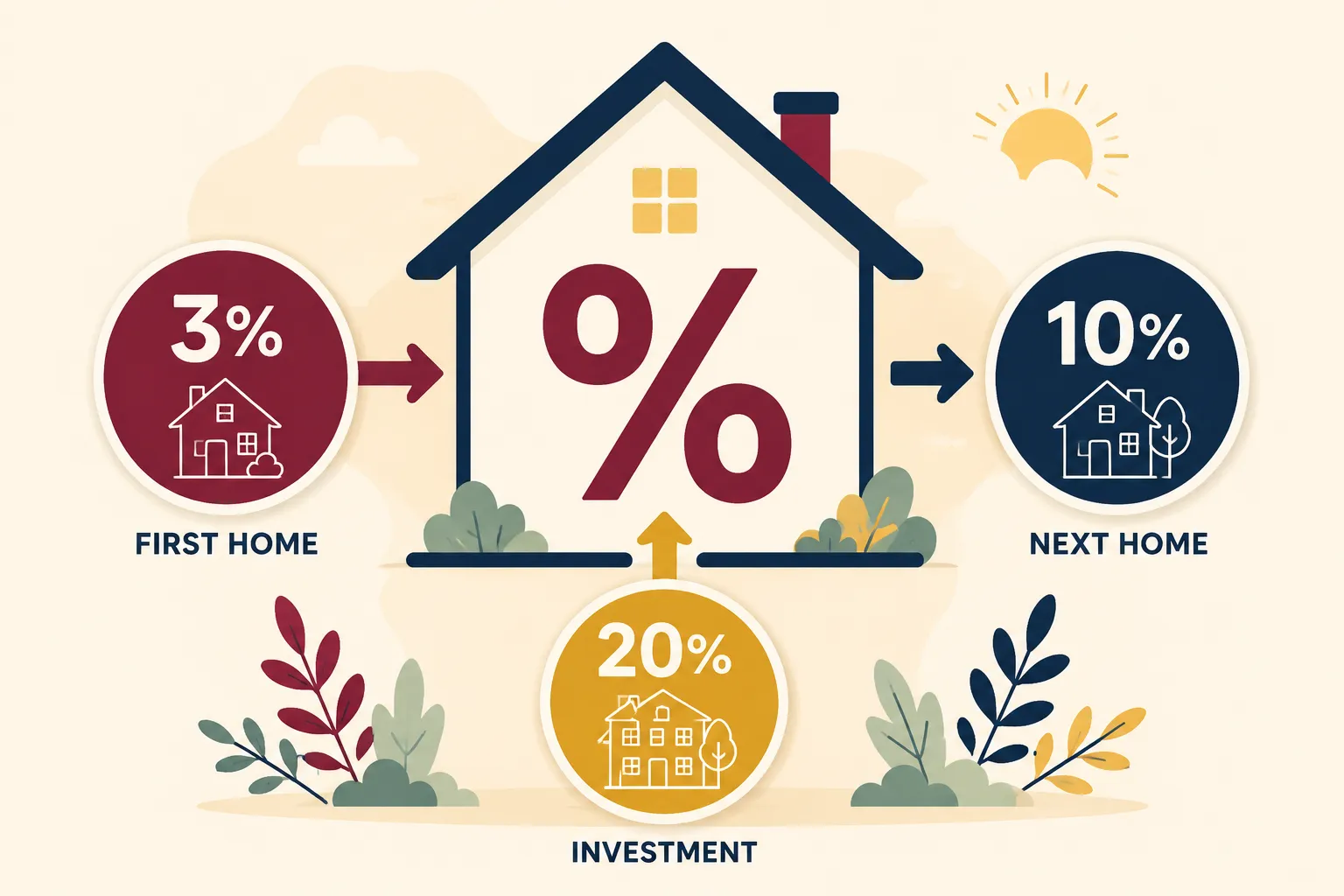
- The minimum down payment for most conventional loans is 3%; FHA loans require 3.5% with a 620+ credit score.
- Putting down less than 20% on a conventional loan triggers private mortgage insurance (PMI), which adds to your monthly cost.
- On a $300,000 home: 3% down = $9,000; 10% = $30,000; 20% = $60,000.
- On a $400,000 home: 3% down = $12,000; 10% = $40,000; 20% = $80,000.
- On a $500,000 home: 3% down = $15,000; 10% = $50,000; 20% = $100,000.
- First-time buyers can access down payment assistance programs that cover part or all of the required amount.
- Saving $500 to $1,500 per month, most buyers can hit a 3%-5% down payment goal in 12 to 36 months.
- Family gift funds are allowed on most loan types, with proper documentation.
- Raiding retirement accounts is possible but comes with serious tax penalties, know the rules first.
- Waiting to save a full 20% is not always the right move, especially in markets where prices rise faster than savings.
How Much to Save for a Down Payment, The Real Numbers by Home Price
The answer to how much to save for a down payment is not one-size-fits-all. It depends on the home price, the loan type, and how much monthly payment you can handle after closing.
Here's a straight breakdown by home price:
How much down payment for a $300,000 house:
- 3% down = $9,000
- 3.5% (FHA) = $10,500
- 5% down = $15,000
- 10% down = $30,000
- 20% down = $60,000
How much down payment for a $400,000 house:
- 3% down = $12,000
- 3.5% (FHA) = $14,000
- 5% down = $20,000
- 10% down = $40,000
- 20% down = $80,000
How much down payment for a $500,000 house:
- 3% down = $15,000
- 3.5% (FHA) = $17,500
- 5% down = $25,000
- 10% down = $50,000
- 20% down = $100,000
These numbers are fresh and so based on current market realities, but remember, your down payment is not the only cash you need. Closing costs typically run 2% to 5% of the loan amount, and most lenders want to see 2 to 3 months of mortgage payments in reserve after closing. Budget for all three when figuring out how much to save for a home down payment.
For a deeper breakdown of how financing actually works from the ground up, check out the Real Estate Financing Guide: Mortgages, Credit & Down Payments 2026.
What Percentage Should You Save for a Down Payment on a House?
The percentage you need depends on which loan program you use. There's no single correct answer, but there is a smart answer based on your situation.
Here's how the major loan types stack up:
| Loan Type | Minimum Down Payment | Credit Score Minimum | PMI Required? |
|---|---|---|---|
| Conventional (Fannie/Freddie) | 3% | 620 | Yes, if under 20% |
| FHA Loan | 3.5% | 580 | Yes (MIP, for life of loan if <10% down) |
| VA Loan | 0% | Varies by lender | No |
| USDA Loan | 0% | 640 (most lenders) | No (guarantee fee instead) |
| Jumbo Loan | 10%-20%+ | 700+ | Varies |
The impeccable truth that most people gatekeep: you do NOT need 20% down to buy a house. That number comes from an era when it was the standard, today, it's one option, not the rule.
The 20% threshold matters for one specific reason: it's when PMI goes away on a conventional loan. That's it. If avoiding PMI is your goal, 20% is the target. If getting into a home sooner is the goal, 3% to 10% gets you there faster.
For a full comparison of FHA versus conventional loan costs, see our breakdown of FHA Loan vs Conventional Loan: Which Saves More Money in 2026?
What's the Minimum Down Payment Required for a First-Time Buyer?
The minimum down payment for a house as a first-time buyer is 3% on a conventional loan or 3.5% on an FHA loan. VA and USDA loans allow 0% down for qualifying buyers.
The minimum down payment for house first-time buyer programs varies by loan type:
- Conventional 97 (Fannie Mae/Freddie Mac): 3% down, income limits may apply
- HomeReady (Fannie Mae): 3% down, designed for low-to-moderate income buyers
- Home Possible (Freddie Mac): 3% down, similar income-based guidelines
- FHA: 3.5% down with a 580+ credit score; 10% down if your score is 500-579
- VA: 0% down for eligible veterans and active-duty service members
- USDA: 0% down for rural and suburban properties that meet location requirements
Common mistake: Many first-time buyers assume FHA is always the best low-down-payment option. That's not always true. FHA loans carry mortgage insurance premium (MIP) for the life of the loan if you put less than 10% down, while conventional PMI drops off once you hit 20% equity. Run both scenarios through a first-time home buyer down payment calculator before deciding.
How Long Does It Take to Save for a Down Payment?
How fast you save depends on your monthly savings rate and your target down payment amount. At $1,000 per month saved, hitting a $15,000 goal takes 15 months. Hitting a $60,000 goal takes 5 years.
Here's a realistic savings timeline based on monthly contribution:
Target: $15,000 (3% on a $500k home)
- Saving $500/month: 30 months (2.5 years)
- Saving $1,000/month: 15 months
- Saving $1,500/month: 10 months
Target: $30,000 (10% on a $300k home)
- Saving $500/month: 60 months (5 years)
- Saving $1,000/month: 30 months (2.5 years)
- Saving $1,500/month: 20 months
Target: $60,000 (20% on a $300k home)
- Saving $500/month: 10 years
- Saving $1,000/month: 5 years
- Saving $1,500/month: ~3.3 years
The real key to how much to save for a down payment faster is not just cutting expenses, it's stacking income. Side income, tax refunds, bonuses, and selling unused assets can all accelerate the timeline dramatically. Let it cook before you see results, but the compounding effect of consistent saving is extraordinary.
How to Save for a House Down Payment Faster (Especially While Renting)
Saving for a house down payment while renting is genuinely hard, you're paying someone else's mortgage while trying to build your own. But it's absolutely doable with the right system.
Step-by-step approach:
Open a dedicated high-yield savings account (HYSA). Separate your down payment savings from your regular account. Out of sight, out of mind, and earning interest while it sits there.
Automate transfers on payday. Treat your down payment savings like a bill. Automate a fixed transfer the day your paycheck lands so you never "decide" whether to save.
Audit your recurring expenses. Subscriptions, dining, and convenience spending are the biggest leaks. A $200/month cut adds $2,400 to your down payment fund per year.
Stack windfalls. Tax refunds, work bonuses, gifts, and freelance income go straight to the fund. No exceptions.
Explore down payment assistance programs (covered in the next section). Many renters qualify and don't know it.
Consider a house hack. If you already own or can buy a multi-unit property, renting out one unit can cover part of your mortgage, but that's a strategy for buyers who are ready to move.
Use a down payment savings calculator to set a real target date. Knowing you're 18 months away is more motivating than a vague "someday."
One fresh strategy that's gaining traction in 2026: some buyers are using cash-back credit cards for every possible expense (groceries, gas, utilities) and funneling all rewards directly into their HYSA. Done responsibly with a card you pay off monthly, it adds a few hundred dollars per year with zero extra effort.
For more strategies ranked by effectiveness, see the Top 7 Down Payment Strategies: Best Ways to Buy a Home.
Down Payment Assistance Programs for First-Time Buyers
Down payment assistance (DPA) programs exist at the federal, state, and local level, and they are one of the most gatekept resources in real estate. Many first-time buyers leave thousands of dollars on the table simply because they didn't ask.
Types of DPA programs:
- Grants: Free money that doesn't need to be repaid. Usually income-limited.
- Forgivable loans: Loans that are forgiven after you stay in the home for a set period (typically 3-10 years).
- Deferred loans: No payments until you sell, refinance, or pay off the mortgage.
- Matched savings programs: Some nonprofits and employers match your savings dollar-for-dollar up to a cap.
Where to find them:
- Your state's Housing Finance Agency (HFA), every state has one
- HUD-approved housing counselors (free service)
- Local city and county housing authorities
- Employer-sponsored homeownership programs
- Fannie Mae's HomeReady and Freddie Mac's Home Possible include DPA options
The National Council of State Housing Agencies tracks over 2,400 active DPA programs across the U.S. Income limits, purchase price caps, and geographic restrictions vary, so what's available in Atlanta is different from what's available in Phoenix.
Getting pre-approved before you apply for DPA programs is smart. Read our Pre-Approval Pro Tips: Fast-Track Your Path to Homeownership to get that step handled first.

What Happens If You Put Down Less Than 20%?
Putting down less than 20% on a conventional loan means you'll pay private mortgage insurance (PMI) until your loan-to-value ratio drops to 80%. On an FHA loan, you'll pay mortgage insurance premium (MIP), and the rules are stricter.
PMI on a conventional loan:
- Typically costs 0.5% to 1.5% of the loan amount per year
- On a $300,000 loan, that's $1,500 to $4,500 per year ($125 to $375/month)
- Cancels automatically when you reach 20% equity (or you can request it at 20%)
- Not permanent, it goes away
MIP on an FHA loan:
- Upfront MIP: 1.75% of the loan amount (can be rolled into the loan)
- Annual MIP: 0.55% to 1.05% depending on loan term and LTV
- If you put less than 10% down, MIP stays for the life of the loan
- To get rid of it, you'd need to refinance into a conventional loan once you have 20% equity
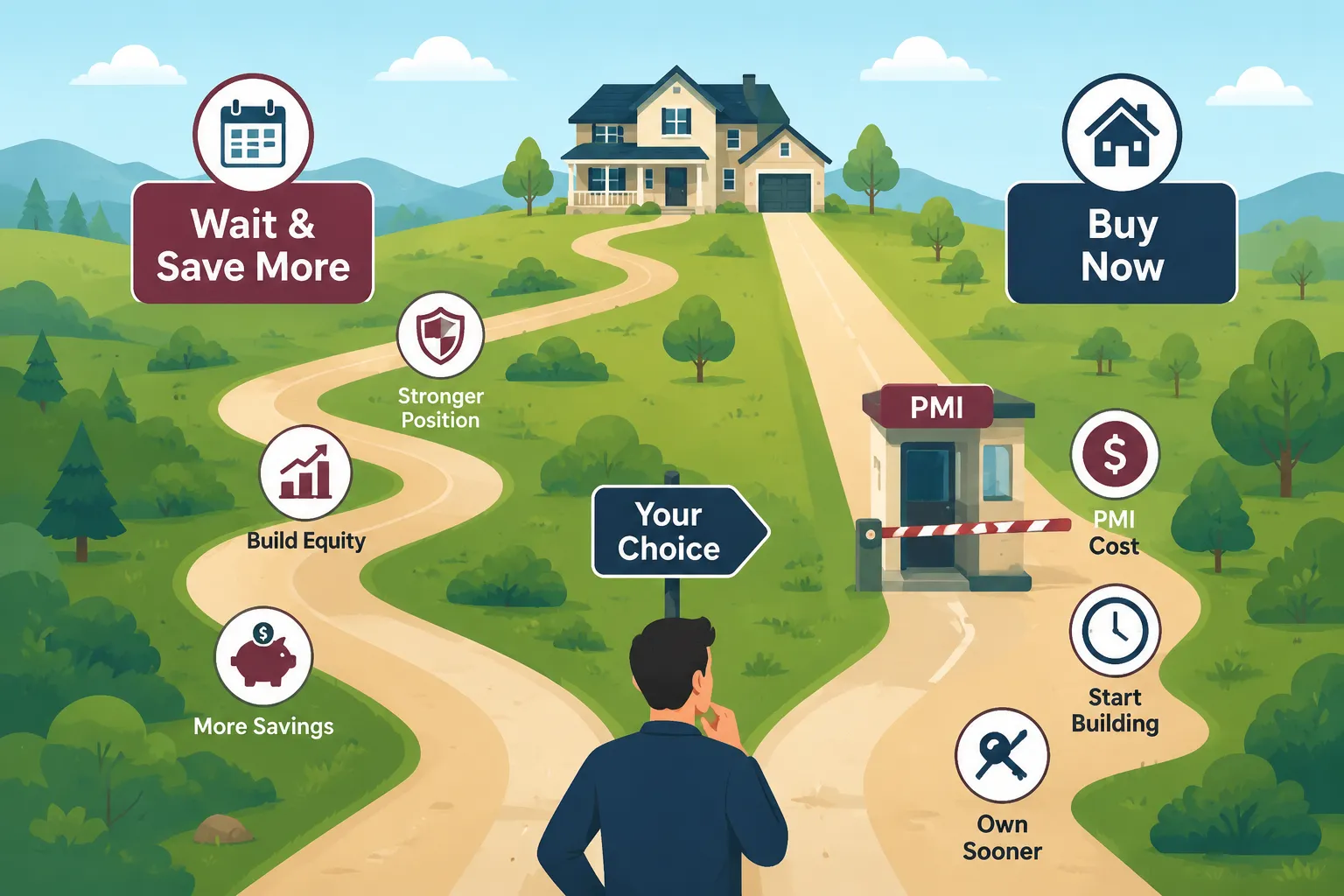
The PMI cost is real, but it's not a dealbreaker for most buyers. Think of it as the cost of getting into a home years earlier. If home prices in your market are appreciating, waiting to save 20% could cost you more in price appreciation than you'd ever pay in PMI.
Should You Wait and Save More, or Buy Now With Less Down?
This is one of the most important financial decisions in the home buying process, and the answer is: it depends on your local market, your financial stability, and how long you plan to stay.
Buy sooner with less down if:
- Home prices in your target market are rising faster than you can save
- You have stable income and a solid emergency fund
- PMI costs are manageable relative to your budget
- You plan to stay in the home 5+ years
- You qualify for a down payment assistance program that reduces the gap
Wait and save more if:
- You're in a flat or declining market where appreciation isn't outpacing your savings rate
- Your credit score needs work (a higher score = better rate = lower lifetime cost)
- You don't have 3-6 months of emergency savings beyond the down payment
- Your income is unstable or you're planning a major life change in the next 12 months
The rent vs. buy math is shifting in 2026. For a current take on how falling rents and slower price growth affect this decision, see our analysis of Rent vs. Buy in 2026: How Falling Rents and Slower Price Growth Are Changing the Math.
Should You Use Savings or Retirement Funds for a Down Payment?
Using retirement funds for a down payment is possible, but it should be a last resort, not a first move. The tax penalties and long-term opportunity cost are significant.
401(k):
- Early withdrawal (before age 59½): 10% penalty plus ordinary income taxes
- Some plans allow loans up to 50% of the vested balance or $50,000, whichever is less
- Loan must be repaid, usually within 5 years
- If you leave your job, the loan may be due immediately
Traditional IRA:
- First-time homebuyers can withdraw up to $10,000 lifetime without the 10% penalty
- You still owe income taxes on the withdrawal
- "First-time buyer" means you haven't owned a home in the past 2 years
Roth IRA:
- Contributions (not earnings) can be withdrawn anytime, tax and penalty-free
- Earnings can be withdrawn penalty-free for a first home purchase up to $10,000 lifetime, if the account is at least 5 years old
The extraordinary power of compound growth in a retirement account means every dollar you pull out today costs you multiple dollars in retirement. Exhaust every other option, DPA programs, gift funds, savings acceleration, before touching retirement accounts.
Can You Use a Gift for a Down Payment?
Yes, gift funds from family members are allowed on most loan types, with proper documentation. The lender will require a gift letter confirming the money is not a loan.
Gift fund rules by loan type:
- Conventional loans: Gifts from family members are allowed. If you put less than 20% down, the entire down payment can be a gift on some programs; others require a minimum borrower contribution of 3-5%.
- FHA loans: Gifts from family, employers, close friends, and charitable organizations are allowed. The full down payment can come from a gift.
- VA and USDA loans: Gift funds are generally allowed.
The gift letter must typically include: donor's name and relationship to buyer, dollar amount, property address, statement that no repayment is required, donor's signature.
One edge case to know: large deposits in your bank account will be scrutinized during underwriting. If a gift hits your account within 60-90 days of closing, document it immediately. Unexplained deposits can delay or kill a loan approval.
How Much Should You Have Saved Before Buying a House?
Beyond the down payment itself, you need three separate buckets of cash before you're truly ready to buy. Knowing how much to save for a house down payment means accounting for all three.
Bucket 1: Down payment
The percentage you've chosen based on loan type and strategy (3% to 20%).
Bucket 2: Closing costs
Typically 2% to 5% of the loan amount. On a $300,000 loan, budget $6,000 to $15,000. On a $400,000 loan, budget $8,000 to $20,000.
Bucket 3: Cash reserves
Most lenders want to see 2 to 3 months of mortgage payments in your account after closing. On a $1,800/month payment, that's $3,600 to $5,400 minimum.
Total cash needed example, $300,000 home with 5% down:
- Down payment: $15,000
- Closing costs (3%): $8,700
- Reserves (2 months): $3,600
- Total cash needed: ~$27,300
This is why knowing how much to save for a down payment is only part of the picture. The full number is always higher than the down payment alone.
FAQ: How Much to Save for a Down Payment
Q: What is 3.5% down payment on a $200,000 house?
A: 3.5% of $200,000 is $7,000. That's the FHA minimum down payment on that price point.
Q: How much is 3.5% down payment on a $300,000 house?
A: $10,500. That's the FHA minimum for a $300,000 home with a 580+ credit score.
Q: How much of a down payment do I need for a $300,000 house?
A: The minimum is $9,000 (3% conventional) or $10,500 (3.5% FHA). If you want to avoid PMI, you'd need $60,000 (20%).
Q: How much of a down payment do I need for a $400,000 house?
A: The minimum is $12,000 (3% conventional) or $14,000 (3.5% FHA). To avoid PMI, you'd need $80,000.
Q: What is a down payment on a $500,000 house for a first-time buyer?
A: The minimum down payment on a 500k house for a first-time home buyer is $15,000 at 3% (conventional) or $17,500 at 3.5% (FHA), assuming the loan stays within conforming limits in your area.
Q: Is there a down payment calculator I can use?
A: Yes, most lenders and real estate sites offer a down payment calculator. Multiply the home price by your target percentage (e.g., $350,000 x 0.05 = $17,500 for 5% down). Our first-time homebuyer guide includes resources to help you run these numbers.
Q: Can I buy a house with no down payment?
A: Yes, if you qualify for a VA loan (military/veterans) or USDA loan (rural/suburban areas). These are the only two mainstream loan programs with a true 0% down option.
Q: Does the down payment affect my mortgage rate?
A: Yes. A larger down payment typically means a lower loan-to-value ratio, which can qualify you for a better interest rate. The difference between 5% and 20% down can affect your rate by 0.25% to 0.75% depending on the lender and your credit profile.
Q: How much should I save for a down payment if I'm also paying rent?
A: The math is the same, your target is the down payment plus closing costs plus reserves. The challenge is cash flow. Automate savings, reduce discretionary spending, and explore DPA programs. Many renters hit a 3-5% down payment goal in 18 to 24 months with focused effort.
Q: Can I use a down payment assistance program with an FHA loan?
A: Yes. Many state and local DPA programs are specifically designed to pair with FHA loans. The DPA covers part or all of the 3.5% requirement, and some programs also cover closing costs.
Q: What's the difference between PMI and MIP?
A: PMI (private mortgage insurance) applies to conventional loans and cancels when you reach 20% equity. MIP (mortgage insurance premium) applies to FHA loans and, if you put less than 10% down, stays for the life of the loan unless you refinance.
Q: Is it better to make a larger down payment or keep cash in reserves?
A: Lenders and financial advisors generally recommend keeping 3-6 months of expenses in reserves over maximizing your down payment. A larger down payment doesn't help you if an unexpected repair or job loss wipes out your savings in month three.
Conclusion: Your Down Payment Action Plan
Figuring out how much to save for a down payment is the starting line, not the finish line. Here's what to do next:
Pick your loan type first. Conventional, FHA, VA, or USDA? Each has a different minimum. Compare your options using our FHA vs. Conventional Loan comparison.
Set your target number. Use the breakdowns above for your price range. Add closing costs (2-5%) and reserves (2-3 months of payments) to get your real cash target.
Check your DPA eligibility. Visit your state's Housing Finance Agency website or talk to a HUD-approved housing counselor before assuming you have to save the full amount yourself.
Open a dedicated HYSA and automate your savings. Set a monthly transfer and treat it like rent.
Get pre-approved. Knowing your real purchase power changes the savings math. Our pre-approval tips guide walks you through the process step by step.
Revisit the buy vs. wait question every 6 months. Markets shift. What made sense to wait on last year may not make sense today.
The path to homeownership is extraordinary when you have the right numbers in front of you. Stop gatekeeping yourself with assumptions about needing 20% down or a decade of saving. The real barrier for most buyers is information, and now you have it.
















Comments 1