

{"cover":"Professional landscape format (1536×1024) hero image with bold text overlay (≤42 chars): 'AI Home Staging vs Traditional: What $0…', crisp white bold sans-serif centered on a deep burgundy semi-transparent overlay panel, 8% safe margins from every edge, no character touches the edge. Background: split editorial scene, left side shows a warmly lit, professionally staged living room with fresh flowers and neutral furniture, right side shows a glowing laptop screen displaying an AI-rendered room transformation, soft natural daylight streaming through large windows, magazine-cover aesthetic, rich contrast, real estate editorial quality, 2026 modern home design palette.","content":["Editorial landscape format (1536×1024), bright natural daylight interior photography showing a side-by-side split of the same empty living room: left half is a bare, empty room with white walls and hardwood floors, right half shows the same room digitally transformed with AI-rendered modern furniture, art, and plants visible on a laptop screen held by a woman of Asian descent in her 30s. Clean, airy, Pinterest-worthy composition, warm neutral tones, real estate staging theme, no tables or text overlays.","Symbolic conceptual illustration (1536×1024), flat vector style on a bright cream background: a large bold dollar sign made of circuit board lines on the left, dissolving into a pile of physical furniture, paint swatches, and staging props on the right. A clean diagonal split divides the two worlds, digital AI blue on the left, warm earthy staging tones on the right. Short label 'AI vs Traditional' in 4 bold words centered at top with 8% safe margins. Save-worthy, modern infographic aesthetic, no pricing tables.","Cinematic editorial photography (1536×1024), a Black male real estate agent in his 40s sitting at a modern home office desk, holding a tablet showing before-and-after AI staging photos of a living room. Warm studio lighting, shallow depth of field, bookshelves and a sold sign visible in the background. Rich, moody editorial color grade, magazine quality, no text overlays, real estate professional theme.","Split-screen editorial (1536×1024), left half: a professional home stager, a Latina woman in her 50s, arranging physical throw pillows and a vase on a console table in a bright staged room. Right half: a glowing laptop screen showing the Collov AI or REimagine Home interface with a digitally staged room render. Both halves share warm natural window light. Clean center dividing line, no tables, no pricing text, high-contrast magazine composition, home staging comparison theme.","Isometric illustration (1536×1024), bright, clean isometric view of a stylized house cutaway showing two rooms: one room is physically staged with real furniture shown in warm earthy tones, the adjacent room shows a glowing digital overlay of AI-rendered furniture floating above an empty floor. Small icon labels, 'Real' and 'AI', in 1 word each, placed with 8% safe margins. Pastel blue and warm cream color palette, modern flat design, save-worthy Pinterest aesthetic, no comparison tables or dollar amounts."}

Last updated: July 20, 2026
Quick Answer: AI home staging uses software to digitally furnish and style listing photos at little to no cost, while traditional staging physically places real furniture and decor in your home before buyers walk through. Free AI tools can make your listing photos look extraordinary, but they cannot replace the in-person experience that closes deals. The smart move in 2026 is a hybrid: AI-stage every photo, physically stage only the rooms that sell the house.
Key Takeaways
- Free AI staging tools like Collov AI and REimagine Home can digitally transform empty-room photos in minutes, with no upfront cost.
- Traditional professional home staging costs between $1,500 and $5,000 on average for a full home, according to data from the Real Estate Staging Association (RESA).
- The National Association of Realtors (NAR) Profile of Home Staging reports that staged homes sell faster and at higher prices than unstaged homes, but the data does not isolate AI staging specifically.
- Free AI staging tools have real limitations: furniture scale can be off, rooms can look unrealistic, and buyers who visit in person may feel misled.
- Disclosure of AI-staged photos is an emerging legal and ethical issue, some MLS boards now require it.
- The hybrid strategy, AI photos plus physical staging of the living room and primary bedroom, gives sellers the best return on investment.
- Staging an empty house with traditional methods costs more than staging an occupied one; AI staging costs the same either way.
- For FSBO sellers and first-time sellers on tight budgets, AI staging is a fresh, accessible entry point, not a complete replacement.
What Is AI Home Staging and How Does It Work?
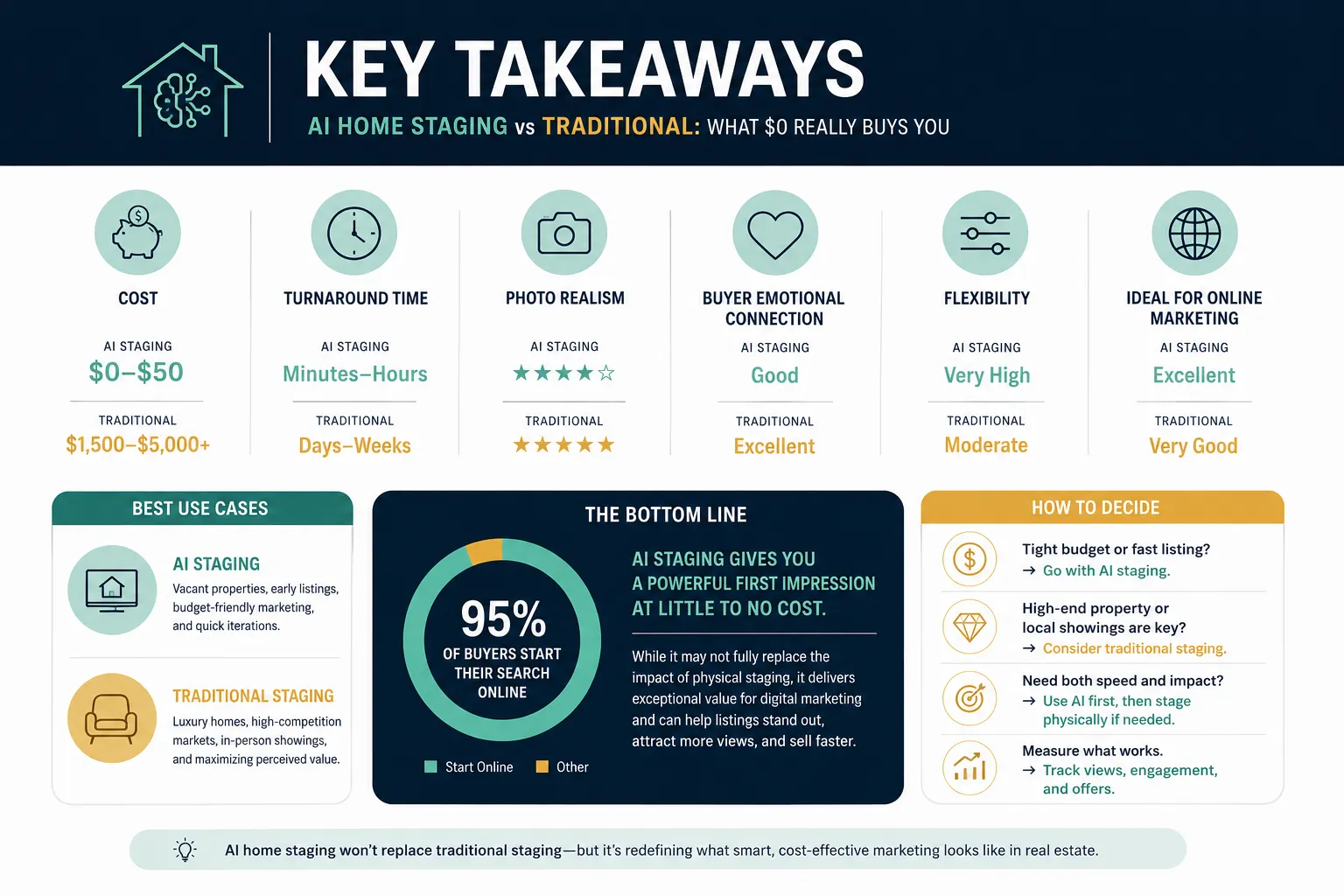
AI home staging is the process of using artificial intelligence software to digitally add furniture, decor, and design elements to photos of empty or sparsely furnished rooms. You upload a photo of a room, select a design style, and the AI renders a fully furnished version of that space, usually in under two minutes.
The technology works by analyzing the room's dimensions, lighting, and architectural features, then placing scaled 3D furniture models into the image. Tools like Collov AI and REimagine Home are among the most-used platforms in 2026 for this purpose. Both offer free tiers that allow a limited number of renders per month.
How the process works, step by step:
- Take a clean, well-lit photo of the empty or unfurnished room.
- Upload the photo to an AI staging platform (Collov AI, REimagine Home, Virtual Staging AI, or similar).
- Select a design style, modern, farmhouse, Scandinavian, transitional, etc.
- The AI generates a furnished version of the room, typically within 60 to 90 seconds.
- Download the image and use it in your listing photos, social media, or marketing materials.
The quality varies significantly between free and paid tiers. Free renders often include watermarks, lower resolution, and less realistic furniture placement. Paid plans, typically ranging from $15 to $50 per room, produce higher-resolution, more accurate results.
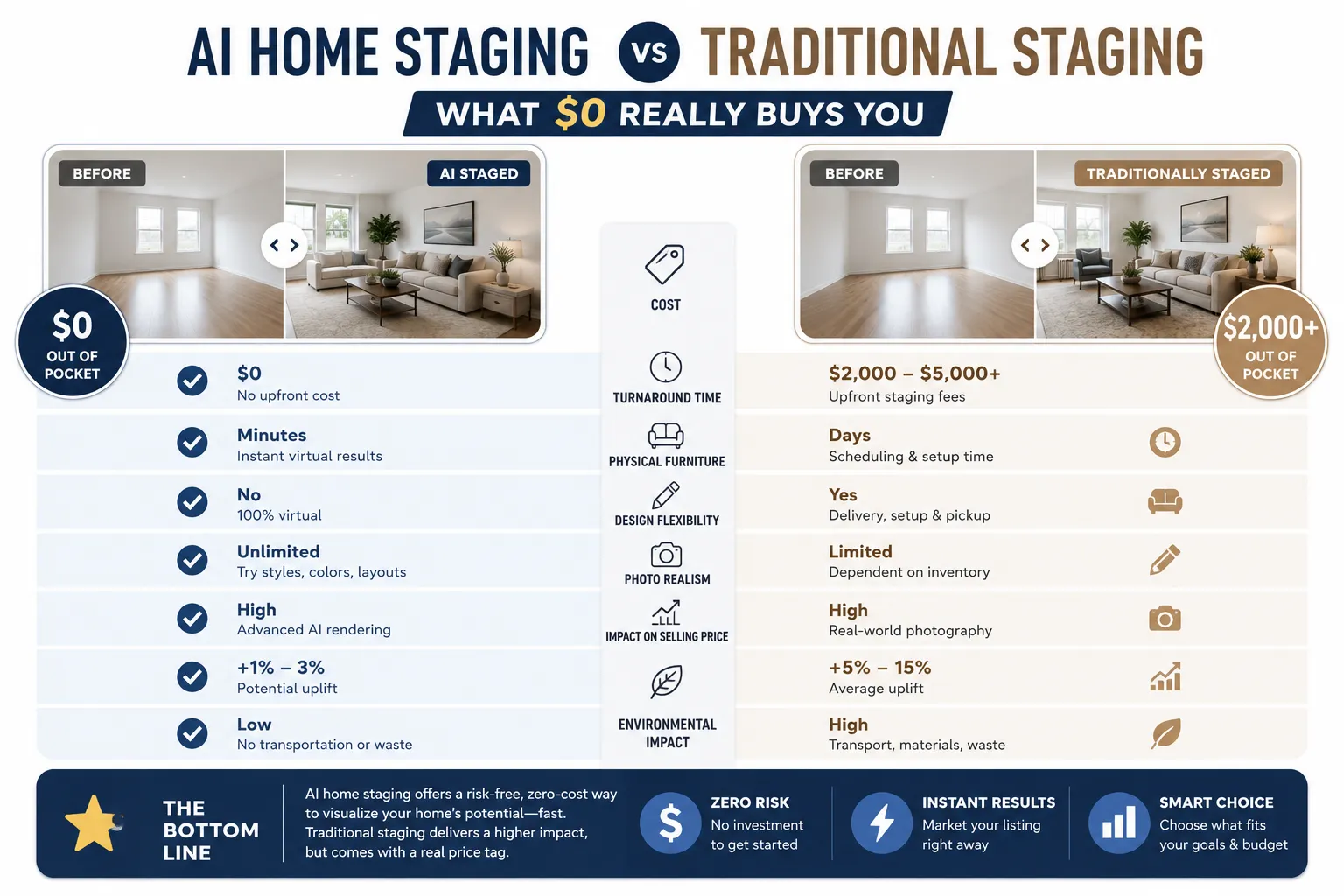
AI Home Staging vs Traditional: What $0 Really Buys You
This is the core question, and the answer depends entirely on what you're trying to accomplish.
At $0, AI staging buys you better listing photos. That's real value, and not nothing. In a market where buyers scroll Zillow and Redfin at 11pm, a photo of a digitally staged living room beats a photo of an empty white box every single time.
What $0 does NOT buy you: the in-person experience. When a buyer walks through your front door, the AI render disappears. If the room is empty, it feels small, cold, and hard to connect with emotionally. That emotional connection is what traditional staging is actually selling.
The cost math, side by side:
| Staging Type | Typical Cost (2026) | What You Get | Best For |
|---|---|---|---|
| Free AI Staging | $0 (limited renders) | Digitally furnished listing photos | FSBO sellers, budget listings, occupied homes |
| Paid AI Staging | $15,$50 per room | High-res renders, no watermarks, multiple styles | Agents, investors, vacant listings |
| DIY Physical Staging | $200,$800 (rentals + accessories) | Real furniture in select rooms for showings | Occupied sellers willing to declutter and style |
| Professional Staging (occupied) | $800,$2,500 | Stager consults, rearranges, adds decor | Sellers who want expert guidance on their existing furniture |
| Professional Staging (vacant/empty) | $1,500,$5,000+ | Full furniture rental, delivery, setup, monthly fees | Vacant luxury listings, model homes, move-up sellers |
Cost ranges based on RESA industry data and vendor pricing as of 2026. Costs vary by market, home size, and scope.
Staging an empty house with a professional stager is the most expensive scenario, you're paying for furniture rental, delivery, setup, and often a monthly continuation fee if the home doesn't sell quickly. That's where AI staging for photos makes the most financial sense as a first line of defense.
For deeper context on what's moving the market right now, the U.S. Homeowners National Real Estate Updates for 2026 has current data worth reviewing before you list.
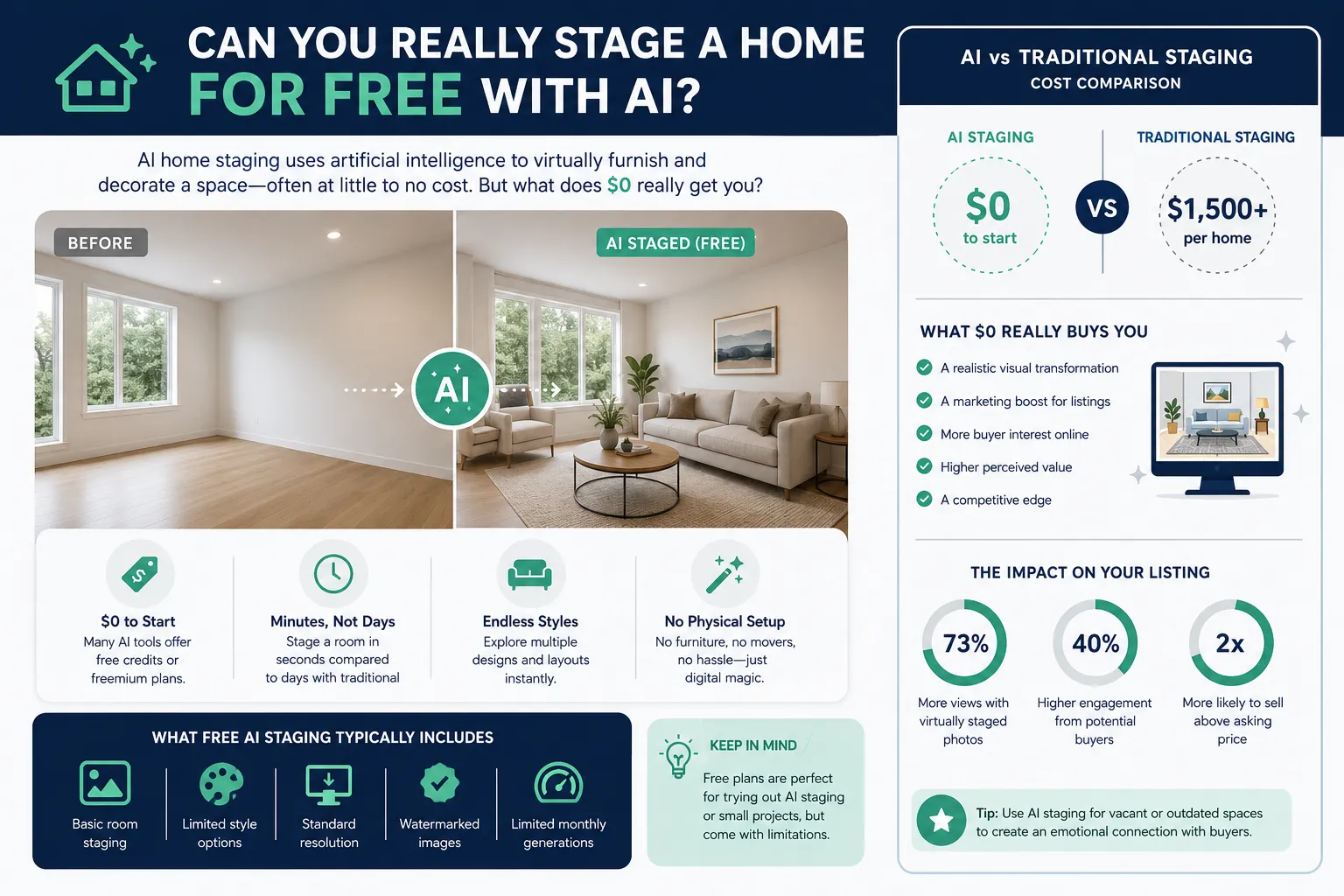
Can You Really Stage a Home for Free with AI?
Yes, with real caveats. Free tiers on platforms like REimagine Home and Collov AI let you generate a limited number of AI-staged room photos at no cost. For a seller with a three-bedroom home, that might mean enough free renders to cover the living room and primary bedroom, which are the two rooms that matter most to buyers.
What free AI staging actually includes:
- Digitally furnished room photos (usually 2-5 free renders per month)
- Multiple design style options
- Basic resolution suitable for online listings
- Watermarks on some platforms (removed with paid upgrade)
What it does not include:
- Physical furniture for in-person showings
- Professional photography (you still need a good camera or a photographer)
- Accurate room measurements, AI can misplace furniture scale
- Guaranteed MLS compliance, some boards require disclosure
So-based take: free AI staging is genuinely useful for online marketing. It is not a substitute for showing a buyer a well-presented home in person.
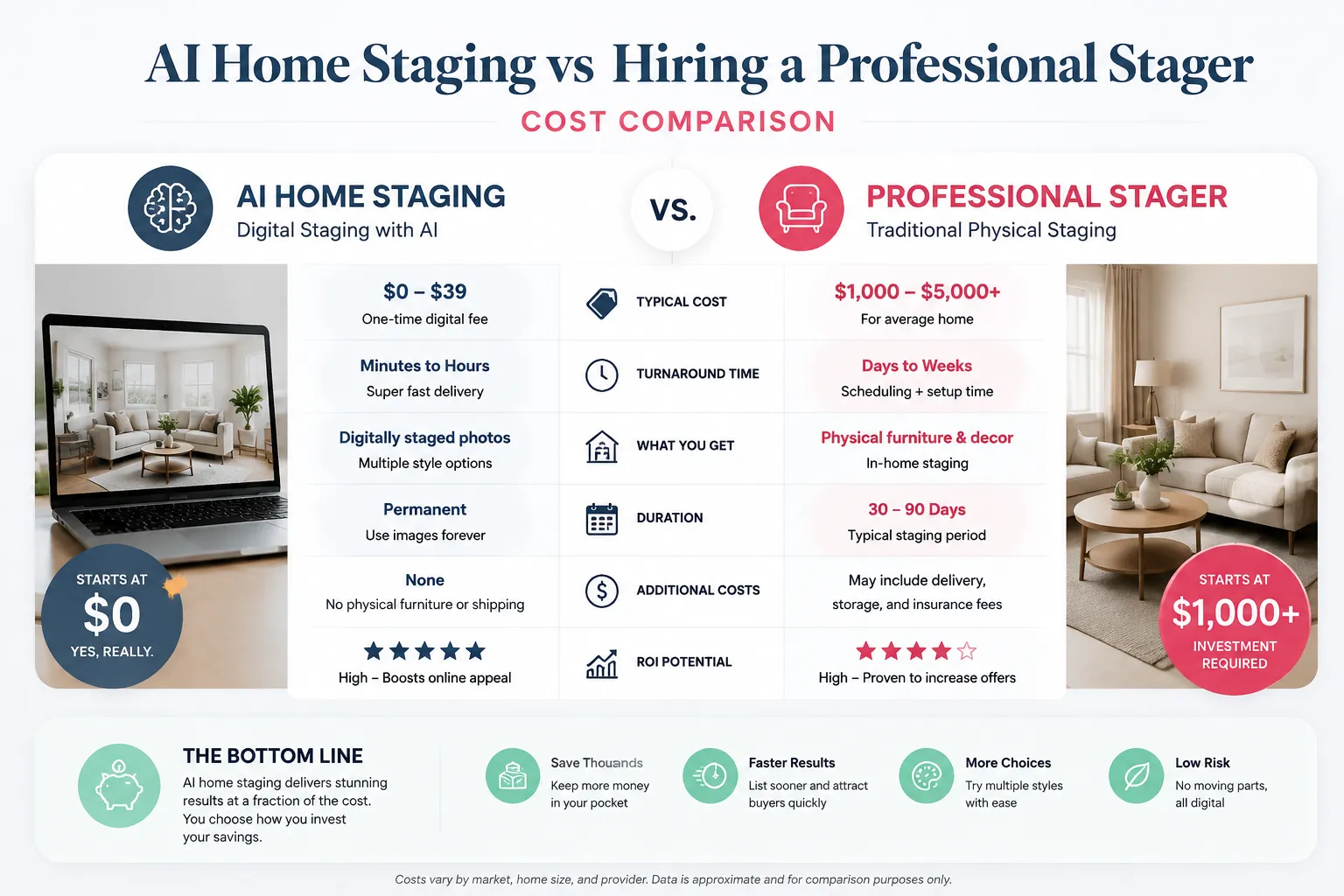
AI Home Staging vs Hiring a Professional Stager: Cost Comparison
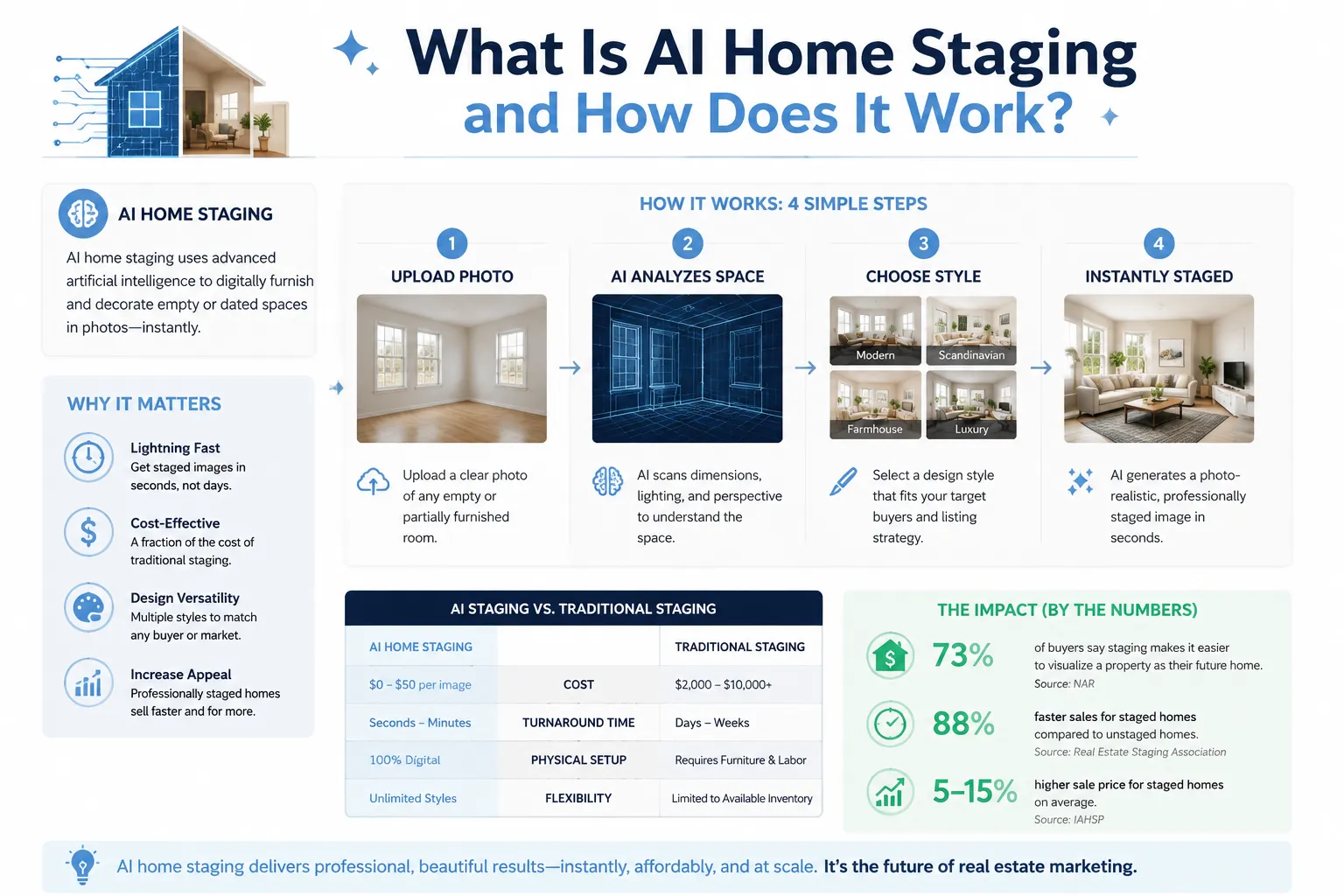
The cost gap between AI staging and traditional staging is extraordinary, and that gap is the whole story for most sellers.
According to RESA (Real Estate Staging Association), the average investment for professional staging of a vacant home runs between $1,500 and $5,000 for the initial setup, plus ongoing monthly rental fees if the home sits on the market. For an occupied home where a stager consults and rearranges existing furniture, costs typically fall between $800 and $2,500.
The NAR Profile of Home Staging has consistently reported that a majority of buyer's agents believe staging affects how buyers view a home, and that staged homes tend to sell faster than unstaged ones. The report does not break out AI staging as a separate category, because the physical experience of walking through a staged home is what drives buyer perception, not just the photos.
The ROI question: RESA data suggests that sellers who invest in professional staging often see a return of 5% to 15% above asking price in competitive markets. That said, staging ROI is highly market-dependent. In a seller's market with low inventory, staging matters less. In a buyer's market, it can be the difference between an offer and a pass.
Choose AI staging if:
- Your budget is under $500
- The home is vacant and you need listing photos fast
- You're an investor flipping a property and need marketing assets quickly
- You're testing the market before committing to full staging costs
Choose traditional staging if:
- Your home is priced above $400,000 in a competitive market
- You have an upcoming open house or broker preview
- The home has been sitting on the market without offers
- You're selling a luxury or high-end property where presentation is non-negotiable
Best Free AI Home Staging Tools Available Right Now
Several free AI staging platforms are worth knowing in 2026. Each has a different free tier, output quality, and design library.
Collov AI, One of the most-used AI interior design and staging platforms. The free tier offers a limited number of renders with access to multiple design styles. Output quality is strong for the price point, and the interface is beginner-friendly enough for FSBO sellers with no design background.
REimagine Home, A popular virtual staging tool that allows free renders with watermarks. The paid upgrade removes watermarks and increases resolution. REimagine Home is frequently used by real estate agents for vacant listing photos.
Virtual Staging AI, Offers a pay-per-render model with no monthly subscription, making it flexible for sellers who only need a few rooms staged. Not entirely free, but low-cost.
Homestyler and RoomGPT, Both offer free AI room design features, though they're more oriented toward interior design exploration than professional listing photography.
What to look for in a free AI staging tool:
- Output resolution high enough for MLS photo standards (typically 1080px minimum)
- Realistic furniture scale and lighting
- Multiple design style options
- Download without watermark (or affordable upgrade to remove it)
- No subscription required for basic use
For a broader look at AI tools that actually move the needle in real estate, the Top 13 Real Estate AI Tools for Investors in 2026 breaks down what's worth your time.
Does AI Home Staging Actually Help Sell Houses Faster?
AI staging helps sell houses faster by improving listing photo quality, which directly affects how many buyers schedule showings. More showings mean faster offers. The data on staging's effect on days on market comes primarily from traditional staging research, but the principle applies to any improvement in how a home presents online.
The NAR Profile of Home Staging reports that staged homes spend less time on the market than unstaged homes. Separately, RESA data shows that homes staged before listing sell significantly faster than homes staged after sitting on the market, meaning the timing of staging matters as much as the staging itself.
AI staging specifically improves the online first impression. In 2026, the majority of buyers start their home search online, and listing photos are the first filter. An empty room photo signals neglect. A digitally staged room photo signals possibility.
What the data supports:
- Staged listings (physical or virtual) generate more online clicks and showing requests
- Homes staged before listing sell faster than homes staged after price reductions
- Virtual staging for sellers is now standard practice among top-producing agents
What the data does not yet confirm:
- Whether AI-staged photos alone (without physical staging) close the full gap with traditionally staged homes
- Long-term impact on final sale price when AI staging is used without any physical staging
Let it cook before you see results, AI staging is a marketing tool, not a magic button. It gets buyers in the door. What happens inside is still on the physical presentation.
What Are the Limitations of Free AI Staging Software?
Free AI staging tools are impeccable at one thing, making empty rooms look furnished in photos. They fall short in several important areas that sellers need to understand before relying on them exclusively.
Common limitations of free AI staging tools:
- Furniture scale errors. AI sometimes places furniture that appears too large or too small for the actual room dimensions, which experienced buyers and agents notice immediately.
- Lighting inconsistencies. The AI-rendered furniture may not match the natural lighting in the original photo, creating an uncanny, slightly-off look.
- Limited free renders. Most free tiers cap you at 2-5 renders per month. A full home listing needs 8-15 photos minimum.
- Watermarks. Free tier images often include platform watermarks that are not MLS-compliant.
- No physical presence. The single biggest limitation: buyers who visit in person see an empty or sparsely furnished home, which can feel jarring after seeing polished AI photos online.
- Design style mismatches. AI staging may not match the architectural style of the home, creating a disconnect between the photos and the property.
Common mistakes people make with AI staging photos:
- Using AI-staged photos without disclosing they are virtually staged (a legal risk in many states and MLS systems).
- Staging rooms that don't photograph well without fixing the underlying issues first (poor lighting, damaged walls, clutter).
- Over-staging digitally, adding too much furniture so the room looks unrealistically perfect.
- Using low-resolution free renders that look pixelated in MLS photo galleries.
- Staging every room when only 2-3 rooms actually drive buyer decisions.
How Accurate Is AI Staging Compared to Real Staging?
AI staging is accurate enough for online marketing and listing photos. It is not accurate enough to replicate the in-person experience of walking through a beautifully staged home.
A professional stager considers traffic flow, scent, natural light at different times of day, how furniture feels to sit in, and the emotional narrative a room tells when you're standing in it. AI staging addresses none of that. It addresses pixels.
For buyers who tour homes virtually (3D tours, video walkthroughs), AI staging holds up reasonably well. For buyers who tour in person, which is still the majority of serious buyers, the gap between a polished AI photo and an empty room is noticeable and can create distrust.
Accuracy comparison:
- Photo realism: AI staging scores well, 7 to 8 out of 10 for top paid tools, 5 to 6 out of 10 for free tiers
- In-person experience: AI staging scores 0, it does not exist in the physical space
- Design coherence: Traditional staging scores higher, a professional stager accounts for the home's architecture, natural light, and buyer demographic
- Speed: AI staging wins, minutes vs. days for traditional staging
- Cost: AI staging wins, free to $50 per room vs. $1,500 to $5,000 for traditional
Can AI Staging Replace Traditional Home Staging Completely?
No, and anyone gatekeeping this information by only telling you the AI side is doing you a disservice. AI staging is a powerful marketing tool. Traditional staging is a sales tool. They solve different problems.
AI staging replaces the need for physical staging in listing photos. It does not replace the need for physical staging during showings, open houses, or buyer walkthroughs.
The hybrid approach is what top agents and experienced sellers are using in 2026:
The hybrid staging strategy:
- Use AI staging for all listing photos, every room, every angle.
- Physically stage only the living room and primary bedroom with real furniture and decor.
- Keep the rest of the home clean, decluttered, and well-lit for showings.
- Disclose AI staging in the listing description as required by your MLS.
This approach cuts traditional staging costs by 60% to 70% while maintaining the in-person impression that matters most. The living room and primary bedroom are where buyers make emotional decisions. Stage those two rooms properly, let AI handle the photography for the rest, and you've built an impeccable presentation at a fraction of full staging cost.
For sellers preparing to list, the 60-Day Home Selling Plan & AI Tools for Effective Marketing is a practical roadmap that pairs well with this strategy.
What Do You Need to Use AI Home Staging Tools?
The barrier to entry for AI staging is genuinely low. You need three things: a decent photo, a device with internet access, and an account on an AI staging platform.
Minimum requirements:
- A smartphone or DSLR camera capable of taking a clear, well-lit room photo
- A free account on a platform like Collov AI or REimagine Home
- Basic understanding of how to upload and download files
What makes AI staging work better:
- Wide-angle lens photos that show the full room (not tight corner shots)
- Natural daylight or well-lit rooms (dark photos produce poor AI renders)
- Empty or decluttered rooms (AI staging works best on clean, clear spaces)
- Straight-on angles rather than extreme diagonal shots
What you do NOT need:
- Design experience
- A real estate license
- Expensive software
- A professional photographer (though professional photography still produces better source images)
This is genuinely accessible for FSBO sellers, first-time sellers, and anyone marketing your home with AI tools in 2026.
Is AI Home Staging Worth It for Selling a House?
For listing photos: yes, AI staging is worth it, especially at the free or low-cost tier. Better photos generate more clicks, more clicks generate more showings, and more showings generate offers.
For the full selling process: AI staging alone is not enough for most home sales above $250,000 in competitive markets. Buyers who see extraordinary photos online and walk into an empty house feel a disconnect that can kill the emotional momentum needed to make an offer.
AI staging is worth it when:
- You're on a tight budget and need listing photos fast
- The home is vacant and full physical staging isn't financially viable
- You're an investor selling a flip who needs marketing assets quickly
- You're testing buyer interest before committing to full staging costs
- You're pairing it with physical staging of key rooms (the hybrid approach)
AI staging alone may not be enough when:
- The home is priced in the luxury segment (above $750,000)
- Buyers in your market expect in-person staged homes
- The home has been sitting on the market and needs a fresh approach
- Your listing is competing directly against professionally staged homes
For sellers asking harder questions about why a home isn't moving, 5 Gaslighting Questions To Ask Your Broker When Your Home Won't Sell is a straight-talking resource worth reading.
Who Should Use AI Staging and Who Shouldn't?
Use AI staging if you are:
- A FSBO seller who needs professional-looking listing photos without a large upfront investment
- A real estate investor staging a flip or rental property for marketing
- An agent with a vacant listing who needs photos before physical staging is arranged
- A seller in a lower price point where staging ROI doesn't justify $3,000+ in traditional staging costs
- Anyone using the hybrid strategy, AI photos plus selective physical staging
Skip AI staging (or use it only as a supplement) if you are:
- Selling a luxury home where buyers expect physical staging as a baseline
- In a market where competing listings are all professionally staged
- Selling a home with significant physical flaws that AI staging will mask and buyers will notice in person
- Working with an MLS that has strict disclosure requirements you're not prepared to follow
For agents building out their full tech stack, Best AI Tools for Real Estate Agents: Worth It or Hype? covers where AI actually earns its place in a real estate business.
What Happens If Buyers Realize Photos Were AI Staged?
This is the disclosure conversation that the real estate industry is still working through in 2026, and sellers need to get ahead of it.
When a buyer sees polished AI-staged photos online and walks into an empty or sparsely furnished home, the reaction ranges from mild disappointment to genuine distrust. In competitive markets, that distrust can cost you an offer.
The disclosure standard in 2026:
Many MLS boards now require that virtually staged photos be labeled as "virtually staged" or "digitally enhanced" in the listing. The NAR Code of Ethics requires honest representation of a property. Using AI-staged photos without disclosure in a jurisdiction that requires it creates legal and ethical exposure.
Best practice for disclosure:
- Add "Photos are virtually staged" to the listing description
- Include a note in the MLS photo caption for each AI-staged image
- Show at least one unstaged photo of each room alongside the AI-staged version
- Disclose verbally to buyers' agents during showing requests
Buyers who are informed upfront that photos are virtually staged are far less likely to feel misled. Buyers who discover it on their own, especially after an in-person showing, may walk away or negotiate more aggressively on price.
So based: transparency here is not just ethical, it's strategic. Disclose early, disclose clearly, and let the AI photos do their job as marketing assets without creating a trust problem at the showing.
How Long Does AI Home Staging Take Versus Traditional Staging?
AI staging takes minutes. Traditional staging takes days.
AI staging timeline:
- Photo upload to finished render: 60 to 90 seconds per room
- Full listing photo set (8-12 rooms): 15 to 30 minutes
- Revision or style change: another 60 to 90 seconds
Traditional staging timeline:
- Initial consultation with a professional stager: 1 to 2 hours
- Furniture sourcing, delivery scheduling: 3 to 7 days
- Setup and styling: 4 to 8 hours on-site
- Total time from decision to staged home: 5 to 10 business days
For sellers in a fast-moving market who need to list quickly, AI staging is the only option that keeps pace with market timing. For sellers who have 2 to 3 weeks before listing, traditional staging, or the hybrid approach, is worth the extra time.
DIY Staging with AI: The Hybrid Play That Actually Works
The hybrid strategy is the most practical answer to the AI home staging vs traditional staging debate, and it's what experienced agents are recommending to sellers in 2026.
The hybrid play:
- Clean and photograph every room, declutter, deep clean, maximize natural light, then photograph every room in the home.
- AI-stage all listing photos, use Collov AI, REimagine Home, or a paid AI staging tool to furnish every room digitally. This is your online marketing package.
- Physically stage the living room and primary bedroom, these are the two rooms where buyers make emotional decisions. Rent or borrow real furniture, add fresh flowers, style the nightstands. Keep it simple but impeccable.
- Disclose AI staging in the listing, add "select photos are virtually staged" to the description.
- Price the staging cost into your net proceeds calculation, even $500 to $1,000 in selective physical staging is a fraction of what a full traditional staging package costs.
This approach gives you extraordinary listing photos for online marketing, a warm and inviting in-person experience in the rooms that matter most, and a total staging investment well under $1,500 for most homes.
For sellers who want to understand how staging fits into the broader pricing strategy, the home selling pricing strategies section at RERIQ covers the full picture.
FAQ: AI Home Staging vs Traditional Staging
Q: Is AI home staging legal?
A: Yes, AI staging is legal. The legal requirement is disclosure, many MLS boards require that AI or virtually staged photos be labeled as such. Check your local MLS rules before listing.
Q: Can I use AI staging photos on Zillow and Redfin?
A: Yes. Both platforms allow virtually staged photos. Zillow recommends labeling them as virtually staged in the photo caption.
Q: How many rooms should I AI-stage for a listing?
A: Stage every room that appears in your listing photos. Living room, primary bedroom, kitchen, and dining area are the highest priority. Bathrooms and secondary bedrooms matter less but are worth staging if you have free renders available.
Q: Does AI staging work for occupied homes with existing furniture?
A: Most AI staging tools are designed for empty rooms. Some platforms offer a "remove and replace" feature that digitally removes existing furniture and replaces it, but results vary. For occupied homes, DIY physical staging (decluttering, rearranging, adding accessories) is often more effective.
Q: What is the staging ROI for traditional staging?
A: RESA data suggests staged homes can sell for 5% to 15% more than unstaged homes in competitive markets. ROI varies significantly by price point, market conditions, and the quality of the staging.
Q: Do buyers care if photos are AI staged?
A: Buyers care about accuracy. If AI-staged photos accurately represent the room's size and layout, most buyers accept them as marketing tools. If photos feel misleading, showing a room that looks dramatically different in person, buyers may lose trust.
Q: Is virtual staging the same as AI staging?
A: Virtual staging and AI staging are often used interchangeably. Technically, virtual staging can include any digital method of adding furniture to photos (including manual Photoshop work). AI staging specifically uses artificial intelligence to automate the process.
Q: How much does professional home staging cost in 2026?
A: Based on RESA data, professional staging for a vacant home typically costs $1,500 to $5,000 for initial setup plus monthly rental fees. Occupied home staging consultations run $800 to $2,500.
Q: Can AI staging help a home that's been sitting on the market?
A: AI staging can refresh listing photos and generate new online interest. It's a low-cost way to update a stale listing. However, if the home isn't selling because of price or condition issues, staging alone won't solve the problem.
Q: What's the best free AI staging tool for a first-time seller?
A: Collov AI and REimagine Home are the most accessible free options for sellers with no design background. Both offer free renders with simple interfaces.
Q: Do I need a professional photographer to use AI staging?
A: No, but better source photos produce better AI renders. A smartphone with a wide-angle lens in a well-lit room is the minimum. Professional photography produces noticeably better results.
Q: Should FSBO sellers use AI staging?
A: Yes, AI staging is one of the most impactful free tools available to FSBO sellers. It levels the marketing playing field without requiring a large upfront investment.
Conclusion: The Real Answer to AI Home Staging vs Traditional
The AI home staging vs traditional debate has a clear winner depending on what you're measuring. For online marketing and listing photos, AI staging wins on cost, speed, and accessibility. For the in-person buyer experience that actually closes deals, traditional staging still holds the edge.
The extraordinary opportunity in 2026 is that you don't have to choose one or the other. The hybrid strategy, AI-stage every photo, physically stage the living room and primary bedroom, gives sellers the best of both worlds at a fraction of full traditional staging cost.
Actionable next steps:
- If you're listing in the next 30 days, sign up for a free account on Collov AI or REimagine Home and generate AI-staged photos of your living room and primary bedroom today.
- If your home is vacant and priced above $400,000, budget $500 to $1,500 for selective physical staging of the two rooms buyers care most about.
- Check your local MLS disclosure requirements for virtually staged photos before your listing goes live.
- If you're working with an agent, ask them directly whether they use AI staging tools and what their staging recommendation is for your specific price point and market.
- Review the best home buying sites in the U.S. for 2026 to see how your listing will appear to buyers before it goes live.
The tools are fresh, the cost is accessible, and the data supports staging in some form for almost every listing. Let it cook before you see results, but start today.
Tags: AI home staging, virtual staging for sellers, home staging cost 2026, AI staging vs traditional staging, free AI staging tools, staging ROI statistics, Collov AI, REimagine Home, diy staging with ai, staging photos for listing, stage before listing, FSBO home selling