

Last updated: May 24, 2026

Quick Answer: A DSCR construction loan lets real estate investors and self-employed borrowers finance ground-up construction or major builds using the property's projected rental income — not personal W-2 income — to qualify. Lenders evaluate the debt service coverage ratio (DSCR) instead of tax returns or pay stubs. In 2026, this is one of the fastest-growing non-QM construction lending products in the U.S. market.
Key Takeaways
- No W-2 required. DSCR construction loans qualify borrowers based on projected or actual rental income, not personal employment income.
- DSCR ratio matters most. Most lenders want a DSCR of at least 1.0–1.25, meaning the property's rental income covers the debt payment.
- Down payments are higher. Expect 20–30% down for most DSCR construction loan products in 2026.
- Credit score minimums apply. Most DSCR lenders require a 620–680 minimum credit score, with better rates above 720.
- Property types are limited. Most programs cover 1–4 unit residential investment properties; some cover small multifamily and short-term rental builds.
- Interest rates run higher than conventional. DSCR construction loan rates in 2026 typically range from 8–12%, reflecting the non-QM risk premium.
- The process takes longer. Ground-up construction DSCR loans can take 45–90 days to close, with draw schedules tied to construction milestones.
- Self-employed borrowers and landlords are the core audience. If your income looks "messy" on paper but your cash flow is real, this loan was built for you.
- Not ideal for primary residences. DSCR loans are investment property tools — they're not designed for owner-occupied builds.
- Non-QM lenders dominate this space. Traditional banks rarely offer true DSCR construction products; you'll need a specialized non-QM lender.
What Exactly Is a DSCR Construction Loan and How Does It Work?
A DSCR construction loan is a non-QM (non-qualified mortgage) financing product that funds the construction of an investment property, with qualification based on the property's projected debt service coverage ratio rather than the borrower's personal income documentation. The lender asks one core question: will this property generate enough rental income to cover its own debt payments?
Here's the basic mechanics:
How the loan is structured:
- The loan funds construction in phases called "draws," released as work is completed and inspected
- Once construction wraps, the loan either converts to a permanent DSCR loan or the borrower refinances into one
- The lender uses a market rent analysis (often from an appraiser's rent schedule) to estimate the property's income potential during underwriting
The two-phase structure most lenders use:
| Phase | What Happens |
|---|---|
| Construction Phase | Funds released in draws; interest-only payments on drawn amounts |
| Permanent Phase | Loan converts or refinances; DSCR evaluated on actual rental income |
Who this is built for:
- Real estate investors building new rental properties from the ground up
- Self-employed borrowers whose tax returns don't reflect their real income
- Landlords expanding their portfolio without touching W-2 employment records
- Builders and developers working on 1–4 unit residential investment projects
This is a DSCR new construction investor strategy that's genuinely fresh — and the non-QM construction lending market has grown significantly as traditional banks tightened their standards post-2022.
DSCR Construction Loan: Build Without W-2 Income Proof — The Full Breakdown
The entire premise of the DSCR construction loan is that your personal income doesn't drive the decision. The property does. That's the core distinction from every traditional construction loan product on the market.
Traditional lenders — think conventional banks and credit unions — want two years of W-2s, tax returns, pay stubs, and a debt-to-income ratio (DTI) under 43–45%. For a self-employed investor with multiple LLCs, write-offs, and depreciation, that picture looks terrible on paper even when the actual cash flow is extraordinary.
What DSCR lenders look at instead:
- Projected monthly rent (from an appraisal rent schedule or comparable market analysis)
- Monthly principal, interest, taxes, insurance, and HOA (PITIA — the full debt payment)
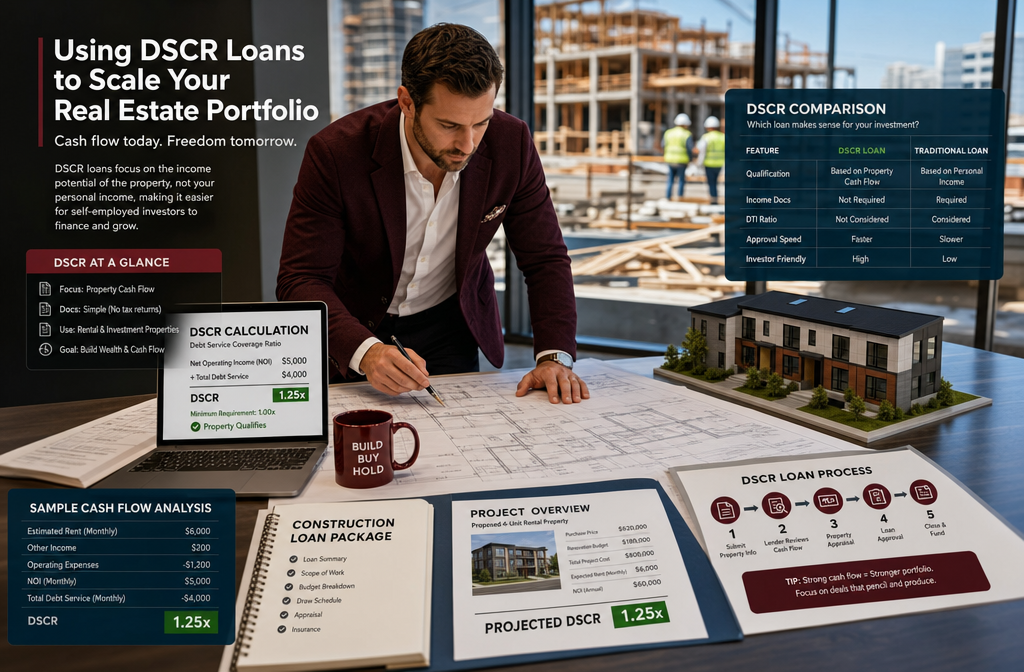
- DSCR ratio = Gross Monthly Rent ÷ Monthly PITIA
- Credit score (minimum 620–680 depending on the lender)
- Down payment / loan-to-value (LTV typically 70–80%)
- Property type and market (location affects rent projections)
- Borrower's real estate experience (some lenders factor this in for ground-up builds)
No W-2. No tax returns. No DTI calculation based on personal income. That's the whole point.
For a deeper look at what qualifies you across DSCR products, check out DSCR Loan Requirements: What Investors Need to Qualify 2026 — it covers the full qualification picture across lenders.
How Is DSCR Calculated and What Ratio Do Lenders Want?
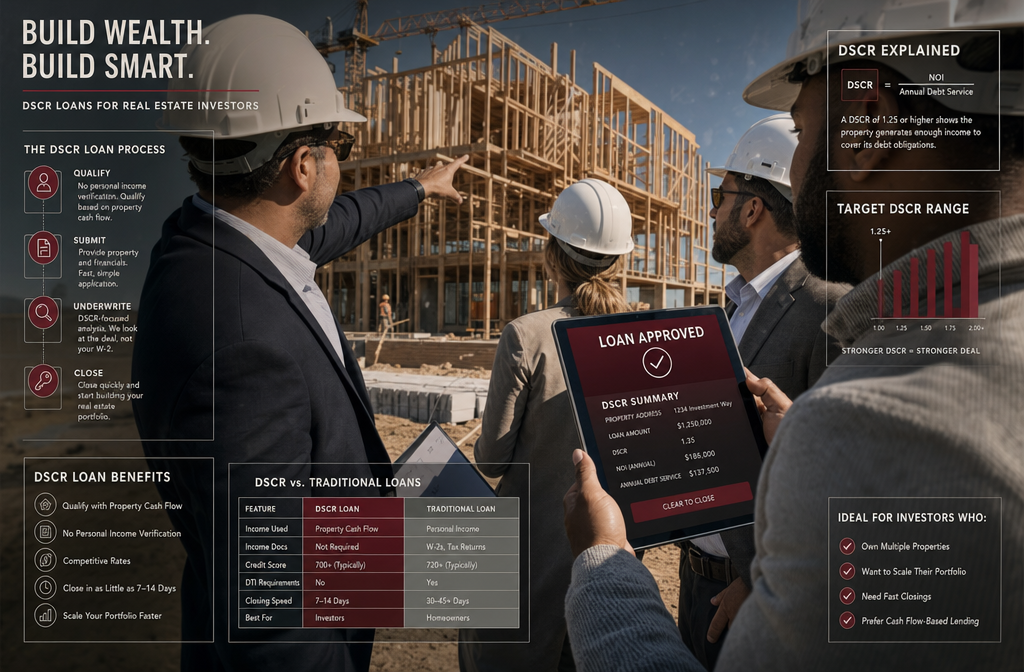
DSCR stands for Debt Service Coverage Ratio, and the formula is simple: Gross Monthly Rent ÷ Monthly PITIA = DSCR.
Most DSCR lenders want a ratio of at least 1.0 to 1.25.
- DSCR of 1.0 means rent exactly covers the debt payment — break-even
- DSCR of 1.25 means rent covers the payment with 25% to spare — this is the sweet spot most lenders prefer
- DSCR below 1.0 means the property doesn't cash flow enough to cover its own debt — many lenders won't approve this, though some will at higher rates and down payments
Quick example:
You're building a duplex. The appraiser's rent schedule shows $3,500/month in projected gross rent. Your monthly PITIA (principal + interest + taxes + insurance) comes to $2,600/month.
DSCR = $3,500 ÷ $2,600 = 1.35 ✅ — most lenders will approve this.
DSCR tiers and what they mean for your loan:
| DSCR Range | Lender Appetite | Typical Impact |
|---|---|---|
| Below 1.0 | Limited / specialty lenders only | Higher rates, larger down payment |
| 1.0–1.10 | Some non-QM lenders | Standard non-QM rates |
| 1.10–1.25 | Most DSCR lenders | Competitive non-QM rates |
| 1.25+ | Strong approval odds | Best available terms |
For construction loans specifically, lenders use projected rent from an appraisal — not actual rent, since the building doesn't exist yet. That projection has to be credible and market-supported. A weak rent estimate is one of the most common reasons DSCR construction loan applications stall.
What's the Difference Between a DSCR Loan and a Traditional Construction Loan?
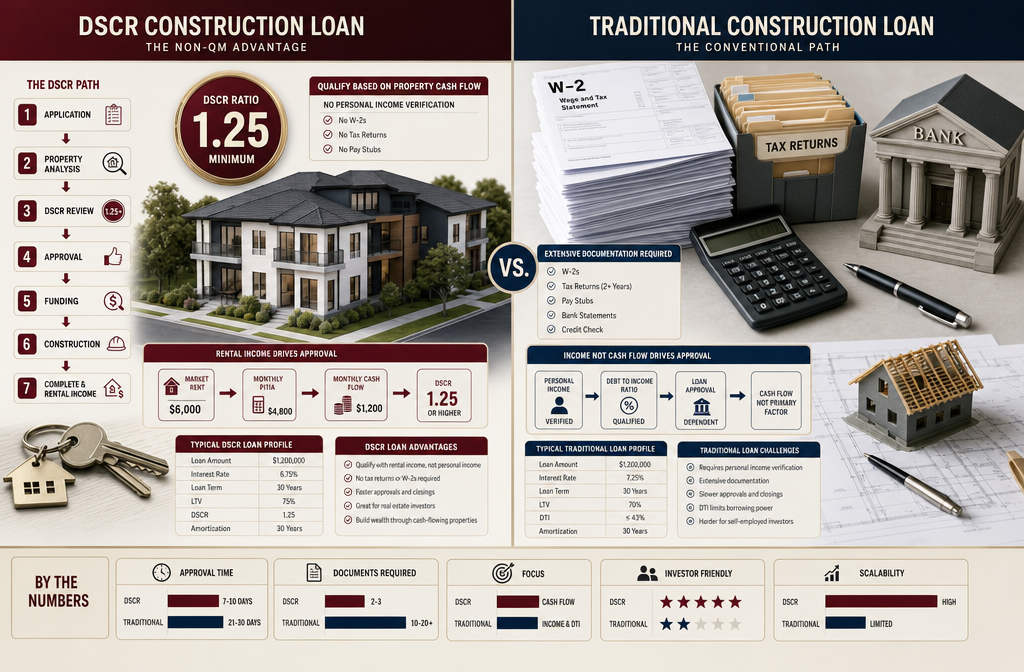
The difference is fundamental: a traditional construction loan qualifies you based on your personal income and creditworthiness, while a DSCR construction loan qualifies you based on the investment property's projected income.
DSCR vs Traditional Construction Loan — Side by Side:
| Factor | Traditional Construction Loan | DSCR Construction Loan |
|---|---|---|
| Income verification | W-2s, tax returns, pay stubs | Not required |
| Qualification basis | Borrower's personal DTI | Property's DSCR ratio |
| Lender type | Banks, credit unions | Non-QM / private lenders |
| Down payment | 10–20% | 20–30% |
| Interest rates | Lower (6–9% range, 2026 est.) | Higher (8–12% range, 2026 est.) |
| Property purpose | Primary or investment | Investment only |
| Self-employed friendly | Rarely | Yes |
| Speed to close | 30–60 days | 45–90 days |
| Loan limits | Conforming limits may apply | More flexible |
Traditional construction loans also often require the borrower to own the land outright or have it as equity. Land and construction loans that bundle both are more common in the conventional space. DSCR lenders can sometimes include land acquisition in the total loan package, but terms vary widely.
Hard money construction loans are another comparison point — they're faster and more flexible but come with even higher rates (often 10–15%+) and shorter terms. DSCR construction loans sit between hard money and conventional: more flexible than banks, more structured than hard money.
Can I Use a DSCR Loan If I'm Self-Employed or Have Rental Income?
Yes — and honestly, this is exactly who the DSCR construction loan was designed for. Self-employed borrowers, landlords with rental portfolios, freelancers, business owners, and high-income professionals with complex tax situations are the primary users of DSCR loan for investment property products.
Why self-employed borrowers love DSCR:
- Tax write-offs and depreciation reduce taxable income on paper, making DTI-based loans nearly impossible to qualify for
- DSCR lenders don't care what your Schedule C shows — they care what the rental property will produce
- Landlords with existing rental income can use that income to demonstrate real estate experience, which some lenders view favorably
If you have existing rental income:
Some DSCR lenders will look at your current rental portfolio's performance as a confidence signal — not for income qualification, but to show you know how to manage investment properties. This matters more for ground-up construction loans where the asset doesn't exist yet.
One edge case to know: If your DSCR ratio is borderline (close to 1.0), having a strong existing rental portfolio and a higher credit score can sometimes tip the approval in your favor with certain non-QM lenders. So based — the property's numbers drive the decision, but your track record as an investor still carries weight with the right lender.
For more on building a portfolio this way, the investment portfolio building hub has solid context on scaling with non-traditional financing.
What Credit Score Do I Need to Qualify for a DSCR Construction Loan?
Most DSCR construction loan lenders require a minimum credit score of 620 to 680. The best rates and terms kick in at 720 and above.
Credit score is one of the few personal financial metrics that DSCR lenders consistently check — even when they're not looking at income. Here's why: your credit score signals repayment behavior, and lenders use it to price risk even when the property's cash flow is the primary qualifier.
Credit score tiers for DSCR construction loans (2026 estimates):
| Credit Score | Lender Access | Rate Impact |
|---|---|---|
| Below 620 | Very limited — specialty lenders only | Significantly higher rates |
| 620–659 | Some non-QM lenders | Higher rates, stricter LTV |
| 660–719 | Most DSCR lenders | Standard non-QM rates |
| 720–759 | Strong access | Better rates, more flexibility |
| 760+ | Best terms available | Lowest non-QM rates |
Common mistake: Investors assume that because DSCR loans skip income verification, credit doesn't matter much. That's not accurate. A 580 credit score will lock you out of most DSCR lenders entirely, regardless of how strong the property's projected DSCR is.
If your credit score needs work before applying, that's worth addressing first. Let it cook before you see results — 60–90 days of credit improvement can meaningfully shift your rate tier and save thousands over the life of a construction loan.
How Much Down Payment Do I Need for a DSCR Construction Loan?
Expect to put down 20–30% for most DSCR construction loan products. Some lenders go as low as 20% for strong borrowers (720+ credit, 1.25+ DSCR), while others require 25–30% for ground-up construction specifically.
Construction loans carry more risk than standard purchase loans — the collateral doesn't fully exist yet — so lenders compensate with higher equity requirements.
Down payment ranges by scenario:
| Scenario | Typical Down Payment |
|---|---|
| Strong credit (720+), DSCR 1.25+ | 20–25% |
| Average credit (660–719), DSCR 1.10–1.24 | 25% |
| Lower credit or borderline DSCR | 25–30% |
| Ground-up construction (no existing structure) | 25–30% |
Land equity counts. If you already own the land where you're building, many DSCR lenders will count that equity toward your down payment requirement. This is a significant advantage for investors who bought land separately.
What about the construction budget? The loan covers construction costs in draws — you're not paying the full build cost upfront. But you do need reserves. Most lenders want to see 6–12 months of PITIA in liquid reserves after closing. That's not a small number on a construction project.
For comparison on how down payment strategies work across loan types, top down payment strategies ranked breaks down the options clearly.
What Types of Properties Can I Build With a DSCR Loan?
DSCR construction loans are primarily designed for 1–4 unit residential investment properties. Some lenders extend to small multifamily (5–8 units) under certain non-QM programs, and short-term rental builds are increasingly supported as that market has matured.
Eligible property types (varies by lender):
- Single-family rental homes (SFR)
- Duplexes, triplexes, and fourplexes
- Short-term rental properties (Airbnb/VRBO style) — some lenders use STR income projections
- Small multifamily (5–8 units, specialty programs)
- Planned unit developments (PUDs) in some cases
What's typically NOT eligible:
- Primary residences (DSCR is an investment product)
- Commercial properties (different loan category)
- Large multifamily (10+ units — commercial financing applies)
- Raw land with no construction plan
Short-term rental note: Some DSCR lenders now accept projected STR income using platforms like AirDNA for rent analysis. This is a relatively fresh development in non-QM construction lending — and it's impeccable news for investors building vacation rental properties in high-demand markets.
The new construction vs resale homes buyer's guide is worth reading if you're deciding whether to build or buy an existing investment property.
What Are the Typical Interest Rates for DSCR Construction Loans?
DSCR construction loan rates in 2026 typically range from 8% to 12%, depending on credit score, DSCR ratio, loan-to-value, and the specific lender. These are higher than conventional construction loan rates, which is the trade-off for skipping income documentation.
Why rates are higher on DSCR construction loans:
- Non-QM loans carry a risk premium because they don't meet Fannie Mae/Freddie Mac guidelines
- Construction adds additional risk (the collateral is incomplete during the build)
- The combination of non-QM + construction = two risk layers priced into the rate
Rate factors that move the needle:
| Factor | Rate Direction |
|---|---|
| Credit score 720+ | ⬇️ Lower |
| DSCR 1.25+ | ⬇️ Lower |
| LTV under 70% | ⬇️ Lower |
| Experienced investor | ⬇️ Lower (some lenders) |
| Credit score below 660 | ⬆️ Higher |
| DSCR near 1.0 | ⬆️ Higher |
| Ground-up vs renovation | ⬆️ Higher |
| Short-term loan (12 months) | ⬆️ Higher |
Rate vs. cost reality check: On a $500,000 construction loan at 10% interest-only, you're paying roughly $4,167/month during the build phase. That's real carrying cost. Smart investors factor this into their total project budget — not just the construction hard costs.
For context on how DSCR loan products are structured across lenders, best DSCR loan lenders for investment properties 2026 gives a solid ranked breakdown.
What Documentation Do I Need to Apply for a DSCR Construction Loan?
The documentation list for a DSCR construction loan is shorter than a traditional loan — but it's not zero. You still need to prove the property makes sense, even if you don't have to prove your personal income.
Standard DSCR construction loan documentation:
- Credit report authorization (lender pulls this directly)
- Entity documents (if borrowing through an LLC or corporation — articles of incorporation, operating agreement, EIN)
- Property information — address, legal description, lot details
- Construction plans and specs — architectural drawings, scope of work
- Construction budget / cost breakdown — itemized hard and soft costs
- General contractor information — license, insurance, experience
- Appraisal with rent schedule — the lender orders this; it's the foundation of the DSCR calculation
- Title report — standard for any real estate loan
- Proof of down payment funds — bank statements showing liquid assets
- Reserve documentation — proof of 6–12 months PITIA in reserves
What you don't need:
- W-2s or pay stubs
- Tax returns (personal or business)
- Employment verification
- DTI calculation documents
Pro tip: The general contractor (GC) you choose matters more than most investors realize. Lenders doing ground-up construction loans want to see a licensed, insured GC with a track record. Showing up with an unlicensed contractor or a vague scope of work is one of the fastest ways to get a DSCR construction loan declined — not because of your financials, but because of the project's credibility.
What Mistakes Do Real Estate Investors Make When Applying for DSCR Loans?
The most common mistake is assuming a strong DSCR ratio is the only thing that matters. In reality, DSCR construction loans have multiple failure points — and most of them are avoidable.
Top mistakes investors make:
1. Inflating rent projections
Using optimistic rent numbers that don't match the appraiser's market analysis. The lender's appraiser will set the rent figure — not you. If your deal only works with above-market rent assumptions, it's not a deal.
2. Choosing the wrong lender
Not every DSCR lender does construction. Many only handle stabilized (already-rented) properties. Applying to the wrong lender wastes 30–60 days. Research DSCR lenders who specifically advertise ground-up construction loan or DSCR new construction loan programs.
3. Underestimating construction costs
Construction budgets almost always run over. If your loan is sized based on a tight budget and costs spike, you may face a funding gap mid-build. Build in a 10–15% contingency.
4. Weak GC documentation
Lenders underwriting a construction loan investment property need confidence in the build team. A GC without proper licensing, insurance, or a portfolio of completed projects is a red flag.
5. Ignoring reserves
Showing just enough for the down payment without adequate reserves will kill the approval. Lenders want to see you can carry the loan if the property sits vacant after construction.
6. Not understanding the draw schedule
Draws are released as construction milestones are met and inspected. Investors who don't understand this process often run into cash flow problems mid-project when they expect funds that aren't yet available.
This is the kind of intel that people are gatekeeping in expensive masterminds. We're giving it to you straight.
For more on financing investment builds, best loans for flipping houses in any market covers the broader lending landscape for real estate investors.
How Long Does the DSCR Construction Loan Process Usually Take?
From application to first draw, expect 45–90 days for a DSCR construction loan. The construction phase itself typically runs 6–18 months depending on the project scope.
Timeline breakdown:
| Stage | Estimated Time |
|---|---|
| Application and pre-approval | 1–2 weeks |
| Appraisal (with rent schedule) | 2–3 weeks |
| Underwriting and approval | 2–4 weeks |
| Closing | 1–2 weeks |
| Construction phase (draws) | 6–18 months |
| Conversion to permanent DSCR loan | 30–45 days after completion |
What slows the process down:
- Incomplete construction plans or budget
- Appraisal delays (common in 2026 with high demand)
- Title issues on the land
- GC documentation problems
- Lender-specific underwriting queues
What speeds it up:
- Having all documents ready before applying
- Working with a lender who specializes in DSCR new construction loans
- A clean title on land you already own
- A licensed GC with a complete bid package ready
The new-home construction surge 2026 builder incentives guide has relevant context on current construction market conditions that affect timelines.
Are DSCR Loans Good for Fix-and-Flip or New Construction Projects?
DSCR loans are better suited for new construction and long-term rental holds than for fix-and-flip projects. Here's the distinction:
For new construction (ground-up builds):
DSCR construction loans are an excellent fit. The loan funds the build, then converts to a long-term DSCR rental loan. The investor builds equity from day one and holds a cash-flowing asset.
For fix-and-flip:
Traditional DSCR loans aren't designed for flips — flips don't generate rental income, which is the entire basis of DSCR qualification. Hard money loans or bridge loans are the standard tool for fix-and-flip investors.
That said, some investors use a hybrid strategy:
- Build or renovate using a hard money construction loan
- Stabilize the property (get it rented)
- Refinance into a long-term DSCR loan (a DSCR "cash-out refi")
This is a legitimate DSCR new construction investor strategy — build it, rent it, refinance it. The refinance into a permanent DSCR loan is where the real long-term play lives.
Choose DSCR construction if:
- You're building to hold as a rental
- You're self-employed or can't document income traditionally
- Your project is 1–4 units residential
- You have 20–30% down and 6–12 months reserves
Choose hard money if:
- You're building or renovating to sell
- You need faster closing (sometimes 2–3 weeks)
- You have a short project timeline (under 12 months)
FAQ: DSCR Construction Loans
Q: Can I use a DSCR construction loan for my primary residence?
No. DSCR loans are investment property products. They require the property to generate rental income, which means owner-occupied primary residences don't qualify.
Q: What's the minimum loan amount for a DSCR construction loan?
Most non-QM lenders have minimums around $100,000–$150,000. Some specialty lenders go lower, but options become limited under $100K.
Q: Can I borrow through an LLC?
Yes — and many DSCR lenders prefer it. Borrowing through an LLC is standard practice for investment property financing and doesn't affect DSCR qualification.
Q: Do DSCR construction loans have prepayment penalties?
Often yes. Many DSCR loan products include 3–5 year prepayment penalties (step-down structure). Read the loan terms carefully before signing.
Q: What happens if construction goes over budget?
If costs exceed the loan amount, you'll need to cover the difference out of pocket or negotiate a loan modification. This is why contingency reserves matter.
Q: Can I use projected short-term rental income for DSCR qualification?
Some lenders accept STR income projections using tools like AirDNA. Not all do — confirm this with your lender before applying if you're building a vacation rental.
Q: Is a DSCR construction loan the same as a construction-to-permanent loan?
Similar concept, different underwriting. A DSCR construction-to-perm loan funds the build and then converts to a permanent DSCR rental loan without requiring a full refinance. Not all DSCR lenders offer the conversion feature — some require a separate refinance after completion.
Q: How many properties can I finance with DSCR loans?
DSCR loans don't have the same 10-property limit that conventional loans impose. Many non-QM lenders will finance investors with 10, 20, or more properties — each deal is evaluated on its own DSCR merits.
Q: Do DSCR lenders require an appraisal?
Yes, always. The appraisal establishes both the property's value and the projected rent schedule — both are essential to DSCR underwriting.
Q: What if my DSCR is below 1.0?
Some specialty lenders offer "no-ratio" DSCR loans or will approve sub-1.0 DSCR with a larger down payment (30%+) and higher rates. Options exist but are limited.
Q: Are DSCR construction loans available in all states?
Not always. Non-QM lending regulations vary by state. Confirm your state is eligible with any lender before starting the application process.
Q: Can I refinance out of a DSCR construction loan once the property is rented?
Yes — and this is often the plan. Once the property is stabilized with actual rental income, refinancing into a long-term DSCR loan or even a conventional investment property loan (if you qualify) is a common exit from the construction loan.
Conclusion: Is a DSCR Construction Loan Right for You?
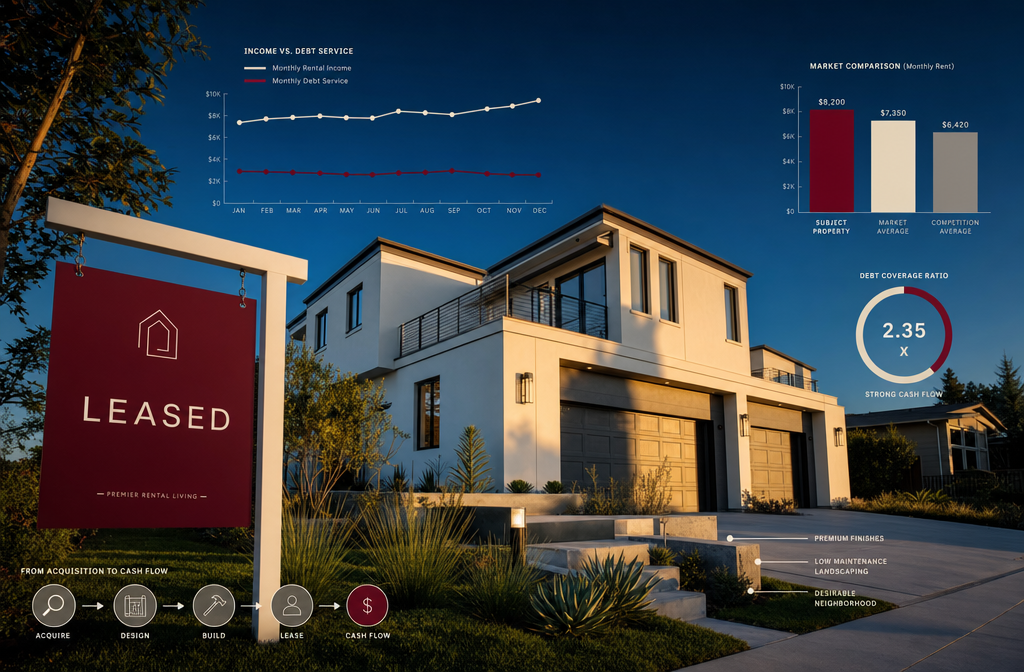
The DSCR construction loan is an extraordinary tool for the right investor. If you're self-employed, a landlord, a business owner, or anyone whose income looks complicated on paper but whose cash flow is real — this product was built specifically for you. The non-QM construction lending space has matured significantly in 2026, with more DSCR lenders offering ground-up construction programs than ever before.
The trade-offs are real: higher rates, larger down payments, and a more complex process than a standard purchase loan. But for investors who can't or won't qualify through traditional W-2 income channels, the DSCR construction loan is one of the most impeccable financing tools available.
Your next steps:
- Run your numbers first. Use the DSCR formula (projected rent ÷ PITIA) before you talk to any lender. Know your ratio going in.
- Pull your credit report. Know your score and address any issues before applying. A 720+ score opens significantly better terms.
- Find a DSCR-specific lender. Not every lender does construction. Research lenders who specifically offer DSCR new construction loan or ground-up DSCR financing programs. Start with best DSCR loan lenders for investment properties 2026.
- Get your GC documentation ready. License, insurance, portfolio, and a complete bid package. This is often the bottleneck.
- Build your reserves. Lenders want 6–12 months of PITIA in liquid reserves. Start accumulating before you apply.
- Understand the full cost. Rate + construction timeline + draw schedule + reserves = total project carrying cost. Model it all before committing.
The DSCR construction loan isn't a shortcut — it's a legitimate financing strategy for investors who know how to use it. Let it cook, do the prep work, and the approval process becomes a whole lot smoother.
For more on real estate investment financing strategies, explore the real estate investment financing hub and investment hub at Real Estate Rank IQ.