

{"cover":"Professional landscape format (1536×1024) editorial hero image showing a diverse group of confident investors gathered around a sleek conference table reviewing real estate portfolio documents and digital dashboards on large screens, modern high-rise apartment buildings and commercial properties visible through floor-to-ceiling windows in the background, warm burgundy and navy blue color palette with cream accents, dramatic lighting, cinematic depth of field, no text on image, magazine cover aesthetic, editorial quality","content":["Detailed landscape format (1536×1024) illustration showing a clean infographic-style diagram of a real estate syndication structure with arrows connecting a central apartment complex icon to smaller investor icons arranged in a circle, a general partner figure at the top coordinating the group, muted navy and burgundy tones on cream background, financial chart elements in the background, professional editorial style, no text rendered on image","Landscape format (1536×1024) top-down aerial view of a mixed-use commercial and residential development with a transparent overlay showing stacked dollar bill icons and percentage return graphics floating above the buildings, soft golden hour lighting casting long shadows across the property rooftops, rich burgundy and gold color scheme, no text on image, editorial financial photography style","Landscape format (1536×1024) close-up shot of a laptop screen displaying a real estate crowdfunding platform dashboard with property listings and investment metrics, a coffee mug and legal documents beside it on a wooden desk, soft natural window light, shallow depth of field with the background showing a blurred cityscape through a home office window, navy and cream tones, no text visible on screen, editorial lifestyle photography","Landscape format (1536×1024) split-composition image contrasting two scenes side by side — left side shows a stressed landlord dealing with a broken pipe and angry tenant in a dingy apartment hallway, right side shows a relaxed investor in casual attire reviewing passive income reports on a tablet poolside at a luxury resort, warm vs cool lighting contrast, burgundy accent border dividing the scenes, cinematic editorial quality, no text on image"}

Last updated: May 24, 2026
Quick Answer: Real estate syndication is a group investment model where multiple investors pool their money to buy large properties — apartment complexes, commercial buildings, storage facilities — that none of them could afford alone. You invest as a passive partner, collect returns, and never deal with a single tenant, toilet, or 2 a.m. maintenance call. Minimum investments typically start at $25,000–$50,000, and most deals are open to accredited investors only.
Key Takeaways
- Real estate syndication lets you own a fractional stake in large commercial or multifamily properties without managing them yourself.
- Most syndications require accredited investor status (net worth over $1M excluding primary residence, or income over $200K/year).
- Minimum investments typically range from $25,000 to $100,000, though some platforms offer entry points as low as $5,000.
- Returns generally fall between 7%–15% annually (cash-on-cash plus appreciation), depending on deal type and market conditions.
- Fees matter — expect an asset management fee of 1%–2% annually, plus acquisition fees and profit splits at exit.
- The general partner (GP) runs the deal. You, as the limited partner (LP), are purely passive.
- Preferred returns (usually 6%–8%) protect limited partners by paying them first before the GP takes profit.
- Syndication is illiquid — your money is typically locked up for 3–7 years.
- Platforms like RealtyMogul, CrowdStreet, and EquityMultiple have made syndication more accessible than ever.
- Tax benefits — including depreciation pass-throughs — are one of the most underrated advantages of syndication investing.
Real Estate Syndication for Beginners: Get In Without Being a Landlord — The Full Breakdown
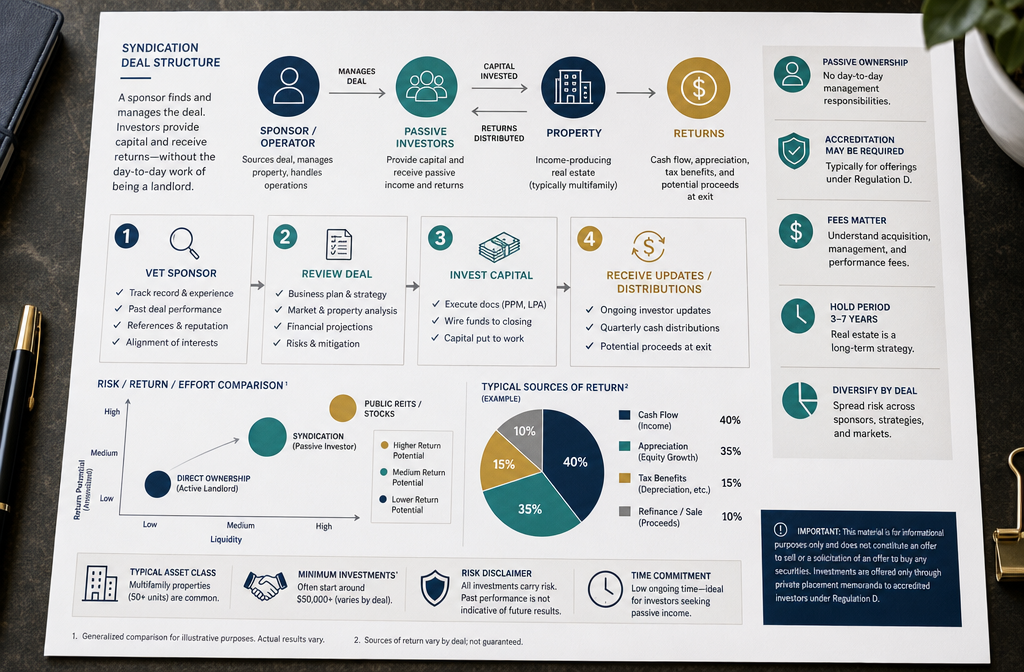
Real estate syndication for beginners is exactly what it sounds like: a way to get into real estate investing without buying, managing, or stressing over a property yourself. A group of investors (that's you and others like you) pool capital together. A professional operator — called the general partner — finds the deal, secures financing, manages the asset, and eventually sells it. You collect distributions along the way and a share of the profits at exit.
Think of it like being a silent investor in a restaurant. You put in money, the chef runs the kitchen, and you get a cut of the revenue. You're not flipping burgers. You're not taking reservations. You're just collecting your share.
This structure has existed for decades in private equity real estate circles — the kind of deals that used to be gatekept behind country club memberships and multi-million dollar minimums. The JOBS Act of 2012 changed that, opening syndication investing to a broader pool of accredited investors and eventually allowing some non-accredited participation through specific crowdfunding exemptions.
Here's how the mechanics work, step by step:
- A general partner (GP) identifies a target property — say, a 200-unit apartment complex in Phoenix.
- The GP structures a deal, secures a loan (usually 60%–75% of the purchase price), and raises the remaining equity from limited partners (LPs).
- Investors like you wire their capital into an LLC or limited partnership entity.
- The GP manages the property, handles renovations if it's a value-add deal, and distributes cash flow quarterly.
- After the hold period (typically 3–7 years), the property is sold. Profits are split between the GP and LPs according to the deal's waterfall structure.
So based, right? The appeal is real — but so are the risks. We'll get to those.
How Much Money Do You Need to Start Investing in Real Estate Syndication?
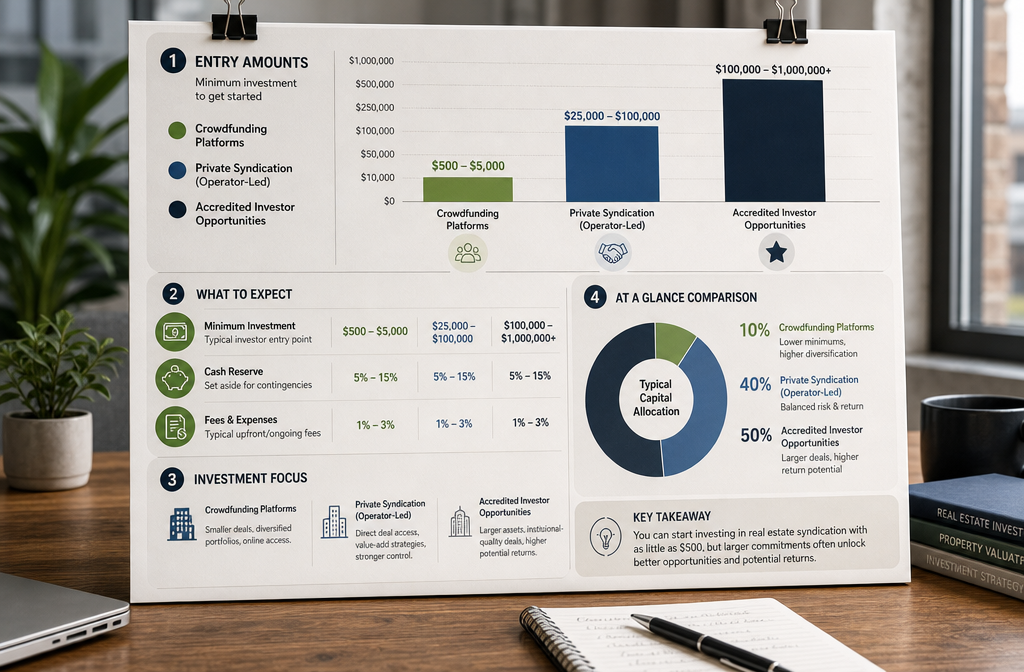
The honest answer: most private syndication deals require a minimum of $25,000 to $50,000, and many institutional-quality deals start at $100,000. That said, online platforms have pushed the floor down significantly.
Minimum investment ranges by platform type:
| Platform / Deal Type | Typical Minimum |
|---|---|
| Private syndication (direct) | $50,000–$100,000+ |
| RealtyMogul | $5,000–$25,000 |
| CrowdStreet | $25,000 |
| EquityMultiple | $5,000–$10,000 |
| Fundrise (non-accredited) | $10 |
The lower-end platforms are a solid entry point if you're testing the waters. But understand the trade-off: lower minimums often mean less direct access to the deal sponsor, less negotiating power on terms, and sometimes lower-quality deal flow.
If you're starting out and don't yet have $50K to deploy, check out our guide on how to invest in real estate with $5,000 or less — there are legitimate paths that don't require a six-figure check.
Decision rule: If you have $25,000–$50,000 ready to deploy and you meet accredited investor requirements, private syndications through platforms like CrowdStreet or EquityMultiple are worth exploring. Under $25K? Start with a platform like RealtyMogul or Fundrise to learn the structure before committing larger capital.
Syndication vs. Buying a Rental Property: Which One Actually Makes More Sense?
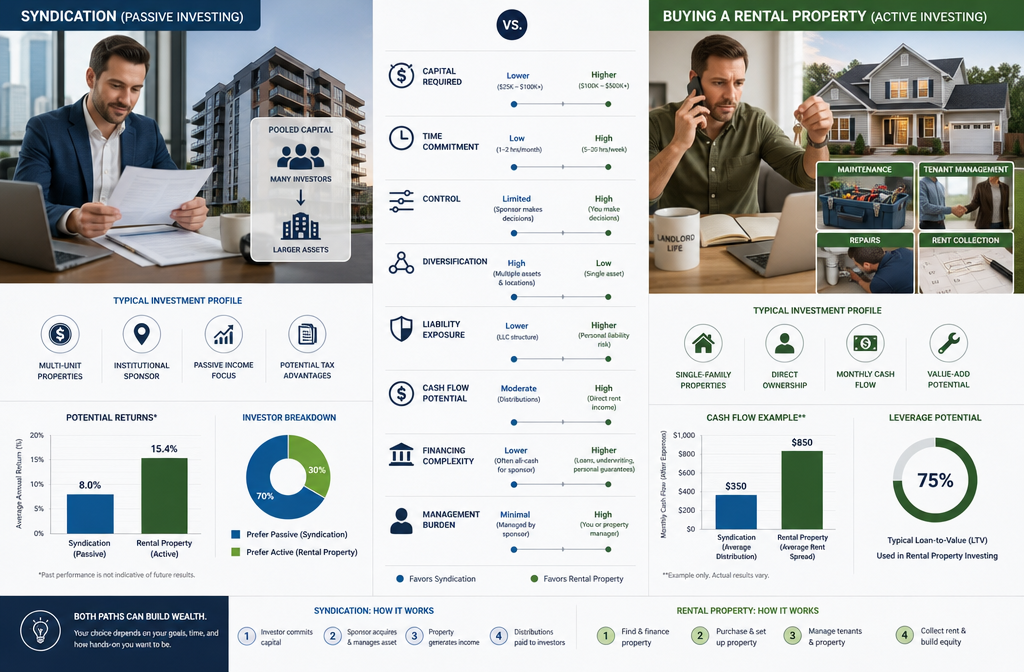
Syndication wins on simplicity and scale. Rental property wins on control and flexibility. The right choice depends entirely on your time, capital, and goals.
Side-by-side comparison:
| Factor | Rental Property | Real Estate Syndication |
|---|---|---|
| Management required | Yes (or hire a PM) | None |
| Minimum capital | $20K–$60K (down payment) | $5K–$100K |
| Control over asset | Full | None |
| Liquidity | Moderate (can sell) | Low (locked up 3–7 years) |
| Leverage | Yes (your mortgage) | Yes (GP secures financing) |
| Tax benefits | Depreciation, deductions | Depreciation pass-through |
| Scalability | Slow | Fast (invest in multiple deals) |
| Tenant headaches | All yours | None |
Owning a rental property is extraordinary if you want control, want to build equity directly, and have the time to manage it (or the budget to hire a property manager). Syndication is the move if you want truly passive real estate exposure, have capital ready to deploy, and can afford to have it illiquid for a few years.
For a deeper look at the different investment vehicles available, our 4 Types of Real Estate Investments guide breaks down the full spectrum.
The Risks of Real Estate Syndication That No One Talks About
Syndication is not a guaranteed return machine. The risks are real, and some of them are genuinely underappreciated by beginners.
The risks worth knowing:
- Illiquidity: Your capital is locked up. If you need money in year two of a five-year hold, you typically can't get it out. No secondary market, no early exit.
- GP dependency: The entire deal lives or dies on the operator's competence. A bad general partner can sink a good property. You have zero control over day-to-day decisions.
- Market risk: Rising interest rates, local economic downturns, or oversupply in a market can compress returns or eliminate them entirely. The 2022–2023 rate environment hit many multifamily syndications hard.
- Fee drag: Acquisition fees (1%–3%), asset management fees (1%–2% annually), and disposition fees can quietly eat into your returns. Always model the deal with fees included.
- Projected vs. actual returns: Sponsors present pro forma projections. Those are estimates, not guarantees. Assumptions about rent growth, exit cap rates, and occupancy can be optimistic.
- Regulatory risk: Zoning changes, rent control legislation, or tax law shifts can affect a deal's performance mid-hold.
- Fraud: It happens. Unregistered offerings, misrepresented financials, and outright Ponzi schemes exist in this space. Due diligence is non-negotiable.
Common mistake: New investors focus entirely on the projected return percentage and skip reading the Private Placement Memorandum (PPM). The PPM is where the real terms live. Read it. Or pay an attorney $500 to review it. Worth every dollar.
Best Platforms for Passive Real Estate Syndication Investments
The three platforms most frequently cited for accredited investors are RealtyMogul, CrowdStreet, and EquityMultiple — each with a distinct focus.
RealtyMogul offers both accredited and non-accredited investment options. Their REITs are available to anyone, while individual syndication deals require accredited status. Minimums start around $5,000 for their REIT products. They focus heavily on commercial real estate and multifamily.
CrowdStreet is one of the most well-known platforms for direct commercial real estate syndication. They've historically focused on institutional-quality deals with minimums around $25,000. CrowdStreet primarily serves accredited investors and offers individual deals as well as funds.
EquityMultiple targets accredited investors with a clean interface and deal variety spanning equity, preferred equity, and debt investments. Minimums start at $5,000 for some products, with higher minimums for direct equity deals.
Beyond these three, platforms like Arrived Homes (single-family rentals, lower minimums) and Fundrise (non-accredited, as low as $10) serve investors who aren't yet accredited or are starting smaller.
For a broader comparison of crowdfunding-style real estate platforms, our 7 Real Estate Crowdfunding Platforms Compared guide walks through the details.

Is Real Estate Syndication Good for Someone With a Full-Time Job?
Yes — and this is actually where syndication shines brightest. If you have W-2 income, limited time, and capital to invest, syndication is one of the most impeccable passive income vehicles available in real estate.
Once you wire your investment and sign the documents, your active involvement is essentially over. You'll receive quarterly reports, K-1 tax documents annually, and distributions when cash flow is available. That's it.
Who syndication works best for:
- Professionals with high income but limited time (doctors, attorneys, engineers, executives)
- W-2 earners who want real estate exposure without landlord responsibilities
- Investors already maxing out retirement accounts looking for alternative asset exposure
- People who want geographic diversification without physically managing properties in other states
Who it's probably not the right fit for:
- Investors who need liquidity within 1–3 years
- People who haven't built an emergency fund yet
- Anyone who can't afford to lose the invested capital
- Investors who want full control over asset decisions
Let it cook before you see results — syndication is a long game. Distributions build, appreciation compounds, and the real payoff often comes at the exit event 4–6 years in.
Typical Returns and Fees for Syndication Investments
Returns in real estate syndication generally range from 7% to 15% annually on an IRR (internal rate of return) basis, depending on the deal type, market, and strategy. Cash-on-cash returns during the hold period typically run 5%–9%.
Return benchmarks by deal type (estimates based on typical market conditions):
| Strategy | Typical IRR | Cash-on-Cash | Hold Period |
|---|---|---|---|
| Core (stabilized assets) | 7%–9% | 5%–6% | 5–10 years |
| Value-Add (multifamily) | 12%–16% | 6%–8% | 3–5 years |
| Opportunistic (development) | 15%–20%+ | Low/deferred | 2–5 years |
| Debt/Preferred Equity | 8%–12% | Fixed monthly | 1–3 years |
Fee structure to expect:
- Acquisition fee: 1%–3% of purchase price (paid at closing)
- Asset management fee: 1%–2% of gross revenue annually
- Preferred return: 6%–8% paid to LPs before GP takes profit
- Equity split: Often 70/30 or 80/20 (LP/GP) after preferred return is met
- Disposition fee: 1%–2% of sale price at exit
The preferred return is your friend as a limited partner. It means the GP doesn't participate in profit splits until you've received your preferred return first. Think of it as a built-in priority queue for your money.
How Do I Know If a Real Estate Syndication Deal Is Legit?
A legitimate syndication deal will always have a Private Placement Memorandum (PPM), a registered offering (or a valid exemption like Reg D 506(b) or 506(c)), and a track record you can verify.
Due diligence checklist for evaluating a syndication:
- ✅ Is the offering registered or exempt under SEC Regulation D? (Check SEC EDGAR)
- ✅ Does the sponsor have a verifiable track record of completed deals?
- ✅ Is the PPM clear about fees, waterfall structure, and exit strategy?
- ✅ Are the pro forma assumptions conservative and market-supported?
- ✅ Is the debt structure fixed-rate or floating? (Floating rate adds risk)
- ✅ What's the loan-to-value ratio? (Under 75% is generally safer)
- ✅ Does the sponsor have skin in the game (their own capital in the deal)?
- ✅ Are investor references available and verifiable?
- ✅ Is there a third-party property management company involved?
Red flags that should stop you cold:
- Guaranteed returns (illegal in private securities)
- Pressure to invest quickly before "the deal closes"
- No PPM or vague legal documents
- Sponsor won't provide audited financials or references
- Returns that seem too extraordinary to be real (20%+ cash-on-cash with no risk disclosure)
This is not the space for gatekeeping information — every investor deserves to know these checks before committing capital.
Differences Between Residential and Commercial Syndication Deals
Residential syndications focus on multifamily properties (apartment complexes, typically 5+ units). Commercial syndications cover office buildings, retail centers, industrial warehouses, self-storage, and mixed-use developments.
Key differences:
| Factor | Multifamily (Residential) | Commercial |
|---|---|---|
| Demand driver | Housing need (stable) | Business activity (cyclical) |
| Lease length | Month-to-month to 1 year | 3–10+ years (NNN leases) |
| Vacancy risk | Spread across many units | Concentrated (one tenant = big risk) |
| Financing | Easier, more lenders | More complex |
| Management complexity | Higher (many tenants) | Lower (fewer tenants, NNN) |
| 2026 market conditions | Strong in Sun Belt metros | Industrial/data center demand surging |
Multifamily syndication companies dominate the beginner-friendly space because the asset class is easier to understand and has historically shown resilience. Commercial deals — particularly industrial and data center-adjacent properties — are seeing fresh demand in 2026, especially in Sun Belt markets. Our Data Center Boom Driving Sun Belt Real Estate article covers that trend in detail.
Tax Implications of Real Estate Syndication Investments
The tax treatment of syndication investments is one of the most underrated advantages — and one of the most misunderstood parts of how does real estate syndication work for investors.
Key tax benefits:
- Depreciation pass-through: The property's depreciation is allocated to limited partners, often creating a "paper loss" that offsets passive income. This is legal and impeccable when structured correctly.
- Bonus depreciation: Accelerated depreciation (via cost segregation studies) can front-load tax benefits in year one of the deal.
- Capital gains treatment: Profits at exit are typically taxed at long-term capital gains rates if the hold period exceeds one year.
- 1031 exchange potential: Some sponsors offer 1031 exchange options at exit, allowing you to defer capital gains taxes by rolling into a new deal.
- K-1 reporting: You'll receive a Schedule K-1 annually instead of a 1099. K-1s can be complex — budget for a CPA who understands pass-through entities.
Important caveat: Passive losses from syndication can generally only offset passive income, not W-2 income, unless you qualify as a real estate professional under IRS rules. Talk to a tax advisor before assuming the depreciation benefit will offset your salary income.
What Kind of Investor Profile Works Best for Syndication?
The ideal syndication investor is accredited, patient, and has capital they won't need for at least 3–5 years. Beyond that, the profile gets more specific.
Accredited investor requirements (as of 2026):
- Net worth exceeding $1 million (excluding primary residence), OR
- Annual income exceeding $200,000 ($300,000 joint with spouse) for the past two years with expectation of the same
Some deals under Reg CF (crowdfunding) allow non-accredited investors with lower minimums, but the deal quality and sponsor access are typically more limited.
The investor who thrives in syndication:
- Has $50,000–$500,000 in investable capital beyond emergency reserves
- Understands they're investing in illiquid assets
- Has diversified across other asset classes (stocks, bonds, retirement accounts) already
- Is comfortable reading financial documents or has advisors who can
- Wants real estate exposure without the operational burden
The investor who should wait:
- Hasn't yet built a 6-month emergency fund
- Has high-interest debt outstanding
- Needs the invested capital within 3 years
- Has never invested outside of a 401(k) and isn't ready to evaluate private securities
If you're newer to real estate investing broadly, our beginner's blueprint to real estate investing is a solid foundation before stepping into syndication.
Common Mistakes New Syndication Investors Make
Even smart investors make avoidable errors when entering real estate syndication for beginners for the first time. Here are the ones that show up most often.
Mistake 1: Chasing the highest projected return
A 22% IRR projection from a sponsor with no track record is not more attractive than a 12% IRR from a sponsor with 10 completed deals. Projected returns are marketing. Track records are evidence.
Mistake 2: Ignoring the fee structure
A deal with a 12% projected return and 3% acquisition fee + 2% annual asset management fee + 2% disposition fee is delivering far less to you than it appears. Always model net-of-fee returns.
Mistake 3: Over-concentrating in one deal or one sponsor
Diversification matters in syndication just like it does in stocks. Spreading across multiple deals, markets, and sponsors reduces the impact of any single deal underperforming.
Mistake 4: Not reading the PPM
The Private Placement Memorandum is long, legal, and dense. It's also the only document that tells you exactly what you agreed to. Skipping it is how investors get surprised by terms they didn't know existed.
Mistake 5: Underestimating illiquidity
Life happens. Investors who put money into a 5-year syndication and then need it in year two for a medical expense or business opportunity are stuck. Only invest capital that is genuinely long-term.
Mistake 6: Skipping the sponsor background check
Search the sponsor's name on SEC EDGAR, check for litigation history, verify their claimed track record. A 30-minute background check has saved investors from catastrophic losses.
For a broader look at passive real estate investing options beyond syndication, check out our guide to best alternatives to REITs for passive income.
How to Find Real Estate Syndication Deals
Finding quality deals is where most beginners get stuck. The best deals are rarely advertised publicly — they move through networks.
Where to find legitimate syndication opportunities:
- Online platforms: RealtyMogul, CrowdStreet, EquityMultiple (vetted deal flow, lower barrier to entry)
- Investor networks: BiggerPockets, local real estate investment clubs, LinkedIn groups focused on passive investing
- Direct sponsor relationships: Follow multifamily syndication companies on social media, subscribe to their newsletters, attend their webinars
- Real estate conferences: Events like Best Ever Conference, IMN forums, and local apartment association events put you in rooms with active GPs
- Referrals: Existing syndication investors are often the best source — ask your network who they've invested with and what their experience has been
What to look for in a sponsor:
- Minimum 3–5 completed deals with verifiable exits
- Clear communication cadence (monthly or quarterly investor updates)
- Conservative underwriting assumptions (not assuming 10% annual rent growth in a flat market)
- Alignment of interest (GP has personal capital in the deal)
The general partner vs limited partner real estate dynamic is the core relationship in every syndication. A GP who invests their own money alongside yours is telling you something important about their conviction in the deal.
FAQ: Real Estate Syndication for Beginners
Q: What is real estate syndication in simple terms?
A group of investors pool money to buy a large property together. A professional operator manages everything. Investors collect returns without managing the property.
Q: Do I need to be an accredited investor for real estate syndication?
Most private syndications require accredited investor status. Some crowdfunding platforms (Fundrise, Arrived Homes) allow non-accredited investors with lower minimums.
Q: How long is my money locked up in a syndication?
Typically 3–7 years, depending on the deal's business plan. Most deals don't offer early exit options.
Q: What is a preferred return in real estate syndication?
A preferred return (usually 6%–8%) means limited partners receive that percentage of returns before the general partner takes any profit split. It's a built-in investor protection.
Q: What's the difference between a general partner and a limited partner?
The general partner (GP) finds, manages, and operates the deal. The limited partner (LP) provides capital and receives passive returns. LPs have no management authority.
Q: Can I invest in real estate syndication through my IRA?
Yes — through a Self-Directed IRA (SDIRA). This allows tax-advantaged investing in private placements including syndications. Consult a SDIRA custodian and tax advisor first.
Q: What is a waterfall structure in syndication?
The waterfall defines how profits are distributed. Typically: return of capital first, then preferred return to LPs, then profit split between LPs and GP (e.g., 70/30).
Q: Are real estate syndication returns guaranteed?
No. Returns are projected, not guaranteed. Actual performance depends on market conditions, management quality, and deal execution.
Q: What's the difference between syndication and a REIT?
REITs are publicly traded (or public non-traded) and liquid. Syndications are private, illiquid, and offer more direct deal exposure with potentially higher returns and tax benefits.
Q: How are syndication investments taxed?
You receive a K-1 annually. Income is taxed as ordinary income or capital gains depending on the type. Depreciation pass-throughs can offset passive income. Consult a CPA.
Q: What is private equity real estate vs. syndication?
Private equity real estate typically refers to institutional fund structures with high minimums ($250K+). Syndication is a similar structure but often more accessible to individual accredited investors.
Q: How do I evaluate if a syndication deal is worth it?
Review the sponsor's track record, the PPM, fee structure, debt terms, market fundamentals, and underwriting assumptions. Never invest based on projected returns alone.
Conclusion: Your Next Steps Into Real Estate Syndication
Real estate syndication for beginners is one of the most fresh and genuinely compelling ways to build passive income through real estate — without ever becoming a landlord. The structure is clean, the tax benefits are real, and the ability to own fractional stakes in institutional-quality properties that were once gatekept for ultra-high-net-worth investors is an extraordinary development for everyday accredited investors.
But this is not a set-it-and-forget-it lottery ticket. The work happens upfront: vetting sponsors, reading PPMs, understanding fee structures, and making sure the deal fits your timeline and liquidity needs. Do that work, and syndication can be a powerful addition to a diversified investment portfolio.
Your action plan:
- Confirm your accredited investor status — or identify which platforms allow non-accredited participation if you don't yet qualify.
- Start with a platform — RealtyMogul, EquityMultiple, or CrowdStreet are solid starting points with established deal flow.
- Read at least one full PPM before investing — even if it's for a deal you don't end up joining. The education is worth it.
- Talk to a CPA who understands pass-through entities and K-1 tax treatment before committing capital.
- Start small — your first syndication investment doesn't need to be your biggest. Learn the process, evaluate the sponsor's communication, and scale from there.
- Diversify across deals and sponsors — don't put all your syndication capital into one deal or one operator.
Real estate syndication explained simply is this: you bring the capital, experts bring the deal, and you both share the upside. Let it cook before you see results — the real returns in this asset class reward patience.
For more on building a real estate investment strategy from the ground up, explore our real estate investing beginner's blueprint and stay current with 2026 real estate market trends shaping where the best syndication opportunities are emerging.
Tags: real estate syndication, passive real estate investing, accredited investor, multifamily syndication, real estate syndication returns, general partner vs limited partner, CrowdStreet, RealtyMogul, EquityMultiple, real estate crowdfunding, private equity real estate, syndication for beginners
For more rental analysis and investing guides, visit the Investment Hub.