

Last updated: July 20, 2026

Quick Answer: A buyers market exists when housing supply exceeds demand, giving buyers negotiating power and pushing prices down. A sellers market is the opposite, too many buyers chasing too few homes, which drives prices up and favors sellers. Knowing which market you are in right now changes every decision you make about buying, selling, or investing.
Key Takeaways
- A buyers market typically shows more than 6 months of housing inventory, while a sellers market shows fewer than 3 months, according to the National Association of Realtors (NAR).
- As of early 2026, the U.S. housing market is showing early signs of a buyer-friendly shift in many metros, with inventory rising in sunbelt cities and days on market increasing nationally (Redfin, 2026).
- Interest rates near 6% in 2026 are cooling buyer demand in some regions while simultaneously keeping move-up sellers locked in place, creating a split-market dynamic.
- Days on market (DOM), list-to-sale price ratio, and months of supply are the three most reliable indicators for identifying your local market type.
- Buyers in a sellers market should come in pre-approved, limit contingencies strategically, and move fast, hesitation costs offers.
- Sellers in a buyers market must price aggressively from day one; overpricing in a soft market is the single fastest way to sit on the shelf.
- Market conditions can shift within 60 to 90 days when economic triggers hit, rate changes, job reports, and seasonal inventory surges all move the needle quickly.
What Is a Buyers Market vs Sellers Market?
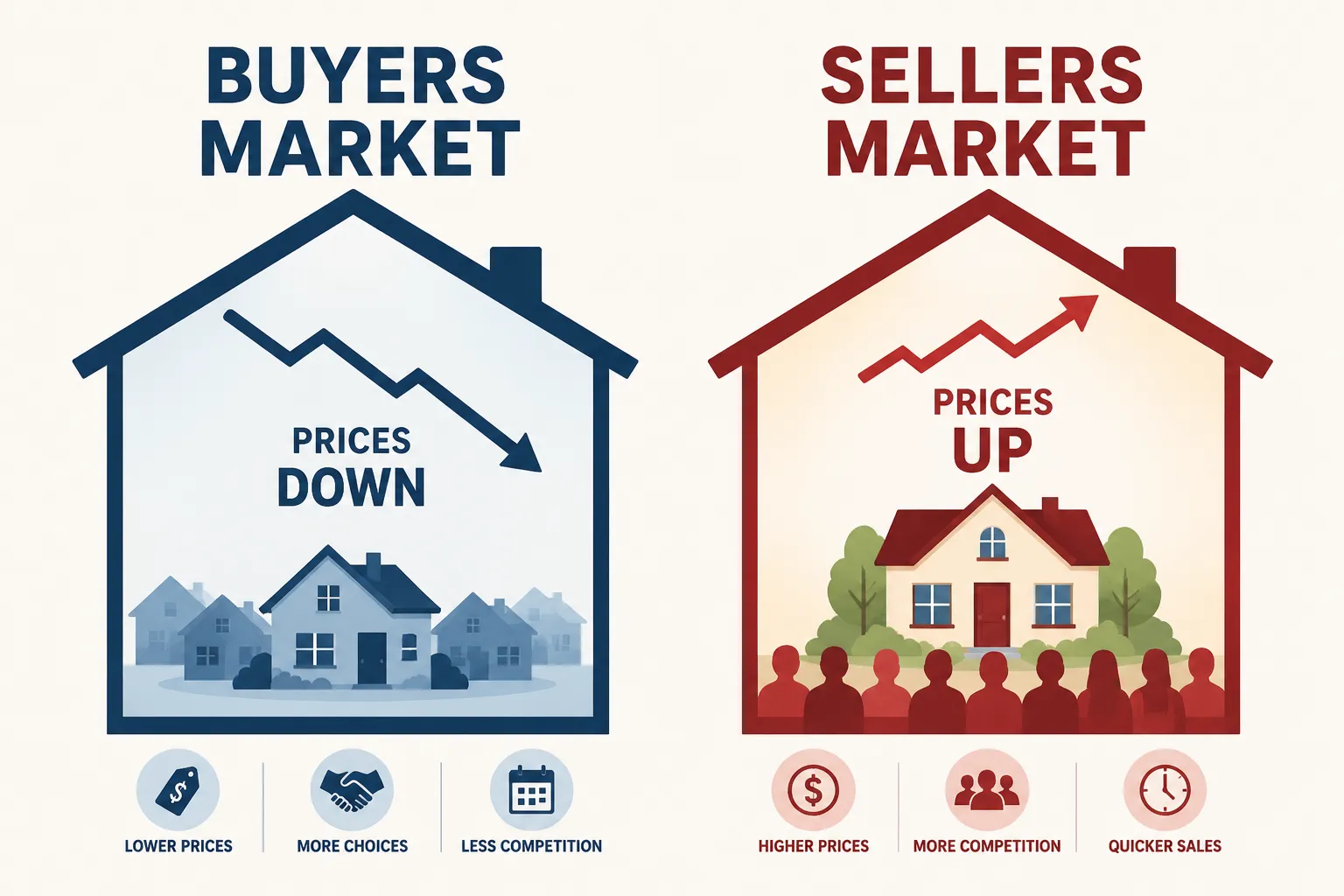
A buyers market means supply outpaces demand. Homes sit longer, prices soften, and buyers gain the upper hand in negotiations. A sellers market means demand outpaces supply. Homes sell fast, often above asking price, and sellers hold most of the cards.
Think of it like concert ticket availability. When Taylor Swift drops a surprise tour and only 500 seats are available for 50,000 fans, that is a sellers market. When a mid-tier act announces a show and half the arena is still available the day before, that is a buyers market. The product is the same. The power just shifts.
Here is how each market breaks down at its core:
Buyers Market:
- Inventory above 6 months of supply
- Homes sit on the market longer (high days on market)
- Sellers reduce prices and offer concessions
- Buyers can negotiate repairs, closing costs, and contingencies
Sellers Market:
- Inventory below 3 months of supply
- Homes sell in days, sometimes hours
- Multiple offer situations are common
- Buyers often waive contingencies to compete
A market between 3 and 6 months of supply is generally considered balanced, neither side has a clear advantage.
How Do I Know If I Am in a Buyers or Sellers Market?
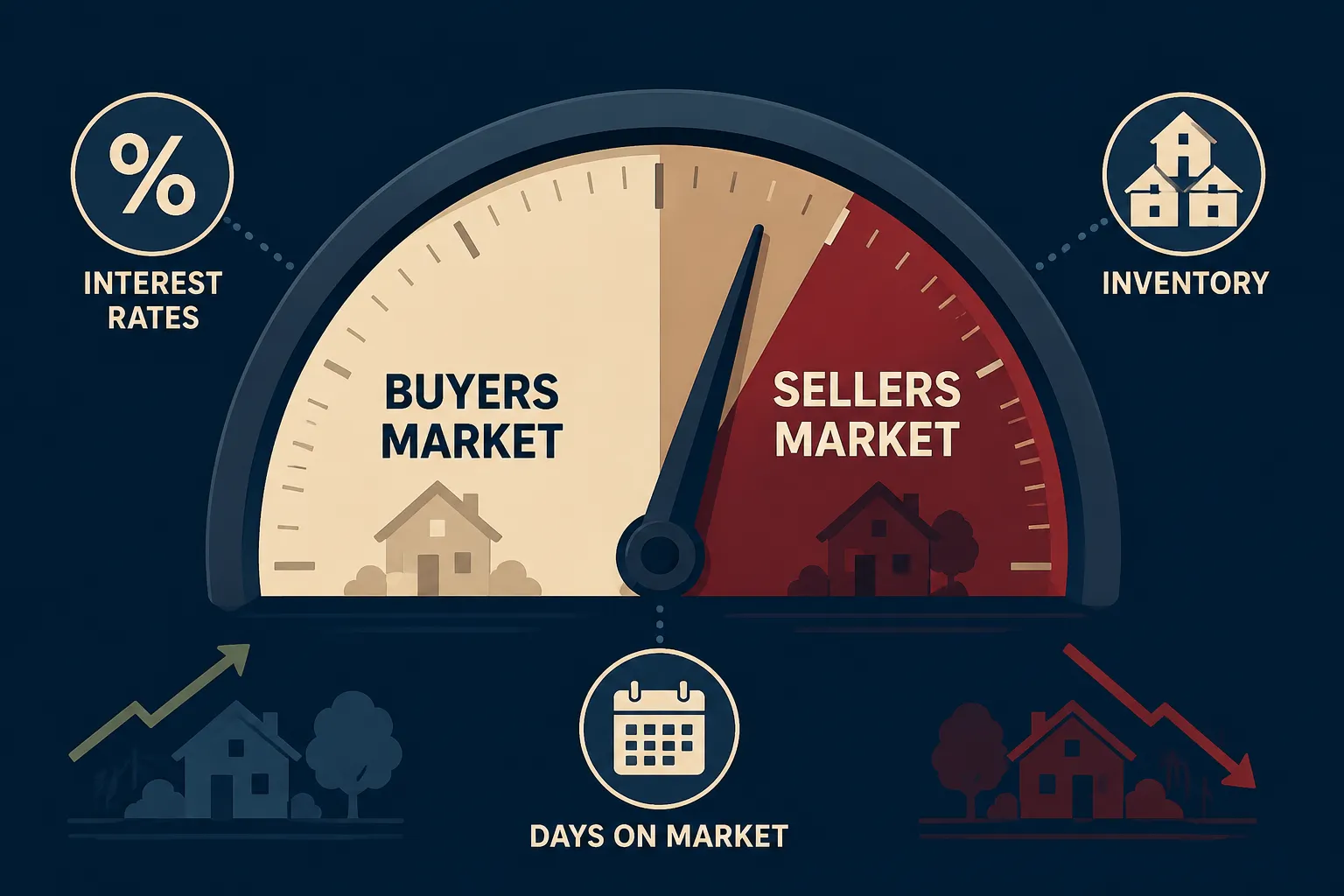
You can identify your market type by tracking three key metrics: months of housing supply, average days on market, and the list-to-sale price ratio. These numbers are publicly available through Redfin, Zillow, and your local MLS.
Here is a quick reference guide:
| Indicator | Buyers Market | Balanced Market | Sellers Market |
|---|---|---|---|
| Months of Supply | 6+ months | 3-6 months | Under 3 months |
| Days on Market (DOM) | 45+ days | 20-45 days | Under 20 days |
| List-to-Sale Price Ratio | Below 97% | 97%,100% | 100%+ |
| Price Reductions | Common | Occasional | Rare |
| Multiple Offers | Uncommon | Occasional | Very common |
Pull up your target zip code on Redfin or Zillow and check these numbers. If DOM is climbing and price reductions are popping up everywhere, that is a fresh signal that your local market is softening. Our U.S. home buyers market trends in 2026 breakdown covers exactly which metros are shifting right now.
What Are the Characteristics of Each Market Type?
Buyers Market Characteristics
A buyers market is defined by choice, time, and negotiating room. Buyers are not competing against a crowd, they are shopping.
Key signs you are in a buyers market:
- Active listings are piling up and homes are sitting for weeks without offers
- Sellers are offering concessions: closing cost credits, rate buydowns, repair allowances
- Price reductions appear on listings within the first two to three weeks
- New construction builders are offering incentives and upgrades to move inventory
- Buyers can include inspection contingencies, financing contingencies, and appraisal gaps without losing deals
Sellers Market Characteristics
A sellers market is fast, competitive, and unforgiving for unprepared buyers. Impeccable preparation is the price of entry.
Key signs you are in a sellers market:
- Homes go under contract within days of listing
- Offers come in above asking price
- Buyers are waiving inspection contingencies to win
- Open houses draw 20 to 50 groups in a single weekend
- Sellers rarely negotiate, they simply pick the strongest offer
For a deeper look at how these dynamics are playing out across the country right now, check out our Spring 2026 housing market overview covering lower rates and rising inventory.

How Do Buyers Markets and Sellers Markets Affect Home Prices?
In a buyers market, prices fall or stagnate because sellers are competing for a limited pool of buyers. In a sellers market, prices rise because buyers are competing for a limited pool of homes. The relationship between supply, demand, and price is direct and consistent.
According to NAR data, the national median home price rose sharply from 2020 through 2022 during one of the most extreme sellers markets in U.S. history, driven by record-low inventory and sub-3% mortgage rates. When rates climbed above 7% in 2023, demand cooled, inventory started recovering in select markets, and price growth slowed or reversed in some metros.
How prices move in each market:
- Buyers market: Sellers drop prices to attract offers. Expect list-to-sale ratios below 97%, and price reductions within the first two to three weeks on market.
- Sellers market: Buyers bid prices up. Homes routinely sell 2% to 5% above asking price in hot markets. During peak 2021 and 2022 conditions, some metros saw homes sell 10% to 15% over list.
- Transition periods: When a sellers market starts cooling, prices do not drop overnight. They plateau first. Watch for increasing DOM and rising inventory as early signals before price cuts actually appear.
This is where a lot of buyers and sellers get tripped up. The market can feel like it is still hot while the data is already telling a different story. Let it cook before you see results, price adjustments lag the inventory data by 30 to 60 days.
Is It Better to Buy in a Buyers Market or Sellers Market?
Buying in a buyers market is financially advantageous, you pay less, negotiate more, and face less competition. But waiting for a buyers market is not always practical or smart, especially if rates are rising or your personal timeline demands action.
Here is the honest breakdown:
Buy in a buyers market if:
- You have time flexibility and are not facing a lease expiration or relocation deadline
- You want maximum negotiating power on price, repairs, and concessions
- You are investing and need the numbers to work (rent-to-price ratio, cap rate)
Buy in a sellers market if:
- Your personal situation demands it (job relocation, growing family, lease ending)
- You plan to hold the property long-term, time in the market beats timing the market
- Renting alternatives are more expensive than owning in your target area
- You have strong financing and can compete effectively
The so-based truth that most people gatekeep: the "best time to buy" is almost always when your personal finances are ready and your life situation calls for it. Trying to time the market perfectly is a strategy that keeps people renting for years while prices quietly climb.
For buyers navigating financing decisions regardless of market type, our guide on FHA loans vs conventional loans in 2026 breaks down which option saves more money based on your situation.
What Should Buyers Do in a Sellers Market?
In a sellers market, buyers must come in prepared, pre-approved, and decisive. Hesitation is the enemy. The buyers who win are not always the ones with the most money, they are the ones with the cleanest, most credible offers.
Extraordinary moves buyers should make in a sellers market:
- Get fully pre-approved, not just pre-qualified. A pre-approval letter with verified income and assets carries far more weight than a quick online pre-qual.
- Know your ceiling before you start touring. Emotional bidding wars are real. Set your max number and stick to it.
- Move fast. In a hot market, a 24-hour delay can cost you the deal. If you love it, offer the same day.
- Limit contingencies strategically. You do not have to waive everything, but an inspection contingency with a short window (5 days instead of 10) signals seriousness without eliminating your protection entirely.
- Write a personal letter, selectively. In some markets, sellers respond to emotional connection. In others, it is irrelevant. Ask your agent what works locally.
- Escalation clauses. Include an escalation clause that automatically beats competing offers up to your max. This keeps you competitive without overbidding unnecessarily.
Common mistake: Buyers in sellers markets often get so focused on winning the offer that they skip due diligence. Never waive your inspection entirely unless you are a contractor or investor who has physically walked the property with trained eyes.
What Should Sellers Do in a Buyers Market?
In a buyers market, sellers who price correctly and present their home impeccably will still sell. Sellers who overprice and underinvest in presentation will sit, and eventually chase the market down with price cuts that signal desperation.
What actually moves homes in a buyers market:
- Price it right from day one. Overpricing is the number one mistake sellers make in soft markets. A home that sits for 30+ days starts to carry stigma. Buyers assume something is wrong.
- Offer concessions proactively. Closing cost credits, rate buydowns, and home warranties are extraordinary tools in a buyers market. Offering them upfront removes friction.
- Invest in presentation. Professional photography, staging, and curb appeal are not optional in a competitive environment. Our 60-day home selling plan gives you a step-by-step prep system that works.
- Be flexible on terms. Closing date flexibility, leaseback options, and willingness to negotiate repairs make your listing stand out when buyers have choices.
For more on pricing strategy in any market, see our home sellers pricing strategies playbook for 2026.

How Long Does a Buyers Market Typically Last, and Can It Shift Quickly?
A buyers market can last anywhere from several months to several years, depending on the economic forces driving it. Markets can also shift from buyers to sellers (or vice versa) within 60 to 90 days when a major catalyst hits.
Historical context: The buyers market following the 2008 financial crisis lasted roughly six years in many U.S. markets before inventory tightened and prices recovered. The sellers market that followed lasted nearly a decade. These are not quick cycles.
What can trigger a fast market shift:
- A significant drop in mortgage rates (even 0.5% can unlock a wave of buyer demand)
- A major employer announcing a relocation or expansion in a metro area
- A natural disaster or economic shock that rapidly reduces demand
- Seasonal inventory surges (spring listings) that temporarily tip the balance
- Federal policy changes affecting housing supply or lending standards
Indicators that a market is shifting toward buyers:
- Months of supply increasing for three or more consecutive months
- Days on market trending up across multiple price points
- Price reductions appearing in previously hot zip codes
- New construction completions outpacing absorption rates
Our article on what indicators show a shift in your local housing market covers nine specific signs to watch.
How Do Interest Rates Affect the Buyers Market vs Sellers Market Dynamic?
Interest rates are one of the most powerful forces shaping whether you are in a buyers or sellers market at any given time. When rates rise, buyer purchasing power drops, demand cools, and markets soften toward buyers. When rates fall, purchasing power increases, demand surges, and markets tighten toward sellers.
In 2026, mortgage rates hovering near 6% have created an unusual split dynamic. Rates are lower than the 7%+ peaks of 2023, which is bringing some buyers back. But many existing homeowners who locked in rates at 2.5% to 3.5% during 2020 and 2021 are still reluctant to sell and give up those rates, a phenomenon economists call the "rate lock-in effect." This keeps inventory constrained even as demand moderates.
The rate-market relationship in plain terms:
- Rates drop: More buyers qualify and enter the market. Demand rises. Sellers gain power.
- Rates rise: Fewer buyers qualify. Demand falls. Buyers gain power.
- Rates stabilize: The market adjusts to the new normal. Both sides recalibrate expectations.
For a full breakdown of how stable 6% rates are reshaping strategies for both buyers and sellers in 2026, see our 2026 real estate trends analysis.
What Mistakes Do Buyers Make in Sellers Markets?
The biggest mistakes buyers make in sellers markets come down to one thing: letting emotion override strategy. The competitive pressure of a hot market pushes buyers into decisions they would never make with a clear head.
The most costly buyers market vs sellers market mistakes we see:
- Skipping the pre-approval. Showing up to tour homes without a pre-approval letter in a sellers market is like showing up to a job interview without a resume. Sellers will not take you seriously.
- Falling in love before doing the math. Overbidding beyond your budget because you "have to have this house" is a fast path to financial stress after closing.
- Waiving the inspection entirely. This is the mistake that haunts buyers. A $500 inspection can save you from a $30,000 foundation problem. Never waive it without a very specific reason and a contractor walkthrough.
- Ignoring appraisal risk. If you bid $50,000 over asking and the home appraises at list price, you are on the hook for that gap in cash. Know your appraisal gap coverage limit before you offer.
- Waiting for the market to cool. Some buyers spend 18 months waiting for prices to drop while paying rent. In markets with strong job growth and constrained supply, that wait rarely pays off.
- Choosing the wrong lender. A slow lender in a fast market kills deals. Speed and reliability matter as much as rate in a sellers market.
For first-time buyers navigating these decisions, our first-time home buyers tips guide covers the full playbook from pre-approval to closing.
Where Does the U.S. Housing Market Stand in 2026?
The 2026 U.S. housing market is not a clean buyers or sellers market nationally, it is a tale of two markets depending on where you look. That is the fresh reality buyers and sellers need to accept.
Markets trending toward buyers in 2026:
- Several Florida metros (Tampa, Jacksonville, Orlando) where condo inventory has surged and HOA cost concerns are pushing buyers toward detached homes
- Parts of Texas (Austin, San Antonio) where new construction has added significant supply
- Some Mountain West markets where pandemic-era price spikes have corrected
Markets still favoring sellers in 2026:
- Northeast metros (Boston, New York suburbs, parts of New Jersey) where supply remains historically tight
- Midwest metros (Columbus, Indianapolis, Kansas City) with strong job markets and limited new construction
- Select Southeast markets with strong in-migration
The national picture from Redfin's 2026 market data shows inventory recovering but still below pre-pandemic norms in most markets. That means the extreme sellers market of 2021 and 2022 is over, but a full buyers market nationally has not arrived either.
Check our top 5 hottest regional real estate markets ranked for 2026 for a city-by-city breakdown.
Wrapping It Up: Know Your Market, Make Your Move
Understanding the buyers market vs sellers market dynamic is not just academic, it is the foundation of every smart real estate decision you will make in 2026. Whether you are buying your first home, selling a property, or building an investment portfolio, knowing which side of the power equation you are on changes your strategy entirely.
Actionable next steps based on where you stand:
- If you are a buyer in a sellers market: Get pre-approved today, set a firm budget ceiling, and be ready to move within 24 hours of finding a home you want. Speed and preparation are your competitive edge.
- If you are a seller in a buyers market: Price it right from day one, invest in presentation, and offer concessions proactively. Do not chase the market down with price cuts, lead with a strong position.
- If you are an investor: Use the market type to calibrate your strategy. Buyers markets are extraordinary for acquisition. Sellers markets are extraordinary for disposition. Know which game you are playing.
- If you are unsure which market you are in: Pull the three key metrics (months of supply, DOM, list-to-sale ratio) for your specific zip code. The data will tell you the truth faster than any headline will.
Real estate markets are not static. They shift, they split by price point, and they behave differently street by street in some cities. Stay current, stay data-driven, and stay connected to what is actually happening in your local market, not just the national narrative.
For the latest market intelligence, news, and strategies built by brokers, visit Real Estate Rank IQ, ranked by brokers, read by everyone.
Frequently Asked Questions
What is the simplest way to tell if I am in a buyers or sellers market?
Check months of housing supply in your target area. Under 3 months means sellers have the advantage. Over 6 months means buyers do. You can find this data on Redfin or your local MLS.
Can the same city be a buyers market in one neighborhood and a sellers market in another?
Yes, absolutely. Market conditions vary by price point, school district, and zip code within the same city. A $300,000 price range in a city can be highly competitive while the $600,000 range in the same city sits with excess inventory.
How does a buyers market vs sellers market affect my negotiating power on price?
In a buyers market, you can typically negotiate 2% to 5% below list price and request seller concessions. In a sellers market, you may need to offer at or above list price with minimal contingencies just to be considered.
Should I sell my home in a buyers market or wait for conditions to improve?
If you must sell, price it correctly and compete hard on presentation. If you have flexibility, watching for 3 to 6 months of inventory data trending back down can signal a better window. Waiting indefinitely is not always the right answer, carrying costs and life circumstances matter.
How quickly can a sellers market turn into a buyers market?
It can shift in 60 to 90 days when a major economic trigger hits, a rate spike, a large employer leaving a market, or a sudden surge in new construction completions. More typically, the transition takes 6 to 12 months and shows up in the data before it shows up in prices.
Do interest rate changes always shift the market from sellers to buyers?
Not always immediately. Rate increases reduce buyer purchasing power, which softens demand. But if inventory stays low (as it has in many U.S. markets due to the rate lock-in effect), prices can remain elevated even as buyer activity slows. It is a supply-demand equation, not just a rate equation.
What is the rate lock-in effect and how does it affect housing supply?
The rate lock-in effect refers to homeowners who are reluctant to sell because they would have to give up a low mortgage rate (often 2.5% to 3.5% locked in during 2020 and 2021) and take on a new loan at current rates near 6%. This keeps existing homes off the market, constraining supply even when buyer demand cools.
Is 2026 a buyers market or sellers market nationally?
It is neither cleanly. The 2026 U.S. market is split, some Sun Belt and Mountain West metros are trending toward buyers as inventory recovers, while Northeast and Midwest markets with tight supply still favor sellers. Local data matters far more than the national headline.
References
- National Association of Realtors (NAR). Housing inventory and months of supply methodology. https://www.nar.realtor/research-and-statistics
- Redfin. 2026 Housing Market Data and Trends. https://www.redfin.com/news/housing-market-data/
- Zillow Research. Home Value Index and Days on Market Reports. https://www.zillow.com/research/
- Federal Reserve Bank of St. Louis (FRED). Existing Home Sales and Inventory Data. https://fred.stlouisfed.org/