



Picture this: It's 11 PM on a Tuesday, and you're still manually responding to lead inquiries from three days ago while your competitors are already nurturing those same prospects with personalized, automated sequences. Sound familiar? The real estate game in 2026 isn't just about who works the hardest anymore—it's about who works the smartest. Real estate marketing automation has shifted from a luxury reserved for mega-brokerages to an absolute necessity for agents who want to stay competitive without sacrificing their sanity (or their weekends).

If 2025 was the year agents experimented with artificial intelligence, 2026 is the year they rely on it.[2] The industry has reached a critical inflection point where manual marketing processes aren't just inefficient—they're actively costing you thousands of dollars in lost opportunities, wasted time, and missed conversions. But here's the extraordinary news: implementing the right automation stack can save real estate professionals $1,000s annually while simultaneously increasing lead conversion rates and reclaiming 10-15 hours per week.
This comprehensive guide breaks down everything real estate investors, agents, and brokers need to know about marketing automation—from understanding the fundamentals to implementing specific tools that deliver measurable ROI. Whether you're managing a solo operation or coordinating a team of agents, the strategies ahead will transform how you capture, nurture, and convert leads in 2026's hyper-competitive market.
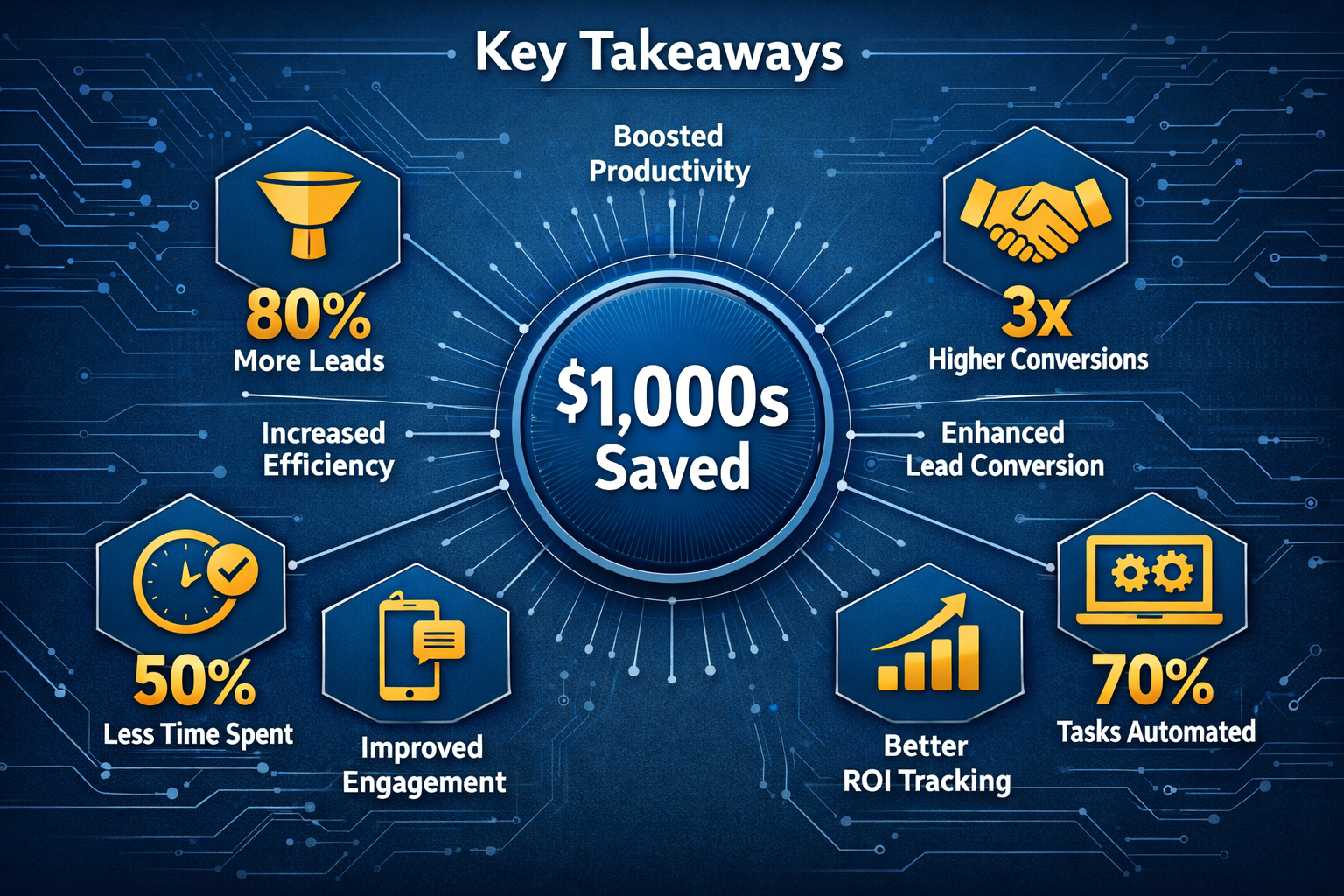
Key Takeaways
- Real estate marketing automation saves professionals $1,000s annually by eliminating repetitive manual tasks and reducing the need for additional administrative staff
- Leads contacted within the first five minutes are 21 times more likely to convert—automation ensures you hit this critical window consistently[2][3]
- The 2026 strategic shift prioritizes augmentation over replacement: using AI and automation to enhance human relationships, not eliminate them[1][4]
- Budget consolidation on essential automation tools (CRM, lead capture, email marketing, social media scheduling) delivers higher ROI than spreading resources across multiple disconnected platforms[1]
- Implementation follows a proven framework: assess current workflows → select category-specific tools → integrate systems → train team → measure and optimize
What Is Real Estate Marketing Automation? (And Why It Matters in 2026)
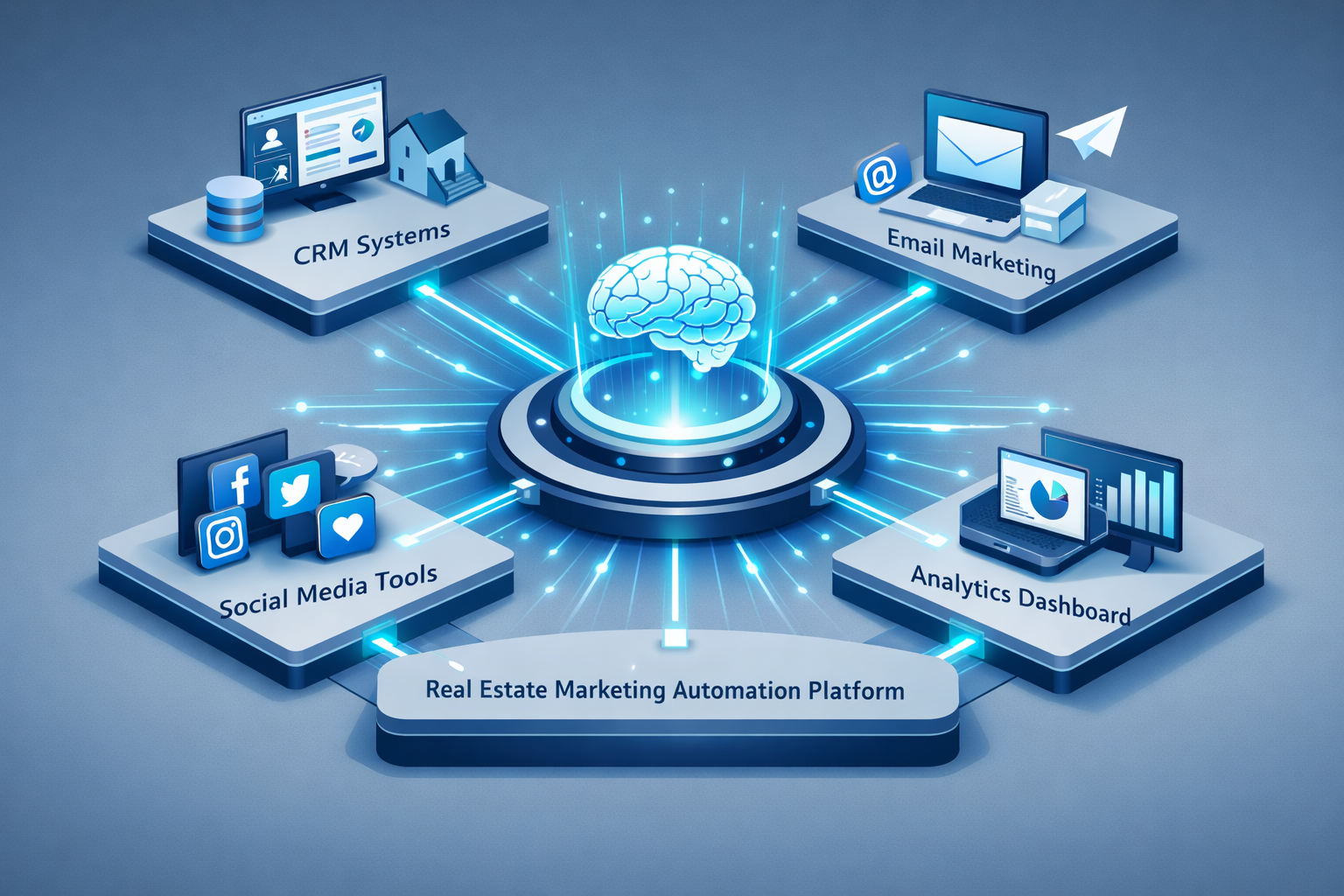
Real estate marketing automation refers to technology platforms and software systems that automatically execute repetitive marketing tasks—lead capture, email follow-up, social media posting, lead scoring, client communication, and campaign management—without requiring constant manual intervention. Think of it as your tireless digital assistant that works 24/7, never takes vacation, and executes tasks with impeccable consistency.
But let's be clear: automation isn't about replacing the human touch that makes real estate relationships so based. It's about augmentation, not replacement.[1][4] The goal is freeing your time from administrative quicksand so you can focus on what actually closes deals—building genuine relationships, conducting property showings, negotiating contracts, and providing the personalized service that turns clients into lifelong referral sources.
The 2026 Reality: Why Automation Became Non-Negotiable
The real estate landscape has fundamentally shifted. According to industry research, top agent priorities in 2026 reveal a strategic evolution: 28% prioritize selling more homes, 19% focus on increasing referrals, and 14% emphasize generating more leads.[1] This data tells an important story—agents are retreating from complex, expensive lead generation tactics and instead maximizing their Sphere of Influence (SOI) to prioritize referrals and high-ROI relationships over broad lead-casting.[1]
Here's where automation becomes critical: you can't effectively nurture your SOI, follow up with new leads within five minutes, maintain consistent social media presence, send personalized property alerts, and actually show homes—all while maintaining work-life balance—without intelligent systems handling the repetitive components.
The fresh perspective? Budget consolidation is the 2026 priority. Rather than spreading resources thin across multiple disconnected platforms, successful agents are focusing spending on "non-negotiable essentials" including professional photography, floor plans, aerials, 3D tours, and integrated automation platforms that actually talk to each other.[1] For insights on how AI is transforming real estate analysis and decision-making, check out our guide on analyzing real estate markets with AI.
The Financial Case: Where the $1,000s in Savings Actually Come From
Let's break down the real numbers. Manual marketing processes cost real estate professionals in three distinct ways:
Direct Labor Costs:
- Administrative assistant salary: $2,500-$4,000/month
- Virtual assistant for lead management: $800-$1,500/month
- Social media manager: $1,000-$2,500/month
Opportunity Costs:
- Time spent on administrative tasks instead of client-facing activities: 15-20 hours/week
- Missed leads due to slow response times: 30-40% conversion loss
- Inconsistent follow-up leading to database decay: 50-60% of leads never contacted beyond initial response
Technology Inefficiency Costs:
- Multiple disconnected tools requiring separate subscriptions: $200-$500/month
- Data entry duplication across platforms: 5-8 hours/week
- Marketing campaign creation from scratch: 10-15 hours/month
A comprehensive automation stack typically costs $300-$800/month depending on business size and needs, but eliminates or dramatically reduces all three cost categories above. The math is straightforward: even conservative estimates show $1,000-$3,000 in monthly savings, or $12,000-$36,000 annually.
Understanding the Two Critical Types of AI in Real Estate Marketing Automation
Before diving into specific tools and implementation strategies, understanding the two fundamental AI types transforming real estate marketing helps you make smarter technology decisions.
Agentic AI: Your Autonomous Task Executor
Agentic AI autonomously plans and executes tasks without constant human oversight.[1] In real estate marketing, this manifests as systems that:
- Automatically qualify leads based on behavioral signals and data points
- Route high-priority prospects to the right team member based on specialization and availability
- Trigger follow-up sequences when leads take specific actions (property views, email opens, website visits)
- Re-engage cold database contacts with relevant market updates or property matches
- Schedule appointments directly into calendars based on availability rules
The extraordinary advantage? Agentic AI handles the decision-making logic that typically requires human judgment, but does so instantly and consistently. While you're sleeping, meeting clients, or actually enjoying your weekend, these systems are qualifying new leads, sending personalized responses, and ensuring nothing falls through the cracks.
Generative AI: Your Creative Content Partner
Generative AI creates optimized marketing content—listing descriptions, social media posts, email campaigns, area guides, and more.[1] Tools like ChatGPT and Google Gemini have moved from experimental novelty to daily necessity for real estate professionals who understand their strategic value.
The key is using generative AI for ideation and first drafts while always injecting personal insights and human review.[1][4] For example:
Instead of this manual process:
- Stare at blank screen for 20 minutes
- Write mediocre listing description
- Second-guess every word choice
- Spend 45 minutes total for subpar results
Use this automated approach:
- Input property details into ChatGPT with proven prompt template
- Receive three optimized description variations in 30 seconds
- Select best option and personalize with local insights
- Spend 10 minutes total for superior results
The possibilities are endless for copywriting applications: social media posts, email newsletters, area guides, market reports, client communications, and even practice scripts for difficult conversations.[5] For more on leveraging AI in your real estate business, explore our comprehensive guide to AI tools that actually close deals.
Real Estate Marketing Automation Platform Categories: Building Your Tech Stack
The automation landscape can feel overwhelming with hundreds of platforms claiming to revolutionize your business. Let's cut through the noise and organize tools by specific function, so you can build a cohesive tech stack instead of accumulating disconnected software subscriptions.
Marketing Automation Platforms for Real Estate Agents
These comprehensive platforms serve as your central nervous system, connecting various marketing functions and creating seamless workflows between different tools.
Zapier – The integration powerhouse that connects your various real estate tools even when they don't natively communicate. Think of Zapier as the universal translator for your tech stack. When a new lead fills out a form on your website, Zapier can automatically add them to your CRM, send a welcome email, create a task reminder, and notify you via text—all without touching a button. The platform offers 5,000+ app integrations and uses simple "if this, then that" logic anyone can master.
IFTTT (If This Then That) – A simpler, more streamlined automation platform perfect for connecting real estate apps and services with straightforward triggers. While less powerful than Zapier for complex workflows, IFTTT excels at basic automations like automatically posting new listings to social media, saving email attachments to cloud storage, or sending weather alerts that might affect open houses.
Propertybase – An all-in-one real estate platform built specifically for the industry, combining CRM, marketing automation, lead management, and transaction coordination in a single ecosystem. Propertybase eliminates the integration headaches of connecting multiple tools by providing everything under one roof, though at a premium price point that makes most sense for teams and brokerages rather than solo agents.
Chime – A real estate platform with built-in automation capabilities designed for high-volume lead generation and team management. Chime's strength lies in its automated lead distribution, instant response systems, and behavioral tracking that identifies which prospects are actively searching versus casually browsing.
Ylopo – A digital marketing platform designed specifically for real estate with sophisticated Facebook and Google advertising automation, dynamic retargeting, and AI-powered lead engagement. Ylopo's standout feature is its ability to automatically create and optimize paid advertising campaigns based on your inventory and target market, then nurture those leads with personalized content.
8n8 – Real estate AI automation platform specializing in intelligent lead qualification and automated communication workflows. The system uses machine learning to identify high-intent prospects and automatically engages them with relevant property suggestions and market information.
Automating Lead Capture: Never Miss Another Opportunity
Lead capture automation ensures every potential client who shows interest gets immediately added to your system and receives prompt acknowledgment—hitting that critical five-minute response window that increases conversion likelihood by 21 times.[2][3]
BoldLeads – Specialized real estate lead generation platform that combines Facebook advertising with automated lead capture and instant response systems. BoldLeads generates exclusive leads (not shared with competitors), automatically captures their information, and immediately sends personalized text and email responses while alerting you to follow up.
Zillow Premier Agent – Lead capture directly from Zillow's massive marketplace where millions of active home shoppers browse daily. While more expensive than other sources, Zillow leads come with high intent and detailed behavioral data showing which properties they've viewed and how long they've been searching.
Real Geeks – IDX websites with integrated lead capture forms that automatically sync with your CRM. Real Geeks excels at capturing organic website visitors through strategically placed registration gates, property alerts, and home valuation tools that exchange valuable information for contact details.
Realty.com – Domain-based lead generation system leveraging the powerful Realty.com brand to attract searchers and capture their information through property search tools and market reports.
Wise Agent – Lead capture forms that integrate seamlessly with its CRM platform, ensuring every inquiry automatically becomes a tracked contact with assigned follow-up tasks and drip campaigns.
Lead Scoring and Distribution Automation: Prioritize What Matters
Not all leads are created equal. Automated lead scoring analyzes behavioral signals and demographic data to identify which prospects deserve immediate attention versus long-term nurturing, then routes them to the appropriate team member.
Follow Up Boss – Real estate CRM with sophisticated lead routing capabilities that automatically assign new leads based on customizable rules: geographic territory, price range, property type, agent availability, or round-robin distribution. The platform tracks response times and holds team members accountable for timely follow-up.[2]
LionDesk – CRM with automated lead assignment features and built-in communication tools including video texting, email, and calling—all tracked within the same platform. LionDesk's automation triggers ensure leads receive immediate acknowledgment while routing high-priority prospects to senior agents.
Zurple – Automated lead scoring and engagement tracking platform that monitors prospect behavior across your website and email campaigns, assigning numerical scores based on activity level. When leads hit predetermined thresholds indicating high intent, Zurple automatically alerts you and triggers personalized outreach.
Kunversion+ – Lead qualification and distribution system designed for teams and brokerages managing high lead volumes. The platform uses AI to analyze lead quality, predict conversion likelihood, and distribute prospects to agents best positioned to convert them based on historical performance data.
Sierra Interactive – Lead routing and team distribution platform with advanced automation rules that consider agent capacity, specialization, past client relationships, and performance metrics when assigning new opportunities.
Automated Lead Nurturing: Stay Top-of-Mind Without the Time Investment
Lead nurturing automation maintains consistent communication with prospects over weeks, months, or even years—turning cold leads warm and keeping your name front-of-mind when they're finally ready to transact.
BoomTown – Real estate CRM with automated nurturing workflows that send personalized property alerts, market updates, and educational content based on lead behavior and preferences. BoomTown's automation adapts to prospect engagement, increasing or decreasing communication frequency based on responsiveness.[2]
Firepoint – Lead nurturing and follow-up system that automates the repetitive touchpoints required to convert long-term prospects. The platform combines email, text, and voicemail drops in coordinated sequences that feel personal despite being automated.
Realvolve – Workflow automation platform specifically designed for real estate relationship management. Realvolve excels at creating complex, multi-step nurturing sequences that trigger based on specific events: listing anniversaries, market milestones, life events, or behavioral signals.
Contactually – Relationship-based CRM with nurturing programs called "buckets" that automatically organize contacts by relationship stage and engagement level. The system prompts you when relationships need attention and automates routine touchpoints while highlighting opportunities for personal outreach.
Happy Grasshopper – Automated follow-up messaging service that sends personalized (but automated) text and email messages designed to sound like they came directly from you. The platform specializes in SOI nurturing with messages tied to holidays, seasons, and life events that keep you top-of-mind with past clients and referral sources. To maximize your sphere of influence strategy, read our no-BS guide to growing your agent sphere.
Email Marketing Campaign Automation: Consistent Communication at Scale
Email remains one of the highest ROI marketing channels when executed consistently—something nearly impossible manually but effortless with automation.
Market Leader – Email marketing platform with property alert automation that sends leads new listings matching their search criteria the moment they hit the market. This "concierge service" positions you as their dedicated property scout without requiring daily manual searches.
Constant Contact for Real Estate – Email automation with real estate-specific templates for market reports, listing announcements, open house invitations, and neighborhood guides. The platform's drag-and-drop builder and pre-designed templates eliminate the design learning curve.
BombBomb – Video email platform for personalized communication that combines automation with authentic human connection. While the videos themselves require recording, BombBomb automates delivery, tracks engagement, and triggers follow-up sequences based on viewing behavior. Video emails achieve 2-3x higher engagement than text-only messages.
Mailchimp Real Estate – Popular email automation platform with real estate templates and audience segmentation tools that send different content to buyers, sellers, investors, and past clients based on their interests and stage in the customer journey.
ActivePipe – Real estate-specific email marketing platform with sophisticated automation that analyzes recipient engagement and automatically adjusts sending frequency and content type. ActivePipe's "Smart Campaigns" use AI to determine optimal send times and subject lines for each individual recipient.
Automating Social Media Posting: Maintain Presence Without the Daily Grind
Social media automation ensures consistent presence across platforms without consuming hours daily creating and posting content. The key is scheduling authentic content in batches while still engaging in real-time when notifications warrant personal responses.
Hootsuite – Comprehensive social media scheduling across all major platforms with bulk upload capabilities, content calendar visualization, and team collaboration features. Hootsuite's automation allows you to dedicate 2-3 hours monthly to content creation, then schedule everything in advance for daily posting.
Buffer – Simple, intuitive social scheduling tool perfect for agents who want automation without overwhelming complexity. Buffer's clean interface and mobile apps make it easy to queue content from anywhere, and its analytics show which posts drive the most engagement.
SocialBee – Content categorization and scheduling platform that ensures balanced posting across different content types: listings, market updates, educational content, community highlights, and personal brand building. SocialBee's category-based approach prevents the common mistake of posting only listings and neglecting relationship-building content.
Sprout Social – Comprehensive social media management platform combining scheduling, monitoring, engagement tracking, and competitive analysis. Sprout Social's automation includes optimal send-time recommendations, hashtag suggestions, and automated reporting that proves social ROI to skeptical brokers.
Later – Visual social media planning tool especially powerful for Instagram and Pinterest, where real estate's visual nature shines. Later's drag-and-drop calendar and visual preview ensure your feed maintains aesthetic cohesion while its automation handles posting across time zones.
Sociamonials – Social media automation platform designed specifically for real estate with features for testimonial collection, review management, and social proof amplification across platforms.
For additional strategies on leveraging social media effectively, explore our guide on using social media and AI tools to sell real estate.
The Real Estate Marketing Automation Implementation Framework

Having the right tools means nothing without proper implementation. This proven framework takes you from automation novice to sophisticated operator in manageable phases.
Phase 1: Audit Your Current Marketing Workflows (Week 1)
Before adding new technology, understand exactly where your time goes and which processes cause the most friction. Spend one week tracking:
- Time spent on repetitive tasks: Email responses, social media posting, lead data entry, appointment scheduling, follow-up reminders
- Lead leakage points: Where prospects fall through the cracks between initial contact and follow-up
- Communication gaps: How long it typically takes to respond to new inquiries
- Database health: Percentage of contacts receiving consistent communication versus sitting dormant
- Content creation bottlenecks: How long it takes to create listing descriptions, social posts, email campaigns
Document everything in a simple spreadsheet. The goal isn't perfection—it's awareness of where automation will deliver the highest ROI.
Phase 2: Select Your Core Automation Stack (Week 2-3)
Based on your audit, prioritize tools in this order:
First Priority: CRM with Lead Management
Choose one comprehensive CRM that handles contact management, lead capture, and basic automation. Options like Follow Up Boss, LionDesk, or BoomTown provide the foundation everything else builds upon.[2] Don't gatekeep this decision—involve your team if you have one, because adoption depends on user-friendliness.
Second Priority: Email Marketing Automation
Select an email platform that integrates with your CRM. Start with basic drip campaigns for new leads, past client nurturing, and sphere of influence touchpoints. Platforms like ActivePipe or Constant Contact offer real estate-specific templates that accelerate setup.
Third Priority: Social Media Scheduling
Choose one social scheduling tool and commit to batching content creation. Buffer or Hootsuite work well for beginners, while SocialBee offers more sophisticated category-based posting for those ready to level up.
Fourth Priority: Integration Platform
Add Zapier or IFTTT to connect your tools and eliminate manual data transfer between systems. Start with simple automations (new lead → add to CRM → send welcome email) before building complex workflows.
Phase 3: Implement in Manageable Chunks (Week 4-8)
Trying to automate everything simultaneously guarantees overwhelm and abandonment. Instead, implement one category every 1-2 weeks:
Week 4: CRM Setup and Lead Capture
- Import existing database
- Create lead capture forms for website
- Set up basic contact fields and tags
- Configure mobile app for on-the-go access
Week 5-6: Email Automation
- Build 3-5 core drip campaigns (new lead sequence, buyer nurture, seller nurture, past client, SOI)
- Create email templates for common scenarios
- Set up property alert automation
- Test all sequences by sending to yourself first
Week 7: Social Media Automation
- Audit existing content and identify top performers
- Create content categories and posting calendar
- Batch-create 30 days of social posts
- Schedule content and set up engagement monitoring
Week 8: Integration and Optimization
- Connect tools via Zapier/IFTTT
- Create automation workflows between platforms
- Test all integrations thoroughly
- Document processes for team training
Phase 4: Train Your Team and Establish Protocols (Week 9-10)
Automation only works when everyone understands and trusts the systems. Create clear protocols:
- Response expectations: Automation handles initial acknowledgment; humans respond personally within 2 hours during business hours
- Override procedures: When to pause automated sequences for personal outreach
- Content approval: Who reviews automated communications before they go live
- Data hygiene: Standards for contact information, tagging, and notes
- Performance monitoring: Weekly review of automation metrics and conversion rates
Record simple video tutorials showing exactly how to use each tool. Let it cook for a few weeks before making major changes—teams need time to adapt.
Phase 5: Measure, Optimize, and Scale (Ongoing)
Track these critical metrics monthly:
- Lead response time: Average time from inquiry to first contact (goal: under 5 minutes for new leads)[2][3]
- Email engagement rates: Open rates (goal: 20-25%), click rates (goal: 3-5%)
- Conversion rates by source: Which lead sources convert best with your nurturing sequences
- Time savings: Hours reclaimed weekly from automation
- Cost per lead: Total marketing spend divided by leads generated
- Database engagement: Percentage of contacts receiving and engaging with communications
Use this data to optimize sequences, eliminate underperforming campaigns, and double down on what works. Automation isn't "set it and forget it"—it's "set it and improve it."
Advanced Real Estate Marketing Automation Strategies for 2026
Once you've mastered the fundamentals, these sophisticated strategies separate top performers from the pack.
Behavioral Trigger Automation: Respond to What Prospects Actually Do
Instead of generic drip campaigns that send the same content to everyone on the same schedule, behavioral triggers respond to specific actions prospects take:
- Property view triggers: When leads view a listing multiple times, automatically send comparable properties and neighborhood information
- Email engagement triggers: When recipients click specific links, trigger follow-up sequences related to that topic
- Website behavior triggers: When leads visit your site after weeks of inactivity, automatically re-engage with market updates or new inventory
- Price change alerts: Automatically notify interested leads when properties they've viewed reduce price
- Abandonment triggers: When leads start but don't complete home valuation requests, automatically follow up with simplified versions
Platforms like Zurple, BoomTown, and Sierra Interactive excel at behavioral automation, using AI to identify patterns and trigger appropriate responses.[2]
Predictive Lead Scoring: Focus on Prospects Most Likely to Convert
Advanced CRM platforms use machine learning to analyze thousands of data points and predict which leads are most likely to convert soon versus those requiring long-term nurturing.
Predictive models consider:
- Engagement frequency: How often leads open emails, click links, view properties
- Behavioral signals: Progression from browsing to researching to comparing properties
- Demographic factors: Income level, current homeownership status, family size, employment stability
- Market timing: How long they've been searching, seasonal patterns, local market conditions
- Communication preferences: Responsiveness to different outreach methods
Scout AI exemplifies this approach, using millions of data points to create personalized, AI-written emails and automated follow-ups based on lead characteristics like home size, purchase price, bedrooms, and occupancy length.[5] The platform targets busy agents with large databases looking to maximize existing lead value without manually crafting individual messages.
Cross-Platform Retargeting Automation: Stay Visible Everywhere Prospects Go
Sophisticated automation extends beyond email and social media to paid advertising retargeting:
- Automatically create Facebook Custom Audiences from CRM contacts and website visitors
- Trigger Google Display Network ads to leads who viewed specific properties
- Retarget email non-openers with social media ads featuring the same content
- Automatically exclude converted clients from lead generation campaigns
- Create lookalike audiences based on your best converting leads
Ylopo specializes in this cross-platform approach, automatically creating and optimizing paid campaigns while nurturing leads through email and text.[5]
Personalization at Scale: Mass Communication That Feels Individual
The extraordinary power of modern automation is combining efficiency with personalization. Advanced strategies include:
- Dynamic content blocks: Email templates that automatically insert different content based on recipient characteristics (buyer vs. seller, price range, location preference)
- Personalized video: Platforms like BombBomb allow recording one video with personalized elements (recipient name, specific property) automatically inserted for each recipient
- Smart property recommendations: AI analyzes lead behavior and automatically suggests listings matching their demonstrated preferences, not just stated criteria
- Lifecycle stage automation: Different communication strategies for new leads, active prospects, under contract, past clients, and referral sources—all managed automatically based on status changes
Overcoming Common Real Estate Marketing Automation Challenges
Implementation isn't always smooth. Here's how to navigate the most common obstacles:
Challenge 1: "Automation Feels Impersonal and Inauthentic"
Solution: Remember that automation handles repetitive tasks so you can focus on high-value personal interactions. The goal isn't replacing human connection—it's ensuring no one gets ignored while you're busy with active clients. Always inject personality into automated messages, use conversational language, and clearly define when automation hands off to personal outreach.
Challenge 2: "I Don't Have Time to Set Everything Up"
Solution: Block dedicated implementation time or hire a virtual assistant specifically for initial setup. The upfront investment of 20-30 hours saves 10-15 hours weekly ongoing—a 4-6 week payback period. Alternatively, many platforms offer done-for-you setup services for $500-$2,000 that accelerate implementation. For guidance on hiring virtual assistance, check out our guide on finding your next virtual assistant for real estate.
Challenge 3: "My Database Is a Mess—Automation Will Just Scale the Chaos"
Solution: Start fresh with new leads while gradually cleaning existing data. Import only contacts you've communicated with in the past 12 months initially. Use automation to identify and tag engaged contacts, then manually review and clean segments monthly. Most CRMs offer data enrichment services that automatically append missing information.
Challenge 4: "Technology Overwhelms Me—I'm Not Tech-Savvy"
Solution: Choose user-friendly platforms with strong customer support and training resources. Start with one tool, master it completely, then add others. Join user communities and Facebook groups where other agents share tips and troubleshooting advice. Remember: if you can use social media, you can handle marketing automation.
Challenge 5: "Automation Is Expensive—I Can't Afford Multiple Subscriptions"
Solution: Calculate the true cost of manual processes (your hourly value × hours spent on tasks automation handles). Start with free or low-cost tools: ChatGPT free tier for content creation, Buffer free plan for social scheduling, Mailchimp free tier for email automation. Upgrade only when you've proven ROI. Many platforms offer real estate agent discounts or team pricing that reduces per-user costs.
Challenge 6: "I'm Worried About Privacy and Data Security"
Solution: Choose platforms with clear privacy policies, SOC 2 compliance, and data encryption. Never store sensitive financial information in marketing automation tools. Obtain clear consent for email and text communications. Stay compliant with CAN-SPAM, TCPA, and state-specific regulations. Most reputable real estate platforms build compliance features directly into their systems.
The ROI Calculator: Quantifying Your Marketing Automation Investment

Let's make the financial case concrete with real numbers based on typical agent scenarios:
Solo Agent Scenario
Current Manual Process Costs:
- Time spent on admin tasks: 15 hours/week × $100/hour value = $1,500/week
- Missed leads due to slow response: 5 leads/month × 20% conversion × $8,000 commission = $8,000/month lost
- Inconsistent follow-up: 30% database decay = $15,000/year lost referrals
Total Annual Cost of Manual Processes: $93,600
Automation Stack Investment:
- CRM (Follow Up Boss): $69/month
- Email automation (ActivePipe): $99/month
- Social scheduling (Buffer): $15/month
- Integration (Zapier): $30/month
- Setup time investment: 30 hours × $100/hour = $3,000 one-time
Total Annual Automation Cost: $5,556
Net Annual Savings: $88,044
Even if automation only recovers half the identified losses, the ROI is extraordinary: 792% return on investment.
Small Team Scenario (3-5 Agents)
Current Manual Process Costs:
- Administrative assistant: $36,000/year
- Lead leakage across team: $25,000/year
- Inconsistent brand messaging: $10,000/year in lost credibility
Total Annual Cost: $71,000
Automation Stack Investment:
- Team CRM (BoomTown): $500/month
- Email platform (Constant Contact): $150/month
- Social management (Hootsuite): $99/month
- Lead distribution (Sierra Interactive): $400/month
- Setup and training: $5,000 one-time
Total Annual Automation Cost: $18,788
Net Annual Savings: $52,212
Plus: Reduced admin assistant hours to part-time (additional $18,000 savings) for total annual savings of $70,212.
Privacy, Ethics, and Best Practices in Automated Real Estate Marketing
As automation becomes more sophisticated, maintaining ethical standards and respecting client privacy becomes increasingly important.
Transparency in Automated Communications
Always be honest about automation. While you don't need to announce "This is an automated email" in every message, avoid creating false impressions of personal attention. Use language like "I've set up automatic alerts for properties matching your criteria" rather than implying you're manually searching daily.
Consent and Compliance
- Obtain explicit consent before adding contacts to automated email or text campaigns
- Include clear unsubscribe options in every automated communication
- Honor opt-out requests immediately (most platforms handle this automatically)
- Never purchase lead lists and add them to automated campaigns without consent
- Maintain compliance with TCPA (Telephone Consumer Protection Act), CAN-SPAM, and state-specific regulations
Data Security and Privacy
- Use platforms with encryption and secure data storage
- Limit team member access to client data based on role requirements
- Never share client information with third parties without explicit consent
- Regularly audit and delete outdated contact information
- Implement two-factor authentication on all marketing platforms
The Human Override Principle
Establish clear protocols for when automation should pause and human intervention should begin:
- High-value prospects showing strong buying signals
- Leads expressing frustration or confusion
- Sensitive situations (divorce, foreclosure, estate sales)
- Long-term clients deserving personal attention
- Situations requiring negotiation or complex problem-solving
Automation should enhance relationships, not replace them. When in doubt, err on the side of personal communication.
Future Trends: Where Real Estate Marketing Automation Is Heading
Understanding emerging trends helps you stay ahead of the curve and make smart technology investments.
Voice-Activated CRM and Communication
Voice assistants integrated with CRM platforms will allow agents to update contact records, send follow-ups, and retrieve client information hands-free while driving between showings. Expect platforms to integrate with Alexa, Google Assistant, and Siri for seamless voice-based workflows.
Hyper-Personalized AI Content Generation
Next-generation AI will analyze individual prospect behavior patterns and automatically generate uniquely personalized content for each contact—not just inserting names into templates, but crafting messages addressing specific interests, concerns, and preferences demonstrated through their interactions.
Predictive Market Timing
AI will analyze thousands of signals—search behavior, life events, financial indicators, market conditions—to predict with increasing accuracy when specific contacts are likely to transact, automatically adjusting communication frequency and content accordingly.
Augmented Reality Property Matching
Automation will extend beyond marketing to property discovery, with AR tools automatically matching prospects with properties based on visual preferences, lifestyle indicators, and behavioral patterns rather than just traditional search criteria.
Blockchain-Based Transaction Automation
Smart contracts and blockchain technology will automate transaction workflows, automatically triggering next steps when conditions are met, reducing transaction timelines and administrative overhead.
The agents who embrace these emerging technologies early will gain competitive advantages measured in years, not months. For broader insights into how technology is reshaping real estate, read our analysis of real estate investment technology trends.
Conclusion: Your Automation Implementation Action Plan
Real estate marketing automation isn't about replacing the human relationships that make this business so based—it's about eliminating the repetitive tasks that prevent you from building more of them. The extraordinary reality is that the same technology once reserved for mega-brokerages with six-figure marketing budgets is now accessible to solo agents for a few hundred dollars monthly.
The $1,000s in savings aren't hypothetical—they're the documented result of reclaiming 10-15 hours weekly, responding to leads 21 times faster, nurturing your database consistently, and maintaining social media presence without sacrificing evenings and weekends.[2][3] But savings are just the beginning. The real value is the business growth that happens when you're freed to focus on revenue-generating activities instead of administrative quicksand.
Your Next Steps (Start This Week):
Day 1-2: Audit your current marketing workflows using the framework in Phase 1. Document where time goes and where leads leak.
Day 3-4: Research and select your core CRM platform. Schedule demos with 2-3 options (Follow Up Boss, LionDesk, BoomTown) and choose based on user-friendliness and feature fit.[2]
Day 5-7: Set up basic lead capture automation and import your existing database. Create simple welcome sequences for new leads.
Week 2: Add email marketing automation with 3 core drip campaigns: new lead nurture, past client touchpoints, and sphere of influence updates.
Week 3: Implement social media scheduling with 30 days of batched content.
Week 4: Connect tools via Zapier and optimize based on early performance data.
The agents crushing it in 2026 aren't working harder—they're working smarter with intelligent automation handling the repetitive while they focus on the irreplaceable. The technology is fresh, the ROI is impeccable, and the competitive advantage is real.
Let it cook for 90 days, measure the results, and watch your business transform.
Ready to explore more strategies for real estate success? Discover why Real Estate Rank IQ is the ultimate resource for agents looking to stay ahead of industry trends and maximize their potential.
References
[1] Real Estate Marketing Trends Strategies 2026 – https://www.virtuance.com/blog/real-estate-marketing-trends-strategies-2026/
[2] 5 Tools Every Real Estate Agent Needs To Win In 2026 – https://www.realtor.com/marketing/resources/5-tools-every-real-estate-agent-needs-to-win-in-2026/
[3] Real Estate Automation Tools – https://parseur.com/blog/real-estate-automation-tools
[4] The Future Of Real Estate Marketing Trends Every Agent Needs To Watch In 2026 – https://serhant.com/blog/the-future-of-real-estate-marketing-trends-every-agent-needs-to-watch-in-2026
[5] Real Estate Marketing Tools – https://www.housingwire.com/articles/real-estate-marketing-tools/