





Last updated: February 24, 2026
The housing market in 2026 is experiencing an extraordinary shift that's rewriting the rules of real estate negotiation. The Rank IQ: Inventory vs. lock-in effect — 2026 negotiation leverage guide reveals how two powerful forces—rising inventory levels and the weakening mortgage rate lock-in effect—are creating fresh opportunities for savvy buyers, sellers, and investors who understand the new dynamics at play.
For the first time since the pandemic-era boom, the share of outstanding mortgages with rates above 6% now exceeds the share with rates below 3%[2]. This fundamental change means the financial penalty for moving has shrunk dramatically for millions of homeowners, and the market is starting to let it cook.
Key Takeaways
- The lock-in effect is loosening: Homeowners with newer mortgages (above 6%) face smaller financial penalties when moving, reducing market constraints[2]
- Inventory is gradually increasing: More homes are hitting the market as the lock-in effect weakens, creating better conditions for buyers
- Regional variations matter: Coastal and high-cost markets still experience tighter constraints than Midwest and affordable regions[2]
- Storage rentals signal pent-up demand: 16% of Americans have rented storage because they can't move to homes that fit their needs[1]
- Negotiation leverage is shifting: Understanding which force dominates your local market determines your strategy
- Affordability is improving: Home prices are flattening while incomes rise, creating better conditions for transactions[3]
- One-in-four homeowners remain stubborn: Despite changes, 25% with low rates say no amount of money would convince them to move[1]
Quick Answer
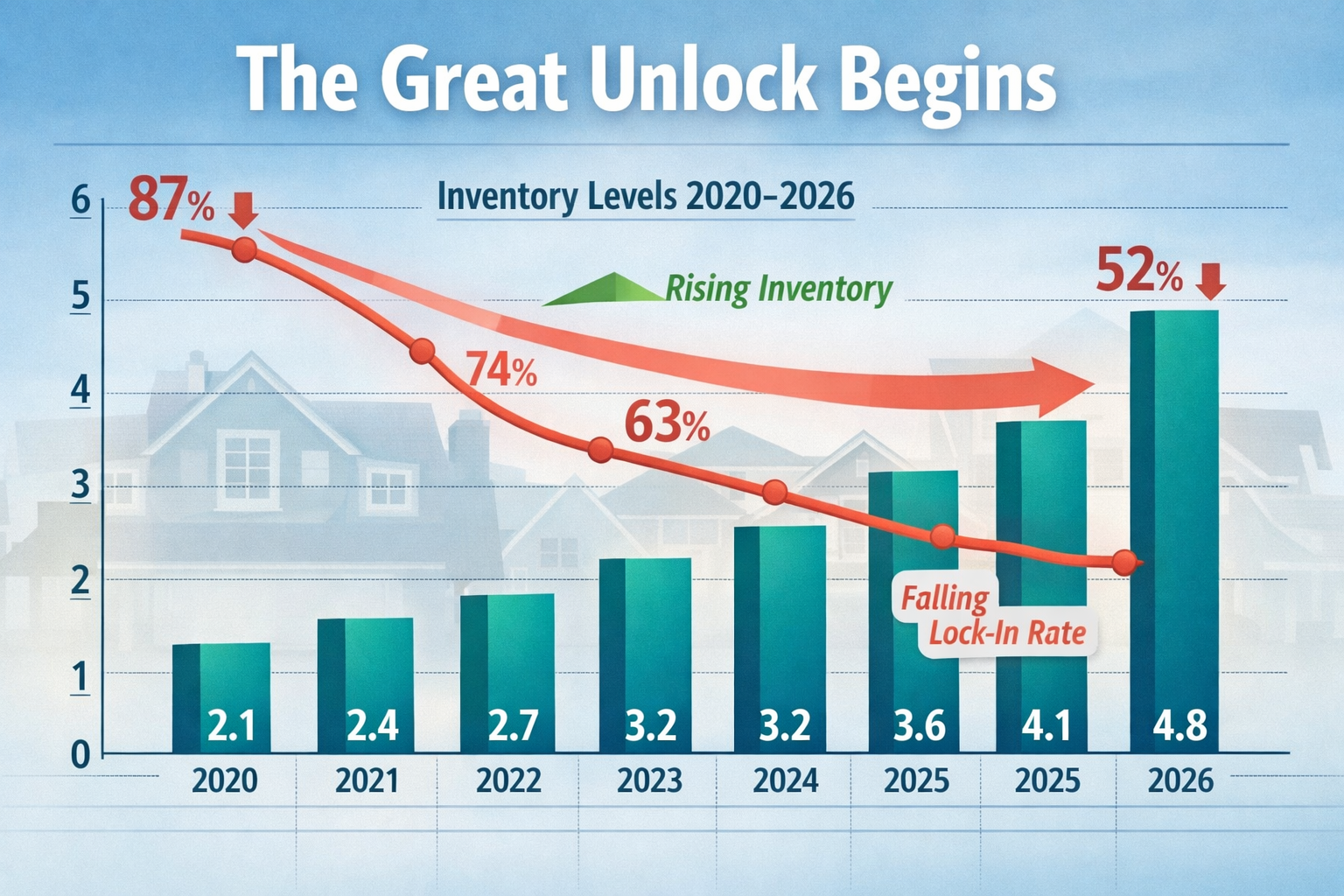
The Rank IQ: Inventory vs. lock-in effect — 2026 negotiation leverage guide helps property investors, homeowners, and real estate professionals understand how rising inventory and weakening mortgage rate lock-in are reshaping negotiation power. In 2026, the lock-in effect that trapped millions of homeowners is finally easing as more mortgages carry rates above 6%, reducing the financial penalty for moving. Meanwhile, inventory levels are climbing as these homeowners re-enter the market. Your negotiation leverage depends on which force dominates your local market—and knowing how to read the signals gives you an impeccable advantage.
What Is the Lock-In Effect and Why Does It Matter in 2026?
The lock-in effect occurs when homeowners with low mortgage rates (typically below 3-4%) feel financially trapped in their current homes because moving would mean accepting significantly higher rates. This psychological and financial barrier has kept millions of potential sellers on the sidelines since 2022.
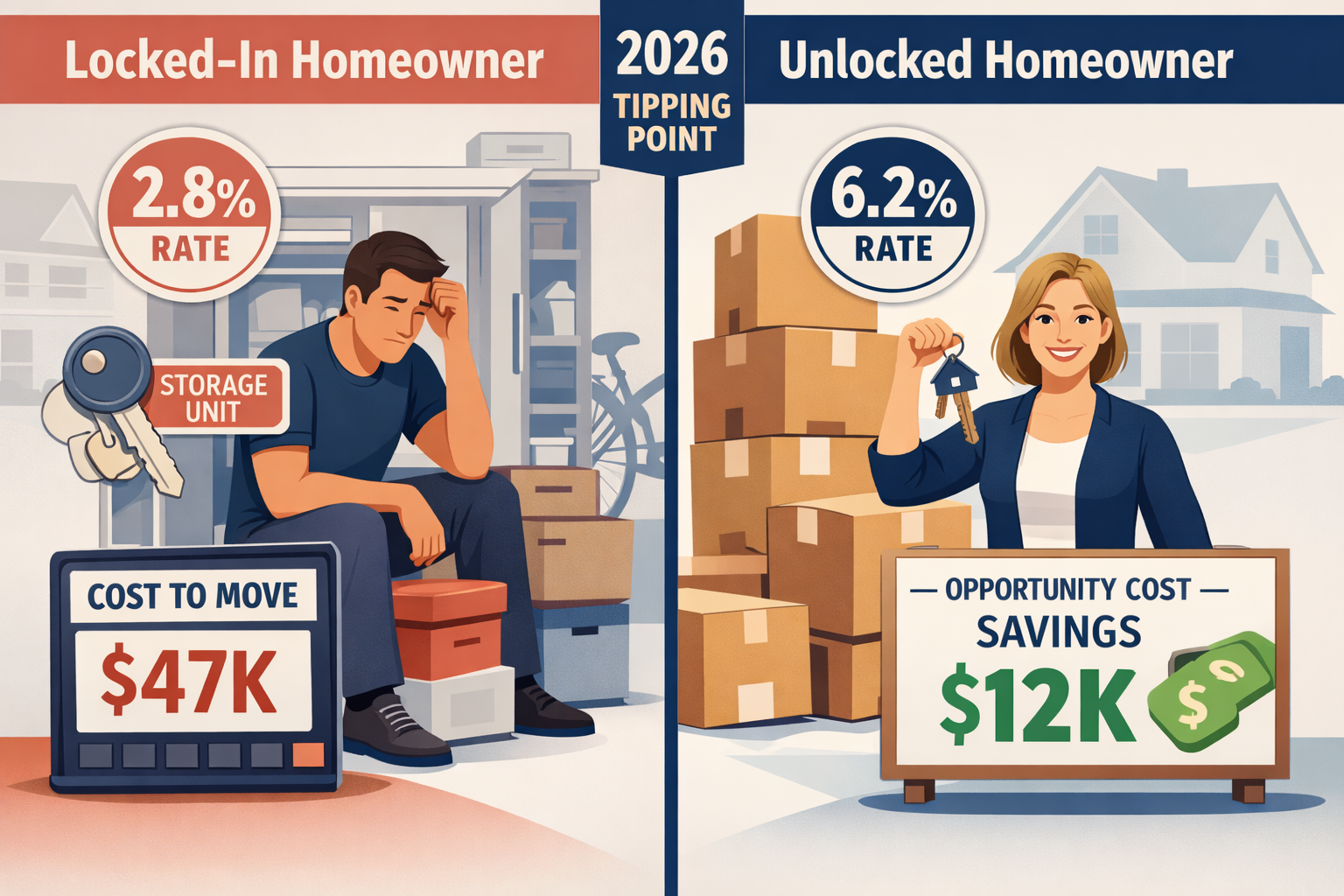
In 2026, this effect is finally weakening because mortgage rates have stabilized in the low-6% range while newer homeowners who purchased at higher rates face smaller penalties when considering a move[2]. The math has changed: if you bought in 2023 at 6.5%, moving to a new home at 6.2% doesn't create the same financial shock as going from 2.8% to 6.5%.
Why the Lock-In Effect Dominated 2022-2024
Between 2020 and 2021, millions of homeowners refinanced or purchased homes with rates below 3%. When rates jumped to 7%+ in 2022-2023, the monthly payment difference became staggering:
- $400,000 mortgage at 2.8%: ~$1,640/month (principal + interest)
- $400,000 mortgage at 6.5%: ~$2,528/month (principal + interest)
- Financial penalty: $888/month or $10,656/year
This created an extraordinary barrier to mobility. Even homeowners who desperately needed more space, wanted to relocate for jobs, or faced life changes stayed put because the financial cost was too painful.
The 2026 Shift: Lock-In Is Loosening
For the first time since the pandemic, the share of mortgages above 6% now exceeds those below 3%[2]. This matters because:
- Homeowners with 5-6% rates face smaller penalties when moving
- The psychological barrier is lower when rates are "only" 1-2% higher
- More sellers are willing to test the market as affordability improves
- Inventory is starting to normalize as these homeowners list their properties
Choose this strategy if: You're a buyer in a market where inventory is rising but still constrained. Understanding that some sellers are still locked in helps you identify which properties might have motivated sellers (those with higher existing rates) versus stubborn holdouts (those with sub-3% rates).
How Does Inventory Level Affect Your Negotiation Power?
Inventory level—measured in months of supply—directly determines whether buyers or sellers hold negotiation leverage. In 2026, inventory is gradually increasing as the lock-in effect weakens, but regional variations create dramatically different conditions.
Months of supply indicates how long it would take to sell all available homes at the current sales pace:
- 0-3 months: Extreme seller's market (buyers have minimal leverage)
- 4-6 months: Balanced market (negotiation power is relatively equal)
- 7+ months: Buyer's market (sellers must compete and negotiate)
Current Inventory Trends in 2026
Pending home sales were near multi-month lows in early 2026[1], indicating that while inventory is improving, transaction volume remains constrained. This creates a unique dynamic:
- Supply is increasing as lock-in loosens
- Demand remains cautious due to affordability concerns
- The market is transitioning from extreme shortage to more balanced conditions
- Regional differences are massive: some markets have 2 months of supply while others have 6+
Reading Your Local Market
To determine your negotiation leverage, you need fresh data on your specific market:
- Check months of supply: Contact local agents or use platforms like Real Estate Rank IQ for market data
- Track listing trends: Are more homes hitting the market week-over-week?
- Monitor days on market: Properties selling in under 10 days signal tight inventory
- Watch price reductions: Increasing price cuts indicate shifting leverage
Common mistake: Assuming national trends apply to your local market. A coastal California market might still have 2 months of supply while a Midwest suburb has 7 months—completely different negotiation environments.
Rank IQ: Inventory vs. Lock-In Effect — How to Assess Your Market Position
The Rank IQ: Inventory vs. lock-in effect — 2026 negotiation leverage guide framework helps you determine which force dominates your market and how to adjust your strategy accordingly.
The Four Market Scenarios
| Market Type | Inventory Level | Lock-In Intensity | Who Has Leverage | Best Strategy |
|---|---|---|---|---|
| Tight & Locked | Low (0-3 months) | High (60%+ locked in) | Sellers dominate | Buyers: compete aggressively, waive contingencies; Sellers: price high |
| Loosening Supply | Rising (3-5 months) | Moderate (40-60% locked) | Shifting to balance | Buyers: negotiate selectively; Sellers: price realistically |
| Balanced Unlock | Moderate (4-6 months) | Low (20-40% locked) | Equal power | Both: focus on terms, creative financing, seller credits |
| Buyer's Paradise | High (6+ months) | Minimal (<20% locked) | Buyers control | Buyers: demand concessions; Sellers: offer incentives |
How to Rank Your Market
Step 1: Determine local inventory level (months of supply)
- Contact three local agents for current data
- Check MLS statistics if you have access
- Use online platforms that track regional inventory
Step 2: Estimate lock-in intensity
- Markets with more 2020-2021 purchase/refi activity = higher lock-in
- Coastal and high-cost markets typically have higher lock-in[2]
- Midwest and affordable regions show lower lock-in intensity[2]
Step 3: Identify your market scenario
- Plot your findings on the table above
- Recognize that markets can shift between scenarios quarterly
Step 4: Adjust your negotiation approach
- Use the strategy column to guide your tactics
- Revisit monthly as conditions change
Edge case: Some neighborhoods within the same city can fall into different scenarios. Luxury markets might remain tight while starter homes see rising inventory—always drill down to your specific price point and location.
What Negotiation Tactics Work Best in High-Inventory Markets?
When inventory is rising (4+ months of supply) and the lock-in effect is weakening, buyers gain significant negotiation leverage. This is where the Rank IQ: Inventory vs. lock-in effect — 2026 negotiation leverage guide becomes so based for securing better deals.
Buyer Tactics for High-Inventory Environments
1. Request Seller Credits for Rate Buydowns
With more homes available, sellers are motivated to help buyers overcome affordability barriers. Requesting 2-3% of the purchase price as a credit toward a mortgage rate buydown can reduce your monthly payment significantly.
2. Negotiate Repairs and Upgrades
In tight markets, buyers accept homes "as-is." When inventory rises, you can:
- Request repairs identified in inspections
- Ask for credits to handle updates yourself
- Negotiate for specific improvements before closing
3. Include Contingencies
Financing, inspection, and appraisal contingencies protect buyers but can make offers less competitive. In high-inventory markets, you can safely include these protections because sellers have fewer backup offers.
4. Take Your Time
Don't rush. When inventory is abundant, new listings appear regularly. If negotiations stall, walk away and find another property—this leverage alone often brings sellers back to the table.
5. Lowball Strategically
In markets with 6+ months of supply, offering 5-10% below asking price becomes reasonable, especially for properties with:
- Extended days on market (30+ days)
- Price reductions already taken
- Visible deferred maintenance
Seller Tactics for High-Inventory Markets
1. Price Aggressively from Day One
The biggest mistake sellers make in rising-inventory markets is overpricing. Avoid pricing pitfalls by pricing at or slightly below comparable sales to generate immediate interest.
2. Offer Buyer Incentives
Stand out by offering:
- Rate buydown credits
- Closing cost assistance
- Home warranty coverage
- Flexible closing dates
3. Stage and Prep Impeccably
When buyers have choices, presentation matters. Follow a 60-day home prep checklist to ensure your property outshines the competition.
4. Be Flexible on Terms
If you can't compete on price, compete on convenience:
- Offer leaseback options if buyers want immediate possession
- Accept contingencies to attract cautious buyers
- Provide detailed inspection reports upfront
Choose high-inventory tactics if: Your market shows 4+ months of supply, days on market are increasing, and price reductions are common. These conditions signal that buyers have options and sellers must compete.
How Do You Negotiate in Low-Inventory, Lock-In Dominated Markets?

Despite the overall loosening trend, some markets—particularly coastal cities and high-cost metros—still experience tight inventory and strong lock-in effects[2]. In these environments, the Rank IQ: Inventory vs. lock-in effect — 2026 negotiation leverage guide requires completely different tactics.
Buyer Tactics for Low-Inventory Markets
1. Move Fast and Decisively
In markets with under 3 months of supply, hesitation costs deals. Prepare by:
- Getting pre-approved (not just pre-qualified) before house hunting
- Having earnest money ready to deposit immediately
- Reviewing comparable sales so you can make instant decisions
2. Write Clean Offers
Minimize contingencies that slow down or complicate transactions:
- Waive inspection contingencies (but still inspect for your own knowledge)
- Offer larger earnest money deposits
- Shorten closing timelines if possible
3. Escalation Clauses
Include escalation clauses that automatically increase your offer up to a maximum price if competing offers come in. Example: "Offer $500,000, escalating $5,000 above any competing offer up to $530,000."
4. Personal Letters (Where Legal)
In some markets, personal letters to sellers explaining why you love their home can create emotional connections. Check local regulations—some jurisdictions restrict these to prevent discrimination.
5. Accept Higher Prices
This is the harsh reality of low-inventory markets: you'll pay more. Focus on long-term value and appreciation potential rather than getting a "deal."
Seller Tactics for Low-Inventory Markets
1. Price at Market Value
You have leverage, but overpricing can still backfire. Price at market value to generate multiple offers, then let competition drive the price up.
2. Set Offer Deadlines
Create urgency by setting offer review dates (e.g., "reviewing all offers Monday at 5 PM"). This concentrates buyer activity and encourages best-and-final submissions.
3. Evaluate Offer Quality, Not Just Price
The highest offer isn't always the best. Consider:
- Buyer financing strength (cash vs. conventional vs. FHA)
- Contingency count
- Closing timeline alignment with your needs
- Earnest money amount
4. Limit Showings to Pre-Approved Buyers
In hot markets, you can require proof of financing before scheduling showings. This filters out unqualified buyers and reduces disruption.
Edge case: Even in low-inventory markets, overpriced homes sit. If your property hasn't received offers within 14 days, you've priced too high—adjust immediately before momentum dies.
What Role Does Mortgage Rate Strategy Play in 2026 Negotiations?
Mortgage rates hovering in the low-6% range create unique negotiation opportunities that didn't exist during the 3% or 7% extremes. Understanding rate buydowns, assumable mortgages, and creative financing becomes essential in the Rank IQ: Inventory vs. lock-in effect — 2026 negotiation leverage guide.
Rate Buydown Strategies
Temporary Buydowns (2-1 or 1-0)
Sellers can pay to temporarily reduce the buyer's interest rate:
- 2-1 Buydown: Rate is 2% lower in year one, 1% lower in year two, then normal
- 1-0 Buydown: Rate is 1% lower in year one, then normal
This helps buyers qualify and reduces early payments, making your property more attractive without permanent price reductions.
Permanent Buydowns
Sellers contribute funds at closing to permanently reduce the buyer's rate by 0.25-0.5%. The cost varies but typically runs 1-2% of the loan amount per 0.25% rate reduction.
Assumable Mortgages: The Hidden Gem
If the seller has an FHA, VA, or USDA loan with a low rate, buyers might be able to assume that mortgage. This is gate keeping information that many agents overlook:
How it works:
- Buyer assumes the seller's existing mortgage at the original rate
- Buyer must qualify with the lender
- Buyer pays the seller the difference between the home price and remaining loan balance
Example: Home sells for $450,000, seller has an assumable VA loan at 3.2% with $300,000 remaining. Buyer assumes the $300,000 loan and brings $150,000 cash (or gets a second mortgage) for the difference.
Common mistake: Assuming all mortgages are assumable. Conventional loans typically are not—only government-backed loans offer this option.
Creative Financing Options
Seller Financing
Sellers who own their homes outright or have substantial equity can offer financing:
- Seller acts as the bank
- Buyer makes payments to seller
- Terms are negotiable (rate, down payment, length)
- Requires legal documentation
Lease-Option Agreements
Buyers lease the property with an option to purchase later:
- Locks in purchase price today
- Portion of rent may credit toward down payment
- Gives buyers time to improve credit or save money
For more creative strategies, explore our guide on negotiation power moves.
How Do Regional Differences Impact the Lock-In Effect and Inventory?
The Rank IQ: Inventory vs. lock-in effect — 2026 negotiation leverage guide must account for dramatic regional variations. Coastal and high-cost markets experience different dynamics than Midwest and affordable regions[2].
High-Cost Coastal Markets
Characteristics:
- Stronger lock-in effect (more homeowners refinanced at ultra-low rates)
- Tighter inventory (geographic constraints, zoning restrictions)
- Higher average home prices ($700K+)
- More homeowners with substantial equity trapped by rate differences
Negotiation implications:
- Buyers face continued competition and limited leverage
- Sellers maintain pricing power longer
- Creative financing becomes more valuable
- Patience is required—these markets unlock more slowly
Examples: San Francisco, Los Angeles, Boston, New York metro, Seattle, San Diego
Midwest and Affordable Markets
Characteristics:
- Weaker lock-in effect (fewer homeowners refinanced at rock-bottom rates)
- More available land for new construction
- Lower average home prices ($200K-$400K)
- Faster inventory recovery
Negotiation implications:
- Buyers gain leverage more quickly
- Sellers must compete on price and terms earlier
- Traditional negotiation tactics work better
- Market normalizes faster toward historical patterns
Examples: Indianapolis, Columbus, Kansas City, Oklahoma City, Pittsburgh, Memphis
Sunbelt Growth Markets
Characteristics:
- Mixed dynamics (rapid population growth vs. new construction)
- Many recent buyers purchased at higher rates (less lock-in)
- Strong investor presence
- Volatile inventory levels
Negotiation implications:
- Market conditions can shift quickly
- Neighborhood-level analysis is critical
- New construction competes with resales
- Investor activity creates cash competition
Examples: Austin, Nashville, Phoenix, Tampa, Charlotte, Raleigh
Choose regional tactics if: You're investing or relocating across markets. What works in Cleveland won't work in San Diego—adjust your approach based on local dynamics.
What Data Signals Should You Monitor in 2026?
To effectively use the Rank IQ: Inventory vs. lock-in effect — 2026 negotiation leverage guide, you need to track specific metrics that reveal shifting market conditions.
Critical Metrics to Track Monthly
1. Months of Supply
- Where to find: Local MLS reports, real estate news sites, agent market updates
- What to watch: Increasing months = more buyer leverage; decreasing = more seller leverage
- Action threshold: Movement of 0.5+ months in either direction signals meaningful change
2. Days on Market (DOM)
- Where to find: MLS data, Zillow, Redfin, Realtor.com
- What to watch: Rising DOM = weakening seller power; falling DOM = strengthening seller power
- Action threshold: 10+ day changes in median DOM indicate shifting conditions
3. Price Reduction Frequency
- Where to find: Track new listings vs. price changes on real estate platforms
- What to watch: 20%+ of listings taking price cuts = buyer's market emerging
- Action threshold: Sharp increases in reduction frequency (5%+ monthly change)
4. New Listing Volume
- Where to find: MLS weekly reports, local real estate news
- What to watch: Increasing new listings = lock-in effect weakening
- Action threshold: 15%+ year-over-year increase in new listings
5. Pending Sales Ratio
- Where to find: MLS data, local market reports
- What to watch: Pending sales / active listings ratio shows absorption rate
- Action threshold: Below 25% = slow market; above 50% = hot market
Leading Indicators of Change
Storage Unit Rentals
Research shows 16% of Americans have rented storage specifically because they cannot move to homes that fit their needs, and another 26% are considering it[1]. This represents massive pent-up demand that will hit the market as conditions improve.
Mortgage Application Volume
Rising purchase applications signal growing buyer confidence and potential inventory absorption. Falling applications warn of weakening demand.
New Construction Permits
Increasing permits indicate builders expect demand, which can pressure resale inventory as new homes compete for buyers.
For comprehensive market trend analysis, check our 2026 real estate market trends guide.
How Should Real Estate Agents Adapt Their Client Strategies?
Real estate agents and brokers need to provide extraordinary guidance as the Rank IQ: Inventory vs. lock-in effect — 2026 negotiation leverage guide reshapes client expectations and strategies.
Buyer Agent Strategies
1. Set Realistic Expectations
Educate buyers on local market conditions:
- Show them months of supply data
- Explain how lock-in affects seller behavior
- Prepare them for appropriate competition levels
2. Create Market-Specific Game Plans
- Tight markets: Pre-approval, fast decisions, competitive offers
- Balanced markets: Strategic negotiation, contingency protection
- Buyer's markets: Patient searching, aggressive negotiation, inspection leverage
3. Identify Motivated Sellers
Look for signals that sellers are less locked in:
- Properties purchased or refinanced after 2021 (higher existing rates)
- Extended days on market
- Life event indicators (job relocation, estate sales, divorce)
- Price reductions already taken
4. Leverage Technology
Use AI marketing tools to:
- Track market metrics automatically
- Identify new listings instantly
- Analyze comparable sales quickly
- Create compelling offer presentations
Seller Agent Strategies
1. Conduct Honest CMAs
Don't inflate values to win listings. In 2026's shifting market, accurate pricing is critical:
- Account for rising inventory in your projections
- Adjust for local lock-in intensity
- Show sellers data on DOM and price reductions
- Recommend aggressive initial pricing
2. Prepare Sellers for Negotiation
In markets where lock-in is loosening, sellers must adjust expectations:
- Buyers will request more concessions
- Inspection negotiations will be tougher
- Offers may include more contingencies
- Multiple offers are less guaranteed
3. Highlight Property Advantages
Help sellers compete by emphasizing:
- Recent updates and improvements
- Assumable financing if available
- Flexible terms they can offer
- Unique features competitors lack
4. Master Seller Credit Strategies
Become an expert in structuring rate buydowns and seller credits. This knowledge becomes a competitive advantage when helping sellers stand out. Learn more about seller credits that buyers request most.
Investor-Focused Agent Tactics
1. Identify Emerging Buyer's Markets
Help investors find markets where:
- Lock-in is weakening fastest
- Inventory is rising significantly
- Prices haven't adjusted yet
- Rental demand remains strong
2. Analyze Cash Flow Impact
Show investors how changing rates and prices affect:
- Purchase price vs. rental income ratios
- Debt service coverage
- Cash-on-cash returns
- Appreciation potential
3. Source Off-Market Deals
In markets still constrained by lock-in, off-market sourcing becomes valuable:
- Direct mail to homeowners with higher-rate mortgages
- Networking with estate attorneys and divorce lawyers
- Probate and pre-foreclosure opportunities
For comprehensive investment strategies, explore our best real estate investment strategies guide.
What Are the Biggest Mistakes to Avoid in 2026 Negotiations?
Understanding the Rank IQ: Inventory vs. lock-in effect — 2026 negotiation leverage guide means avoiding common pitfalls that cost buyers and sellers thousands.
Buyer Mistakes
1. Using 2021-2022 Strategies in 2026
The market has changed. Waiving all contingencies made sense when inventory was at historic lows—it's often unnecessary now as inventory rises.
2. Ignoring Regional Differences
Applying national trends to your local market leads to poor decisions. Always verify local inventory levels and lock-in intensity.
3. Overestimating Seller Desperation
Just because inventory is rising doesn't mean every seller is desperate. Lowball offers on well-priced, recently listed properties often backfire.
4. Neglecting Rate Buydown Negotiations
Many buyers focus only on purchase price. Negotiating seller credits for rate buydowns can save more money over the loan term than a small price reduction.
5. Skipping Pre-Approval
Even in rising-inventory markets, sellers prefer pre-approved buyers. Pre-qualification letters carry less weight and may cost you deals.
Seller Mistakes
1. Overpricing Based on 2021-2022 Comps
Markets have shifted. Using peak-market comparables leads to overpricing, extended DOM, and eventual price reductions that signal desperation.
2. Refusing All Negotiations
Even in tight markets, some negotiation is normal. Refusing reasonable requests for repairs or credits can kill deals unnecessarily.
3. Ignoring Presentation
When inventory rises, presentation matters more. Skipping staging, professional photos, or necessary repairs costs money. Check our guide on home improvements before selling for high-ROI projects.
4. Misunderstanding Buyer Financing
Not all offers are equal. A cash offer at 5% below asking may be better than a financed offer at asking price with multiple contingencies.
5. Waiting for Perfect Conditions
Some sellers wait for rates to drop or inventory to tighten. This often backfires—list when you're ready to sell, not when you think conditions will be perfect.
Agent Mistakes
1. Providing Generic Advice
Every market and client situation is unique. Customize your guidance based on specific local conditions and client goals.
2. Failing to Update Market Knowledge
2026 is a transitional year. What worked in January may not work in June. Stay current on local data and adjust strategies accordingly.
3. Avoiding Difficult Conversations
Telling sellers their home is overpriced or buyers their budget is unrealistic is hard—but necessary. Honest guidance builds trust and produces better outcomes.
4. Neglecting Follow-Up on Changing Conditions
Markets shift. Check in with clients monthly to reassess strategy based on new data.
How Will the Inventory vs. Lock-In Dynamic Evolve Through 2026?
Looking ahead, the Rank IQ: Inventory vs. lock-in effect — 2026 negotiation leverage guide will continue evolving as economic conditions change.
Expected Trends for Mid-to-Late 2026
Gradual Inventory Increases
As more homeowners with 5-6% mortgages decide the penalty for moving is acceptable, inventory should continue rising. This trend accelerates if:
- Mortgage rates drop below 6%
- Job market remains strong (enabling moves)
- Home prices stabilize or decline slightly
Regional Divergence Widens
Expect growing differences between markets:
- Coastal cities: Slower inventory recovery, persistent lock-in
- Sunbelt markets: Faster normalization due to new construction and recent buyer activity
- Midwest markets: Return to more traditional seasonal patterns
Affordability Improvements
Housing affordability is expected to improve in 2026 as home prices flatten and incomes rise[3]. This creates better conditions for transactions and reduces the psychological barrier to moving.
Pent-Up Demand Release
The 16% of Americans currently renting storage because they can't move[1] represents significant latent demand. As conditions improve, this demand will enter the market, supporting prices even as inventory rises.
Scenario Planning for Different Outcomes
Optimistic Scenario: Rates Drop to 5-5.5%
- Lock-in effect dissolves rapidly
- Inventory surges 20-30%
- Buyer's markets emerge in most regions
- Transaction volume increases significantly
- Negotiation heavily favors buyers
Base Case: Rates Remain 5.75-6.25%
- Gradual lock-in loosening continues
- Inventory rises 10-15%
- Most markets move toward balance
- Negotiation power equalizes
- Regional differences persist
Pessimistic Scenario: Rates Rise Above 7%
- Lock-in effect re-intensifies
- Inventory growth stalls
- Seller's markets persist
- Transaction volume remains suppressed
- Buyers face continued challenges
Prepare for uncertainty by: Building flexibility into your strategy, monitoring leading indicators monthly, and maintaining relationships with knowledgeable local agents who track conditions closely.
Frequently Asked Questions
Q: How do I know if sellers in my market are still locked in by low mortgage rates?
Check when most homes in your target neighborhood were purchased or refinanced. If 60%+ of sales occurred in 2020-2021, lock-in intensity is likely high. You can also ask listing agents directly about the seller's existing mortgage rate—motivated sellers with higher rates (5%+) are less locked in and may negotiate more readily.
Q: What's the best way to negotiate seller credits for a rate buydown in 2026?
Request 2-3% of the purchase price as a seller credit specifically designated for a permanent rate buydown or temporary 2-1 buydown. Frame it as helping the seller compete in a rising-inventory market where buyers have more choices. Work with your lender to show the seller exactly how the credit will be used and how it makes your offer more attractive than competitors.
Q: Should I wait to buy until inventory increases more and the lock-in effect fully dissolves?
Timing the market perfectly is impossible. If you find a home that meets your needs at a price you can afford, buying now makes sense—especially if rates are reasonable. Waiting risks rising prices if demand increases faster than inventory, and you lose months of building equity and enjoying your home. Focus on long-term value, not short-term market timing.
Q: How can I tell if a seller is motivated or just testing the market?
Look for these signals of motivation: property listed for 20+ days, price reductions already taken, flexible showing availability, willingness to negotiate on inspection items, and life circumstances like job relocation or estate sales. Sellers who reject reasonable offers quickly, have minimal showing flexibility, or refuse to negotiate on anything are likely testing the market.
Q: What inventory level signals a true buyer's market in 2026?
Generally, 6+ months of supply indicates a buyer's market where sellers must compete for buyers. However, this varies by region and price point. In historically tight markets like coastal cities, even 4-5 months might feel like a buyer's market. In traditionally balanced Midwest markets, 7-8 months might be needed. Compare current levels to your market's 10-year average for context.
Q: Are assumable mortgages really worth pursuing in 2026?
Yes, if the seller has an FHA, VA, or USDA loan with a rate significantly below current market rates (3-4% range). The challenge is finding them and qualifying for assumption. You'll also need cash or a second mortgage to cover the difference between the home price and remaining loan balance. Work with a lender experienced in assumptions—many agents and lenders aren't familiar with the process.
Q: How should I adjust my negotiation strategy if I'm selling in a market where inventory is rising?
Price aggressively from day one—at or slightly below recent comparable sales. Offer buyer incentives like rate buydown credits or closing cost assistance. Stage impeccably and address obvious repairs before listing. Be prepared to negotiate on inspection items and show flexibility on closing dates. The biggest mistake is overpricing and then chasing the market down with multiple reductions.
Q: What's the financial penalty for moving if I have a 3% mortgage and new rates are 6%?
On a $400,000 mortgage, moving from 3% to 6% increases your monthly payment by approximately $675 (from $1,686 to $2,398 for principal and interest). Over 30 years, that's $243,000 in additional interest. However, if your new home better fits your needs, the quality-of-life improvement may justify the cost. Also consider that you might be buying a more expensive home with more equity potential.
Q: How do I find accurate months of supply data for my local market?
Contact three local real estate agents and ask for their latest market reports—most have access to MLS data showing months of supply. You can also check local real estate board websites, regional MLS public portals, or use platforms like Redfin and Realtor.com which publish market trend data. For the most accurate information, drill down to your specific neighborhood and price range, not just city-wide averages.
Q: Should real estate investors focus on high-inventory or low-inventory markets in 2026?
It depends on your strategy. High-inventory markets offer better purchase prices and negotiation leverage, ideal for cash flow investors seeking deals. Low-inventory markets may offer stronger appreciation potential and easier rent growth, better for long-term equity building. Analyze specific market fundamentals: job growth, population trends, rental demand, and price-to-rent ratios. Check our fix and flip opportunities guide for market-specific investment insights.
Q: What happens if mortgage rates drop significantly later in 2026 after I buy?
You can refinance to capture lower rates, though you'll pay closing costs (typically 2-3% of the loan amount). If rates drop 0.75-1% or more, refinancing usually makes financial sense. Alternatively, negotiate seller credits at purchase to buy down your initial rate, then refinance later if rates drop further—you get immediate payment relief and can refinance to a low rate later.
Q: How can I tell if a market is transitioning from seller's to buyer's market?
Watch for these signals: months of supply increasing 0.5+ months quarter-over-quarter, median days on market rising 10+ days, price reduction frequency exceeding 20% of listings, new listing volume increasing 15%+ year-over-year, and pending sales ratio dropping below 35%. When you see three or more of these indicators simultaneously, the market is likely transitioning. Markets rarely flip overnight—transitions typically take 6-12 months.
Conclusion
The Rank IQ: Inventory vs. lock-in effect — 2026 negotiation leverage guide reveals that 2026 is a year of transition and opportunity in real estate. The lock-in effect that dominated the market since 2022 is finally loosening as more mortgages carry rates above 6%, reducing the financial penalty for moving[2]. Meanwhile, inventory is gradually increasing as these homeowners re-enter the market, creating fresh dynamics that favor prepared buyers, sellers, and investors.
Understanding which force—inventory or lock-in—dominates your local market determines your negotiation strategy. High-cost coastal markets still experience tight constraints, while Midwest and affordable regions are normalizing faster[2]. Regional analysis matters more than ever.
The 16% of Americans renting storage because they can't move to homes that fit their needs[1] represents massive pent-up demand waiting to be released. As affordability improves through 2026 with flattening prices and rising incomes[3], this demand will fuel transactions and support the market.
Your Next Steps
If you're a buyer:
- Get pre-approved immediately to move quickly when opportunities arise
- Track your local months of supply monthly to gauge negotiation leverage
- Learn about rate buydowns and seller credits to reduce financing costs
- Work with agents who understand current market dynamics
- Explore our negotiation power moves guide for additional tactics
If you're a seller:
- Price aggressively based on current market conditions, not 2021-2022 peaks
- Consider offering buyer incentives if inventory is rising in your market
- Prepare your home impeccably using our 60-day selling checklist
- Understand your existing mortgage rate affects your motivation and negotiation position
- Review seller closing costs to budget accurately
If you're a real estate agent:
- Track local market metrics monthly and adjust client strategies accordingly
- Educate clients on the inventory vs. lock-in dynamic in your market
- Master rate buydown structuring to provide extraordinary value
- Build your sphere of influence with market expertise
- Leverage AI marketing tools to stay ahead of market changes
If you're an investor:
- Identify markets where lock-in is weakening fastest for better deal flow
- Analyze how changing rates and prices affect cash flow projections
- Consider markets with rising inventory for negotiation leverage
- Explore our best real estate investments guide for strategy insights
- Use tools like PropStream to find off-market opportunities
The 2026 real estate market rewards those who understand the interplay between inventory and lock-in effects. Stay informed, track local data, and adjust your strategy as conditions evolve. The market is finally letting it cook after years of extreme constraint—those who adapt will find extraordinary opportunities.
For ongoing market analysis and expert guidance, visit Real Estate Rank IQ or subscribe to our YouTube channel @Realestaterankiq. Contact us at news@realestaterankiq.com for personalized market insights.
References
[1] Storables 2026 Moving Forecast – https://www.storable.com/resources/storables-2026-moving-forecast/
[2] Housing Market Lock In Effect Easing – https://www.kiplinger.com/real-estate/selling-a-home/housing-market-lock-in-effect-easing
[3] Page – https://www.housingwire.com/housing-market/page/8/
{“@context”:”https://schema.org”,”@type”:”Article”,”headline”:”Rank IQ: Inventory vs. lock-in effect u2014 2026 negotiation leverage guide”,”description”:” Master the inventory vs lock-in effect with our 2026 negotiation leverage guide. Expert tactics for buyers, sellers, and agents in changing markets.”,”image”:”https://zsxkvszxbhpwnvzxdydv.supabase.co/storage/v1/object/public/generated-images/kie/53d00008-926c-4619-a22f-a46b65a97747/slot-0-1771913315367.png”,”datePublished”:”2026-02-24T06:03:32.543545+00:00″,”dateModified”:”2026-02-24T06:09:09.214Z”,”author”:{“@type”:”Organization”,”name”:”real estate rank iq”},”publisher”:{“@type”:”Organization”,”name”:”real estate rank iq”}}