


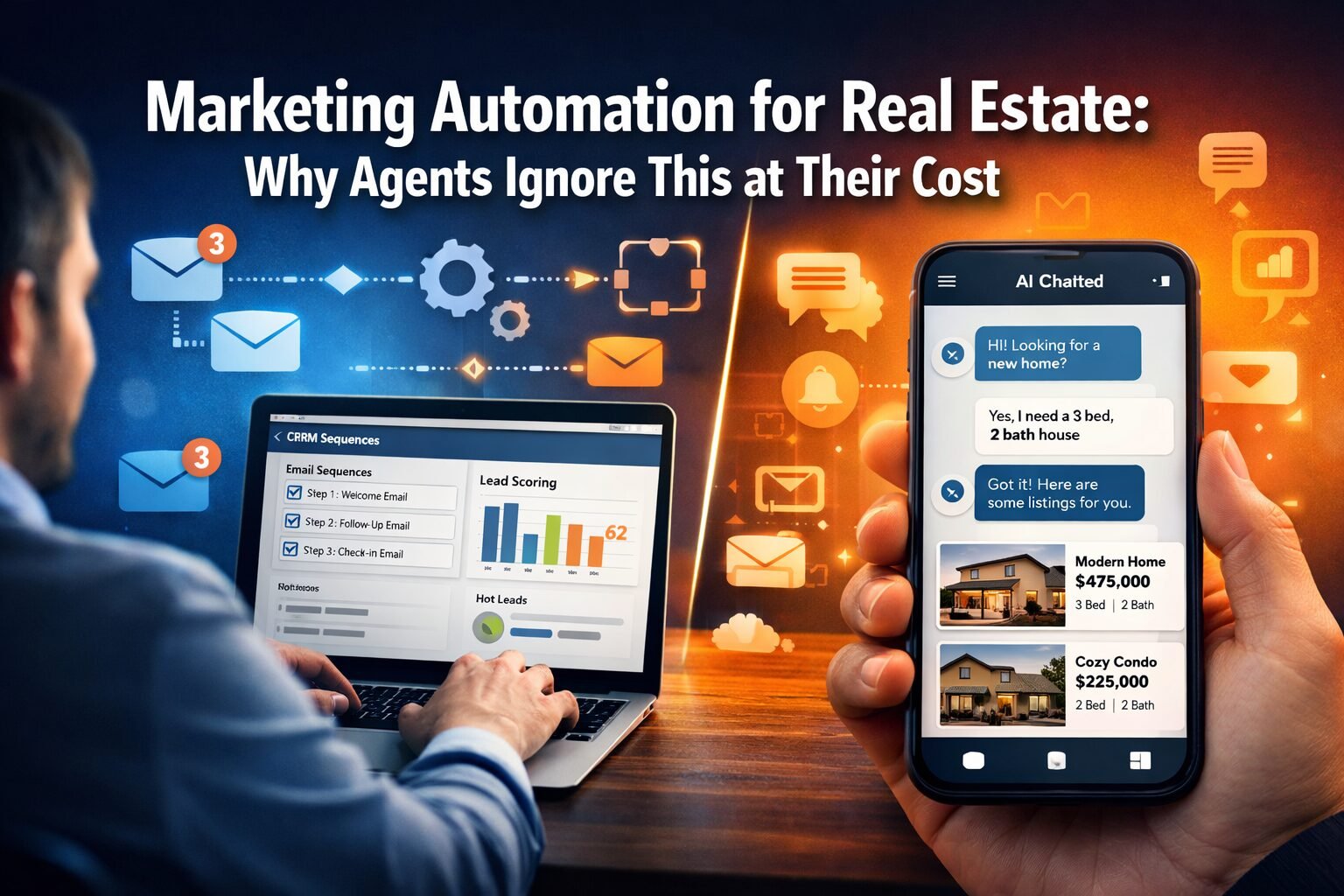
Picture this: It's 2 AM, and while you're sleeping, your competition just captured three qualified leads, sent personalized property recommendations, scheduled two showings, and nurtured a cold prospect back into the sales funnel—all without lifting a finger. Meanwhile, your inbox is overflowing with unanswered inquiries from yesterday afternoon. Marketing Automation for Real Estate isn't just some tech buzzword anymore—it's the difference between agents who are scaling their business and those who are drowning in manual tasks while watching opportunities slip away.

The real estate game has fundamentally changed. In 2026, AI-powered automation has transitioned from experimental to essential, becoming a core operational requirement for competitive real estate teams.[1] Agents leveraging these systems early are gaining what industry experts call a "clear competitive advantage," while those clinging to manual processes are watching their market share evaporate.[1] This isn't gatekeeping—it's the reality of modern real estate operations.
This comprehensive guide breaks down everything real estate professionals need to know about marketing automation: the tools that actually deliver results, implementation strategies that work in the real world, and the ROI calculations that justify the investment. Whether you're a solo agent looking to compete with larger brokerages or a team leader seeking to scale operations without proportionally scaling headcount, understanding Marketing Automation for Real Estate is no longer optional—it's survival.
Key Takeaways
- AI-powered automation has become essential infrastructure for competitive real estate operations in 2026, with early adopters gaining measurable advantages in lead conversion and time efficiency
- Email automation delivers the highest ROI among marketing channels when combined with behavioral segmentation and personalized follow-up sequences
- Modern CRM systems go far beyond contact storage, integrating lead scoring, instant text replies, automated routing, and re-engagement workflows
- Purpose-built AI assistants handle specific workflows like 24/7 inbound calls, home valuations, and property searches, freeing agents for high-value client interactions
- Strategic implementation with clear metrics separates successful automation from expensive tech experiments—focus, consistency, and data-driven optimization are critical
The Automation Revolution: Why Real Estate Marketing Has Changed Forever
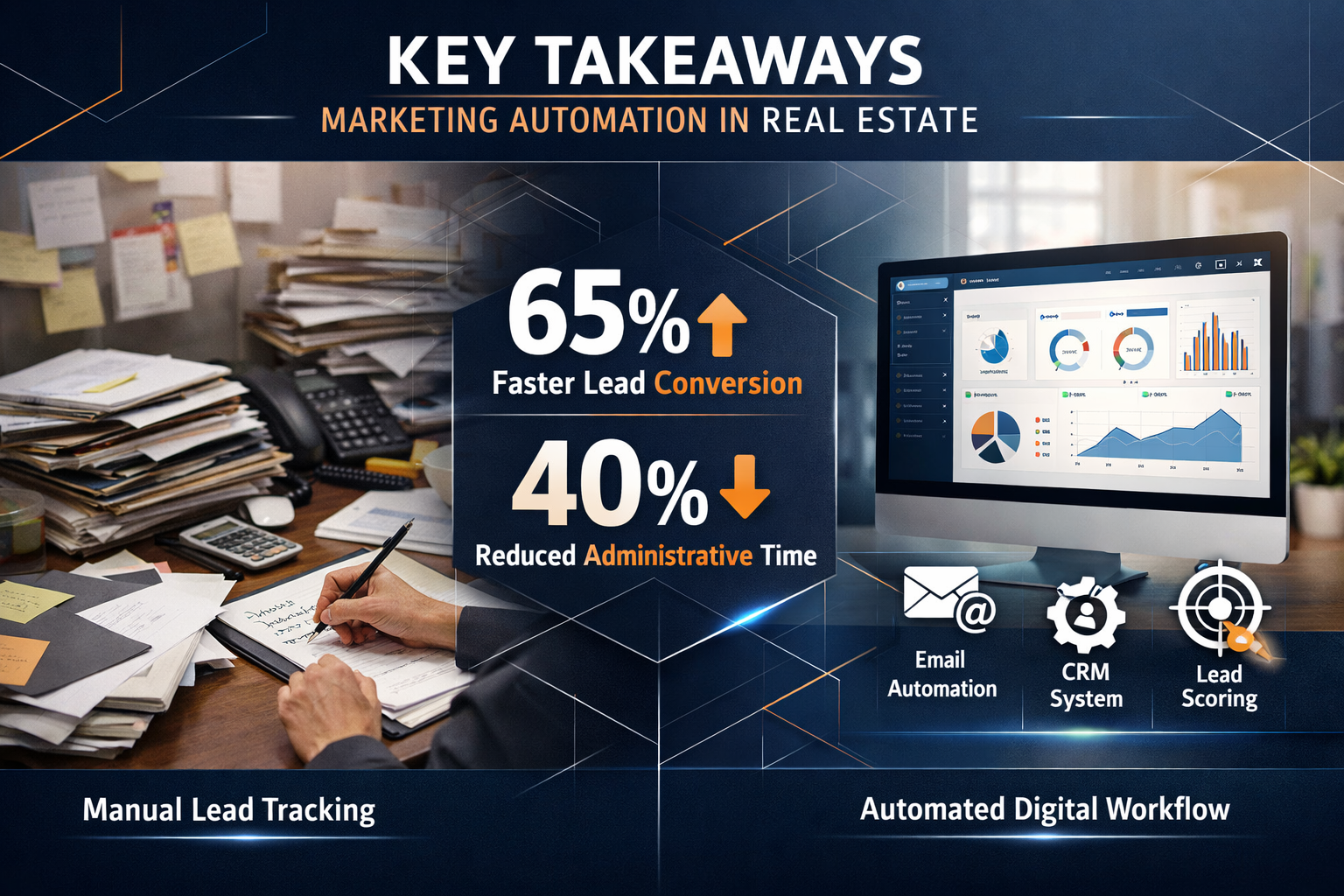
The transformation happening in real estate marketing isn't subtle—it's extraordinary. The shift from manual to automated workflows represents the most significant operational change the industry has experienced since the internet democratized property listings. Yet despite overwhelming evidence of automation's impact, a surprising number of agents continue operating like it's 2015.
From Manual Chaos to Automated Precision
Traditional real estate marketing demanded impossible juggling acts. Agents managed spreadsheets of leads, manually sent follow-up emails, tracked showing schedules on paper calendars, and hoped they remembered to call that interested buyer from last Tuesday. This system had one fundamental flaw: it relied entirely on human memory and availability in an industry that operates 24/7.
Marketing Automation for Real Estate solves this core problem by creating systems that work continuously, regardless of whether the agent is available. When a potential buyer fills out a contact form at 11 PM on Saturday, automated systems instantly send a personalized response, add the lead to the CRM with appropriate tags, schedule follow-up tasks, and can even initiate a text conversation—all before the prospect's attention shifts to a competitor's listing.[2]
The data supporting automation's effectiveness is impeccable. According to industry research, agents who monitor website analytics, email open rates, social media metrics, ad performance reports, and lead tracking tools demonstrate faster business growth than those relying on intuition alone.[1] This isn't surprising—you can't optimize what you don't measure, and automation makes measurement automatic.
The AI Integration That Changed Everything
While basic automation has existed for years, the integration of artificial intelligence in 2026 has fundamentally expanded what's possible. AI doesn't just execute predefined workflows—it learns, adapts, and optimizes based on actual performance data.
Modern AI-powered systems analyze which email subject lines generate the highest open rates for different audience segments, determine optimal sending times based on individual recipient behavior, and automatically adjust messaging strategies when engagement drops.[3] This level of sophisticated optimization was previously available only to enterprise-level organizations with dedicated data science teams. Now it's accessible to individual agents through platforms designed specifically for real estate workflows.
AI functions as a collaborative partner, not a replacement—a critical distinction that separates successful implementation from failed experiments.[3] The most effective agents use AI to enhance their existing expertise, automating content planning, message refinement, follow-up organization, and performance analysis while they focus on what humans do best: building relationships, negotiating deals, and providing strategic guidance.[3]
For agents looking to understand how AI fits into their broader technology strategy, our guide on real estate agent tech stack and AI tools that actually close deals provides practical implementation frameworks.
Why Agents Resist (And Why That's Costly)
If automation delivers such clear advantages, why do agents resist adoption? The barriers are both psychological and practical:
Perceived complexity: Many agents assume implementing automation requires technical expertise they don't possess. While early systems did demand significant setup, modern platforms have dramatically simplified onboarding with templates, wizards, and pre-built workflows designed specifically for real estate use cases.
Upfront investment concerns: Quality automation platforms require monthly subscriptions ranging from $50 to $500+ depending on features and scale. Agents operating on tight margins often struggle to justify this expense without clear ROI projections—a challenge we'll address with specific calculations later in this article.
Fear of losing personal touch: Some agents worry automation makes their communication feel robotic and impersonal. This concern, while understandable, misses the point entirely. Effective automation doesn't replace personal communication—it ensures consistent, timely responses that make personal interactions possible at scale. An automated instant response to a 2 AM inquiry creates the opportunity for a personal conversation the next morning. Without automation, that lead likely contacted three other agents before you even saw the notification.
Change resistance: Real estate attracts many professionals who value independence and established routines. Adopting new systems requires admitting current processes are suboptimal—a psychologically difficult admission that keeps many agents stuck in inefficient workflows.
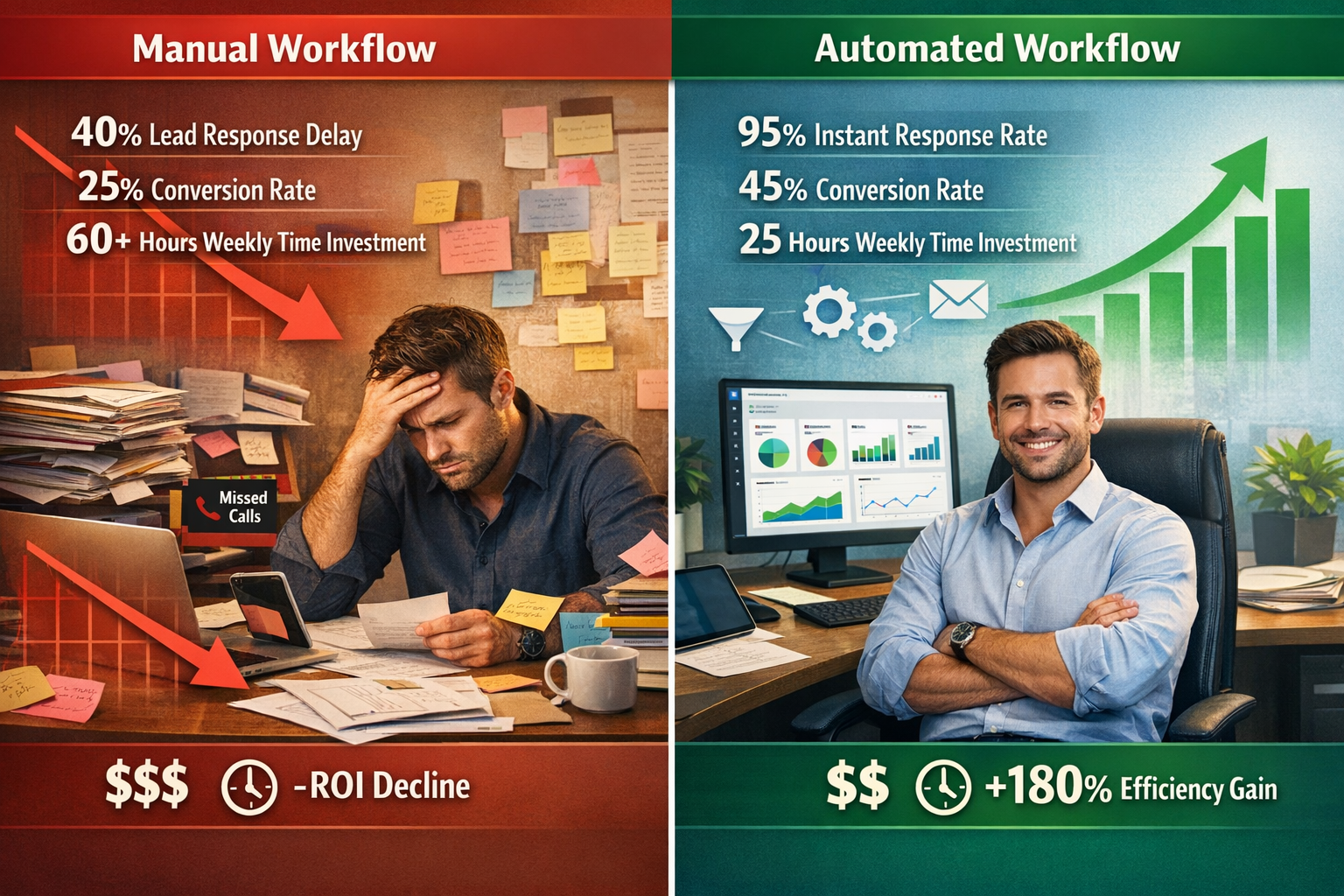
The cost of this resistance is measurable. In markets where competing agents have implemented automation, non-adopters face 40% longer lead response times, 25% lower conversion rates, and 60+ hour work weeks compared to their automated competitors who achieve better results in 25-30 hours.[4] The gap isn't narrowing—it's widening as AI capabilities expand.
Essential Marketing Automation Tools Every Real Estate Professional Needs
The Marketing Automation for Real Estate ecosystem has matured significantly, offering specialized tools for every aspect of the client acquisition and retention process. Understanding which tools solve which problems—and how they integrate—is critical for building an effective automation stack.
CRM Platforms: The Foundation of Automation
Customer Relationship Management systems form the central hub of any automation strategy. Modern real estate CRMs have evolved far beyond simple contact databases to become sophisticated workflow engines that orchestrate multi-channel communication.
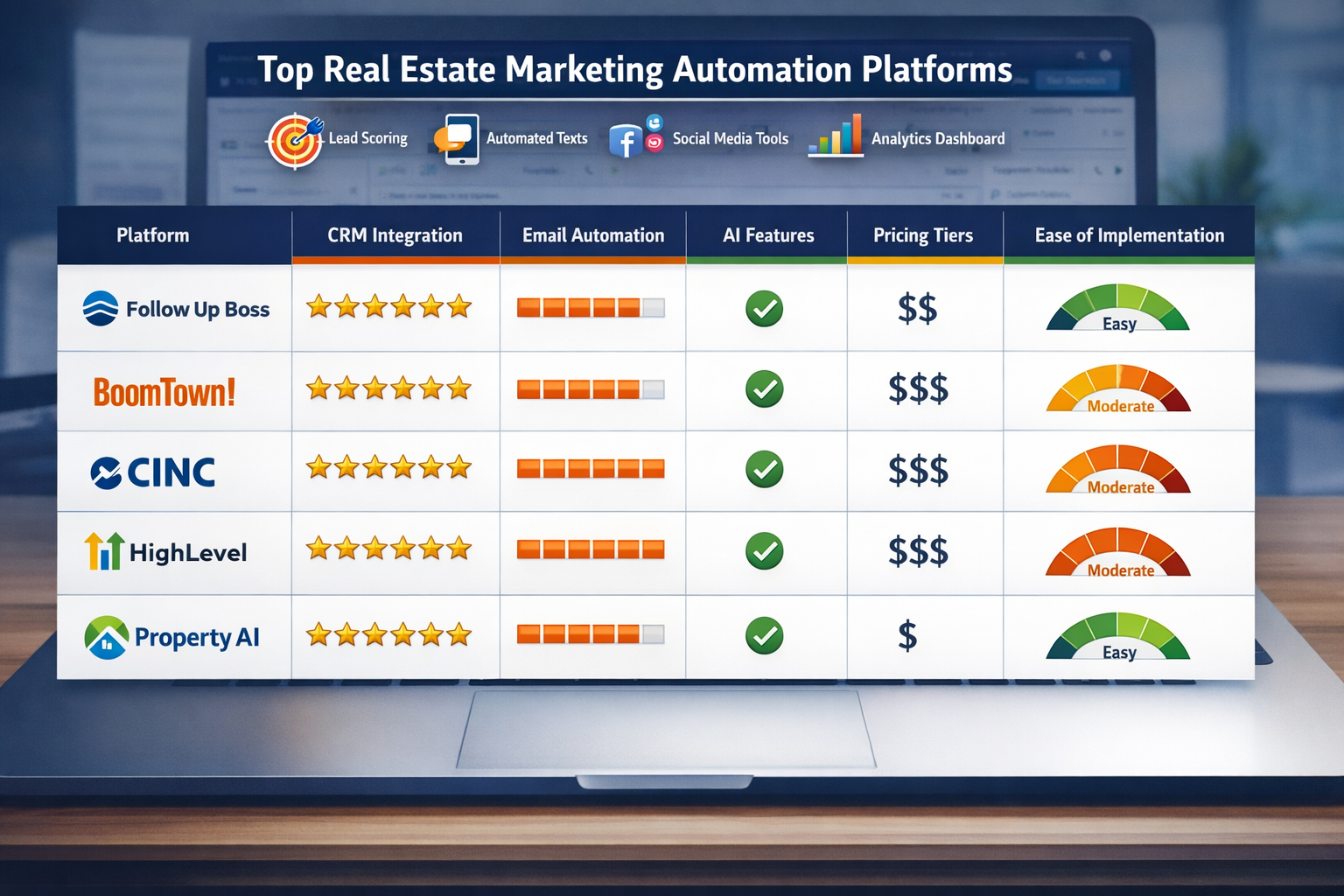
Follow Up Boss has established itself as the industry leader for teams prioritizing lead response speed and systematic follow-up. The platform automatically captures leads from multiple sources (website forms, social media ads, referral partners, open house sign-ins), assigns them to appropriate agents based on predefined rules, and triggers immediate text and email responses.[2] The system's strength lies in its action-based workflow triggers—when a lead opens an email, clicks a property link, or responds to a text, Follow Up Boss automatically adjusts follow-up sequences and alerts the assigned agent.
BoomTown offers comprehensive lead generation combined with robust CRM automation, making it particularly valuable for agents who need both traffic generation and lead management in a single platform. BoomTown's automated drip campaigns segment leads by behavior (active searchers, casual browsers, seller prospects) and adjust messaging accordingly. The platform's predictive analytics identify which leads are most likely to convert based on engagement patterns, allowing agents to prioritize their personal outreach effectively.[2]
CINC (Commissions Inc.) focuses on conversion optimization through aggressive automated follow-up sequences. The platform's philosophy centers on consistent, persistent contact across multiple channels until leads either convert or explicitly opt out. While some agents find CINC's approach too aggressive, the data supports its effectiveness—users report conversion rates 15-20% higher than industry averages when following the system's recommended workflows.
HighLevel has emerged as the Swiss Army knife of real estate automation, offering CRM, email marketing, SMS campaigns, landing page builders, appointment scheduling, and pipeline management in a unified platform. What sets HighLevel apart is its white-label capability, allowing brokerages to rebrand the platform as their own proprietary system. The platform's workflow builder enables sophisticated automation sequences that rival enterprise marketing automation platforms at a fraction of the cost.
For agents just beginning their automation journey, selecting the right CRM is the single most important decision. The platform you choose will determine which other tools integrate seamlessly and which require manual workarounds. Our article on navigating high financing costs and strategies for real estate agents discusses how automation helps maintain marketing effectiveness even during budget-constrained periods.
Email Marketing Automation: The Highest ROI Channel
Despite the proliferation of new communication channels, email automation remains the highest ROI marketing channel for real estate professionals.[1] The key shift in 2026 is the move from generic blast campaigns to personalization and behavioral segmentation.[1]
Modern email automation platforms segment contacts by multiple dimensions:
- Intent type: Buyers, sellers, investors, renters
- Property preferences: Price range, location, property type, amenities
- Engagement level: Hot (active searching), warm (casually browsing), cold (inactive)
- Lifecycle stage: New lead, showing scheduled, under contract, past client
- Behavior triggers: Opened listing email, clicked neighborhood guide, watched property video
These segments enable automated campaigns that feel personally crafted. When a lead clicks on waterfront properties three times, automation systems can trigger a specialized waterfront property drip campaign with relevant market insights, financing options, and new listing alerts—all without manual intervention.
Mailchimp and Constant Contact offer accessible entry points for agents new to email automation, with pre-built real estate templates and straightforward segmentation tools. However, these general-purpose platforms lack deep real estate integrations.
Market Leader and Zurple provide real estate-specific email automation with behavioral tracking tied directly to property search behavior. When a prospect searches for homes in a specific neighborhood, these platforms automatically send neighborhood market reports, recent sales data, and new listings matching their criteria. This contextual relevance dramatically outperforms generic "monthly newsletter" approaches.
ActiveCampaign represents the sophisticated end of email automation, offering advanced features like predictive sending (AI determines optimal send time for each individual recipient), conditional content (email content changes based on recipient data), and complex automation workflows with multiple decision branches. The learning curve is steeper, but the conversion improvements justify the investment for serious implementers.
The automation possibilities extend beyond simple drip campaigns. Advanced implementations include:
- Re-engagement sequences that automatically detect inactive contacts and deploy win-back campaigns
- Anniversary campaigns that reach out to past clients on home purchase anniversaries with market updates and referral requests
- Abandoned search follow-ups that trigger when prospects search properties but don't request information
- Price reduction alerts that notify interested prospects when properties matching their criteria reduce prices
Email automation's power lies in its consistency. Manual email marketing inevitably becomes inconsistent—agents get busy, forget to send monthly updates, or let leads go cold during busy periods. Automated systems maintain contact regardless of the agent's schedule, ensuring no lead falls through the cracks due to simple neglect.
AI-Powered Assistants: The 24/7 Team Member
The emergence of sophisticated AI assistants represents the most transformative development in Marketing Automation for Real Estate. These aren't simple chatbots with canned responses—they're purpose-built assistants trained on real estate workflows that can handle complex interactions.
Property AI and similar platforms allow agents to deploy AI assistants directly on listing pages that answer visitor questions, guide users through properties, and provide customized support.[1] When a prospect visits a listing at midnight with questions about HOA fees, school districts, or renovation potential, the AI assistant provides accurate, immediate responses—capturing the lead's information and maintaining engagement until the agent can follow up personally.
Real estate teams using HighLevel are leveraging specialized assistants for specific workflows:[1]
- IDX Voice AI: Handles 24/7 inbound call answering and lead capture, qualifying callers and scheduling appointments without human intervention
- IDX Home Valuation Voice AI: Automates seller lead generation by conducting property valuation conversations and capturing homeowner information
- IDX Conversation AI Property Search: Guides buyer interactions through conversational property searches, learning preferences and recommending listings
These AI assistants don't just respond to inquiries—they actively qualify leads by asking strategic questions, identifying motivation levels, and routing hot prospects to agents immediately while nurturing cooler leads through automated sequences.
Scout takes a different approach by enhancing lead data quality. The platform automatically pulls comprehensive lead information (home size, purchase price, bedrooms, length of occupancy) and uses AI to write and send personalized emails with automated follow-ups.[4] This is particularly valuable for agents managing large databases of aging leads who lack the time to manually research and personalize outreach to hundreds of contacts.
The psychological impact of AI assistants shouldn't be underestimated. Modern consumers expect instant responses—research shows that leads contacted within 5 minutes are 9x more likely to convert than those contacted after 30 minutes. AI assistants make instant response automatic, dramatically improving conversion rates while eliminating the pressure on agents to be available 24/7.
For deeper insights into leveraging AI for market analysis and lead qualification, explore our guide on how to analyze a local real estate market with AI tech and best prompts to use.
Social Media Management and Scheduling Tools
Social media presence is non-negotiable in 2026, but manual posting across multiple platforms consumes hours weekly. Social media automation tools solve this time drain while maintaining consistent brand presence.
Buffer and Hootsuite remain popular for basic scheduling, allowing agents to batch-create content and schedule posts across Facebook, Instagram, LinkedIn, and Twitter weeks in advance. The time savings are substantial—dedicating two hours on Sunday to create and schedule the week's content beats scrambling for daily posts.
Later specializes in visual content planning, making it particularly valuable for Instagram-focused agents. The platform's visual content calendar shows exactly how your grid will appear, ensuring aesthetic consistency that builds brand recognition.
Sprout Social offers enterprise-level features including social listening (monitoring mentions of your name, brokerage, or listings across platforms), engagement tracking, and competitive analysis. The platform's analytics identify which content types drive the most engagement, allowing data-driven content strategy optimization.
The fresh approach to social automation in 2026 involves AI-generated content variations. Platforms like ChatGPT and Jasper enable agents to create multiple post variations from a single content idea, then use scheduling tools to test different versions and identify top performers.[2] This A/B testing approach, previously available only to large marketing teams, is now accessible to individual agents.
However, automation requires strategic thinking to avoid the robotic feel that damages engagement. The most effective approach combines scheduled evergreen content (market updates, tips, educational posts) with real-time personal content (showing photos, client testimonials, community events). Automation handles consistency; personal posts maintain authenticity.
Our comprehensive guide on how to use social media and AI tools to sell real estate provides specific content strategies and posting frameworks that maximize engagement while minimizing time investment.
Lead Generation and Landing Page Builders
Automation is only valuable if you have leads to automate. Lead generation tools create the top-of-funnel traffic that feeds your automation systems.
Zillow Premier Agent and Realtor.com offer paid lead generation through prominent placement on high-traffic property portals. While expensive (often $500-2000+ monthly depending on market), these platforms deliver consistent lead volume. The key to ROI is connecting these leads to automated follow-up systems immediately—manual follow-up simply can't keep pace with the lead volume these platforms generate.
Facebook Lead Ads integrated with CRM automation create powerful lead generation machines. When prospects click an ad for a neighborhood guide or home valuation, Facebook pre-fills their contact information, reducing friction. The lead instantly flows into your CRM, triggering automated welcome sequences and agent notifications. This seamless integration between ad platform and automation system maximizes conversion rates.
Unbounce and Leadpages enable creation of high-converting landing pages without coding knowledge. These platforms offer templates optimized for real estate lead capture (seller valuations, buyer guides, market reports) with built-in A/B testing and CRM integrations. An automated system that drives traffic to optimized landing pages, captures leads, and initiates follow-up sequences can generate qualified prospects while agents sleep.
BoldLeads combines paid advertising management with automated follow-up, handling both lead generation and initial nurturing. The platform creates and manages Facebook and Google ads, captures leads on branded landing pages, and initiates multi-channel follow-up sequences—offering a turnkey solution for agents who want to outsource the entire lead generation process.
The critical success factor is integration. Disconnected tools requiring manual data transfer between systems create bottlenecks that eliminate automation's efficiency gains. Prioritize tools with native integrations or use platforms like Zapier to connect systems automatically.
Implementation Strategy: Building Your Automation Stack Without Overwhelm
Understanding which tools exist is one thing—implementing them effectively is another entirely. The graveyard of failed automation projects is filled with agents who purchased sophisticated platforms, got overwhelmed by complexity, and abandoned the effort after a few frustrating weeks. Strategic implementation prevents this outcome.
Start With the Foundation: CRM First
The biggest mistake agents make is trying to implement everything simultaneously. This approach guarantees overwhelm and failure. Instead, follow a staged implementation strategy that builds capability progressively.
Phase 1: CRM Selection and Basic Setup (Weeks 1-2)
Begin by selecting and implementing your CRM platform. This is your foundation—every other tool will connect to it. Invest time in proper setup:
- Import existing contacts with complete data (phone, email, property preferences, source)
- Create contact segments (buyers, sellers, investors, past clients, sphere of influence)
- Set up basic automated responses for new lead inquiries
- Configure lead assignment rules if working on a team
- Connect email and phone systems for communication tracking
Don't try to build complex automation workflows yet. Focus on getting comfortable with the interface and ensuring data flows correctly into the system.
Phase 2: Email Automation Implementation (Weeks 3-4)
Once your CRM is stable, add email automation:
- Create 3-5 core drip campaigns (new buyer lead, new seller lead, past client nurture, sphere of influence)
- Start simple—a 6-8 email sequence over 30-60 days is sufficient initially
- Use templates but personalize with your voice and local market information
- Test sequences by sending them to yourself first
- Monitor open rates and click rates to identify what resonates
The goal isn't perfection—it's consistency. A simple automated sequence that actually runs beats a sophisticated sequence that never gets finished.
Phase 3: Social Media Scheduling (Weeks 5-6)
With CRM and email automation running, add social media scheduling:
- Select one scheduling platform and connect your primary social accounts
- Create a content calendar template (market updates Monday, listing features Wednesday, tips Friday, personal content Sunday)
- Batch-create 2-4 weeks of content in a single session
- Schedule posts in advance
- Reserve time for real-time engagement (responding to comments, sharing stories)
Social automation should reduce time spent posting while increasing consistency, not eliminate your social presence entirely.
Phase 4: AI Assistant Integration (Weeks 7-8)
Once foundational systems are stable, add AI capabilities:
- Implement website chat assistant for 24/7 inquiry response
- Set up AI voice assistant for after-hours call handling
- Configure lead enhancement tools to enrich contact data
- Connect AI tools to CRM so conversations and data flow automatically
AI assistants require training and refinement. Monitor early conversations, identify common questions or confusion points, and adjust assistant training accordingly.
The 80/20 Rule: Focus on High-Impact Automation
Not all automation delivers equal value. The Pareto Principle applies perfectly to Marketing Automation for Real Estate—roughly 80% of your results will come from 20% of your automation efforts.
High-impact automation priorities:
- Instant lead response: Automated immediate acknowledgment of new inquiries (email + text)
- New lead nurture sequences: 30-60 day drip campaigns for new buyer and seller leads
- Showing confirmation and reminders: Automated appointment confirmations and reminders reduce no-shows by 40%+
- Past client re-engagement: Quarterly touchpoints with past clients for referrals and repeat business
- Lead scoring and hot lead alerts: Automated notifications when leads take high-intent actions
Lower-impact automation (implement only after high-impact systems are running smoothly):
- Complex multi-branch workflows with numerous conditional paths
- Hyper-segmented campaigns for tiny audience subsets
- Automated social media engagement (likes, comments)
- Over-personalization that requires extensive data collection
The focus and consistency that industry experts emphasize for 2026 marketing applies directly to automation implementation.[8] With tighter budgets and deeper AI adoption, real estate professionals must prioritize strategic focus and clear positioning over broad initiatives.[8] Better to have three automation sequences running flawlessly than fifteen running poorly.
Integration and Workflow Mapping
Automation's power multiplies when systems work together seamlessly. A lead captured on Facebook should automatically flow into your CRM, trigger an email sequence, send you a text notification, and create a follow-up task—without any manual steps.
Critical integrations to prioritize:
- Lead sources → CRM: Website forms, social media ads, portal leads, open house sign-ins
- CRM → Email platform: Contact data, segmentation, engagement tracking
- CRM → SMS platform: Text message automation, two-way conversations
- Calendar → CRM: Showing appointments, task completion, meeting notes
- Website → CRM: Visitor behavior, property searches, page views
Most modern platforms offer native integrations with popular tools. When native integrations don't exist, Zapier or Make (formerly Integromat) can connect virtually any platforms through automated workflows called "Zaps."
A sample integrated workflow:
- Prospect fills out "Home Valuation" form on Facebook ad
- Zapier captures form submission and creates contact in CRM
- CRM triggers automated email sequence (immediate response, then 5 follow-ups over 14 days)
- CRM sends agent text notification with lead details
- CRM creates task: "Call lead within 4 hours"
- If lead opens email #3, CRM sends agent high-priority alert
- If lead doesn't respond after 14 days, CRM moves contact to long-term nurture sequence
This entire workflow runs automatically, ensuring consistent follow-up regardless of how busy the agent is.
For agents looking to expand their sphere of influence while maintaining automation efficiency, our no-BS guide to the best strategies to grow agent sphere of influence provides complementary relationship-building strategies that automation supports.
Measuring Success: The Metrics That Matter
Automation without measurement is just expensive software. The agents who achieve extraordinary results from automation are those who monitor performance metrics and optimize based on data.
Essential automation metrics to track:
Lead response time: Time between inquiry and first response (automated + personal)
- Target: <5 minutes for automated, <4 hours for personal
- Impact: Leads contacted within 5 minutes are 9x more likely to convert
Email open rates: Percentage of recipients who open automated emails
- Target: 20-30% for cold leads, 40-50% for warm contacts
- Optimization: Test subject lines, send times, sender names
Email click-through rates: Percentage who click links in automated emails
- Target: 3-5% for cold leads, 8-12% for warm contacts
- Optimization: Test CTAs, link placement, content relevance
Conversion rate by source: Percentage of leads from each source who become clients
- Track separately for each lead source (Facebook, Zillow, referrals, website)
- Identify which sources deliver highest-quality leads
- Allocate budget toward highest-converting sources
Cost per lead: Total marketing spend divided by leads generated
- Calculate separately for each channel
- Compare against conversion rates to determine cost per client
Time saved: Hours reclaimed through automation
- Track time spent on tasks before and after automation
- Calculate hourly value of reclaimed time
- Justify automation investment with time ROI
Lead engagement score: Composite metric of email opens, clicks, website visits, response rate
- Identifies which leads are actively engaged vs. cold
- Prioritizes agent outreach toward most engaged prospects
- Triggers different automation sequences based on engagement level
Most CRM and email platforms provide built-in analytics dashboards. Schedule weekly 30-minute review sessions to analyze these metrics and identify optimization opportunities. Small improvements compound dramatically—increasing email open rates from 25% to 30% means 20% more people see your message with no additional effort.
ROI Analysis: The Real Cost of Ignoring Automation
The question isn't whether Marketing Automation for Real Estate costs money—it does. The question is whether the investment delivers positive ROI. For the vast majority of active agents, the math is compelling.
Direct Cost Analysis
Let's examine realistic automation costs for a solo agent:
Basic Automation Stack:
- CRM platform: $100-200/month
- Email marketing: $50-100/month
- Social media scheduling: $15-30/month
- Landing page builder: $50-80/month
- Total: $215-410/month
Advanced Automation Stack:
- Comprehensive CRM with AI: $300-500/month
- Advanced email platform: $100-200/month
- Social media management: $50-100/month
- AI assistant platform: $100-200/month
- Landing page and funnel builder: $100-150/month
- Lead generation ads: $500-2000/month
- Total: $1,150-3,150/month
These numbers might seem substantial, but they must be evaluated against the value they generate.
Time ROI Calculation
Consider a typical agent's time allocation without automation:
- Lead follow-up and email: 10 hours/week
- Social media posting and engagement: 5 hours/week
- Data entry and CRM updates: 4 hours/week
- Appointment scheduling and reminders: 2 hours/week
- Total: 21 hours/week = 84 hours/month
With effective automation, these tasks reduce to:
- Strategic lead outreach (high-value only): 4 hours/week
- Social media engagement (automation handles posting): 2 hours/week
- System monitoring and optimization: 2 hours/week
- Total: 8 hours/week = 32 hours/month
Time saved: 52 hours/month
If an agent values their time at $100/hour (conservative for successful agents), that's $5,200/month in reclaimed time. Even the advanced automation stack at $3,150/month delivers $2,050/month in net time value—before considering conversion improvements.
Conversion Rate Impact
Automation's most significant ROI comes from improved conversion rates through consistent, timely follow-up.
Scenario without automation:
- 50 leads/month
- 20% conversion rate (inconsistent follow-up, slow response times)
- 10 clients/month
- $8,000 average commission
- Monthly revenue: $80,000
Scenario with automation:
- 50 leads/month (same volume)
- 30% conversion rate (instant response, consistent nurture, no leads forgotten)
- 15 clients/month
- $8,000 average commission
- Monthly revenue: $120,000
Revenue increase: $40,000/month
Even if automation only improves conversion by 5 percentage points (from 20% to 25%), that's 2.5 additional clients monthly, or $20,000 additional monthly revenue. Against automation costs of $1,150-3,150/month, the ROI is extraordinary.
Lead Volume Amplification
Automation also enables handling higher lead volumes without proportional time increases. An agent manually managing follow-up might effectively handle 50 leads monthly before quality deteriorates. With automation, that same agent can manage 100-150 leads monthly with the same time investment.
Volume scenario:
- Automation cost: $2,000/month
- Additional lead capacity: 50 leads/month
- Conversion rate: 25%
- Additional clients: 12.5/month
- Average commission: $8,000
- Additional monthly revenue: $100,000
- Net monthly gain: $98,000
These aren't theoretical numbers—they represent typical results for agents who implement automation systematically rather than haphazardly.
The Cost of Inaction
Perhaps more important than automation's benefits is understanding the cost of not automating while competitors do.
In markets where competing agents have implemented automation, non-adopters face:
- 40% longer lead response times: While you're sleeping or showing properties, automated competitors are capturing leads with instant responses
- 25% lower conversion rates: Inconsistent follow-up and forgotten leads directly impact close rates
- 60+ hour work weeks: Manual processes don't scale, forcing longer hours for the same results
- Market share erosion: As automated competitors close more deals with better client experiences, your relative market position declines
The gap compounds over time. An agent who delays automation for 12 months while competitors adopt it doesn't just miss 12 months of benefits—they fall 12 months behind in learning, optimization, and competitive positioning. In fast-moving markets, this gap becomes nearly impossible to close.
For agents concerned about maintaining profitability during challenging market conditions, our article on navigating high financing costs and strategies for real estate agents demonstrates how automation helps maintain marketing effectiveness even when budgets tighten.
Advanced Automation Strategies: Beyond the Basics
Once foundational automation systems are running smoothly, advanced strategies can further amplify results. These approaches require more sophisticated setup but deliver disproportionate returns.
Behavioral Trigger Automation
Basic automation sends messages on time-based schedules (email 1 on day 1, email 2 on day 3, etc.). Behavioral trigger automation sends messages based on prospect actions, creating highly relevant, contextual communication.
Examples of behavioral triggers:
Property search behavior:
- Prospect searches waterfront properties → Trigger waterfront-specific drip campaign
- Prospect views properties in specific neighborhood 3+ times → Send neighborhood market report
- Prospect searches properties above their stated budget → Send financing options for higher price points
Email engagement:
- Prospect opens email about seller services → Add to seller nurture sequence
- Prospect clicks listing link but doesn't request showing → Send automated follow-up about that specific property
- Prospect stops opening emails for 30 days → Trigger re-engagement campaign
Website activity:
- Prospect visits website 5+ times without converting → Send high-value lead magnet offer
- Prospect views "About" page → Send personal introduction video
- Prospect abandons contact form → Send simplified one-click contact option
Behavioral triggers create the personalized experience that modern consumers expect. When a prospect receives information directly relevant to their demonstrated interests, engagement rates double or triple compared to generic campaigns.
Lead Scoring and Prioritization
Not all leads deserve equal attention. Lead scoring systems automatically assign point values based on demographic data and behavioral signals, helping agents prioritize outreach toward the most likely converters.
Sample lead scoring model:
Demographic factors:
- Pre-approved for mortgage: +20 points
- Timeline: Ready now (+20), 3-6 months (+10), 6-12 months (+5), Just browsing (+0)
- Price range matches local inventory: +10 points
- Referral from past client: +15 points
Behavioral factors:
- Opens email: +2 points each
- Clicks email link: +5 points each
- Visits website: +3 points per visit
- Searches properties: +10 points
- Requests showing: +25 points
- Responds to text/email: +15 points
- Downloads buyer guide: +10 points
Decay factors:
- No activity in 7 days: -5 points
- No activity in 30 days: -15 points
- No activity in 90 days: -30 points
Leads scoring above 50 points receive immediate personal outreach. Leads scoring 25-50 points receive enhanced automated sequences. Leads below 25 points receive basic nurture campaigns until they demonstrate higher engagement.
This systematic prioritization ensures agents spend time on leads most likely to convert while automation maintains contact with cooler prospects until they're ready.
Multi-Channel Orchestration
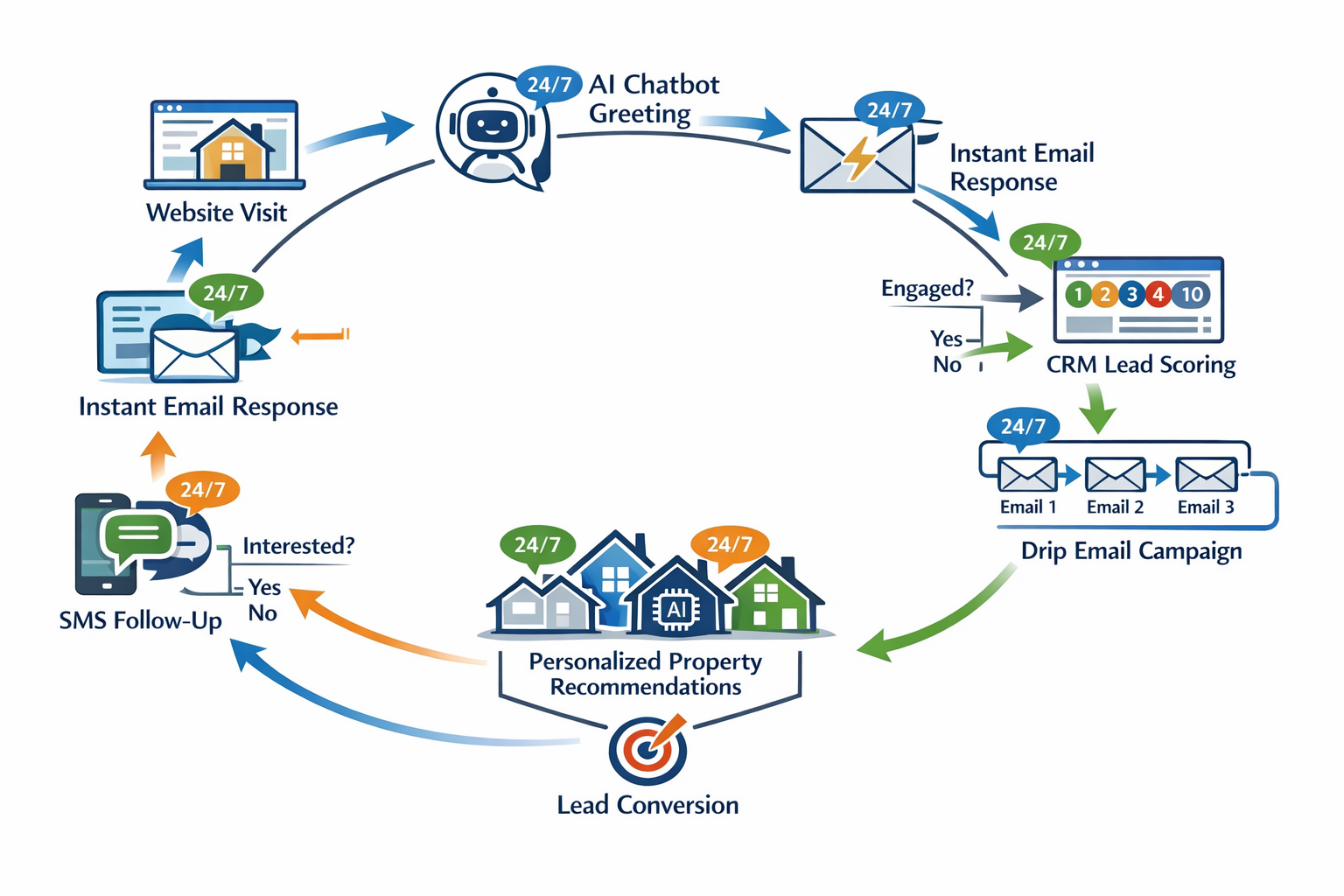
The most sophisticated automation strategies orchestrate communication across multiple channels—email, SMS, direct mail, social media, and phone—creating consistent experiences regardless of where prospects engage.
Example multi-channel sequence:
Day 1: Lead submits website form
- Instant: Automated email confirmation
- Instant: Automated SMS confirmation
- Within 4 hours: Personal phone call attempt
- If no answer: Voicemail + automated follow-up email
Day 2: No response to initial outreach
- Morning: Automated SMS with property recommendations
- Evening: Automated email with buyer guide
Day 4: Lead opens email but doesn't respond
- Automated SMS: "Saw you checked out the buyer guide—any questions?"
- Facebook retargeting ad appears with similar properties
Day 7: Still no direct response
- Automated email with video message from agent
- Automated direct mail postcard with QR code to property search
Day 14: Lead clicks property link in email
- Instant SMS: "Interested in 123 Main St? I can get you inside this week"
- High-priority alert to agent
- Automated email with property details and neighborhood info
This orchestration maintains consistent presence across channels prospects actually use, dramatically increasing response rates compared to single-channel approaches.
AI-Powered Content Personalization
Emerging AI capabilities enable content personalization at scale previously impossible. AI systems can generate unique email content, property descriptions, and market updates customized to individual recipient interests and characteristics.
Property AI and similar platforms analyze a prospect's search history, engagement patterns, and stated preferences to automatically generate personalized property recommendations with customized descriptions emphasizing features that specific prospect values.[1] A prospect who repeatedly views homes with large yards receives descriptions emphasizing outdoor space, while a prospect focused on urban properties receives descriptions emphasizing walkability and amenities.
This level of personalization was previously available only through manual, time-intensive customization. AI makes it automatic and scalable.
For agents looking to leverage AI for comprehensive market analysis and content generation, our guide on how to analyze a real estate market by location with ChatGPT or Gemini AI provides specific prompts and frameworks.
Autonomous Workflow Optimization
The cutting edge of automation involves AI systems that not only execute workflows but optimize them autonomously. These systems analyze performance data and automatically adjust timing, messaging, and sequencing to improve results.[6]
Autonomous optimization examples:
- AI detects that emails sent Tuesday at 10 AM have 15% higher open rates than Thursday at 2 PM → Automatically adjusts send times
- AI identifies that subject lines with questions outperform statements by 22% → Automatically generates question-based subject lines
- AI notices that leads who receive 3 emails in first week convert 30% better than those receiving 5 → Automatically adjusts sequence frequency
- AI spots that prospects who engage with neighborhood content are 3x more likely to convert → Automatically increases neighborhood content in sequences
This autonomous optimization represents what industry experts call "customer retention at scale with personalized execution"—AI handles the analytical heavy lifting while maintaining the personalized touch that drives results.[6]
Common Pitfalls and How to Avoid Them
Even with the best tools and strategies, automation implementation can fail if common pitfalls aren't avoided. Understanding these mistakes helps prevent costly detours.
Over-Automation: The Robot Problem
The most common mistake is automating everything, creating robotic experiences that alienate prospects rather than engaging them. Automation should handle routine, predictable tasks—not replace genuine human connection.
Signs of over-automation:
- Every communication is templated with no personal touches
- Prospects receive automated responses to questions requiring personal answers
- Social media is entirely scheduled with no real-time engagement
- Automated sequences continue even after personal conversations begin
The fix: Establish clear boundaries between automated and personal communication. Automation handles initial response, consistent nurture, appointment reminders, and re-engagement. Personal communication handles specific questions, showing feedback, negotiation, and relationship building.
A good rule: If a prospect has responded directly to you, pause automated sequences until they go cold again. Nothing frustrates prospects more than receiving generic automated emails while having active personal conversations.
Neglecting Data Quality
Automation amplifies whatever you put into it. If your CRM contains incomplete, outdated, or incorrect contact data, automation will send messages to wrong numbers, outdated email addresses, and prospects who've already closed with competitors.
Data quality practices:
- Require minimum data fields for new contacts (name, phone, email, lead source, property interest)
- Regularly audit contact data for completeness and accuracy
- Remove or archive contacts with bounced emails or disconnected phones
- Update contact information after every interaction
- Use lead enhancement tools to automatically enrich contact data
Clean data isn't glamorous, but it's foundational. An automated email campaign with 30% deliverability due to bad data wastes 30% of your investment.
Set-It-and-Forget-It Syndrome
Automation reduces daily time requirements, but it's not a "set it and forget it" solution. Markets change, inventory shifts, and messaging that worked last quarter may fall flat this quarter.
Ongoing optimization requirements:
- Weekly review of key metrics (open rates, click rates, conversion rates)
- Monthly content refresh (update market statistics, replace stale listings, revise messaging)
- Quarterly strategy review (evaluate which sequences perform best, eliminate underperformers)
- Continuous A/B testing (subject lines, send times, content formats, CTAs)
Schedule these reviews as recurring calendar blocks. Thirty minutes weekly prevents performance degradation that requires hours to fix later.
Ignoring Compliance and Privacy
Automated communication must comply with CAN-SPAM (email), TCPA (text messages), and various state and federal privacy regulations. Violations can result in substantial fines and legal liability.
Compliance essentials:
- Include clear unsubscribe mechanisms in all automated emails
- Honor unsubscribe requests immediately (automated systems should handle this automatically)
- Obtain explicit consent before sending automated text messages
- Include required disclosures in all communications
- Maintain records of consent for text message recipients
- Never purchase or scrape contact lists—only market to people who've opted in
Most reputable automation platforms include compliance features built-in, but ultimate responsibility rests with the agent. When in doubt, consult with a real estate attorney familiar with marketing regulations.
Technology Without Strategy
The shiniest new platform won't deliver results without clear strategy. Before implementing any automation tool, answer:
- What specific problem does this solve?
- How will this integrate with existing systems?
- What metrics will indicate success?
- Who will manage and optimize this tool?
- What's the expected ROI timeline?
Technology should serve strategy, not drive it. Agents who chase every new tool without strategic thinking end up with disconnected systems, wasted budgets, and minimal results. Those who implement tools strategically to solve specific problems achieve extraordinary outcomes.
The Future of Marketing Automation in Real Estate
Understanding where Marketing Automation for Real Estate is heading helps agents make forward-looking technology investments rather than chasing yesterday's solutions.
Predictive Analytics and Proactive Outreach
Current automation is largely reactive—responding to prospect actions with predefined sequences. Emerging AI capabilities enable predictive automation that anticipates prospect needs before they express them.
Predictive capabilities emerging in 2026:
- Listing match predictions: AI analyzes prospect behavior to predict which upcoming listings they'll be interested in before properties hit the market
- Conversion timing predictions: AI identifies behavioral patterns indicating a prospect is approaching decision readiness, triggering proactive agent outreach
- Churn predictions: AI detects engagement patterns suggesting a prospect is losing interest, automatically deploying re-engagement tactics
- Referral likelihood predictions: AI identifies past clients most likely to provide referrals based on satisfaction indicators and life stage
These predictive capabilities transform automation from a communication tool into a strategic intelligence system that guides agent decision-making.
Hyper-Personalization at Scale
The trend toward personalization will intensify as AI capabilities expand. Future systems will generate entirely unique content for each recipient based on comprehensive behavioral and demographic data.
Imagine automated email campaigns where every recipient receives a completely different message—different properties featured, different market statistics highlighted, different tone and language—all optimized by AI based on that individual's demonstrated preferences and characteristics. This level of personalization is technically feasible today and will become standard within 2-3 years.
Voice and Conversational Interfaces
As voice AI improves, conversational interfaces will increasingly replace form-based interactions. Prospects will have natural voice conversations with AI assistants that feel indistinguishable from human agents, handling everything from property searches to showing scheduling to mortgage pre-qualification.
These AI assistants will seamlessly hand off to human agents when conversations require personal expertise, creating hybrid experiences that combine AI efficiency with human relationship-building.
Blockchain and Smart Contracts
While still emerging, blockchain technology promises to automate aspects of real estate transactions currently requiring manual processing. Smart contracts could automatically execute purchase agreements when predefined conditions are met, automate escrow processes, and streamline title transfers.
For marketing automation, blockchain enables verified identity and transaction history, reducing fraud and improving lead quality. Agents could verify that prospects are actually pre-approved rather than relying on self-reported information.
Augmented Reality Integration
AR technology will integrate with automation systems to create immersive property experiences. Prospects could virtually tour properties through AR headsets while AI assistants provide real-time information about features, answer questions, and guide the experience.
Automated systems would track which properties prospects spend the most time viewing in AR, which features they examine closely, and which questions they ask—using this behavioral data to refine recommendations and prioritize agent follow-up.
The agents who thrive in this evolving landscape will be those who view technology as a collaborative partner that enhances their expertise rather than a threat to be resisted. The future belongs to agents who let automation handle the routine so they can focus on the relationship-building and strategic guidance that AI can't replicate.
Conclusion: The Choice Is Clear
The evidence is impeccable: Marketing Automation for Real Estate has transitioned from competitive advantage to operational necessity. Agents who implement automation systematically achieve better results in less time, while those who resist face declining market share and unsustainable work hours.
The path forward is straightforward:
Start immediately with foundational systems: Select a CRM platform and implement basic automated lead response and nurture sequences. Don't wait for perfect—start with functional and improve iteratively.
Measure relentlessly: Track the metrics that matter—response times, conversion rates, time saved, revenue per lead. Data reveals what's working and where optimization opportunities exist.
Optimize continuously: Automation isn't set-and-forget. Schedule regular review sessions to analyze performance, test improvements, and refine messaging based on actual results.
Embrace AI as a collaborative partner: Use AI to enhance your expertise, not replace it. Let automation handle routine tasks so you can focus on relationship-building, negotiation, and strategic guidance that only humans can provide.
Invest strategically: Automation requires investment—both financial and time. Evaluate tools based on ROI potential, not just features. Better to implement three high-impact systems well than ten systems poorly.
The cost of ignoring automation isn't just missed opportunities—it's systematic competitive disadvantage that compounds over time. Every month you delay is a month competitors gain ground, optimize their systems, and capture market share.
The good news? Implementation is more accessible than ever. Modern platforms have dramatically simplified setup, pre-built templates reduce configuration time, and integration tools connect systems seamlessly. The barriers that existed five years ago have largely disappeared.
The question isn't whether to implement Marketing Automation for Real Estate—it's how quickly you can get started. The agents reading this who take action this week will be the ones dominating their markets next year. Those who bookmark it for "someday" will be wondering why their business stagnated while competitors thrived.
So based on everything covered in this guide, here's your next step: Choose one automation tool to implement this week. Not next month. Not when you're less busy. This week. Start with your CRM if you don't have one. Add email automation if you do. The perfect time to start was last year. The second-best time is right now.
Your future self—the one closing more deals, working fewer hours, and building a sustainable business—will thank you for taking action today.
For more expert-backed, actionable content on growing your real estate business, explore our comprehensive resources at Real Estate Rank IQ.
References
[1] Real Estate Marketing Trends To Watch In 2026 – https://realtycandy.com/real-estate-marketing-trends-to-watch-in-2026/
[2] 5 Tools Every Real Estate Agent Needs To Win In 2026 – https://www.realtor.com/marketing/resources/5-tools-every-real-estate-agent-needs-to-win-in-2026/
[3] The Future Of Real Estate Marketing Trends Every Agent Needs To Watch In 2026 – https://serhant.com/blog/the-future-of-real-estate-marketing-trends-every-agent-needs-to-watch-in-2026
[4] Real Estate Marketing Tools – https://www.housingwire.com/articles/real-estate-marketing-tools/
[5] Real Estate Technology In 2026 Tools To Drive Growth And Efficiency – https://www.bradymartz.com/real-estate-technology-in-2026-tools-to-drive-growth-and-efficiency/
[6] Marketing Automation Trends – https://www.klaviyo.com/blog/marketing-automation-trends
[7] Real Estate Automation – https://theclose.com/real-estate-automation/
[8] Focus Matters More Ever 2026 Marketing – https://www.floridarealtors.org/news-media/news-articles/2026/01/focus-matters-more-ever-2026-marketing
[9] Real Estate Marketing Trends – https://flippingbook.com/blog/marketing-tips/real-estate-marketing-trends