


nn

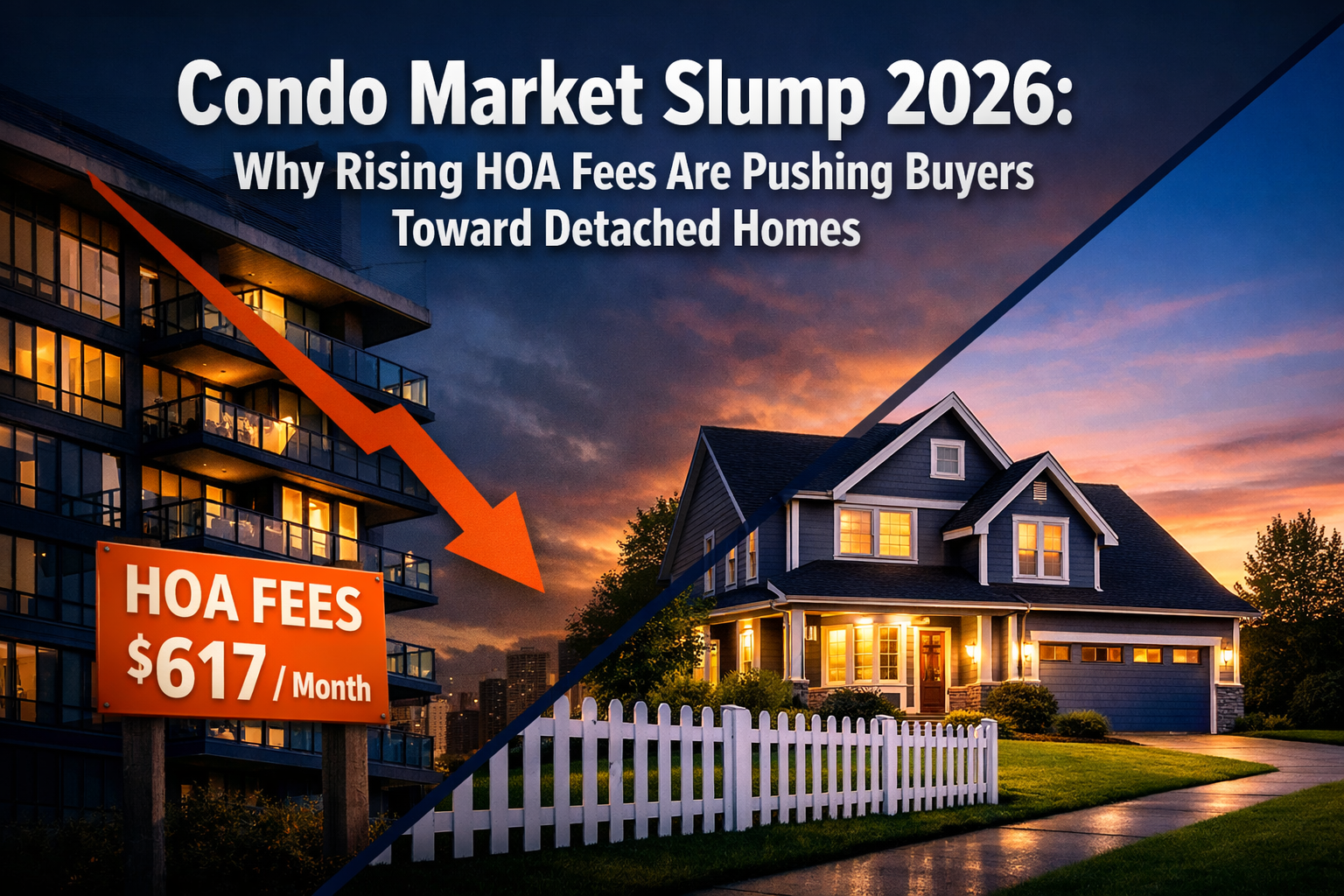
Picture this: You've finally saved enough for a down payment, you're ready to make your move, and you find the perfect condo—sleek, modern, great location. Then you see the HOA fee: $617 per month. That's an extra $7,404 per year on top of your mortgage, insurance, and property taxes. Suddenly, that single-family home with a yard a few miles away doesn't look so expensive after all.
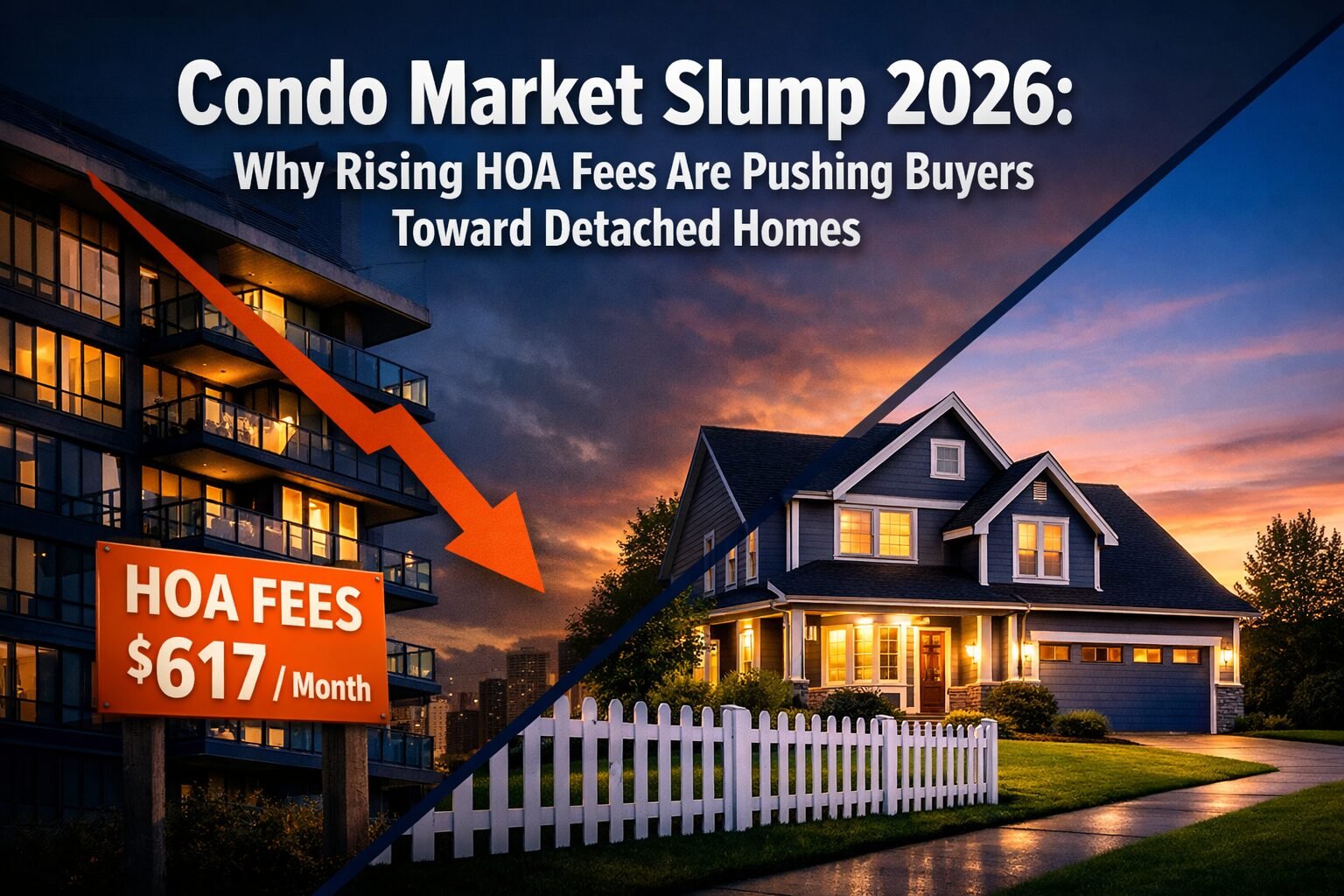
Welcome to the Condo Market Slump 2026: Why Rising HOA Fees Are Pushing Buyers Toward Detached Homes. This isn't just about sticker shock—it's a fundamental shift in how Americans are choosing where to live. The condo market is experiencing its largest annual price decline since 2012, dropping 1.9% year-over-year, while HOA fees have climbed to a median of $135 nationally, with some markets charging over $700 monthly[1][3]. So based on current trends, buyers are voting with their wallets and choosing detached homes with yards over shared-wall living with escalating monthly obligations.
At Real Estate Rank IQ, we've spent over 15 years analyzing market trends and helping buyers, sellers, agents, and investors navigate shifting conditions. This comprehensive analysis breaks down exactly what's happening in the condo market, why HOA fees have become the deal-breaker nobody saw coming, and what this means for your real estate decisions in 2026.
Key Takeaways
- Condo prices fell 1.9% year-over-year in late 2025—the first annual decline in over a decade—while nearly 70% of condos sold below list price in Q1 2025[1][4]
- HOA fees reached a median of $135 nationally in 2025, with Florida markets commanding $532-$711 monthly, representing extraordinary cost burdens that fundamentally alter affordability calculations[3]
- 43.6% of all U.S. home listings now include HOA fees, up from just 34.3% in 2019, making these monthly obligations far more common than ever before[3]
- Buyers increasingly prefer detached homes for yard space, privacy, and freedom from escalating HOA costs, creating a clear market divide between property types
- Investors are pulling back from condos, with purchases down 3% in Q1 2025 as rental yields deteriorate and price declines accelerate[4]
Understanding the Condo Market Slump 2026: The Numbers Behind the Decline
Let's let it cook with the data, because the numbers tell an extraordinary story about what's happening in America's condo market.
The Price Drop That Changed Everything
The U.S. condo market experienced its largest annual price decline since 2012, with prices falling 1.9% year-over-year in September and October 2025[1]. This represents the first annual decline in over a decade—a significant market correction that's sending shockwaves through real estate communities nationwide.
But that national average masks even more dramatic regional declines. In 20 major metropolitan areas, condo prices have fallen between 10% and 23% from their peaks[4]. Florida, Texas, and Arizona are experiencing the steepest drops, though the trend affects most major cities including Nashville, Atlanta, and Austin[5].
Here's what's particularly impeccable about this data: More than one in 10 condos (over 10%) held a lower estimated value in November than their most recent sales price[1]. That means buyers who purchased in the past year or two are already underwater on their investments—a scenario that hasn't been this widespread since the Great Recession.
The Selling Pressure Is Real
Perhaps the most telling indicator of market weakness: Nearly 70% of condos sold below list price in Q1 2025—the highest rate in five years[4]. When seven out of ten sellers can't get their asking price, that's not just negotiation—that's a fundamental imbalance between supply and demand.
This selling pressure creates a vicious cycle:
- Sellers reduce prices to attract buyers in a weakening market
- Recent buyers see their equity evaporate, creating reluctance among new purchasers
- Appraisals come in lower, making financing more difficult
- Inventory builds as properties sit longer on the market
- Prices decline further, perpetuating the cycle
For real estate agents working with condo sellers, understanding how to value your home in any market has become absolutely critical to avoiding extended days on market and multiple price reductions.
Geographic Concentration of Decline
While the condo slump is nationwide, certain markets are experiencing particularly severe corrections:
| Metro Area | Estimated Price Decline from Peak | Key Factors |
|---|---|---|
| Miami-Fort Lauderdale | 15-20% | Insurance costs, HOA fees, oversupply |
| Austin | 18-23% | Tech sector slowdown, rental rate decline |
| Phoenix | 12-17% | Investor pullback, insurance increases |
| Tampa | 14-19% | Climate insurance, HOA cost escalation |
| Nashville | 10-15% | Overbuilding, cooling demand |
These markets share common characteristics: rapid appreciation during the pandemic, heavy investor activity, and now, significant oversupply as both investors and owner-occupants pull back simultaneously.
Rising HOA Fees: The Hidden Cost Crushing Condo Affordability
Here's where the Condo Market Slump 2026: Why Rising HOA Fees Are Pushing Buyers Toward Detached Homes story gets particularly fresh. HOA fees aren't just rising—they're fundamentally reshaping housing affordability calculations in ways most buyers didn't anticipate.
The Dramatic Escalation of HOA Costs
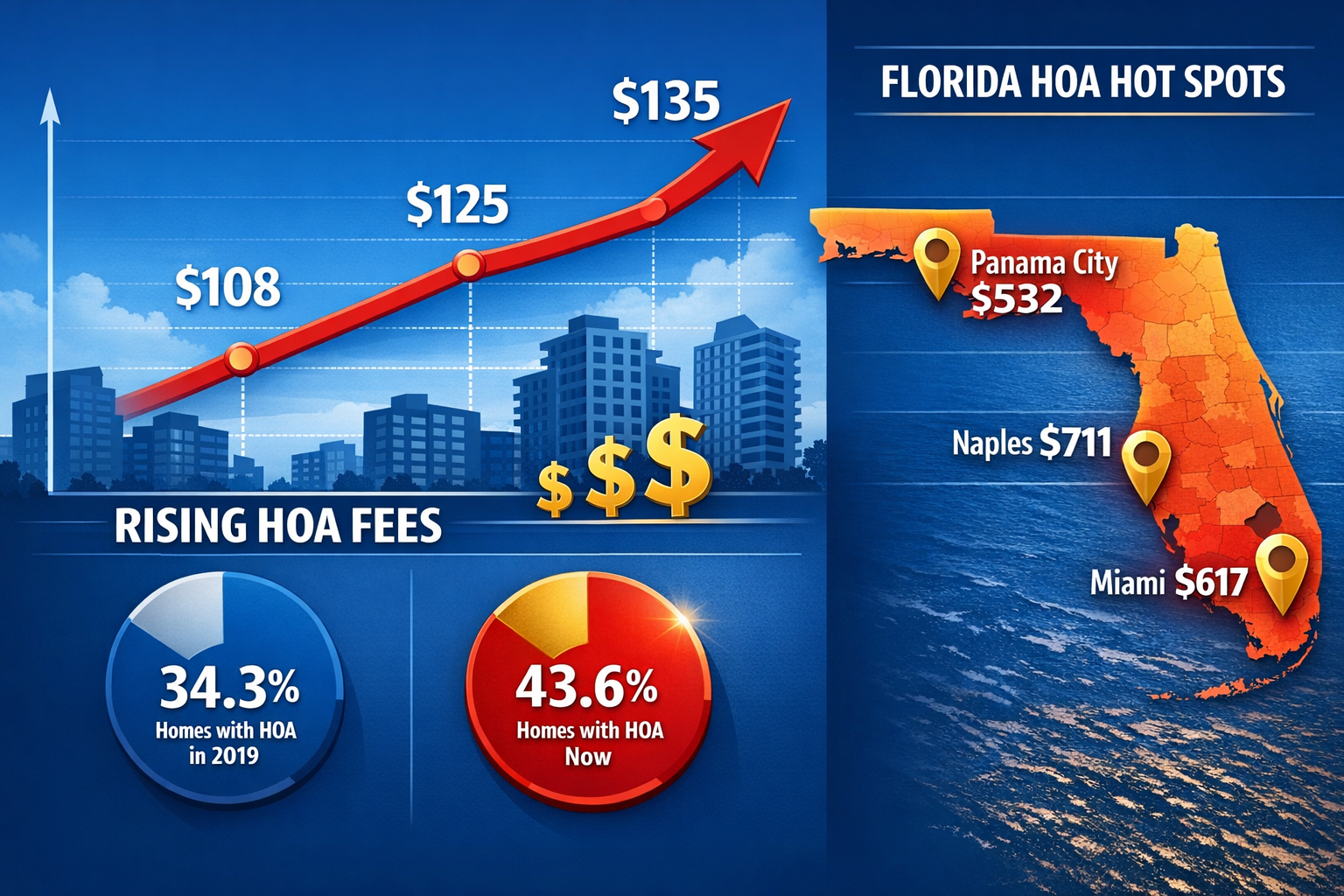
The median HOA fee reached $135 in 2025, climbing from $125 in 2024 and just $108 in 2019[3]. That's a 25% increase in just six years—far outpacing general inflation and wage growth.
But national medians tell only part of the story. In high-cost markets, HOA fees have reached levels that rival mortgage payments:
- Miami-Fort Lauderdale: $617/month median[3]
- Naples, Florida: $711/month median[3]
- Panama City: $532/month median[3]
- St. Petersburg (individual properties): Up to $1,990/month[5]
Let that sink in: some condo owners are paying nearly $2,000 per month just in HOA fees—before mortgage, property taxes, insurance, or utilities. At those levels, HOA fees alone exceed the total housing payment many Americans make for detached homes in affordable markets.
Why HOA Fees Are Skyrocketing
According to Realtor.com's senior economist Joel Berner, several converging factors are driving HOA costs higher[3]:
1. Insurance Premium Explosions
Climate-related risks have caused property insurance premiums to skyrocket, particularly in coastal markets. Florida condos face the perfect storm of hurricane risk, flooding exposure, and litigation-friendly insurance laws that have driven many carriers out of the market entirely. What remains are higher premiums that HOAs must pass through to residents.
2. Post-Surfside Legislative Changes
The tragic 2021 Surfside condo collapse in Florida triggered sweeping legislative reforms requiring:
- Stricter building inspections for structures over 30 years old
- Mandatory reserve funding for major repairs (no more special assessments to defer costs)
- Enhanced structural integrity assessments
- Accelerated repair timelines for identified deficiencies
These requirements are absolutely necessary for safety, but they've added extraordinary costs to condo ownership, particularly for older buildings[3].
3. Labor and Material Cost Inflation
Construction labor shortages and material price increases have made routine maintenance and capital improvements significantly more expensive. When an HOA needs to replace a roof, repave parking areas, or upgrade elevators, those projects now cost 30-50% more than they did pre-pandemic.
4. Deferred Maintenance Coming Due
Many HOAs deferred maintenance during the pandemic or kept fees artificially low to maintain property values. Now, those chickens are coming home to roost. Buildings need major repairs, and reserves are insufficient, forcing rapid fee increases or special assessments.
The Affordability Impact Nobody Talks About
Here's what makes HOA fees particularly insidious for affordability: they don't build equity. Every dollar you pay toward your mortgage principal increases your ownership stake. Every dollar in HOA fees is simply gone—paying for shared services, maintenance, insurance, and reserves.
Consider this comparison for a $400,000 property purchase:
Condo with $600/month HOA:
- Monthly mortgage (20% down, 7% rate): ~$2,128
- HOA fee: $600
- Insurance: $150
- Property tax: $333
- Total monthly: $3,211
- Annual HOA cost: $7,200 (pure expense, no equity)
Single-family home without HOA:
- Monthly mortgage (20% down, 7% rate): ~$2,128
- HOA fee: $0
- Insurance: $200
- Property tax: $333
- Total monthly: $2,661
- Monthly savings: $550 (can go toward principal, maintenance reserve, or other investments)
That $550 monthly difference represents $6,600 annually—money that could accelerate mortgage payoff, fund home improvements, or build investment accounts. Over a 30-year mortgage, we're talking about $198,000 in cumulative savings, not accounting for investment returns.
For buyers exploring their options, understanding mortgage options for Gen Z home buyers becomes even more critical when HOA fees consume such a large portion of monthly housing budgets.
The HOA Expansion Beyond Condos
Here's something that's gatekeeping important information from many buyers: HOAs are no longer just a condo phenomenon. Approximately 33.4% of single-family home listings now carry HOA fees[3], and that percentage continues to rise as master-planned communities and suburban developments incorporate homeowner associations.
Overall, 43.6% of all U.S. home listings now include HOA fees as of 2025, up dramatically from 34.3% in 2019[3]. This means HOA obligations have become a standard feature of American homeownership rather than an exception.
However, there's a crucial difference: single-family homes with HOAs typically charge far less than condos. The median single-family HOA fee covers basic services like:
- Neighborhood entrance maintenance
- Common area landscaping
- Street lighting
- Community amenities (pool, clubhouse)
- Exterior paint/roof standards enforcement
These fees typically range from $50-$200 monthly—significant, but far below the $532-$711 charged in high-cost condo markets[3].
Why Buyers Are Choosing Detached Homes Over Condos in 2026
The Condo Market Slump 2026: Why Rising HOA Fees Are Pushing Buyers Toward Detached Homes isn't just about costs—it's about what buyers value and how their priorities have shifted.
The Yard Factor: Post-Pandemic Preferences Persist
During the pandemic, outdoor space became precious. Families stuck at home discovered that balconies and shared courtyards couldn't replace actual yards for children's play, gardening, pets, or simply having private outdoor space.
Those preferences haven't faded. In 2026, buyers consistently rank private outdoor space as a top-three priority, particularly among:
- Families with children who want play areas without shared amenities
- Pet owners seeking yards for dogs
- Remote workers wanting outdoor office spaces or break areas
- Gardening enthusiasts interested in landscaping control
Detached homes deliver this in ways condos fundamentally cannot. Even modest suburban homes typically offer 5,000-10,000 square feet of yard space—an amenity worth thousands in perceived value.
For buyers prioritizing space efficiency, our analysis of why smaller homes are winning clicks shows that "smaller" doesn't mean "no yard"—it means right-sized homes with outdoor space.
Control and Autonomy
Condo living means committee decisions, architectural review boards, and rules about everything from paint colors to holiday decorations. For many buyers, this level of oversight feels restrictive, particularly when they're paying hundreds of thousands of dollars for property ownership.
Detached homes offer:
- Renovation freedom without board approval
- Exterior customization (paint, landscaping, additions)
- Pet ownership without breed or size restrictions
- Rental flexibility if investment goals change
- No special assessments for building-wide repairs
This autonomy has impeccable value for buyers who view homeownership as both investment and lifestyle expression. Understanding the truth about HOAs helps buyers make informed decisions about whether shared governance aligns with their preferences.
The Investment Calculation
Investor purchases of condos fell 3% in Q1 2025[4], and the reasons are straightforward: the numbers don't work anymore.
Investors evaluate properties based on:
- Cash flow (rental income minus all expenses)
- Appreciation potential (price growth over time)
- Tax benefits (depreciation, expense deductions)
- Exit strategy (ability to sell at profit)
Condos are failing on multiple fronts:
- High HOA fees consume rental income, reducing cash flow
- Price declines eliminate appreciation and create negative equity
- Rental rate softness (down 0.4% nationally, with major markets down 4-7%)[5] reduces income
- Selling challenges (70% below list price) threaten exit strategies[4]
Meanwhile, single-family rentals in many markets still offer positive cash flow, better appreciation prospects, and stronger tenant demand from families seeking yards and school districts.
For investors exploring alternatives, resources on real estate investment strategies and comparing property types provide frameworks for evaluating opportunities in this shifting market.
The Financing Advantage
Here's something many buyers don't realize: detached homes often qualify for better financing terms than condos.
Lenders view condos as higher risk because:
- HOA financial health affects property value (underfunded reserves, pending litigation, or high delinquency rates can make buildings "non-warrantable")
- Concentration risk (if many units are investor-owned or in foreclosure, lenders restrict financing)
- Special assessment risk (unexpected large bills can trigger defaults)
This translates to:
- Higher down payment requirements for condos (often 15-25% vs. 10-20% for houses)
- Stricter qualification standards (lower debt-to-income ratios)
- Higher interest rates (0.125-0.25% premium in some cases)
- Limited loan programs (some government programs restrict condo purchases)
For first-time buyers especially, these financing hurdles make detached homes more accessible despite potentially higher purchase prices. Exploring mortgage options helps buyers understand what financing they qualify for across property types.
The Lifestyle Flexibility Factor
Life changes. Jobs relocate. Families grow. Health situations evolve. Detached homes offer flexibility that condos often don't:
- Multigenerational living: Adding in-law suites or accommodating aging parents
- Home-based businesses: Operating businesses without HOA commercial restrictions
- Accessory dwelling units (ADUs): Building rental units for income
- Storage and hobbies: Garages, workshops, storage for RVs, boats, or collections
- Future expansion: Adding rooms, floors, or square footage as needs change
This adaptability has extraordinary value in uncertain times. Buyers increasingly recognize that housing needs to accommodate multiple scenarios rather than locking them into fixed arrangements.
Market Implications: What the Condo Slump Means for Different Stakeholders

The Condo Market Slump 2026: Why Rising HOA Fees Are Pushing Buyers Toward Detached Homes creates distinct challenges and opportunities depending on your role in the real estate ecosystem.
For Condo Sellers: Navigating a Buyer's Market
If you're selling a condo in 2026, you're facing the toughest market conditions in over a decade. Here's your playbook:
1. Price Aggressively from Day One
With 70% of condos selling below list price[4], overpricing guarantees you'll join that statistic after weeks of market time. Instead:
- Price 3-5% below comparable sales to generate immediate interest
- Account for HOA fees in your pricing strategy (buyers calculate total monthly costs)
- Highlight recent assessments or fee increases transparently (buyers will discover them anyway)
Our guide on avoiding pricing pitfalls provides detailed frameworks for competitive pricing in challenging markets.
2. Emphasize What Condos Do Well
Don't compete on what condos can't offer (yards, privacy). Instead, highlight genuine advantages:
- Location and walkability (urban access, transit proximity)
- Low-maintenance lifestyle (no yard work, exterior maintenance handled)
- Amenities (pools, gyms, concierge services that would cost thousands privately)
- Security features (controlled access, cameras, community oversight)
- Lock-and-leave convenience for frequent travelers
3. Offer Strategic Concessions
In a market where buyers have leverage, smart concessions close deals:
- Cover 6-12 months of HOA fees (removes the immediate cost objection)
- Provide closing cost credits (helps with down payment and closing cash needs)
- Include appliances, furniture, or upgrades (reduces buyer's move-in costs)
- Offer home warranties (provides peace of mind on mechanicals)
Learn more about seller credits buyers ask for most to structure compelling offers.
4. Prepare Your Property Impeccably
When 70% of listings sell below ask, the 30% that hit list price are the best-prepared properties. Follow our expert tips for preparing your home to attract buyers to ensure your condo stands out.
For Condo Buyers: Finding Value in the Slump
If you're willing to embrace condo living despite the challenges, 2026 presents extraordinary buying opportunities:
1. Negotiate Aggressively
Sellers are motivated, inventory is building, and prices are falling. Use this leverage:
- Start offers 10-15% below asking in markets with significant inventory
- Request HOA fee coverage for 12-24 months as part of the deal
- Demand inspection repairs or credits rather than accepting "as-is" terms
- Include contingencies that protect you (financing, inspection, HOA document review)
2. Scrutinize HOA Financials Like Your Life Depends on It
Before buying any condo, review:
- Reserve fund balances (should be 25-50% of annual budget minimum)
- Deferred maintenance lists (what repairs are pending?)
- Insurance coverage and costs (are premiums stable or rising?)
- Special assessment history (frequent assessments indicate poor planning)
- Delinquency rates (high delinquencies mean financial instability)
- Pending litigation (lawsuits can tank property values and financing)
3. Calculate True Total Cost
Don't just look at purchase price. Calculate:
- Monthly mortgage + HOA + insurance + property tax = true monthly cost
- Compare this to renting a similar property
- Factor in opportunity cost of down payment
- Consider potential for further price declines
Use tools and calculators from best home buying sites to run comprehensive cost analyses.
4. Target Buildings with Stable Financials
Not all condos are created equal. Look for:
- Newer buildings (under 15 years old) with lower maintenance needs
- Well-funded reserves that won't require special assessments
- High owner-occupancy rates (70%+ owner-occupied is ideal)
- Stable HOA fees (minimal increases over past 5 years)
- Strong management (professional management companies, not volunteer boards)
For Real Estate Agents: Serving Clients in a Divided Market
The condo-versus-detached divide creates both challenges and opportunities for agents:
1. Educate Clients on Total Cost of Ownership
Most buyers focus on purchase price and monthly mortgage. Fresh agents help clients understand:
- HOA fees as permanent expenses that don't build equity
- Special assessment risks and how to evaluate HOA financials
- Lifestyle trade-offs between property types
- Long-term appreciation potential given current market conditions
2. Specialize in One or the Other
In markets with significant condo inventory, consider specializing:
- Condo specialists who deeply understand HOA dynamics, building financials, and urban lifestyle marketing
- Single-family specialists who focus on suburban markets, school districts, and family-oriented amenities
Specialization builds expertise and referral networks that generalists can't match.
3. Leverage Technology for Market Analysis
Use AI marketing tools for real estate agents to:
- Analyze pricing trends across property types
- Identify neighborhoods where condos still perform well
- Create comparative market analyses that highlight value propositions
- Generate content that educates buyers on market conditions
4. Master Listing Presentation for Condos
Selling condos in a tough market requires impeccable presentation:
- Professional photography that highlights space and light
- Virtual tours that let buyers explore without visiting
- Amenity showcases that demonstrate value beyond the unit
- Neighborhood lifestyle marketing that sells location and convenience
Our guides on home listing social media strategies and neighborhood marketing provide actionable tactics.
For Investors: Repositioning Strategies
If you own condo investments that are underwater or underperforming, consider:
1. Hold for Long-Term Recovery
If cash flow is neutral or slightly positive:
- Wait out the cycle (real estate is cyclical; condos will recover eventually)
- Improve tenant quality to reduce turnover and vacancy
- Refinance if possible to reduce monthly payments
- Take tax benefits (depreciation, expense deductions) while waiting
2. Strategic Exit
If holding costs exceed benefits:
- Sell before further declines even if taking a loss
- 1031 exchange into better properties to defer taxes (see our 1031 exchange basics guide)
- Negotiate short sales if underwater and can't afford to bring cash to closing
- Convert to long-term rentals if currently short-term (more stable income)
3. Pivot to Single-Family Rentals
Many investors are rotating capital from condos to detached rentals:
- Better appreciation prospects in current market
- Lower HOA costs or none at all
- Stronger tenant demand from families
- More control over property improvements and management
Resources on real estate investment property management help optimize rental operations.
Regional Market Variations: Where Condos Still Work
While the national trend shows condo weakness, certain markets buck the trend. Understanding these exceptions helps identify opportunities:
Urban Markets with Limited Land
In cities where geographic constraints limit detached home development, condos maintain stronger demand:
- New York City: Manhattan condos still command premiums due to extreme land scarcity
- San Francisco: Limited buildable land keeps urban condos competitive
- Seattle: Geographic constraints (water, mountains) support condo values in core areas
- Boston: Historic preservation and limited expansion areas maintain urban condo appeal
In these markets, the choice isn't "condo or detached home"—it's "condo or leave the city." This dynamic supports pricing even as HOA fees rise.
Markets with Strong Transit Infrastructure
Cities with excellent public transportation see stronger condo performance:
- Washington, D.C.: Metro accessibility makes car-free condo living viable
- Chicago: CTA coverage supports urban condo lifestyle
- Portland: Transit-oriented development maintains condo demand
- Denver: Light rail expansion supports condo values near stations
Buyers who prioritize walkability and transit access over yards find value propositions that work despite HOA costs.
College Towns and Young Professional Markets
Markets with large populations of young professionals, students, and empty-nesters maintain condo demand:
- Austin (despite overall price declines): Young tech workers still seek urban living
- Nashville: Music industry and healthcare professionals support downtown condos
- Raleigh-Durham: Research Triangle professionals maintain condo demand
- Boulder: University and tech sector support compact urban living
These buyers prioritize location, amenities, and lifestyle over yard space, making condos viable despite costs.
Future Outlook: Will the Condo Market Recover?
The Condo Market Slump 2026: Why Rising HOA Fees Are Pushing Buyers Toward Detached Homes raises an important question: Is this a temporary correction or a permanent shift?
Factors That Could Support Condo Recovery
1. Interest Rate Declines
If mortgage rates drop to 5-6% from current 7%+ levels, affordability improves across all property types. Lower rates could bring buyers back to condos, particularly in expensive urban markets where detached homes remain out of reach.
2. HOA Fee Stabilization
Once buildings complete major repairs and reserves reach adequate levels, fee increases may moderate. If HOA costs stabilize around current levels rather than continuing to rise, the affordability calculation improves.
3. Urban Return Migration
If remote work flexibility decreases and employers require office returns, demand for urban condos near employment centers could strengthen. This would particularly benefit transit-accessible buildings.
4. Millennial and Gen Z Lifecycle Changes
As younger generations age, some will trade yards for walkability and amenities. Empty-nesters downsizing from large homes may also return to condo markets, supporting demand.
Factors That Could Extend the Slump
1. Continued Insurance Cost Escalation
Climate change isn't slowing down. If insurance premiums continue rising due to hurricanes, floods, wildfires, and other climate risks, HOA fees will keep climbing, particularly in vulnerable coastal markets.
2. Building Age and Deferred Maintenance
America's condo stock is aging. Buildings constructed in the 1970s-1990s are reaching 30-50 years old—the point where major systems (roofs, HVAC, plumbing, electrical) need replacement. This wave of capital needs will drive HOA costs higher for years.
3. Persistent Preference for Space
If work-from-home remains common and families continue prioritizing private outdoor space, the preference for detached homes could prove durable rather than temporary.
4. Investor Sentiment Shift
Once investors sour on an asset class, sentiment can take years to recover. If institutional and individual investors continue avoiding condos, reduced demand will suppress prices and appreciation.
Most Likely Scenario: Market Segmentation
The future probably isn't "condos recover everywhere" or "condos fail everywhere." Instead, expect market segmentation:
Strong condo markets:
- Urban cores with transit and walkability
- Markets with geographic constraints
- Buildings with exceptional amenities and strong financials
- Newer construction with lower HOA fees
Weak condo markets:
- Suburban condos competing directly with detached homes
- Older buildings with high HOA fees and deferred maintenance
- Markets with abundant detached home inventory
- Buildings with poor HOA financial health
Smart buyers, sellers, and investors will need to evaluate each market and property individually rather than making blanket assumptions about condos as an asset class.
Actionable Strategies for Navigating the Condo Market in 2026

Whether you're buying, selling, or investing, here are concrete steps to navigate the Condo Market Slump 2026: Why Rising HOA Fees Are Pushing Buyers Toward Detached Homes:
For Buyers
✅ Calculate total monthly costs including HOA fees, not just mortgage payments
✅ Review HOA financials thoroughly before making offers (reserves, assessments, litigation)
✅ Negotiate aggressively in this buyer's market (10-15% below ask, HOA fee coverage, closing costs)
✅ Compare condo costs to renting to ensure ownership makes financial sense
✅ Target newer buildings with lower maintenance needs and stable HOA fees
✅ Get pre-approved for financing and understand condo-specific lending requirements
✅ Consider detached alternatives in the same price range to compare value propositions
For Sellers
✅ Price competitively from day one (3-5% below recent sales to generate activity)
✅ Prepare your property impeccably (staging, repairs, professional photos)
✅ Offer strategic concessions (HOA fee coverage, closing costs, home warranty)
✅ Market lifestyle benefits (location, amenities, low-maintenance) not just square footage
✅ Be transparent about HOA costs and building condition (buyers will discover it anyway)
✅ Work with experienced agents who understand condo marketing in tough markets
✅ Consider timing (spring market typically stronger than fall/winter for condos)
For comprehensive preparation guidance, review our complete home sale checklist.
For Real Estate Agents
✅ Educate clients on total cost of ownership and HOA financial analysis
✅ Develop condo expertise or specialize in single-family to differentiate your service
✅ Use technology for market analysis and comparative pricing
✅ Create educational content that positions you as the market expert
✅ Build referral networks with mortgage brokers who understand condo financing
✅ Master listing presentation for condos (professional photography, virtual tours, amenity showcases)
✅ Stay current on market trends to provide clients with fresh insights
Explore AI marketing tools and social media strategies to enhance your marketing effectiveness.
For Investors
✅ Analyze cash flow carefully including HOA fees, insurance, and potential special assessments
✅ Evaluate HOA financial health as rigorously as property condition
✅ Consider exit strategies before purchasing (can you sell if needed?)
✅ Compare returns to alternative investments (single-family rentals, REITs, other assets)
✅ Target markets where condo fundamentals remain strong (urban cores, transit-accessible)
✅ Build reserves for unexpected assessments and vacancy periods
✅ Explore 1031 exchanges if repositioning from condos to other property types
Resources on real estate investment strategies and commercial real estate provide alternative investment frameworks.
Conclusion: Making Informed Decisions in a Changing Market
The Condo Market Slump 2026: Why Rising HOA Fees Are Pushing Buyers Toward Detached Homes represents a significant market shift that's reshaping American housing preferences. With condo prices falling 1.9% year-over-year, 70% of condos selling below list price, and HOA fees reaching $135 nationally (with some markets exceeding $700 monthly), the economics of condo ownership have fundamentally changed[1][3][4].
But this isn't a story of condos "failing"—it's a story of market segmentation and evolving buyer preferences. Buyers increasingly value private outdoor space, autonomy, and freedom from escalating HOA costs. They're voting with their wallets, choosing detached homes that offer yards, renovation flexibility, and more predictable monthly costs.
For sellers, this means pricing aggressively, preparing properties impeccably, and offering strategic concessions to compete in a buyer's market. For buyers, it means extraordinary opportunities to negotiate favorable terms on condos—if you're willing to accept the lifestyle and cost structure. For agents, it means educating clients on total cost of ownership and developing expertise in either condo or single-family specialization. And for investors, it means carefully evaluating whether condo cash flows and appreciation prospects justify the risks in current market conditions.
The key to navigating this market successfully is information. Understand the data, analyze HOA financials thoroughly, calculate total costs honestly, and make decisions based on your specific situation rather than general market trends.
At Real Estate Rank IQ, we're committed to providing the expert-backed, actionable content you need to make informed real estate decisions. Whether you're buying your first home, selling a property, building your agent business, or growing an investment portfolio, our licensed brokers with over 15 years of experience deliver the insights that matter.
Ready to Take Action?
📧 Have questions about your specific market or situation? Email us at news@realestaterankiq.com
🎥 Want video breakdowns of market trends? Subscribe to our YouTube channel @Realestaterankiq
🌐 Explore more expert content: Visit RealEstateRankIQ.com for comprehensive guides on buying, selling, investing, and agent growth
The condo market slump of 2026 is creating both challenges and opportunities. Armed with the right information and strategies, you can navigate this changing landscape successfully—whether you're choosing between property types, pricing a listing, or repositioning an investment portfolio.
The market has spoken: in 2026, buyers are choosing detached homes with yards over condos with escalating HOA fees. Understanding why this shift is happening—and what it means for your specific situation—is the first step toward making decisions you'll feel confident about for years to come.
References
[1] U S Condo Market Faces Biggest Annual Price Decline Since 2012 – https://structuredfinance.org/u-s-condo-market-faces-biggest-annual-price-decline-since-2012/
[2] The 2026 Condo Market Crash – https://bigdatarealty.com/the-2026-condo-market-crash/
[3] 2026 01 27 Nearly 44 Of U S Homes For Sale Now Carry Hoa Fees As Dues Continue To Climb, Realtor Com R Finds – https://mediaroom.realtor.com/2026-01-27-Nearly-44-of-U-S-Homes-for-Sale-Now-Carry-HOA-Fees-as-Dues-Continue-to-Climb,-Realtor-com-R-Finds
[4] Condo Prices Are Falling Its Not A Great Sign For Single Family Houses – https://www.realtymogul.com/knowledge-center/article/condo-prices-are-falling-its-not-a-great-sign-for-single-family-houses
[5] Watch – https://www.youtube.com/watch?v=J-yCoTL_y5Y
[6] Housing Market Community Associations In 2026 – https://blog.caionline.org/housing-market-community-associations-in-2026/