


The real estate game has changed—and if you're still relying on gut feelings and outdated spreadsheets to make six-figure investment decisions, you're basically gate keeping yourself from extraordinary profits. In 2026, artificial intelligence isn't just a buzzword tossed around at broker conferences; it's the dope secret weapon that separates investors who close deals in their sleep from those who spend weekends drowning in comps and cold calls. The Top 13 Real Estate AI Tools for Investors have transformed how professionals analyze markets, qualify leads, stage properties, and predict which neighborhoods will explode before the competition even notices.

Whether you're a seasoned investor managing a portfolio of rental properties, a real estate agent hustling to convert more leads, or a broker building a team that operates like a well-oiled machine, understanding which AI tools deliver impeccable results versus which ones are just fresh marketing hype can mean the difference between scaling your business and spinning your wheels. This comprehensive guide breaks down the most powerful AI platforms dominating the industry right now—from predictive analytics engines that spot undervalued properties to automated CRM systems that nurture leads while you focus on closing.
Key Takeaways
- AI-powered valuation and analytics platforms like HouseCanary, PropStream, and Zillow Research Data provide real-time market intelligence and predictive modeling that help investors identify lucrative opportunities before they hit the mainstream market.
- Virtual staging and visualization tools such as Rendair AI and integrated platforms like Saleswise have become essential for marketing properties faster and more effectively, with emphasis on photorealistic accuracy rather than artistic interpretation.[2]
- Intelligent CRM and lead management systems including Lofty, CINC, and REDX use behavioral AI to qualify prospects, automate nurture campaigns, and dramatically increase conversion rates through personalized, timely engagement.[2]
- Specialized workflow tools like ChatGPT (GPT-5.2 variants), Claude, and domain-specific platforms are replacing generic solutions by offering superior performance in content generation, market analysis, and document processing.[3][6]
- Integration and automation have become critical differentiators—the most successful teams in 2026 combine multiple AI tools into seamless workflows that handle everything from lead capture to property analysis to marketing execution.[2][3]
Understanding the AI Revolution in Real Estate Investment

The transformation happening in real estate technology isn't subtle—it's a full-blown revolution that's rewriting the rules for how properties are bought, sold, and managed. Just five years ago, AI in real estate meant basic chatbots and automated email sequences. Today, we're talking about sophisticated machine learning algorithms that predict market movements with scary accuracy, natural language models that generate listing copy indistinguishable from top agents, and computer vision systems that can assess property condition from drone footage.
For real estate investors specifically, this technological leap represents an unprecedented competitive advantage. The Top 13 Real Estate AI Tools for Investors featured in this guide aren't just productivity boosters—they're fundamental game-changers that enable individual investors to compete with institutional players by accessing the same level of data intelligence and operational efficiency.
Why AI Tools Matter More Than Ever in 2026
The real estate market in 2026 operates at a pace that would have seemed impossible just a few years ago. Inventory moves faster, buyer expectations have skyrocketed, and the volume of data required to make informed decisions has exploded beyond what any human can process manually. According to industry analysis, AI-powered tools have become essential for identifying investment opportunities, with predictive analytics platforms now capable of surfacing properties with high appreciation potential before they gain widespread attention.[7]
What makes this particularly relevant for investors is the democratization of technology that was previously available only to large institutional funds. Tools like PropStream and HouseCanary put sophisticated market analysis capabilities in the hands of individual investors, while platforms like Skyline AI and Cherre aggregate data from dozens of sources to provide the kind of comprehensive intelligence that used to require entire research teams.
The integration of real-time data streams has become a critical differentiator. Modern AI platforms don't just rely on historical data—they continuously ingest fresh market signals, economic indicators, demographic shifts, and even social media sentiment to provide up-to-the-minute insights.[3] This means investors can spot emerging trends in specific neighborhoods, identify distressed properties before they're officially listed, and adjust their strategies based on actual market dynamics rather than lagging indicators.
The Three Pillars of Real Estate AI Tools
Understanding how to categorize and evaluate AI tools helps investors build the right tech stack for their specific needs. The most effective tools generally fall into three core categories:
1. Data Intelligence & Analytics Platforms
These tools focus on aggregating, analyzing, and predicting market behavior. They answer questions like: Which neighborhoods will appreciate fastest? What's the true market value of this property? Where should I invest my next dollar? Platforms like HouseCanary, Redfin Data Center, and Zillow Research Data excel in this category by providing comprehensive market analysis, valuation models, and predictive analytics.[4]
2. Marketing & Visualization Tools
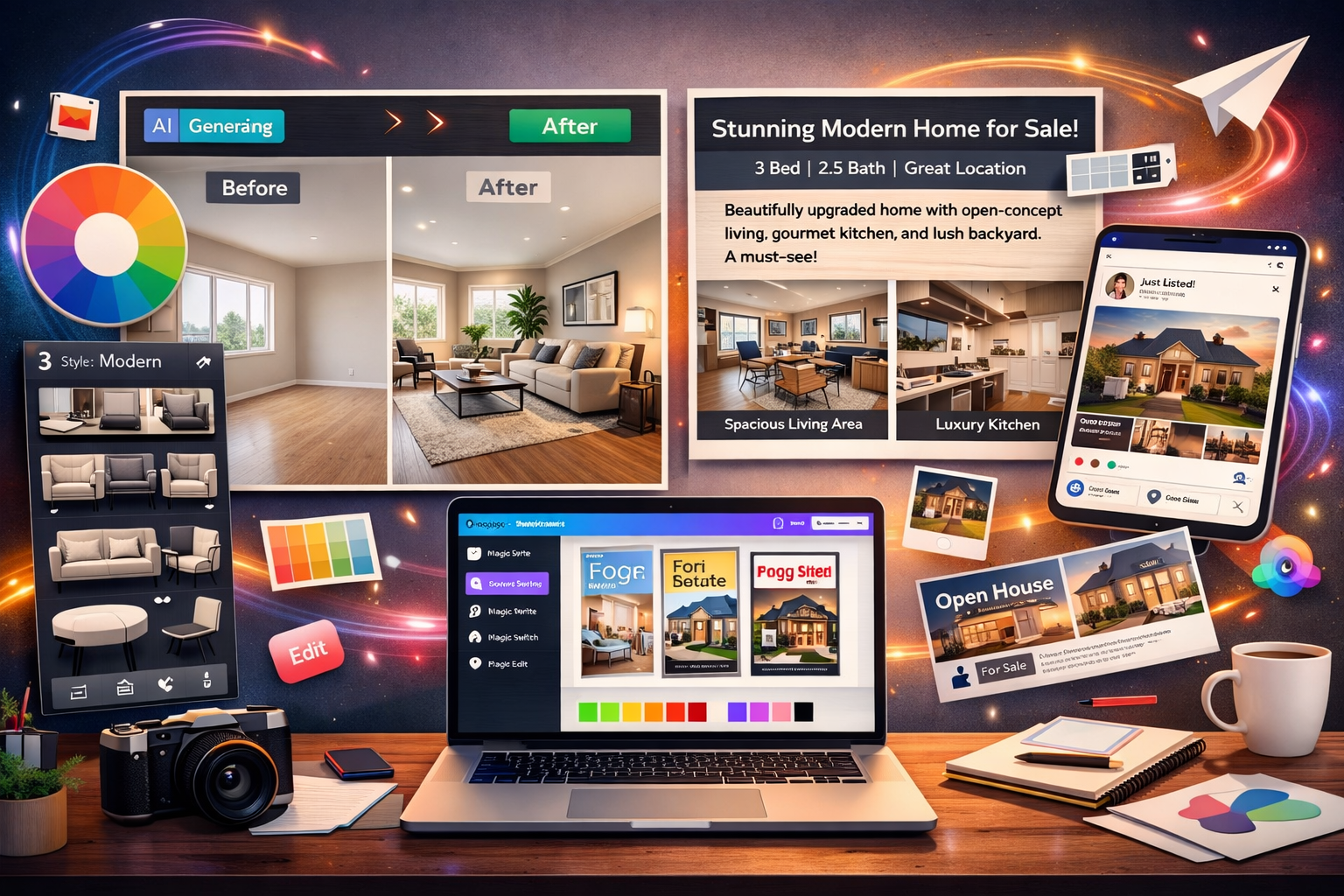
This category includes AI-powered solutions for staging, photography enhancement, listing generation, and marketing automation. Tools like Rendair AI for virtual staging and platforms that integrate with design tools like Canva's Magic Studio help investors and agents present properties in their best light without massive photography budgets.[2] For those looking to maximize their marketing impact, exploring how to use social media and AI tools to sell real estate can provide additional strategies.
3. Operational & CRM Automation
These platforms handle lead management, client communication, transaction coordination, and workflow automation. Lofty, CINC, and REDX represent the cutting edge of AI-driven CRM systems that qualify leads, automate follow-up, and ensure no opportunity falls through the cracks.[2] Agents building comprehensive systems should also review the real estate agent tech stack and AI tools that actually close deals.
The Top 13 Real Estate AI Tools for Investors: Data Intelligence & Market Analysis Platforms
When it comes to making smart investment decisions, data is king—but only if you can actually interpret it and act on it faster than your competition. The following platforms represent the most powerful AI-driven data intelligence tools available to real estate investors in 2026.
1. PropStream – Comprehensive Property Data & Lead Generation
PropStream has established itself as an extraordinary all-in-one platform for real estate investors who need deep property intelligence combined with powerful lead generation capabilities. This tool aggregates data from over 155 million properties across the United States, providing detailed information on ownership, equity, mortgage details, property characteristics, and market trends.
What makes PropStream particularly valuable for investors is its AI-enhanced search functionality that allows users to identify motivated sellers, distressed properties, and off-market opportunities using dozens of customizable filters. The platform's predictive analytics help investors spot properties with high flip potential or strong rental income prospects before they become widely known.
Key Features:
- Property Intelligence: Access to ownership history, mortgage details, equity positions, tax information, and lien records
- Lead Generation: Built-in skip tracing, direct mail campaigns, and contact information for property owners
- Market Analysis: Comparative market analysis (CMA) tools, neighborhood statistics, and appreciation trends
- Mapping & Visualization: Heat maps showing investment opportunity zones, foreclosure clusters, and demographic data
Best For: Fix-and-flip investors, wholesalers, and rental property investors who need comprehensive property data and motivated seller leads in one platform.
Pricing: Typically starts around $99/month with various tier options depending on feature access and lead volume.
For investors looking to combine PropStream's data with strategic analysis, understanding real estate investment strategies can help maximize the platform's potential.
2. HouseCanary – AI-Powered Valuation & Market Forecasting
HouseCanary represents the gold standard in AI-driven property valuation and market forecasting. This platform uses machine learning algorithms trained on billions of data points to provide impeccable accuracy in property valuations, often outperforming traditional appraisal methods in consistency and speed.
What sets HouseCanary apart is its predictive analytics engine that forecasts future property values and market trends at the neighborhood level. The platform integrates seamlessly with CRM systems like HubSpot, allowing investors to overlay valuation data directly into their deal pipeline and client management workflows.[4]
Key Features:
- Automated Valuation Models (AVMs): Instant property valuations with confidence scores and comparable sales analysis
- Market Forecasting: Predictive models showing expected appreciation or depreciation over 1, 3, and 5-year periods
- Neighborhood Analytics: Detailed demographic data, school ratings, crime statistics, and economic indicators
- API Integration: Connect valuation data directly to your CRM, investment analysis tools, or custom applications
Best For: Serious investors making data-driven decisions on acquisition, portfolio management firms, and institutional investors requiring scalable valuation solutions.
Pricing: Enterprise pricing model based on usage volume and integration requirements; typically requires consultation for custom quotes.
Investors using HouseCanary's forecasting capabilities should also understand real estate market trends and identifying lucrative investment opportunities to contextualize the data within broader market dynamics.
3. Redfin Data Center – Real-Time Market Intelligence
Redfin Data Center provides free access to one of the most comprehensive real estate databases available, with real-time updates on listings, sales, inventory levels, and market trends across hundreds of markets nationwide. While Redfin is widely known as a brokerage, their data platform has become an essential resource for investors conducting market research.
The platform's AI-enhanced analytics provide insights into market velocity (how quickly properties sell), price trends, inventory fluctuations, and buyer demand patterns. This real-time intelligence helps investors identify hot markets, understand seasonal patterns, and time their acquisitions and dispositions for maximum profit.
Key Features:
- Market Dashboards: Interactive charts showing median prices, inventory levels, days on market, and sale-to-list ratios
- Trend Analysis: Historical data going back years, allowing investors to identify cyclical patterns and long-term trends
- Neighborhood Comparisons: Side-by-side market statistics for different areas to identify the best investment zones
- Free Access: Unlike many premium platforms, Redfin Data Center provides substantial market intelligence at no cost
Best For: Investors conducting preliminary market research, agents advising clients on market timing, and anyone needing quick access to reliable market statistics.
Pricing: Free access to most features; premium Redfin Pro services available for licensed agents.
4. Zillow Research Data – Comprehensive Housing Market Insights
Zillow Research Data offers extensive housing market data and economic research that goes far beyond simple property listings. The platform provides access to Zillow's proprietary metrics like the Zillow Home Value Index (ZHVI), rental index data, market temperature indicators, and economic research reports.
For investors, Zillow's AI-powered analytics help identify macro trends that impact investment decisions—from migration patterns and remote work effects to affordability indices and inventory forecasts. The platform's data is frequently cited by economists, policymakers, and institutional investors, making it a trusted source for market intelligence.
Key Features:
- ZHVI & Rental Index: Track home values and rental rates across different property types and geographies
- Market Temperature: Gauge whether markets are hot, warm, or cool based on multiple indicators
- Economic Research: Access to detailed reports on housing trends, demographic shifts, and economic factors
- Downloadable Datasets: Export data for custom analysis and integration with your own models
Best For: Investors analyzing macro market trends, portfolio managers making strategic allocation decisions, and researchers conducting housing market studies.
Pricing: Free access to research data and public datasets; premium Zillow Premier Agent services available for real estate professionals.
Understanding broader economic factors is crucial when interpreting Zillow's data—investors should also review understanding real estate financial aspects for comprehensive financial literacy.
5. Rentana – AI-Driven Rental Property Analysis
Rentana specializes in helping investors analyze rental property opportunities with extraordinary precision. This platform combines property data, rental comps, expense estimates, and cash flow projections into a comprehensive investment analysis tool powered by AI.
The platform's algorithms automatically pull rental comparables from multiple sources, estimate operating expenses based on property characteristics and location, and calculate key investment metrics like cap rate, cash-on-cash return, and internal rate of return (IRR). This automation saves investors hours of manual research while providing more accurate projections.
Key Features:
- Automated Rental Comps: AI-powered comparable rent analysis based on property features, location, and market conditions
- Expense Estimation: Intelligent estimates for taxes, insurance, maintenance, property management, and utilities
- Cash Flow Projections: Detailed pro forma statements showing expected income, expenses, and returns
- Scenario Analysis: Test different financing structures, renovation budgets, and rent growth assumptions
Best For: Buy-and-hold investors focused on rental properties, landlords expanding their portfolios, and investors comparing multiple rental opportunities.
Pricing: Subscription-based pricing typically ranging from $29-99/month depending on feature access and property analysis volume.
Landlords using Rentana should also reference how much should I charge for rent – comprehensive landlord's pricing guide to validate the platform's rental estimates against local market realities.
6. Reonomy (Altus Group) – Commercial Real Estate Intelligence
Reonomy, now part of the Altus Group, provides specialized AI-powered intelligence for commercial real estate investors. This platform aggregates property ownership data, transaction history, tenant information, and financial performance metrics across commercial properties nationwide.
What makes Reonomy particularly powerful is its ability to identify ownership patterns, track portfolio transactions, and surface off-market opportunities in the commercial space. The AI algorithms analyze property characteristics, ownership structures, and market signals to predict which properties might be coming to market or represent acquisition opportunities.
Key Features:
- Ownership Intelligence: Detailed ownership structures, portfolio holdings, and decision-maker contact information
- Property Profiles: Comprehensive data on commercial properties including tenant mix, lease terms, and building characteristics
- Market Analytics: Transaction trends, cap rate analysis, and market velocity metrics for commercial properties
- Lead Generation: Identify potential sellers based on ownership patterns, property performance, and market signals
Best For: Commercial real estate investors, multifamily investors, and institutional buyers seeking off-market opportunities.
Pricing: Enterprise pricing model requiring consultation; typically serves professional investors and institutions.
Commercial investors should complement Reonomy's intelligence with knowledge from commercial real estate investments to understand broader investment strategies.
Top 13 Real Estate AI Tools for Investors: Marketing, Staging & Visualization Platforms
In the competitive real estate market of 2026, how you present properties can be just as important as the properties themselves. These AI-powered marketing and visualization tools help investors and agents create impeccable marketing materials that sell properties faster and for higher prices.
7. Rendair AI – Professional Virtual Staging & Visualization
Rendair AI has emerged as the premier AI-powered virtual staging platform, focusing on photorealistic accuracy rather than artistic interpretation.[2] This tool allows investors and agents to transform empty rooms into beautifully furnished spaces in minutes, dramatically improving listing appeal without the cost and logistics of physical staging.
What sets Rendair apart from competitors is its emphasis on realism and accuracy. The AI generates staging that looks natural and believable, avoiding the uncanny valley effect that plagued earlier virtual staging tools. The platform also serves as a comprehensive visualization workspace where users can experiment with different design styles, furniture arrangements, and renovation possibilities.
Key Features:
- Photorealistic Staging: AI-generated furniture and decor that looks authentic in listing photos
- Multiple Style Options: Choose from contemporary, traditional, minimalist, luxury, and other design aesthetics
- Room Transformation: Visualize renovations, layout changes, and design possibilities before investing in physical changes
- Fast Turnaround: Generate professionally staged images in minutes rather than days
Best For: Investors marketing vacant properties, agents listing homes that need staging, and flippers visualizing renovation potential.
Pricing: Typically subscription-based starting around $29-79/month depending on image volume and feature access.
Sellers preparing properties for market should also review sell your home faster – 15 features and upgrades that buyers love to understand which physical improvements complement virtual staging most effectively.
8. Saleswise – Integrated CMA & Virtual Staging Platform
Saleswise represents the next evolution in real estate marketing tools by integrating virtual staging with AI-generated comparative market analysis (CMA) in a single workflow.[1] This platform recognizes that investors and agents need both compelling visuals and solid data to close deals effectively.
The AI-powered CMA generation pulls recent comparable sales, analyzes market trends, and produces professional reports that justify pricing strategies. When combined with the platform's virtual staging capabilities, users can present a complete package that shows both what a property could look like and why the pricing makes sense.
Key Features:
- Integrated Workflow: Generate CMAs and staging in one platform without switching between tools
- AI-Generated CMAs: Automated comparable sales analysis with market trend insights
- Virtual Staging: Transform listing photos with AI-generated furniture and design
- Professional Reports: Export polished presentations for clients and marketing materials
Best For: Agents conducting listing presentations, investors analyzing flip potential, and brokers who need comprehensive marketing and analysis tools.
Pricing: Subscription-based pricing typically in the $49-149/month range depending on feature access and usage volume.
9. Canva Magic Studio – AI-Powered Marketing Design
Canva's Magic Studio has become increasingly sophisticated in 2026, offering AI-powered design tools that democratize professional marketing creation for real estate professionals.[2] The platform's "Magic Grab" feature removes distracting elements from photos, while its template library and AI design assistant help create flyers, social media posts, email headers, and property brochures in minutes.
What makes Canva particularly valuable is its accessibility—even agents and investors with zero design experience can create fresh, professional marketing materials that compete with expensive agency work. The AI understands real estate marketing conventions and can suggest layouts, color schemes, and design elements that convert viewers into leads.
Key Features:
- Magic Grab: AI-powered object removal and photo cleanup for listing images
- Template Library: Thousands of real estate-specific templates for every marketing need
- Brand Kit: Maintain consistent branding across all marketing materials
- Multi-Format Export: Create designs optimized for social media, print, email, and web simultaneously
Best For: Agents creating their own marketing materials, investors managing property portfolios, and small brokerages without dedicated design teams.
Pricing: Free tier available; Pro version starts around $15/month with additional team and enterprise options.
Real estate professionals should also explore real estate photos that sell – shot list and prep guide for sellers plus AI photo tricks that work to maximize the impact of their visual marketing.
10. ChatGPT (GPT-5.2) – Content Generation & Analysis
ChatGPT has evolved significantly by 2026, with GPT-5.2 models offering three variants—Instant, Thinking, and Pro—optimized for different professional workloads.[3] For real estate investors and agents, ChatGPT has become an essential tool for generating listing descriptions, crafting negotiation emails, analyzing inspection reports, creating market analysis summaries, and even drafting investment proposals.
The "Thinking" variant excels at complex analytical tasks like comparing multiple investment scenarios or synthesizing market research from various sources. The "Instant" variant handles quick tasks like social media posts and email responses, while "Pro" offers the most sophisticated reasoning for strategic planning and detailed analysis.
Key Features:
- Listing Descriptions: Generate compelling property descriptions that highlight key features and appeal to target buyers
- Email & Communication: Draft professional emails, negotiation letters, and client communications
- Market Analysis: Summarize complex market data and research into actionable insights
- Document Processing: Analyze inspection reports, contracts, and financial statements to extract key information
Best For: All real estate professionals needing content creation, communication assistance, and analytical support.
Pricing: Free tier available; ChatGPT Plus (approximately $20/month) provides access to advanced models and higher usage limits; Pro tier available for heavy professional use.
Some practitioners report that Claude provides superior results for content generation tasks, particularly for longer-form content and creative writing.[6] Investors should experiment with both platforms to determine which works best for their specific needs.
For professionals looking to leverage AI for financial calculations, how to calculate home buyers closing costs in minutes using ChatGPT or Gemini AI demonstrates practical applications of these tools.
Top 13 Real Estate AI Tools for Investors: CRM, Lead Management & Automation
Converting leads into closed deals requires systematic follow-up, intelligent qualification, and timely engagement—all areas where AI-powered CRM platforms excel. These tools represent the cutting edge of lead management and sales automation for real estate professionals.
11. Lofty (formerly Chime) – AI-Powered Lead Qualification & Nurture
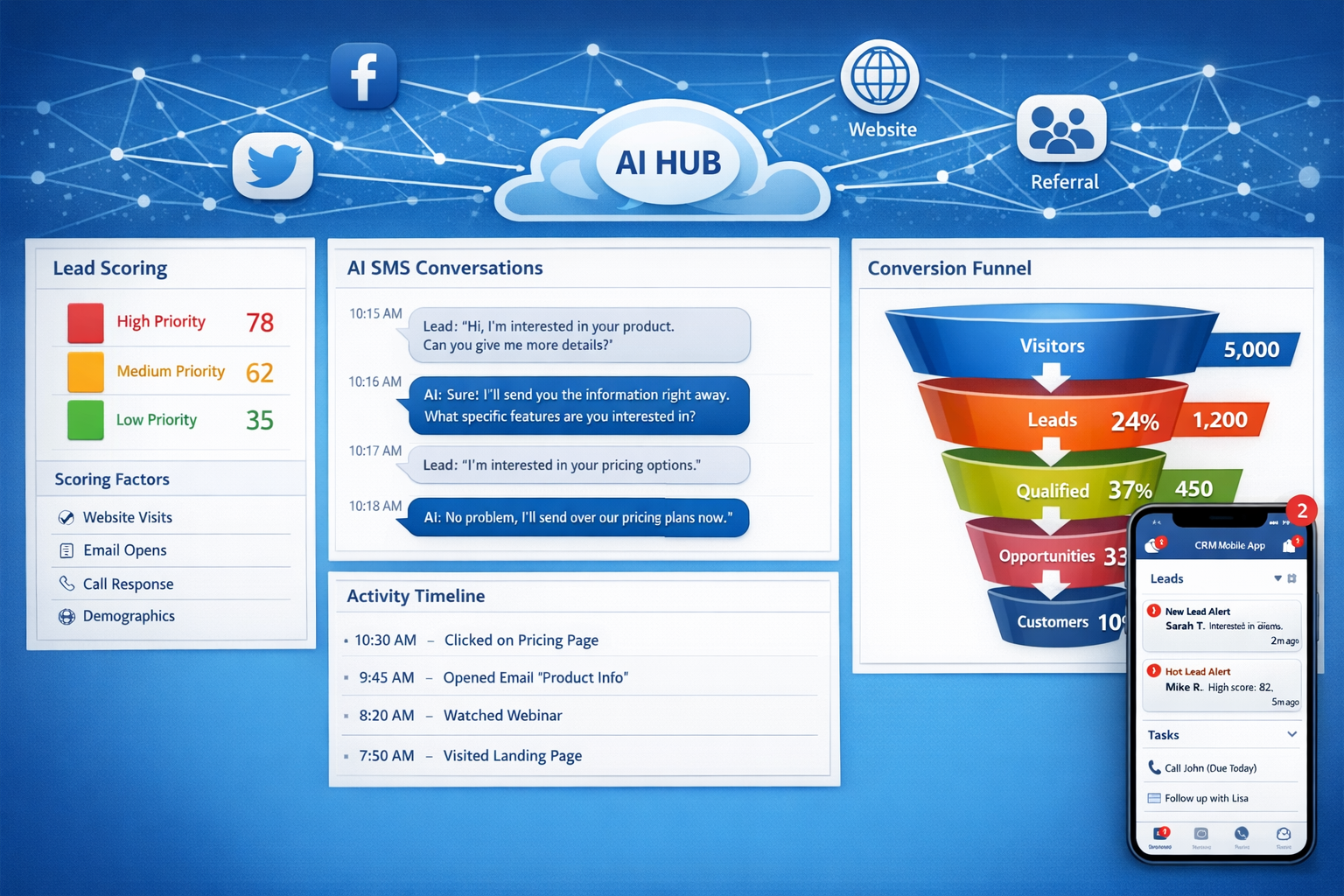
Lofty has established itself as one of the most sophisticated AI-driven CRM platforms for real estate, with a particular focus on automated lead qualification and behavioral nurture campaigns.[2] The platform uses AI to qualify leads via text message and chat, analyzing responses and engagement patterns to prioritize hot prospects and automatically nurture those who need more time.
What makes Lofty extraordinary is its behavioral intelligence—rather than generic drip sequences that send the same emails to everyone, Lofty's AI adapts communication based on how leads interact with your content, website, and messages. This personalization dramatically improves conversion rates compared to traditional CRM systems.
Key Features:
- AI Lead Qualification: Automated text and chat conversations that qualify leads without human intervention
- Behavioral Automation: Nurture campaigns that adapt based on lead engagement and behavior patterns
- Predictive Analytics: AI scoring that identifies which leads are most likely to convert
- Multi-Channel Communication: Coordinate text, email, phone, and social media outreach from one platform
Best For: High-volume teams and brokerages that generate significant lead flow and need sophisticated automation to maximize conversion.
Pricing: Approximately $449/month targeting team and brokerage implementations rather than individual agents.[2]
12. CINC – Comprehensive Real Estate CRM & Lead Generation
CINC (Commissions Inc.) provides an integrated platform combining lead generation, CRM functionality, and marketing automation specifically designed for real estate professionals. The platform's AI-powered lead routing ensures that inquiries reach the right agent immediately, while automated follow-up sequences keep prospects engaged throughout their buying journey.
CINC's strength lies in its comprehensive approach—rather than just managing leads, it helps generate them through integrated IDX websites, Facebook advertising, and Google PPC campaigns, then nurtures those leads through intelligent automation until they're ready to transact.
Key Features:
- Lead Generation: Integrated website, SEO, and paid advertising campaigns that generate qualified leads
- Smart Routing: AI-powered lead distribution based on agent specialization, availability, and performance
- Automated Follow-Up: Multi-touch campaigns combining email, text, and phone outreach
- Performance Analytics: Track conversion rates, response times, and ROI across all marketing channels
Best For: Individual agents and teams looking for an all-in-one solution that handles both lead generation and management.
Pricing: Custom pricing based on market size, lead volume, and feature requirements; typically requires consultation.
Agents building comprehensive lead generation strategies should also explore qualified home buyers leads – the agent's complete networking guide for additional tactics beyond CRM automation.
13. REDX – AI-Enhanced Prospecting & Dialer Platform
REDX specializes in providing fresh, accurate lead data combined with powerful dialing and prospecting tools enhanced by AI. The platform focuses on helping agents and investors identify and contact motivated sellers, expired listings, FSBOs (for sale by owner), and other high-probability prospects.
The AI components of REDX include predictive lead scoring that identifies which prospects are most likely to list or sell, intelligent call scheduling that optimizes contact timing, and conversation intelligence that provides real-time guidance during calls. This combination of quality data and smart automation makes REDX particularly effective for agents who excel at phone prospecting.
Key Features:
- Fresh Lead Data: Continuously updated databases of expired listings, FSBOs, pre-foreclosures, and other motivated sellers
- Power Dialer: Efficient calling system with local presence, voicemail drop, and call recording
- AI Lead Scoring: Predictive analytics identifying the highest-probability prospects
- Script Assistance: Real-time conversation guidance and objection handling support
Best For: Agents and investors who prioritize phone prospecting and direct seller contact.
Pricing: Subscription-based pricing typically ranging from $39-99/month depending on lead types and feature access.
Emerging AI Tools & Specialized Platforms for Real Estate Investors
Beyond the mainstream platforms, several specialized AI tools have emerged as game-changers for specific real estate workflows and investment strategies. These platforms represent the cutting edge of innovation in the industry.
Skyline AI – Institutional-Grade Investment Analytics
Skyline AI brings institutional-level investment analytics to the commercial and multifamily real estate space. This platform uses machine learning to analyze thousands of data points—from property characteristics and location attributes to economic indicators and demographic trends—to identify undervalued assets and predict future performance.
What sets Skyline AI apart is its ability to process unstructured data sources that traditional analysis misses, including satellite imagery, social media sentiment, and local business patterns. This comprehensive intelligence helps investors spot opportunities that others overlook and avoid properties with hidden risks.
Best For: Commercial investors, multifamily syndicators, and institutional buyers seeking data-driven acquisition strategies.
For investors exploring different property types, commercial real estate investments provides foundational knowledge to complement Skyline AI's analytics.
CompStak – Crowdsourced Commercial Real Estate Data
CompStak has built the largest database of commercial real estate lease and sale comps through a unique crowdsourced model where brokers contribute transaction data in exchange for access to the platform. AI algorithms validate, normalize, and analyze this data to provide unprecedented transparency in commercial markets.
For investors, CompStak solves the perennial problem of finding accurate commercial comps—information that's traditionally difficult to access and often unreliable. The platform's AI ensures data quality while providing insights into market trends, tenant preferences, and pricing dynamics.
Best For: Commercial brokers, investors analyzing commercial acquisitions, and anyone needing reliable commercial transaction data.
Cherre – Real Estate Data Integration & Intelligence Platform
Cherre addresses one of the biggest challenges in real estate investing: data fragmentation. This platform uses AI to integrate data from dozens of disparate sources—property records, market data, financial systems, demographics, environmental data—into a unified intelligence layer that powers better decision-making.
The platform's machine learning algorithms identify patterns and relationships across datasets that would be impossible to spot manually. This integration capability makes Cherre particularly valuable for portfolio managers and institutional investors dealing with large volumes of properties and data sources.
Best For: Portfolio managers, institutional investors, and data-driven organizations requiring comprehensive data integration.
Understanding how to integrate various data sources is crucial—investors should also review real estate investment technology for broader context on technological integration.
DealMachine – AI-Powered Driving for Dollars & Direct Mail
DealMachine modernizes the classic "driving for dollars" strategy by adding AI-powered property identification and automated direct mail campaigns. Users drive neighborhoods using the mobile app, which automatically identifies properties, pulls owner information, and can launch direct mail campaigns to motivated sellers.
The AI components include property condition scoring based on photos, predictive modeling to identify distressed properties, and campaign optimization that tests different messages and formats to maximize response rates. This combination of old-school prospecting with modern technology creates a powerful acquisition channel.
Best For: Wholesalers, fix-and-flip investors, and anyone seeking off-market deals through direct seller contact.
Roofstock – AI-Enhanced Marketplace for Rental Properties
Roofstock operates as a marketplace for turnkey rental properties, with AI playing a crucial role in property evaluation, pricing, and matching investors with suitable opportunities. The platform's algorithms analyze rental performance, neighborhood quality, property condition, and market trends to provide comprehensive investment analysis.
What makes Roofstock particularly dope is its ability to facilitate remote investing—the AI-powered due diligence and standardized property certifications allow investors to purchase rental properties in markets they've never visited with confidence in the investment fundamentals.
Best For: Out-of-state investors, passive rental property investors, and anyone seeking turnkey rental opportunities.
Investors using Roofstock should also understand real estate investment property management to ensure they can effectively manage remote properties.
Fundrise – AI-Driven Real Estate Crowdfunding
Fundrise democratizes access to commercial and residential real estate investments through a crowdfunding model enhanced by AI. The platform's algorithms analyze market conditions, property fundamentals, and portfolio construction to create diversified real estate investment opportunities accessible to non-accredited investors.
The AI continuously monitors portfolio performance, rebalances holdings, and identifies new acquisition opportunities that align with investor objectives. This institutional-quality portfolio management was previously available only to high-net-worth individuals and institutions.
Best For: Passive investors seeking real estate exposure without direct property ownership, portfolio diversification, and access to commercial real estate.
For comprehensive information on alternative real estate investment vehicles, investors should review REIT real estate investments and best crowdfunding sites for investors in 2025.
Building Your AI-Powered Real Estate Tech Stack
Understanding individual tools is valuable, but the real magic happens when you combine multiple AI platforms into an integrated workflow that handles everything from lead generation to property analysis to marketing execution. The most successful real estate professionals in 2026 don't rely on a single tool—they build comprehensive tech stacks tailored to their specific business models.
The Investor's Essential AI Stack
For serious real estate investors, an effective tech stack typically includes:
1. Market Intelligence Layer
- Primary: HouseCanary or PropStream for property data and valuation
- Secondary: Zillow Research Data or Redfin Data Center for market trends
- Specialized: Reonomy (for commercial) or Rentana (for rental analysis)
2. Marketing & Presentation Layer
- Staging: Rendair AI for virtual staging
- Content: ChatGPT or Claude for listing descriptions and communications
- Design: Canva Magic Studio for marketing materials
3. Lead Management & CRM Layer
- High-Volume Teams: Lofty or CINC for comprehensive automation
- Prospecting Focus: REDX or DealMachine for direct seller contact
- Integration Hub: HubSpot Smart CRM for connecting multiple data sources[4]
4. Specialized Tools
- Commercial Investors: CompStak and Skyline AI
- Wholesalers: DealMachine and PropStream
- Passive Investors: Fundrise and Roofstock
Integration Best Practices
The key to maximizing AI tool effectiveness lies in integration rather than isolation. Leading practitioners recommend:
Create Workflow Sequences: Rather than using tools in isolation, create sequences where outputs from one tool feed directly into another. For example: PropStream identifies motivated sellers → DealMachine launches direct mail → Lofty manages follow-up → Rendair AI stages the property → Canva creates marketing materials → ChatGPT generates listing copy.[2]
Centralize Data: Use integration platforms or CRMs that connect multiple tools so data flows seamlessly. HubSpot's Smart CRM, for instance, integrates with HouseCanary to overlay valuation data directly into your deal pipeline.[4]
Automate Repetitive Tasks: Identify tasks you perform repeatedly and find AI tools that automate them. This might include lead qualification, follow-up sequences, market reports, or property analysis.
Test and Optimize: AI tools continuously improve, and new platforms emerge regularly. Allocate time quarterly to test new tools and optimize your existing stack based on performance metrics.
For agents building comprehensive systems, real estate agent tech stack – AI tools that actually close deals provides additional implementation strategies.
Cost Considerations and ROI
Building an AI-powered tech stack requires investment, but the ROI can be extraordinary when implemented strategically. A typical comprehensive stack might cost:
- Basic Stack: $200-400/month (PropStream + Canva + ChatGPT Plus + basic CRM)
- Intermediate Stack: $500-800/month (adds HouseCanary, Rendair AI, enhanced CRM features)
- Advanced Stack: $1,000-2,000/month (enterprise platforms, commercial tools, full automation)
The key is matching your investment to your transaction volume and business model. A solo agent closing 12 deals annually might struggle to justify a $2,000/month tech budget, while a team closing 100+ transactions would find that investment pays for itself many times over in time savings and increased conversion rates.
Calculate ROI by considering:
- Time Savings: How many hours per week do the tools save? What's that time worth?
- Conversion Improvement: Do the tools increase your lead-to-close conversion rate?
- Deal Quality: Do the tools help you identify better opportunities or negotiate better terms?
- Competitive Advantage: Do the tools enable you to move faster or provide better service than competitors?
Understanding the financial aspects of your investments is crucial—review understanding real estate financial aspects for comprehensive financial planning guidance.
Advanced AI Capabilities Transforming Real Estate in 2026
Beyond the mainstream tools, several cutting-edge AI capabilities are beginning to reshape how sophisticated investors and agents operate. While some of these technologies are still emerging, early adopters are already seeing competitive advantages.
Computer Vision & Property Analysis
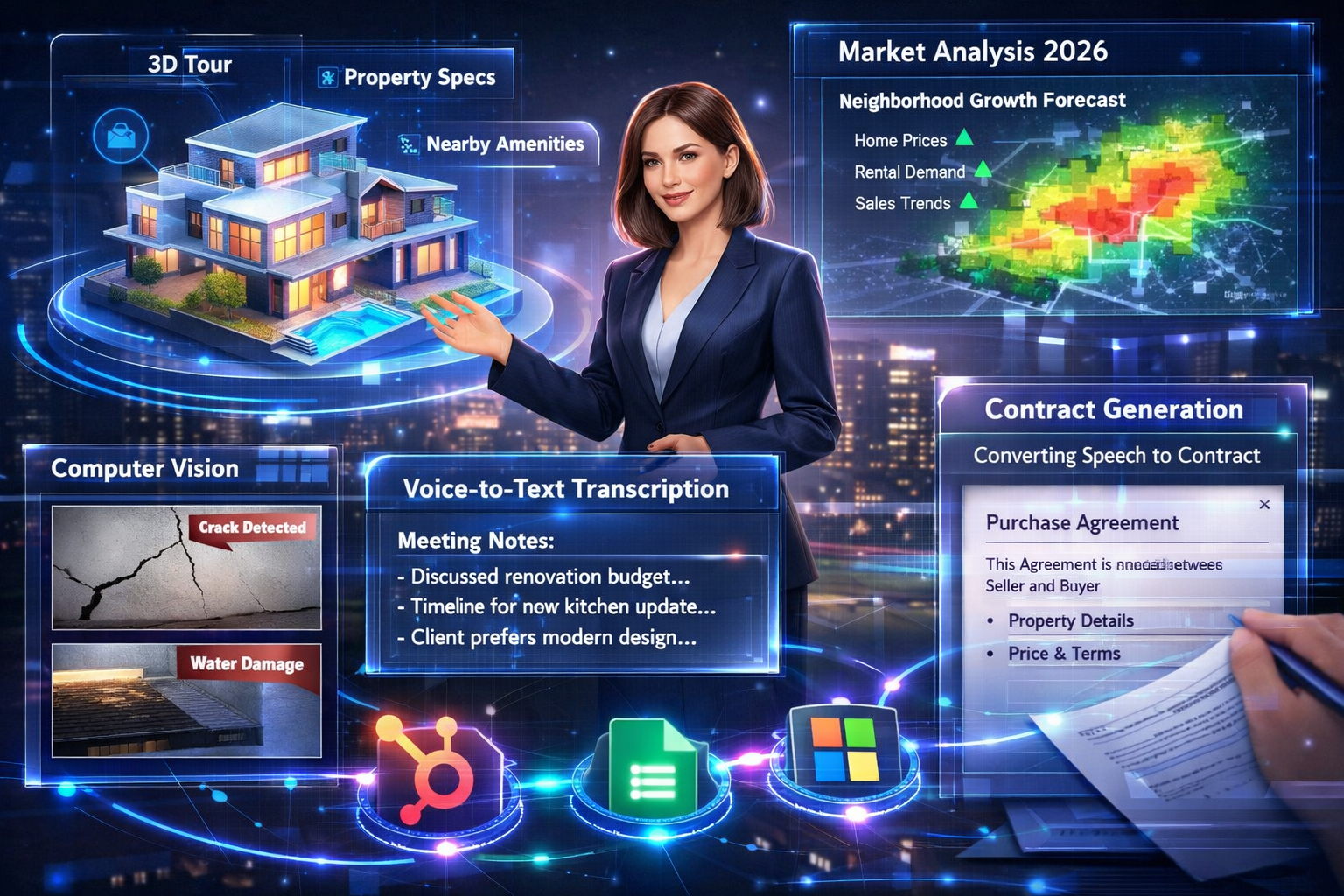
AI-powered computer vision has advanced to the point where algorithms can analyze property photos and videos to assess condition, identify needed repairs, estimate renovation costs, and even predict maintenance issues before they become critical. Gemini 3's computer use capabilities now extend to form-filling, screen understanding, and app control, supporting multimodal analysis across images and video.[3]
For investors, this means uploading property photos and receiving instant assessments of:
- Roof condition and remaining lifespan
- Foundation issues or structural concerns
- HVAC system age and efficiency
- Interior finish quality and renovation needs
- Landscaping condition and curb appeal factors
This technology dramatically accelerates due diligence and helps investors make faster, more confident offers on properties.
Natural Language Processing for Document Analysis
Advanced language models can now process complex real estate documents—inspection reports, appraisals, title reports, lease agreements—and extract key information, identify risks, and summarize findings in plain language. Beam AI's October 2025 updates added integrations with Microsoft Business, SharePoint, and Google Sheets, enabling unified document processing and smarter parameter extraction for multifamily and commercial operations.[3]
This capability saves investors countless hours reviewing documents and reduces the risk of missing critical information buried in lengthy reports.
Predictive Analytics & Market Forecasting
The most sophisticated AI platforms now incorporate real-time data streams to provide predictive insights that go beyond historical analysis. Grok's integration of real-time streams from X (formerly Twitter), news sources, and public filings allows agents to surface fresh, source-linked insights for market analysis rather than relying on static training data.[3]
This real-time intelligence helps investors:
- Identify neighborhoods experiencing rapid appreciation before it shows in official statistics
- Spot emerging market trends from social media sentiment and news coverage
- Detect economic shifts that might impact property values
- Anticipate regulatory changes that could affect investment strategies
For investors seeking to understand these predictive capabilities in context, unlocking 2026 real estate trends – how AI predictive tools are revolutionizing seller intelligence provides additional insights.[7]
Voice-to-Text & Meeting Intelligence
Specialized tools like Whisper Flow have revolutionized how real estate professionals capture and process information from calls, showings, and meetings.[6] These AI-powered transcription services don't just convert speech to text—they identify action items, extract key information, and can automatically update CRM records based on conversation content.
For busy investors and agents, this means:
- Never losing important details from client conversations
- Automatic CRM updates without manual data entry
- Searchable archives of all client interactions
- Better follow-up based on conversation intelligence
AI Avatars & Video Generation
Platforms like HeyGen have expanded AI avatar capabilities to support multi-language text-to-speech and digital doubles with custom character lip-syncing for marketing and training materials.[3] Kling AI leads in affordable, realistic AI video generation with customizable element controls.[3]
These tools enable investors and agents to:
- Create personalized video messages at scale
- Produce property tour videos without expensive videography
- Generate multilingual marketing content for diverse markets
- Build training materials and educational content efficiently
For professionals exploring visual marketing innovations, are virtual tours and drone photography worth it – how can nano banana pro help examines the ROI of advanced visual marketing.
Common Pitfalls & How to Avoid Them
While AI tools offer extraordinary capabilities, implementation challenges and common mistakes can undermine their effectiveness. Here's what to watch for:
Over-Reliance on Automation
The Problem: Some professionals implement AI tools and then completely disengage from the process, assuming the technology will handle everything. This leads to generic communications, missed nuances, and lost opportunities.
The Solution: Use AI as a force multiplier, not a replacement. Review AI-generated content before sending, customize automated sequences based on client feedback, and maintain personal touchpoints in your client relationships. The most successful professionals use AI to handle routine tasks so they can focus on high-value activities that require human judgment and relationship skills.
Tool Overload & Complexity
The Problem: The abundance of AI tools tempts professionals to subscribe to dozens of platforms, creating complexity, redundancy, and wasted budget. Too many tools can actually decrease productivity as users spend time managing systems rather than using them.
The Solution: Start with a core stack of 3-5 essential tools that address your biggest pain points. Master those platforms before adding new ones. Regularly audit your tech stack and eliminate redundant or underutilized tools. Focus on integration and workflow rather than feature collection.
Ignoring Data Quality
The Problem: AI tools are only as good as the data they process. Garbage in, garbage out applies doubly to AI systems. Professionals who don't maintain clean CRM data, verify property information, or validate AI outputs end up with unreliable results.
The Solution: Implement data hygiene practices—regularly clean your CRM, verify property data from multiple sources, cross-check AI valuations against your market knowledge, and validate AI-generated content for accuracy. Use AI to process data faster, but maintain human oversight for quality control.
Neglecting Training & Onboarding
The Problem: Many professionals subscribe to powerful AI tools but never invest time in proper training, resulting in underutilization and poor ROI. They use perhaps 10% of the platform's capabilities and wonder why results are disappointing.
The Solution: Allocate dedicated time for training when implementing new tools. Most platforms offer tutorials, webinars, and documentation—actually use them. Consider hiring virtual assistants who specialize in real estate technology to help with implementation and ongoing management. For guidance on this approach, review how to hire and find your next virtual assistant for your real estate business in 2026.
Privacy & Compliance Concerns
The Problem: Real estate transactions involve sensitive personal and financial information. Uploading client data to AI platforms without proper safeguards can create privacy violations, regulatory issues, and liability exposure.
The Solution: Understand each platform's data handling policies, ensure compliance with real estate regulations and privacy laws, anonymize sensitive information when possible, and maintain proper disclosures with clients about how their data is used. Work with your broker or legal counsel to ensure your AI tool usage complies with industry regulations.
Failing to Measure Results
The Problem: Professionals implement AI tools based on hype rather than results, continuing to pay for platforms that don't actually improve their business metrics.
The Solution: Establish baseline metrics before implementing new tools—conversion rates, response times, deals closed, time spent on specific tasks. After implementation, track whether the tools actually improve these metrics. Be willing to abandon tools that don't deliver measurable value, regardless of how impressive they seem.
The Future of AI in Real Estate Investment
Looking ahead, the integration of AI into real estate will only deepen and become more sophisticated. Several trends are already emerging that will shape the industry over the next few years:
Hyper-Personalization at Scale
AI platforms will increasingly enable mass personalization—delivering customized property recommendations, market insights, and communications to thousands of clients simultaneously, each tailored to their specific preferences, behavior, and transaction history. This level of personalization was previously impossible at scale but is becoming standard practice.
Predictive Seller Identification
Advanced AI will identify potential sellers before they actively list properties by analyzing behavioral signals, life events, financial patterns, and property characteristics. This capability will shift competitive advantage toward professionals who can reach motivated sellers first rather than competing for publicly listed inventory.[7]
Autonomous Transaction Management
AI agents will increasingly handle routine transaction coordination—scheduling inspections, ordering reports, tracking deadlines, coordinating with service providers—with minimal human intervention. This will free professionals to focus on negotiation, strategy, and relationship building.
Blockchain & AI Integration
The combination of blockchain technology for secure, transparent transactions and AI for analysis and automation will create new investment vehicles, fractional ownership opportunities, and transaction mechanisms that reduce friction and costs.
Environmental & Sustainability Analytics
AI will increasingly incorporate environmental data, climate risk assessments, energy efficiency analysis, and sustainability metrics into property valuation and investment analysis as these factors become more important to buyers and investors.
For broader perspective on industry evolution, review real estate trends 2025 predictions and future sustainable development global real estate.
Conclusion: Taking Action with AI Tools
The Top 13 Real Estate AI Tools for Investors outlined in this guide represent more than just software platforms—they're fundamental business infrastructure for anyone serious about competing in the modern real estate market. From data intelligence platforms like PropStream and HouseCanary that identify opportunities before your competition, to marketing tools like Rendair AI and Canva Magic Studio that present properties in their best light, to CRM systems like Lofty and CINC that convert more leads with less manual effort—these tools deliver impeccable results when implemented strategically.
The key takeaway isn't that you need every tool mentioned here. Rather, success comes from building a focused tech stack aligned with your specific business model, investment strategy, and transaction volume. A wholesaler focused on off-market deals will prioritize different tools than a fix-and-flip investor or a rental property portfolio manager.
Your Next Steps
1. Assess Your Current Situation
Identify your biggest bottlenecks and pain points. Where are you losing deals? What tasks consume disproportionate time? Which aspects of your business would benefit most from automation or better data?
2. Start with Core Capabilities
Choose 2-3 tools that address your most critical needs. Master these platforms before expanding your stack. For most investors, this means starting with a data intelligence platform, a marketing tool, and a CRM system.
3. Invest in Training
Allocate dedicated time to learn your chosen platforms thoroughly. Most tools offer far more capabilities than users initially realize. The difference between mediocre and extraordinary results often comes down to implementation quality rather than tool selection.
4. Measure and Optimize
Track concrete metrics—conversion rates, time savings, deals closed, ROI. Let data guide your decisions about which tools to keep, which to eliminate, and where to invest next.
5. Stay Current
AI technology evolves rapidly. Allocate time quarterly to explore new tools, test emerging platforms, and optimize your existing stack. What works today may be obsolete in 18 months—staying current is part of maintaining competitive advantage.
The real estate professionals who thrive in 2026 and beyond won't be those who resist technology or those who blindly adopt every new tool. Success belongs to those who thoughtfully integrate AI capabilities into their workflows, maintaining the human elements that build trust and close deals while leveraging technology to operate faster, smarter, and more efficiently than ever before.
The tools are available. The data is accessible. The competitive advantage is waiting. The only question is whether you'll take action to claim it.
For comprehensive guidance on building your real estate business with cutting-edge tools and strategies, explore the resources available at Real Estate Rank IQ and subscribe to the Real Estate Rank IQ YouTube channel for ongoing education and expert insights.
References
[1] Real Estate Market Analysis Tools – https://www.saleswise.ai/blog/real-estate-market-analysis-tools
[2] Tools Top Ai Tools For Real Estate Brokers In 2026 A Practical Guide – https://rendair.ai/blog/tools-top-ai-tools-for-real-estate-brokers-in-2026-a-practical-guide/
[3] Ai Tools Commercial Real Estate – https://www.adventuresincre.com/ai-tools-commercial-real-estate/
[4] Ai Crm Real Estate – https://blog.hubspot.com/sales/ai-crm-real-estate
[5] Watch – https://www.youtube.com/watch?v=bVpCEzbamjQ
[6] Watch – https://www.youtube.com/watch?v=IPyq8doeT88
[7] Unlocking 2026 Real Estate Trends How Ai Predictive Tools Are Revolutionizing Seller Intelligence – https://fello.ai/academy/unlocking-2026-real-estate-trends-how-ai-predictive-tools-are-revolutionizing-seller-intelligence
[8] Real Estate – https://www.futurepedia.io/ai-tools/real-estate
[9] 5 Tools Every Real Estate Agent Needs To Win In 2026 – https://www.realtor.com/marketing/resources/5-tools-every-real-estate-agent-needs-to-win-in-2026/