

Last updated: March 23, 2026

The top 10 AI tools real estate agents should be using right now include NotebookLM for listing presentations, Claude AI for writing, Nano Banana Pro for image generation, Zapier for lead automation, Claude Code for custom systems, Marky AI for social media, Kling AI for video, Folk CRM for relationship management, Perplexity AI for market research, and Fireflies.ai for meeting notes. Most offer free tiers or trials generous enough for solo agents, and together they can replace 15 to 25 hours of weekly busywork without requiring a single new hire.
Key Takeaways
- NotebookLM turns raw CMA data and MLS reports into polished listing presentations, audio summaries, and visual pitch decks in minutes rather than hours.
- Claude AI produces listing descriptions, offer letters, and client communications that read like they were written by an experienced agent, not a chatbot.
- Nano Banana Pro generates professional-quality staging mockups and neighborhood lifestyle imagery at up to 4K resolution, replacing expensive staging consultations.
- Zapier automates lead follow-up within 90 seconds of form submission, and the free tier covers basic workflows for solo agents.
- Claude Code lets agents build custom lead intake, routing, and nurture systems that would otherwise cost thousands in developer fees.
- Marky AI produces a full month of on-brand social media content in under five minutes, scheduling across six platforms from one dashboard.
- Kling AI creates cinematic neighborhood and listing videos up to three minutes long, replacing videography sessions that typically cost $500 to $1,500.
- Folk CRM offers a relationship-first approach to contact management without the bloat of enterprise platforms like HubSpot or Salesforce.
- Most of these tools cost $0 to $20 per month, making them accessible to agents at every production level.
- The agents gaining market share in 2026 aren't working harder; they're stacking these tools to automate the 60% of their workload that doesn't require a real estate license.
Why Are Top-Producing Agents Quietly Adopting AI Tools in 2026?
Real estate agents spend roughly 60% of their working hours on tasks that don't directly generate revenue: data entry, follow-up emails, social media posting, presentation building, and administrative coordination. According to the National Association of Realtors' 2025 Member Profile, the median agent closed 10 transactions per year, yet reported working an average of 40 hours per week. The math doesn't add up unless most of that time is being consumed by non-revenue activities.
The agents pulling ahead aren't hiring bigger teams. They're quietly automating half their workflow using AI tools the broader tech industry already relies on, repurposed for real estate-specific tasks. These aren't overpriced real estate CRM platforms or MLS add-ons with "AI" slapped on the label. They're general-purpose tools that happen to solve real estate problems exceptionally well when configured correctly.
This guide breaks down ten specific tools, explains exactly how to apply each one to a real estate workflow, and identifies which free tiers are genuinely useful versus which ones require a paid upgrade to deliver real value. Whether you're a solo agent looking to boost your GCI with smarter prospecting or a team leader trying to scale operations without scaling headcount, this stack covers the critical gaps.
1. NotebookLM — How Can Agents Turn Market Data Into Listing Presentations in Minutes?
Free tier available | Google | Minimal learning curve
NotebookLM is Google's AI-powered research assistant, and it has become one of the most underrated productivity tools for real estate professionals. Unlike general-purpose chatbots that answer from broad training data, NotebookLM works exclusively with the documents you upload. That distinction matters enormously for agents, because every output is grounded in your actual data rather than generic market assumptions.
What the Free Tier Actually Includes
The free tier is genuinely generous for solo agents:
- Up to 100 notebooks (think of each as a project folder)
- 50 sources per notebook (PDFs, Google Docs, web links, YouTube videos)
- 50,000 words per source upload limit
- 50 chat queries per day
- Three audio or video generations per day
For most agents handling five to ten active listings at a time, those limits cover everything without spending a dollar.
How Real Estate Agents Should Use It
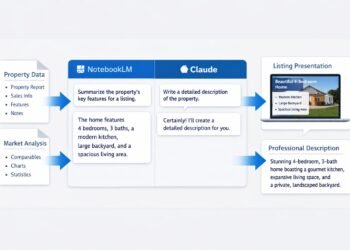
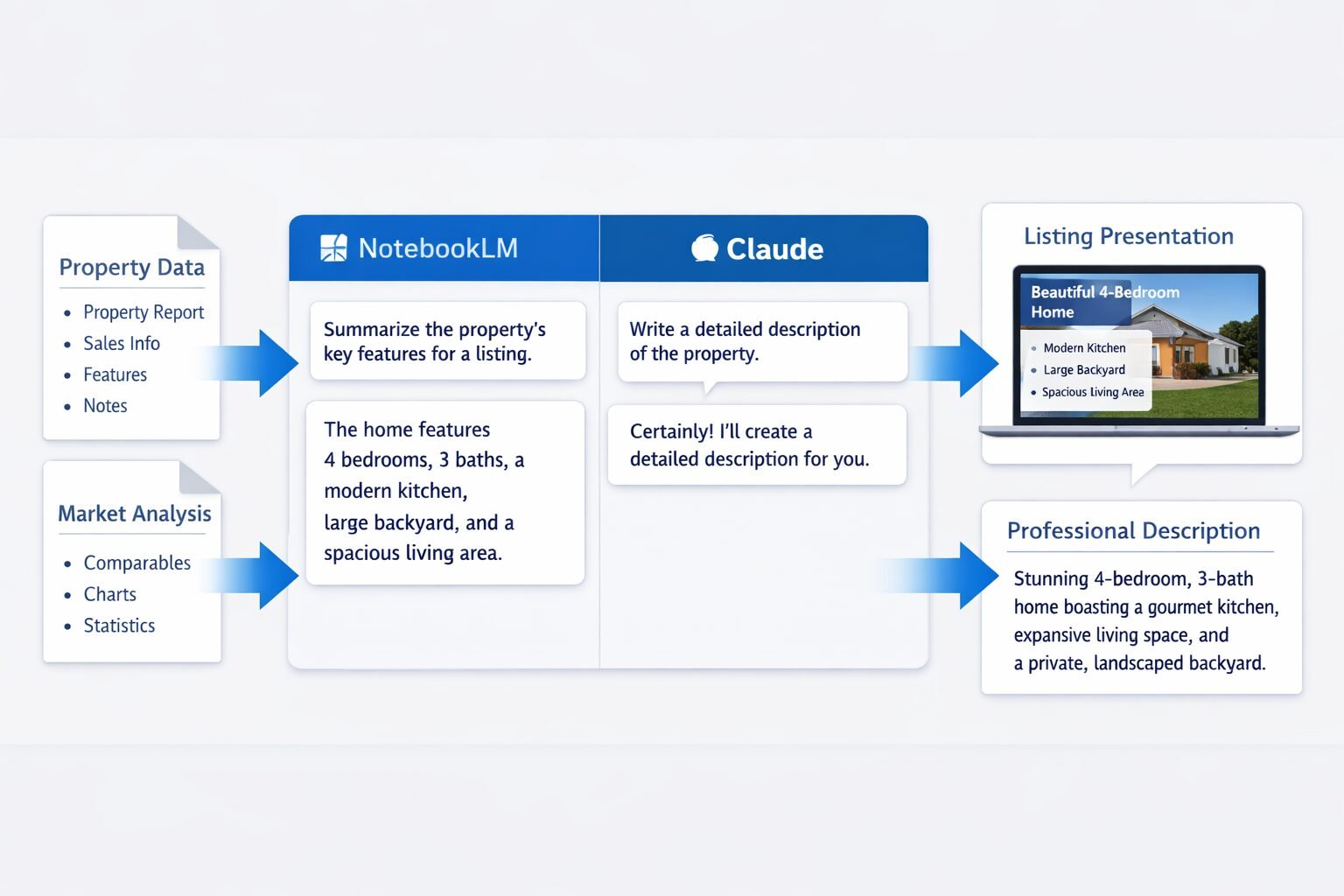
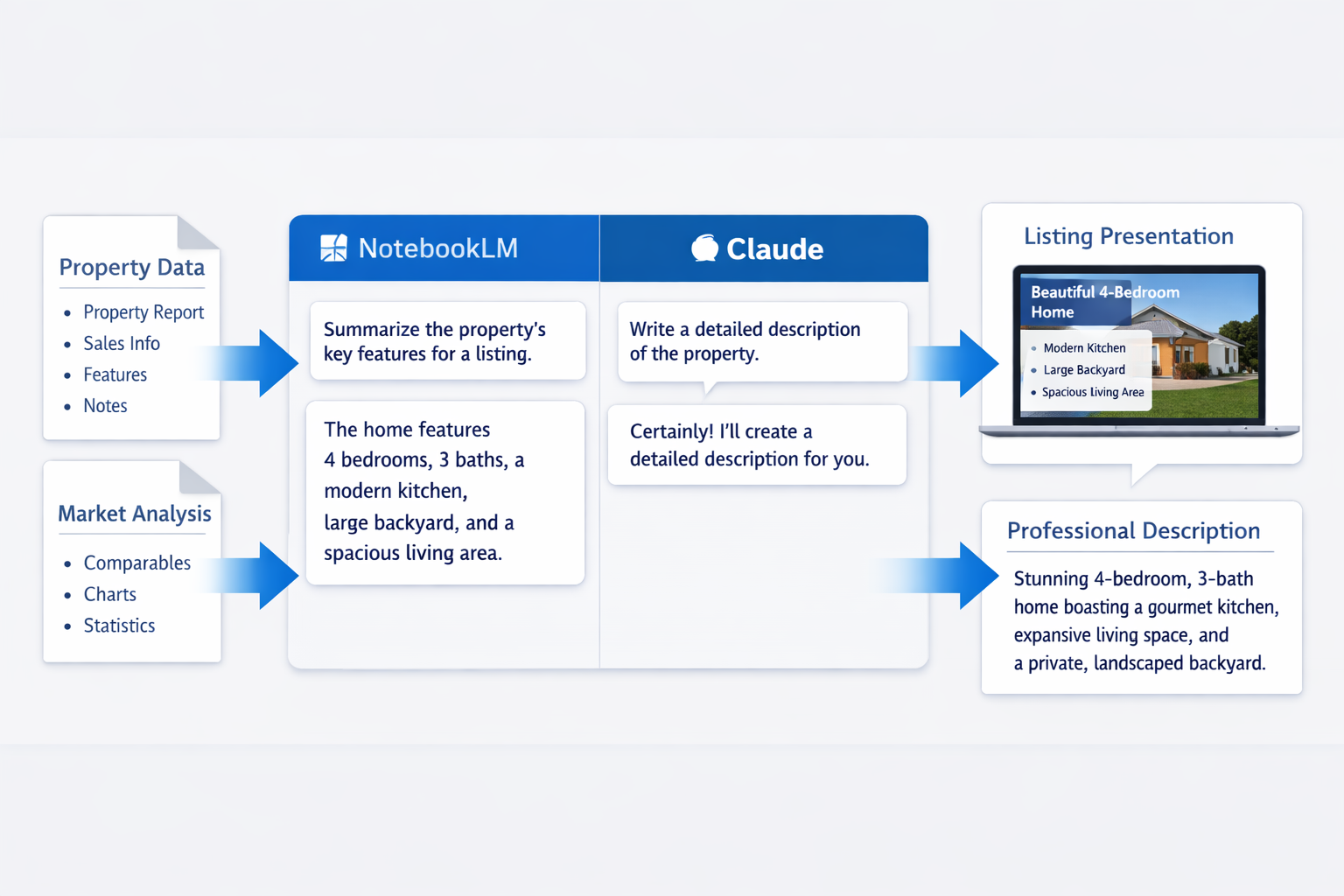
Listing presentation prep: Upload your CMA data, MLS reports, school district information, neighborhood crime statistics, and recent comparable sales. Ask NotebookLM to generate structured talking points, a presentation script, and a summary of how your subject property compares to recent comps. The output pulls directly from your sources, so every claim is backed by the data you provided.
Competitive listing analysis: Feed NotebookLM a competitor's listing description alongside your subject property data. Ask it to write a stronger version grounded in the actual numbers. This is particularly effective when you're competing for a listing against another agent and need your marketing pitch to stand out with specificity.
Audio Overviews for buyers: One of NotebookLM's standout features generates podcast-style audio discussions based on your uploaded documents. Imagine sending a buyer a five-minute audio summary of the three neighborhoods they're considering, complete with data-backed talking points about schools, commute times, and price trends. That kind of personalized touch used to take hours of preparation. Now it takes minutes.
Visual pitch materials: NotebookLM also generates mind maps, slide decks, and infographics from your sources. For agents who present at listing appointments, this converts raw market data into a polished, visual pitch faster than anything else currently available.
When to Upgrade
If you consistently hit the daily query or generation limits, NotebookLM Plus is bundled into the Google One AI Premium plan at roughly $20 per month. That subscription also includes Gemini Advanced and 2TB of cloud storage, making it a strong value bundle for agents already using Google Workspace.
Estimated time saved: 2 to 4 hours per listing presentation.
2. Claude AI — What's the Best Writing Assistant for Real Estate Content?
Free tier available | Anthropic
For listing descriptions, client emails, market reports, and offer letters, Claude consistently produces the most natural-sounding output among current AI writing tools. Where other assistants generate text that reads like obvious AI copy, Claude's writing carries the tone and specificity of an experienced professional. That distinction matters when your listing descriptions and client communications carry your professional reputation.
Free Tier vs. Claude Pro
The free tier provides access to Claude's core capabilities with daily usage limits that work for light use. Claude Pro, at $20 per month, unlocks:
- Priority access during peak hours
- Access to the most advanced model versions
- Significantly higher daily usage limits
- Extended context windows for longer documents
For agents producing content daily, the Pro tier pays for itself within the first week.
How Real Estate Agents Should Use It
Listing descriptions that actually sell: Give Claude your raw notes from a property walkthrough — room dimensions, standout features, neighborhood context, condition notes, recent upgrades — and ask it to write three different versions of the listing description. One emphasizing lifestyle, one emphasizing investment value, one emphasizing family appeal. Pick the strongest version, edit lightly, and publish. What used to take an hour of staring at a blank screen now takes five minutes.
Inspection report translation: Upload a 40-page inspection report and ask Claude to summarize the major findings in plain language. The output is clear, organized, and saves the time of translating technical jargon into something a first-time buyer can actually understand. This is especially valuable when working with buyers who are navigating the home buying process for the first time and feel overwhelmed by inspection terminology.
Offer letter drafting and counter-offer templates: Describe the situation — multiple-offer scenario, seller's priorities, buyer's constraints — and Claude drafts a compelling offer letter or counter-offer response that hits the right emotional and strategic notes.
Email nurture sequences: Describe your ideal buyer nurture workflow (timeline, touchpoints, tone), and Claude drafts a full sequence of personalized emails ready to load into your email platform. Include details about your market area, and the sequences will reference specific neighborhood benefits rather than reading like generic templates.
Common mistake to avoid: Don't paste Claude's output directly into your MLS without editing. AI-generated listing descriptions need a human pass to verify accuracy, add hyperlocal details only you would know, and ensure compliance with fair housing language guidelines.
Estimated time saved: 1 to 2 hours per listing, plus 3 to 5 hours per week on client communication.
3. Nano Banana Pro — Can AI-Generated Images Actually Look Professional Enough for Real Estate?
Free access available through Google products | Google DeepMind
Yes, and the quality gap between AI-generated imagery and professional photography has narrowed dramatically. Nano Banana Pro, Google DeepMind's image generation model built on Gemini 3 Pro, launched in November 2025 and quickly set a new standard. In February 2026, Google released Nano Banana 2, a faster variant built on Gemini 3.1 Flash, which now serves as the default image generation model across Google products.
What Makes It Different From Earlier AI Image Generators
- Resolution: Up to 4K (4096 × 4096 pixels), sufficient for print marketing materials
- Text rendering accuracy: Over 94% accuracy for text within images, meaning property addresses, agent branding, and call-to-action overlays render correctly
- Character consistency: Maintains visual consistency across multiple generations, critical for branded marketing series
- Professional quality: Output that doesn't trigger the "that looks AI-generated" reaction from clients
Free Access and Pricing
- Gemini app: 2 to 3 images per day at standard resolution (free)
- Google AI Studio: Up to 50 free requests per day (developer access)
- Google AI Pro/Ultra subscribers: Higher quotas and access to the Pro model
How Real Estate Agents Should Use It
Virtual staging concepts: Generate furnished mockups of vacant rooms to show sellers during listing appointments. Show them what their empty living room could look like with modern furniture, updated lighting, and fresh decor. This is particularly powerful for agents working with sellers who need to understand which design upgrades actually impact buyer perception.
Before-and-after curb appeal upgrades: Show sellers what their front yard could look like with fresh landscaping, a new walkway, or an updated front door. Visual proof of potential transforms the "you should consider updating the exterior" conversation from abstract advice into a concrete plan.
Neighborhood lifestyle imagery: Need a warm, inviting image of a family walking through tree-lined streets near your listing? Generate it in seconds, tailored to the specific neighborhood aesthetic and season.
Social media and marketing collateral: Create custom imagery for market update posts, just-sold announcements, and open house promotions without hiring a graphic designer.
Disclosure Requirements
Always disclose AI-generated images in listing materials. A single line in the MLS remarks section protects you legally and builds trust with buyers. Most MLSs now require this disclosure as of early 2026, and proactively including it signals professionalism rather than deception. Agents who want to explore how virtual tours and AI photography complement each other should review current MLS guidelines for their market.
Estimated time saved: Replaces expensive staging consultations and graphic design fees for visual marketing concepts.
4. Zapier — How Do Agents Automate Lead Follow-Up Without Writing Code?
Free tier available | No-code automation platform
Speed-to-lead is one of the strongest predictors of conversion in real estate. A 2024 study by InsideSales found that responding to a web lead within five minutes makes you 21 times more likely to qualify that lead compared to responding after 30 minutes. Zapier makes sub-two-minute response times possible without requiring you to be glued to your phone.
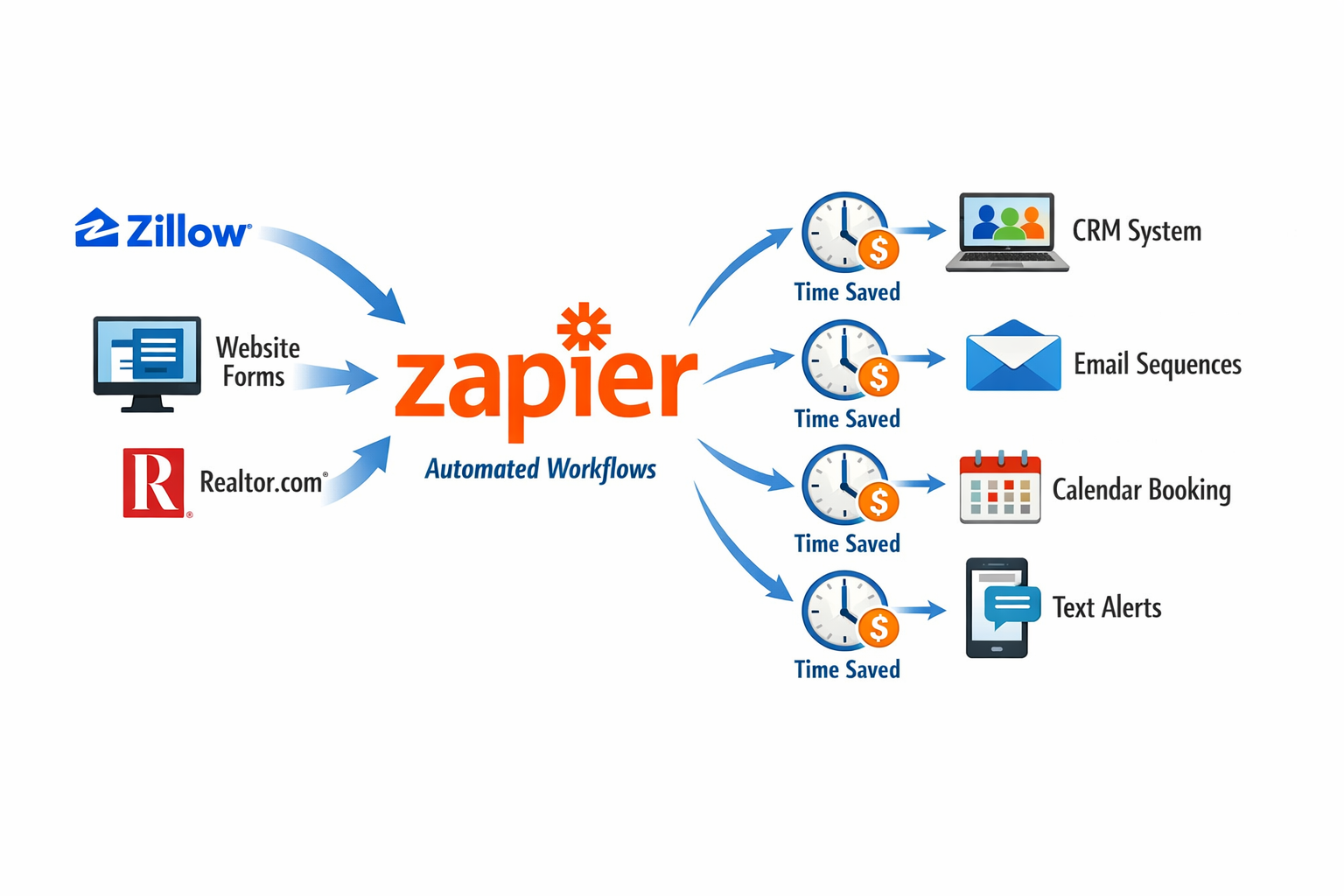
Zapier connects over 7,000 apps to automate repetitive tasks through simple "if this, then that" workflows called Zaps. No coding required.
Free Tier Reality Check
The free plan includes:
- 100 tasks per month
- Two-step automations (one trigger, one action)
- 15-minute polling intervals (checks for new data every 15 minutes)
Here's the honest assessment: 100 tasks per month disappears faster than most agents expect. Each action in a workflow counts as one task, so even a simple two-step Zap triggered 50 times uses half your monthly allotment. Start with your single highest-impact automation and expand from there. When you consistently hit the limit, that's your signal to upgrade.
Paid plans start at $29.99 per month for 750 tasks with multi-step workflows, faster polling (down to one minute), and access to premium app integrations.
The Five Highest-Impact Automations for Real Estate Agents
- Instant lead response: New form submission → personalized email sent within 90 seconds. This single Zap can dramatically improve conversion rates.
- Lead-to-CRM capture: Zillow inquiry, Realtor.com lead, or website form → automatic CRM entry with source tagging. No manual data entry.
- Showing appointment scheduling: CRM status change → calendar event created → confirmation email sent to client.
- New listing alerts: MLS notification in target zip code → text message to your phone. Stay ahead of inventory changes without refreshing the MLS.
- Closed transaction follow-up: Deal marked closed in CRM → trigger a 30/60/90-day follow-up email sequence for referral generation.
Common Mistake
Don't try to automate everything at once. Start with lead response, measure the impact on your conversion rate over 30 days, then add the next automation. Agents who build ten Zaps on day one usually end up with a tangled mess they abandon within a month.
Estimated time saved: 5 to 10 hours per month on manual follow-up and data entry.
5. Claude Code — Can Agents Build Custom Lead Systems Without Hiring a Developer?
Requires Claude Pro ($20/month) | Most powerful tool on this list
Claude Code is Anthropic's agentic coding and automation tool, and it represents the biggest potential ROI on this list for agents willing to invest the learning time. It operates from the command line and connects to dozens of applications through the Model Context Protocol (MCP), allowing it to build, test, and deploy custom workflows that would typically require hiring a developer at $75 to $150 per hour.
This is not a beginner tool. But for agents who want a custom automation system — lead intake, intelligent routing, automated response, and long-term nurture — tailored specifically to their business, the cost of a $20 monthly subscription versus thousands in development fees makes the learning curve worth it.
How Real Estate Agents Should Use It (Progressive Approach)
Week 1 — Email integration: Connect Claude Code to Gmail. Configure it to monitor incoming leads, categorize them by intent level (hot lead actively requesting a showing vs. casual inquiry), and draft appropriate initial responses for your review before sending.
Week 2 — Calendar management: Layer on Google Calendar integration so qualified leads can be automatically offered available showing times based on your real schedule.
Week 3 — CRM synchronization: Connect to your CRM so every interaction is logged, lead scores are updated based on engagement, and follow-up tasks are created automatically.
Week 4 — Intelligent routing: Build rules that route hot leads to your personal phone for immediate callback while lower-intent inquiries flow into an automated email nurture sequence.
Advanced Use Cases
For agents ready to go deeper, Claude Code can build:
- Lightweight lead generation landing pages with integrated form capture
- Custom property search interfaces that pull from MLS data feeds
- Automated market report generators that compile and format weekly or monthly reports for your sphere
- Client portal prototypes where buyers can track their transaction progress
These are the kinds of systems that agencies and tech vendors charge $5,000 to $15,000 to build. With Claude Code, you can prototype, test, and iterate yourself.
Honest Skill Level Assessment
If you've never opened a terminal or command line interface, expect to spend 5 to 10 hours getting comfortable with the basics. YouTube tutorials specifically covering "Claude Code for non-developers" have proliferated since early 2026 and provide solid starting points. The investment pays compounding returns because every workflow you automate frees up time for the activities that actually generate revenue: prospecting, showing, negotiating, and closing.
Estimated time saved: Replaces a part-time assistant for lead management and routine communication (10 to 15 hours per week).
6. Marky AI — What's the Fastest Way to Create a Month of Social Media Content?
Paid plans from $19/month | Free trial with 30 posts
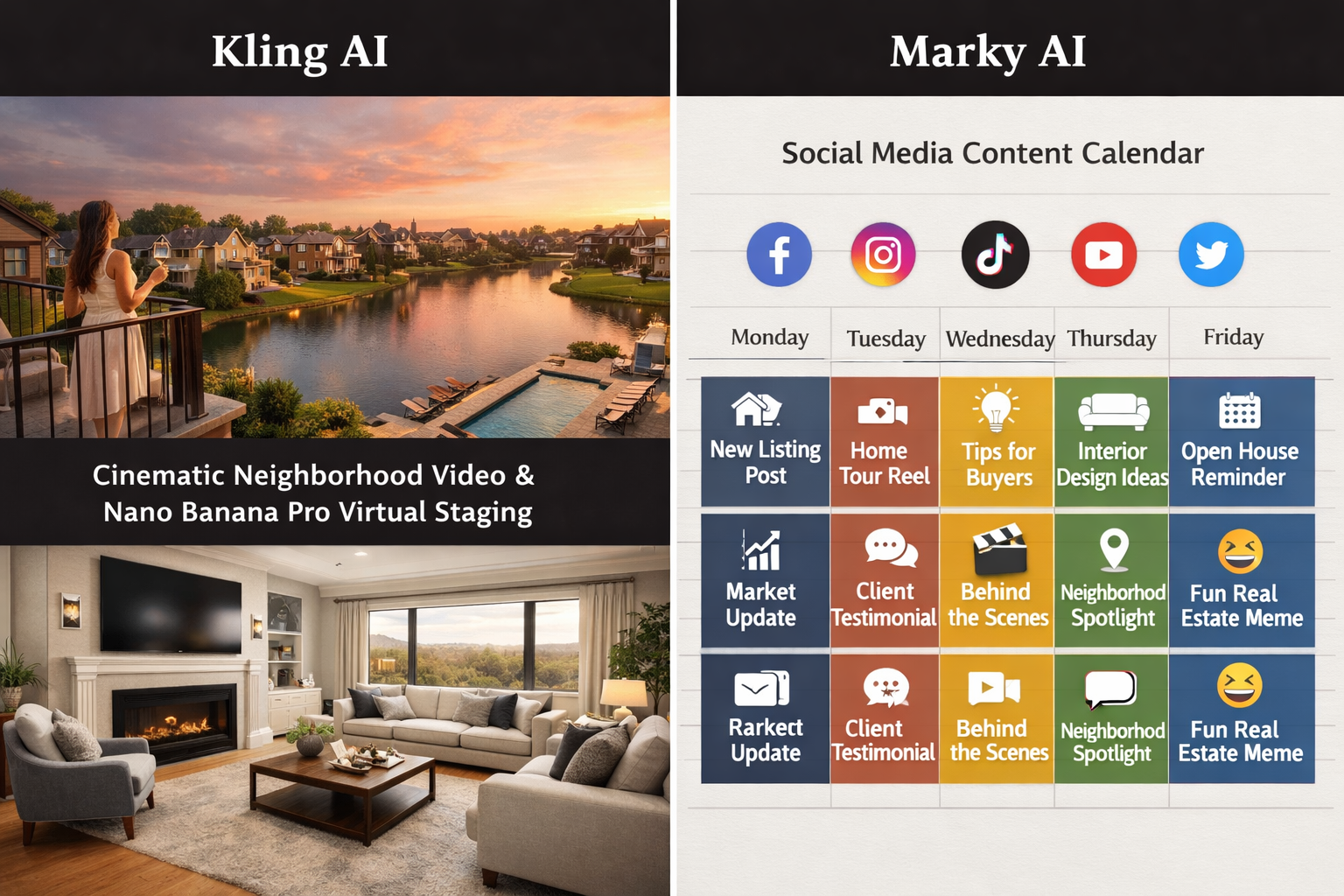
Marky AI generates a full month of on-brand social media content — text, images, and carousels — and schedules it across Facebook, Instagram, LinkedIn, TikTok, Pinterest, and Google Business Profile from a single dashboard. Users report completing this process in under five minutes.
The reason most agents haven't heard of Marky is simple: it doesn't have "real estate" anywhere in its name or marketing. So agents pay five to ten times more for industry-specific social media tools that often deliver less functionality. Marky's AI analyzes your business context, learns your brand voice and visual identity, and produces content that's consistently on-brand regardless of industry.
Pricing and Trial
- Free trial: 30 posts, no credit card required
- Solo creator plan: Approximately $19 per month
- Professional and agency tiers available for teams managing multiple accounts
How Real Estate Agents Should Use It
Initial setup (one time, 10 minutes): Input your brand colors, preferred tone (professional, approachable, authoritative), niche focus (luxury, first-time buyers, investment properties), and service area. Upload your headshot and logo.
Content generation workflow:
- Feed Marky your recent closed transactions, market statistics, neighborhood highlights, or open house announcements as source material.
- Marky transforms each input into multiple platform-optimized posts with appropriate hashtags, image sizing, and copy length.
- Review, approve, and schedule from the content calendar.
- Marky publishes automatically across all connected platforms.
What to feed it for best results:
- Just-sold data (address, sale price, days on market, any compelling story)
- Monthly market statistics for your area
- Neighborhood spotlights (new restaurant openings, school ratings, community events)
- Client testimonials (with permission)
- Tips relevant to your audience, such as home improvements that deliver the best ROI before selling
Why This Matters for Agent Marketing
Consistency is the single biggest factor in social media effectiveness for real estate agents, and it's also the factor most agents fail at. Posting three times in one week then disappearing for a month destroys algorithmic reach. Marky eliminates the consistency problem by removing the friction between having content ideas and actually publishing them.
Estimated time saved: 3 to 5 hours per week on social media content creation and scheduling.
7. Kling AI — Can AI Video Replace a Professional Videographer for Real Estate Marketing?
Free tier available (66 daily credits) | Paid plans from $6.99/month
For certain types of real estate video content, yes. Kling AI, developed by Kuaishou Technology, has attracted over six million users globally since its June 2024 launch and generated $240 million in annual recurring revenue by December 2025. Those adoption numbers reflect genuine output quality that surpasses most AI video generators.
The latest version, Kling 3.0, functions more like a scene-aware AI director than a simple clip generator. It plans multi-shot sequences with coherent camera work, transitions, and character consistency. Videos generate at 1080p at up to 48 frames per second, with a maximum length of three minutes — significantly longer than competitors like Runway (40 seconds) or Sora (35 seconds).
Pricing and Credit System
| Tier | Monthly Cost | Credits | Watermark | Max Resolution |
|---|---|---|---|---|
| Free | $0 | 66/day (rollover) | Yes | 720p |
| Standard | $6.99 | 660/month | No | 1080p |
| Pro | $29.99 | 3,000/month | No | 1080p Professional |
| Enterprise | $180 | 30,000/month | No | 1080p Professional |
A basic 5-second video in standard mode costs approximately 10 credits. Professional mode runs 35 credits for the same length. The free tier's 66 daily credits with rollover allow for meaningful experimentation before committing to a paid plan.
How Real Estate Agents Should Use It
Neighborhood lifestyle videos: Generate cinematic B-roll footage for listing videos — aerial-style shots of tree-lined streets, evening scenes of a vibrant downtown, morning light on a waterfront community. This type of footage typically requires a drone operator ($200 to $500 per session) or stock footage subscriptions.
Weekly market update videos: Produce short-form video content with professional visual quality that sets you apart from agents using stock footage or static talking-head recordings. Pair AI-generated neighborhood visuals with your voiceover commentary for a polished final product.
The strategy most agents aren't executing: Create a 30-second "Why buy in [your neighborhood]" video for each area you serve. Post one per week across Instagram Reels, TikTok, and YouTube Shorts. The combination of professional visuals and hyperlocal content builds geographic authority while most competing agents are still reposting generic motivational quotes.
What Kling AI Won't Replace
Professional property photography and walkthrough videography for active listings still require a real camera and a skilled photographer. AI video excels at supplementary marketing content — neighborhood showcases, market updates, brand-building content — not at replacing the actual listing photos and video tours buyers use to evaluate properties.
Quality Assessment
At the professional tier, Kling's output quality genuinely doesn't look AI-generated to the casual viewer. In real estate, where trust is built visually, that matters more than in almost any other industry. Always disclose AI-generated content in your marketing materials, but know that the quality bar has risen to the point where disclosure is about ethics, not about hiding obvious flaws.
Estimated time saved: Replaces $500 to $1,500 videography sessions for supplementary marketing content.
8. Folk CRM — Is There a CRM Built for How Real Estate Agents Actually Work?
14-day free trial | Paid plans from $20/user/month
Folk CRM is a lightweight, AI-powered customer relationship management tool designed for people who sell through relationships. Unlike HubSpot or Salesforce, which are built for enterprise sales teams and buried under features most agents will never touch, Folk strips CRM down to what actually matters: knowing who you know, when you last talked to them, and what to do next.
Why Most Real Estate CRMs Fail Agents
The dirty secret of real estate CRM adoption is that most agents stop using their CRM within 90 days. The tools are too complex, data entry is too time-consuming, and the interface feels like it was designed for a corporate sales floor rather than an agent juggling 15 active relationships across different transaction stages.
Folk solves this with:
- One-click contact import from Gmail, LinkedIn, and other sources
- AI-powered contact enrichment that automatically fills in missing details
- Smart reminders based on relationship patterns rather than rigid sales pipeline stages
- Simple, visual interface that takes minutes to learn rather than hours
- Group and tag system that mirrors how agents actually categorize contacts (sphere, past clients, neighborhood farm, vendor partners)
How Real Estate Agents Should Use It
Sphere management: Import your entire contact database and let Folk's AI categorize and enrich the records. Set relationship-based reminders: "Haven't contacted in 60 days" triggers a touchpoint suggestion. This prevents the common problem of losing track of past clients who could generate referrals.
Transaction coordination: Create a pipeline view for active deals, but use Folk's flexible structure rather than forcing every interaction into a rigid funnel. Real estate transactions don't follow a linear sales pipeline — they loop, stall, restart, and branch. Folk accommodates that reality.
Vendor and referral partner tracking: Maintain a living database of your preferred lenders, inspectors, contractors, and attorneys with notes on specialties, reliability, and client feedback. When a buyer needs a recommendation, you pull it up in seconds rather than scrolling through old text messages.
Pricing Context
At $20 per user per month, Folk is priced between free CRMs that lack AI features and enterprise platforms that charge $50 to $150 per user per month for capabilities agents don't need. For solo agents and small teams, it hits the right balance of functionality and cost.
Estimated time saved: 2 to 3 hours per week on contact management and follow-up tracking.
9. Perplexity AI — How Should Agents Research Markets, Neighborhoods, and Client Questions?
Free tier available | Pro plan $20/month
Perplexity AI is an AI-powered research engine that provides sourced, cited answers rather than the unsourced responses typical of general chatbots. For real estate agents who need to quickly answer client questions about school districts, zoning changes, tax rates, flood zones, or market trends, Perplexity delivers verified information with links to the original sources.
Why This Matters More Than Google Search
When a buyer asks, "What's the school rating for the elementary school near 425 Oak Street?" or a seller asks, "What did the city council decide about that rezoning proposal?", agents need fast, accurate answers. Google search returns ten blue links that require clicking through and reading. Perplexity returns a synthesized answer with source citations, cutting research time by 70% or more.
How Real Estate Agents Should Use It
Pre-listing research: Before a listing appointment, run Perplexity queries on recent neighborhood developments, planned infrastructure projects, school rating changes, and local market trends. Arrive at the appointment with current, sourced information that demonstrates expertise.
Client question response: When clients text questions you don't immediately know the answer to — "Is that property in a flood zone?" or "What's the HOA litigation history for that condo complex?" — Perplexity provides sourced answers you can verify and forward within minutes.
Market analysis support: Use Perplexity to research comparable markets, economic indicators affecting your area, and emerging real estate trends that could impact buyer and seller decisions. The sourced citations give you credibility when presenting this information to clients.
Competitive intelligence: Research what marketing strategies top-producing agents in other markets are using, what new developments are planned in your area, and what buyer demographics are shifting in your target neighborhoods.
Free Tier vs. Pro
The free tier handles standard research queries well. Pro ($20/month) adds access to more advanced models, file upload analysis, and higher daily query limits. For agents who use it multiple times daily, Pro is worth the investment.
Estimated time saved: 3 to 5 hours per week on research and client question response.
10. Fireflies.ai — How Do Agents Capture Every Detail From Client Meetings?
Free tier available | Pro plans from $18/user/month
Fireflies.ai is an AI meeting assistant that automatically joins your Zoom, Google Meet, or Microsoft Teams calls, records the conversation, generates a searchable transcript, and produces structured meeting summaries with action items. For real estate agents, this means never losing a critical detail from a buyer consultation, listing appointment, or negotiation call.
How Real Estate Agents Should Use It
Buyer consultations: After a 45-minute buyer consultation, Fireflies produces a summary that includes the buyer's must-haves, deal-breakers, budget range, preferred neighborhoods, and timeline. Instead of scribbling notes during the meeting (or worse, trying to remember details afterward), agents can be fully present in the conversation and rely on the AI summary for follow-up.
Listing appointment documentation: Record listing presentations (with the seller's permission) to capture every commitment made, pricing discussion point, and marketing plan detail. This protects both parties and ensures nothing falls through the cracks during the listing period.
Negotiation call records: When negotiating with the other agent, having a searchable transcript means you can reference exactly what was discussed, what was offered, and what conditions were mentioned. This is invaluable when negotiations stretch over multiple calls and days.
Team training: For team leaders, recorded and transcribed calls become training materials. New agents can study how experienced team members handle objections, present pricing strategies, and navigate difficult conversations.
Free Tier Limitations
The free tier includes limited transcription credits per month and basic summaries. For agents conducting multiple client meetings weekly, the Pro tier at $18 per user per month provides unlimited transcription, advanced AI summaries, CRM integrations, and searchable archives.
Important note: Always inform all parties that the meeting is being recorded. Most states require at least one-party consent, but some require all-party consent. Check your state's recording laws and make disclosure a standard part of your meeting opening.
Estimated time saved: 2 to 4 hours per week on meeting notes and follow-up task creation.
How to Build Your AI Stack: A Practical Starting Framework
Don't try to adopt all ten tools simultaneously. That's a recipe for overwhelm and abandonment. Instead, build your stack progressively based on where you're losing the most time.
If You're Drowning in Lead Follow-Up (Start Here)
- Zapier — Automate instant lead response
- Folk CRM — Organize and track every relationship
- Claude AI — Draft follow-up email sequences
If Your Marketing Is Inconsistent
- Marky AI — Automate social media content creation and scheduling
- Kling AI — Produce neighborhood and market update videos
- Nano Banana Pro — Generate visual content for listings and promotions
If Your Listing Presentations Need an Upgrade
- NotebookLM — Transform market data into polished presentations
- Claude AI — Write compelling listing descriptions
- Perplexity AI — Research neighborhood details and market trends
If You Want Maximum Automation (Advanced)
- Claude Code — Build custom systems connecting all your tools
- Fireflies.ai — Automate meeting documentation
- Layer in the remaining tools as your comfort level grows
AI Tools for Real Estate: Quick Comparison Table
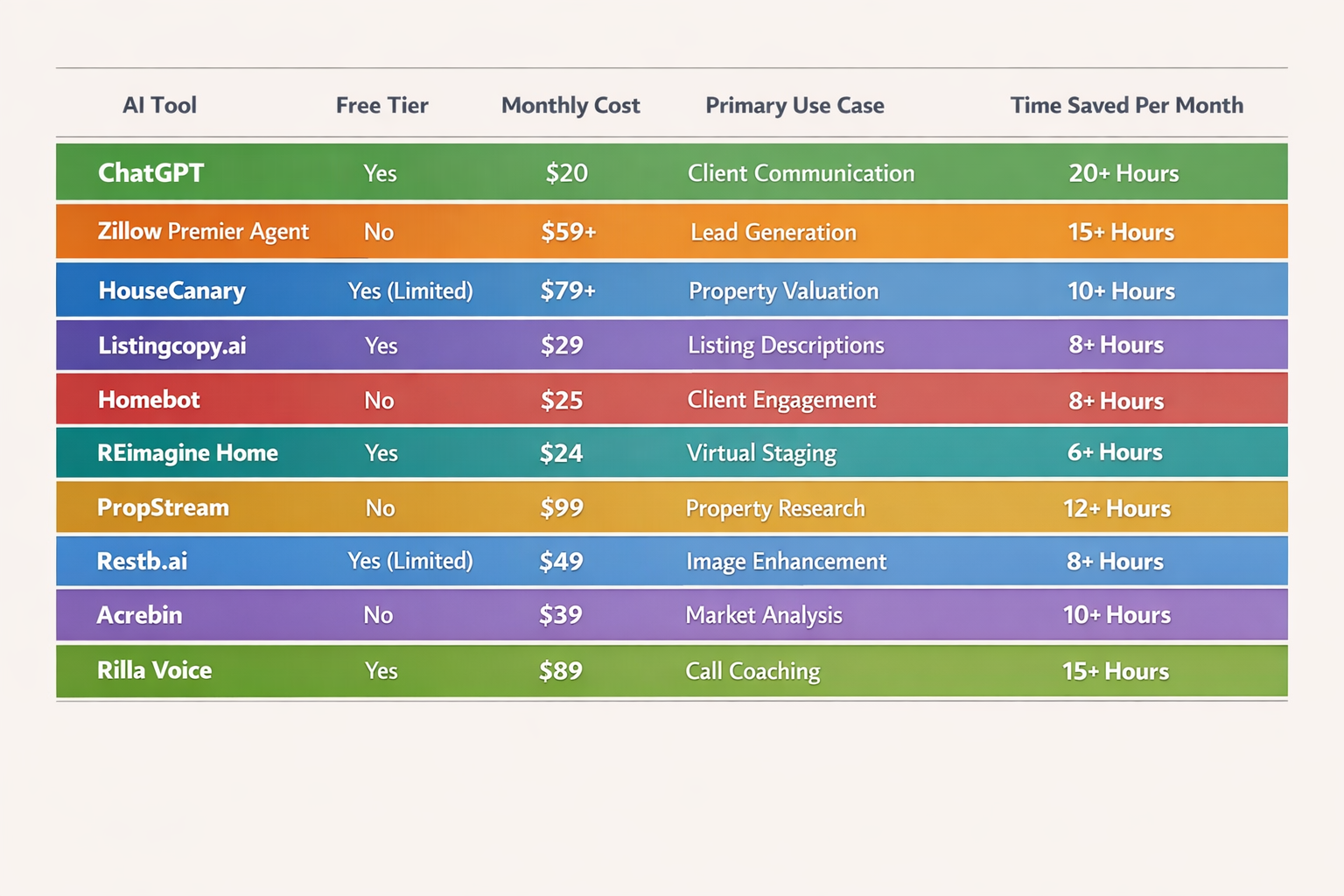
| Tool | Free Tier | Paid Cost | Primary Use | Time Saved |
|---|---|---|---|---|
| NotebookLM | Yes (generous) | $20/mo (bundled) | Listing presentations, research | 2–4 hrs/listing |
| Claude AI | Yes (limited) | $20/mo | Writing, communication | 5–7 hrs/week |
| Nano Banana Pro | Yes (2–3 images/day) | Varies by plan | Image generation, virtual staging | Variable |
| Zapier | Yes (100 tasks/mo) | $29.99/mo | Lead automation | 5–10 hrs/month |
| Claude Code | No (requires Pro) | $20/mo | Custom systems | 10–15 hrs/week |
| Marky AI | 30 free posts | $19/mo | Social media content | 3–5 hrs/week |
| Kling AI | Yes (66 credits/day) | $6.99/mo | Video generation | $500–1,500/session |
| Folk CRM | 14-day trial | $20/user/mo | Relationship management | 2–3 hrs/week |
| Perplexity AI | Yes | $20/mo | Research | 3–5 hrs/week |
| Fireflies.ai | Yes (limited) | $18/user/mo | Meeting transcription | 2–4 hrs/week |
Frequently Asked Questions
Are these AI tools compliant with MLS and fair housing regulations?
The tools themselves are compliant, but the content they generate requires human review. AI-generated listing descriptions must be checked for fair housing language compliance (no references to protected classes, neighborhood demographics, or language that could be interpreted as steering). AI-generated images used in listing materials must be disclosed per most MLS guidelines as of 2026. The responsibility for compliance always rests with the agent, not the tool.
Can I use AI-generated listing descriptions directly in the MLS?
Technically yes, but it's a bad practice. Always edit AI-generated descriptions before publishing. Check for factual accuracy (AI can misinterpret your notes), fair housing compliance, MLS-specific formatting requirements, and hyperlocal details that only you would know. A human editing pass takes five minutes and prevents potential compliance issues.
Will clients know I'm using AI tools?
Most won't notice, and most won't care as long as the output quality is high and the information is accurate. Where disclosure is required (AI-generated images in listing materials), be transparent. Where it's not required (using AI to draft emails or prepare presentations), the tool is simply part of your workflow, similar to using spell-check or a calculator.
Which single tool should I start with if I can only pick one?
Claude AI, because it addresses the widest range of daily tasks: listing descriptions, client emails, offer letters, market report summaries, and social media captions. It's the Swiss Army knife of the list, and the free tier is sufficient to evaluate whether it fits your workflow before committing to Pro.
How much total monthly cost am I looking at for the full stack?
If you use every tool at its paid tier: approximately $170 to $190 per month. But most agents don't need every tool at the paid level. A practical starting stack of Claude Pro, Zapier free, NotebookLM free, and Marky AI costs roughly $39 per month and covers the highest-impact use cases.
Do these tools work with my existing real estate CRM?
Zapier connects to virtually every major real estate CRM (Follow Up Boss, kvCORE, LionDesk, Sierra Interactive, and others). Folk CRM can replace your existing CRM or supplement it. Fireflies.ai integrates with most CRMs for automatic meeting note logging. The other tools on this list produce output (text, images, video) that you manually or automatically feed into whatever systems you already use.
Are AI-generated property images legal to use in listings?
Yes, with proper disclosure. As of early 2026, most MLSs require that AI-generated or AI-altered images be clearly identified in listing remarks. Virtual staging has been common for years, and AI-generated staging follows the same disclosure principles. Never represent AI-generated images as actual photographs of the property.
What about data privacy when uploading client information to AI tools?
Review each tool's data handling policies before uploading sensitive client information. NotebookLM (Google), Claude (Anthropic), and Perplexity all have published data policies. As a best practice, avoid uploading documents containing Social Security numbers, financial account details, or other sensitive personal information. Use these tools for market data, property information, and general communication drafting rather than sensitive client records.
How quickly can I expect to see results from implementing these tools?
Most agents report measurable time savings within the first week. Lead response automation through Zapier shows conversion rate improvements within 30 days. Social media consistency through Marky AI typically shows engagement growth within 60 to 90 days. The compounding effect of using multiple tools together becomes significant after 90 days of consistent use.
Will AI tools replace real estate agents?
No. These tools automate the administrative, creative, and organizational tasks that consume the majority of an agent's time. They don't replace the relationship skills, local market expertise, negotiation ability, and professional judgment that clients hire agents for. The agents who adopt these tools gain a competitive advantage by spending more time on high-value activities and less time on tasks that don't require a real estate license.
Related Reading
- Best Real Estate Marketing Automation Platform for Agents in 2026
- 5 AI Hacks to Beat House Hunting Fatigue and Find Your Dream Home
- 7 Open House Apps Tech-Savvy Agents Use to Get More Leads
Sources
- National Association of Realtors, 2025 Member Profile (NAR, 2025)
- InsideSales Lead Response Management Study (InsideSales, 2024)
- Kuaishou Technology Kling AI Revenue Report (Kuaishou, December 2025)
- Google DeepMind Nano Banana Pro Technical Documentation (Google, November 2025)
- Zapier Platform Statistics (Zapier, 2026)