


Picture this: massive server farms consuming more electricity than entire cities, tech giants throwing down billions like it's Monopoly money, and sleepy Sun Belt towns suddenly becoming the hottest real estate plays in America. Welcome to 2026, where Data Center Boom's Ripple Effect: 2026 Demand Driving Real Estate in Emerging Sun Belt Markets is rewriting the playbook for investors, agents, and anyone paying attention to where the smart money is moving.

The data center industry just secured a record-breaking $170 billion in construction investments in 2025, and 2026 is shaping up to be even more extraordinary[3]. But here's where it gets fresh: this isn't just about tech infrastructure anymore. The ripple effects are transforming residential markets, commercial corridors, and entire regional economies across the Sun Belt. From Abilene, Texas to the Carolinas, the scramble for power capacity is creating unprecedented opportunities—and challenges—for real estate professionals who know where to look.
Key Takeaways
- 💰 Record capital deployment: Data center construction spending could reach $360-$930 billion annually by late 2027, with the Sun Belt capturing significant market share due to power availability and regulatory flexibility[7]
- ⚡ Power replaces connectivity: The ability to secure 300+ megawatt power deliveries within 36 months has become more critical than fiber optic access, fundamentally reshaping site selection criteria[2]
- 🏗️ I-20 corridor explosion: Southern markets along the I-20 corridor—including Alabama, Georgia, and the Carolinas—are experiencing construction booms "with particular ferocity" as developers chase less-regulated electricity markets[1]
- 📈 Pre-leasing at historic highs: Pre-leasing rates hovering in the mid-70% range (versus historical 40-50%) signal tenant urgency and sustained demand through 2026 and beyond[2]
- 🏘️ Multifamily market recovery: Secondary Sun Belt markets are positioned for residential real estate recovery in H2 2026, with data center-driven employment and population growth accelerating the timeline[1]
Understanding the Data Center Boom's Ripple Effect: 2026 Demand Driving Real Estate in Emerging Sun Belt Markets
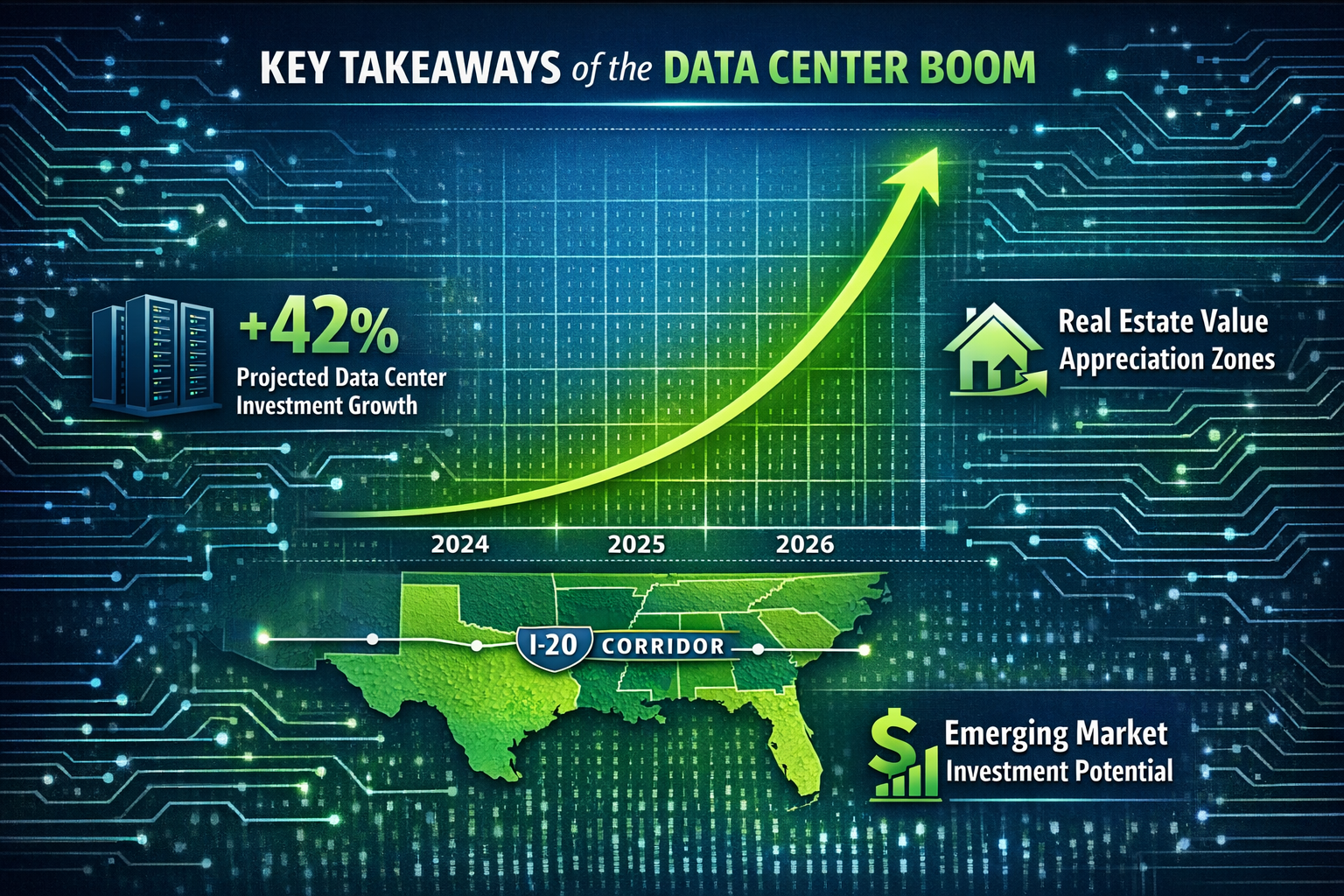
Let's let it cook for a minute and talk about what's actually happening here. The data center industry isn't just building more warehouses full of blinking lights—it's fundamentally restructuring where Americans live, work, and invest their money.
The Numbers That Changed Everything
When OpenAI, Oracle, SoftBank, and Crusoe announced the $500 billion Stargate AI development in Abilene, Texas, it wasn't just tech news—it was a real estate earthquake[2]. This single project consumes over 1.2 gigawatts of power (enough to power roughly 900,000 homes), with Oracle alone committing more than $40 billion to Nvidia hardware for the site[2].
But Abilene is just the most dramatic example. Across the Sun Belt, data center developers are racing to secure power capacity, and they're paying premium prices to do it. The traditional economics of commercial real estate have literally inverted—large tenants now pay higher per-unit rates to secure contiguous blocks of power and space[2]. That's so based it's almost hard to believe.
Why the Sun Belt? Why Now?
Three factors are converging to make Sun Belt markets impeccable for data center development:
- Power availability: Less-regulated electricity markets in Texas, Georgia, Alabama, and the Carolinas can deliver the massive power capacity these facilities demand
- Land availability: Secondary markets offer large contiguous parcels at prices that make 100+ megawatt facilities economically viable
- Regulatory flexibility: Faster permitting processes and business-friendly environments accelerate development timelines
For real estate professionals tracking market trends and investment opportunities, understanding these dynamics isn't optional anymore—it's essential.
The I-20 Corridor: Where Data Center Boom's Ripple Effect: 2026 Demand Driving Real Estate in Emerging Sun Belt Markets Is Most Visible
The Interstate 20 corridor has emerged as ground zero for this transformation. Stretching from Texas through Louisiana, Mississippi, Alabama, Georgia, and into South Carolina, this region is experiencing what industry insiders are calling "construction with particular ferocity"[1].
Power Infrastructure: The New Prime Location Factor
Here's something that would have sounded crazy five years ago: fiber optic connectivity is no longer the primary site selection criterion for data centers. Power availability has taken the crown[2].
Grid interconnection timelines now stretch 24 to 48+ months because these facilities need entirely new high-voltage transmission infrastructure and substations[2]. The ability to secure power deliveries exceeding 300 megawatts within 36 months has become a decisive competitive advantage—and it's reshaping the commercial real estate landscape.
| Traditional Data Center Priorities | 2026 Data Center Priorities |
|---|---|
| Fiber optic redundancy | Power capacity (300+ MW) |
| Proximity to network hubs | Speed of power delivery (<36 months) |
| Urban connectivity | Land availability for expansion |
| Established markets | Regulatory flexibility |
For investors exploring real estate investment strategies in emerging markets, this shift creates extraordinary opportunities in previously overlooked secondary cities.
Market-Specific Opportunities Along I-20
Texas: Beyond the Stargate project in Abilene, Dallas and Houston are positioned for robust growth. Dallas is expected to see concession levels decline in the second half of 2026 as data center employment drives residential demand[1].
Alabama: Birmingham and surrounding areas are attracting capital due to Alabama Power's capacity to deliver large-scale electricity projects with favorable timelines.
Georgia: Atlanta's established tech ecosystem combined with Georgia Power's infrastructure makes it a prime target. Smaller markets like Columbus and Augusta are seeing spillover investment.
The Carolinas: Charlotte and Greenville-Spartanburg are experiencing unprecedented commercial real estate activity, with developers gatekeeping prime power-accessible parcels for data center tenants.
The Residential Real Estate Connection
Here's where it gets interesting for home buyers, sellers, and residential agents: data centers don't just need power—they need people. Each major facility creates hundreds of high-paying jobs in construction, operations, maintenance, and support services.
This employment growth is already impacting multifamily markets. After a postpandemic oversupply period, Sun Belt apartment markets are regaining footing. Multifamily economist Jay Parsons expects concession levels to decline in 2026 with "solid economic growth"[1]—and data center development is a significant driver of that growth.
Markets positioned for the strongest residential recovery include:
- 🏙️ Dallas: Second half 2026 concession easing expected
- 🌴 South Florida: Strong fundamentals despite supply increases
- 🎵 Nashville: Tech sector growth supporting residential demand
- 🤠 Houston: Energy and tech convergence creating employment stability
Austin and West Valley Phoenix face larger supply gluts and slower recovery timelines, but even these markets will benefit from regional data center growth[1].
Investment Implications: How Data Center Boom's Ripple Effect: 2026 Demand Driving Real Estate in Emerging Sun Belt Markets Creates Opportunities
For real estate investors, agents, and anyone building wealth through property, understanding these ripple effects isn't just about being informed—it's about positioning for extraordinary returns.
Pre-Leasing Rates Signal Sustained Demand
Pre-leasing rates in the mid-70% range represent a dramatic increase from the historical norm of 40-50%[2]. This isn't speculative building—tenants are committing years in advance because they understand the power constraints and extended development timelines.
What does this mean for you? Sustained demand through 2026 and beyond. Even if the AI sector experiences volatility, major companies like Google and Meta have extensive long-term infrastructure projects requiring data center space regardless of AI outcomes[1]. The market has built-in resilience that traditional commercial real estate sectors lack.
Capital Migration to Secondary Markets
Here's where smart investors are making moves: secondary Sun Belt markets are attracting increased capital due to lower pricing, available land, and greater power and regulatory flexibility compared to primary gateway cities[2].
Think about it: while everyone's fighting over the same overpriced properties in Austin or Miami, savvy investors are identifying the next-tier cities that will benefit from data center-driven growth. Cities like:
- Abilene, Texas: Ground zero for the Stargate project
- Columbus, Georgia: Proximity to Atlanta with lower entry costs
- Greenville, South Carolina: Manufacturing-to-tech transition underway
- Huntsville, Alabama: Tech corridor expansion accelerating
- Shreveport, Louisiana: I-20 corridor positioning with affordability
For professionals leveraging AI marketing tools and technology to identify emerging markets, these secondary cities represent the highest risk-adjusted returns in 2026.
The Premium-for-Scale Pricing Model
Traditional commercial real estate logic says bulk tenants negotiate discounts. Data centers have flipped that script entirely. Large tenants now pay higher per-unit rates to secure contiguous blocks of power and space[2].
Operators are increasingly reserving full-building configurations for single tenants who can commit to the massive power requirements. This creates a unique opportunity for developers and investors who can assemble the right combination of land, power access, and regulatory approvals.
Multifamily and Residential Plays
The residential angle is equally compelling. As data centers drive employment growth, surrounding residential markets benefit from:
✅ Increased rental demand from construction workers and permanent employees
✅ Home price appreciation as population growth outpaces housing supply
✅ Commercial support services creating additional employment (restaurants, retail, healthcare)
✅ Infrastructure improvements as municipalities upgrade to support data center requirements
For investors exploring property management strategies in these emerging markets, the key is identifying submarkets within 15-30 minutes of major data center developments.
Risk Factors and Considerations
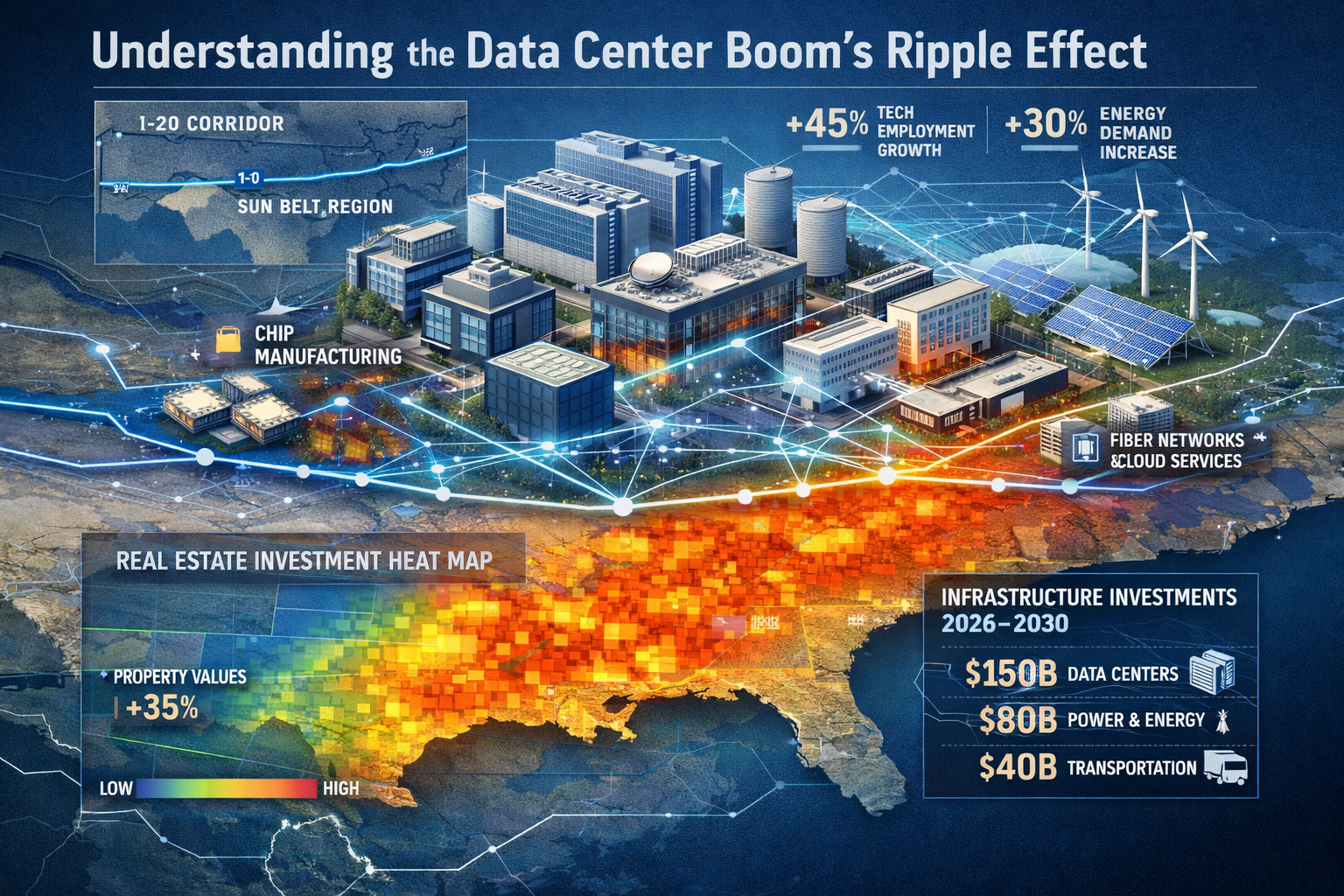
No investment thesis is complete without acknowledging potential challenges. While the data center boom presents extraordinary opportunities, real estate professionals need to consider several risk factors:
Power Grid Constraints
The same power constraints driving site selection could also limit growth. If utilities can't deliver capacity fast enough, development timelines extend and costs increase. The 24 to 48+ month grid interconnection timelines are already stretching developer patience[2].
Regulatory Changes
Business-friendly environments can shift with political changes. Investors should monitor state and local regulatory trends, particularly around:
- Power grid regulations and utility commission decisions
- Tax incentives for data center development
- Environmental regulations related to energy consumption
- Water usage restrictions (data centers require significant cooling capacity)
Market Saturation Concerns
While current demand appears robust, the Federal Reserve's analysis suggests U.S. data center construction spending could range from $360 billion to $930 billion annually by late 2027—a massive variance reflecting uncertainty about AI sector growth[7].
If AI development slows or power constraints prove insurmountable, some markets could experience oversupply. However, the diversification of data center uses (cloud computing, enterprise applications, cryptocurrency mining) provides downside protection.
Residential Market Timing
For multifamily investors, timing matters. Markets like Austin and West Valley Phoenix have "larger supply gluts and slower recovery timelines"[1]. Jumping in too early could mean holding through extended concession periods.
The smart play? Focus on markets with:
- Confirmed data center projects (not just proposals)
- Reasonable supply pipelines (avoiding oversaturated multifamily markets)
- Diversified employment bases (not solely dependent on data centers)
- Infrastructure investment commitments from municipalities
Actionable Strategies for Real Estate Professionals
Whether you're a real estate agent, investor, or home buyer, here's how to capitalize on the Data Center Boom's Ripple Effect: 2026 Demand Driving Real Estate in Emerging Sun Belt Markets:
For Real Estate Agents
🎯 Become the local data center expert: Understand which facilities are planned or under construction in your market. Create content and marketing materials positioning yourself as the agent who understands this economic driver.
🎯 Target corporate relocation specialists: Data center operators need to relocate hundreds of employees. Build relationships with HR departments and corporate relocation services.
🎯 Focus on rental properties near facilities: Construction workers and temporary employees need short-term housing. Partner with investors to create rental portfolios serving this demand.
🎯 Leverage technology: Use AI tools for market analysis to identify emerging submarkets before they become obvious to competitors.
For Real Estate Investors
💰 Follow the power lines: Literally. Identify parcels with access to high-voltage transmission infrastructure. These locations will command premium pricing as data center demand intensifies.
💰 Target multifamily in recovery markets: Dallas, Houston, Nashville, and South Florida are positioned for concession decline in H2 2026[1]. Acquire properties now before the recovery is fully priced in.
💰 Consider industrial conversions: Older industrial properties with power infrastructure can be repositioned for data center support services or converted to meet growing demand.
💰 Build relationships with utilities: Understanding power delivery timelines and capacity constraints gives you an information advantage competitors lack.
💰 Explore crowdfunding opportunities: For investors without capital for direct property acquisition, crowdfunding platforms offer exposure to data center-adjacent real estate projects.
For Home Buyers
🏡 Research employment growth: Before buying in any Sun Belt market, understand whether data center development is driving local employment. This creates home value appreciation potential.
🏡 Consider commute proximity: Properties within 15-30 minutes of major data center facilities will likely appreciate faster than comparable homes farther away.
🏡 Evaluate infrastructure investment: Municipalities supporting data center development typically invest in roads, utilities, and services that benefit all residents.
🏡 Time your purchase strategically: In markets like Dallas and Houston, buying before concessions decline (early-to-mid 2026) could offer better negotiating leverage[1].
The Long-Term Outlook: Beyond 2026
While this article focuses on 2026 demand, the data center boom isn't a short-term phenomenon. Global investment in data center infrastructure is projected to reach $7 trillion, with 100+ megawatt facilities becoming standard[3].
This represents a fundamental restructuring of commercial real estate priorities. For decades, proximity to urban centers and transportation networks drove location decisions. The data center era prioritizes power capacity and regulatory flexibility—factors that favor secondary Sun Belt markets over traditional gateway cities.
The Stargate Effect
The Stargate project in Abilene represents more than just one facility—it's a proof of concept that secondary markets can support massive infrastructure projects. Phase One became operational in 2025, with Phase Two (six buildings) scheduled for 2026[2].
If successful, expect similar mega-projects in other secondary markets with power capacity and land availability. This could accelerate the Sun Belt's transformation from a regional growth story to a global technology infrastructure hub.
Resilience to Market Volatility
Perhaps most importantly for real estate investors, the data center market appears relatively immune to traditional economic cycles. Major technology companies have committed to infrastructure buildouts spanning multiple years, creating sustained demand regardless of short-term AI sector volatility[1].
This resilience makes data center-adjacent real estate investments particularly attractive for portfolio diversification. While residential and traditional commercial sectors experience cyclical fluctuations, data center demand remains robust.
Conclusion: Positioning for the Data Center-Driven Future
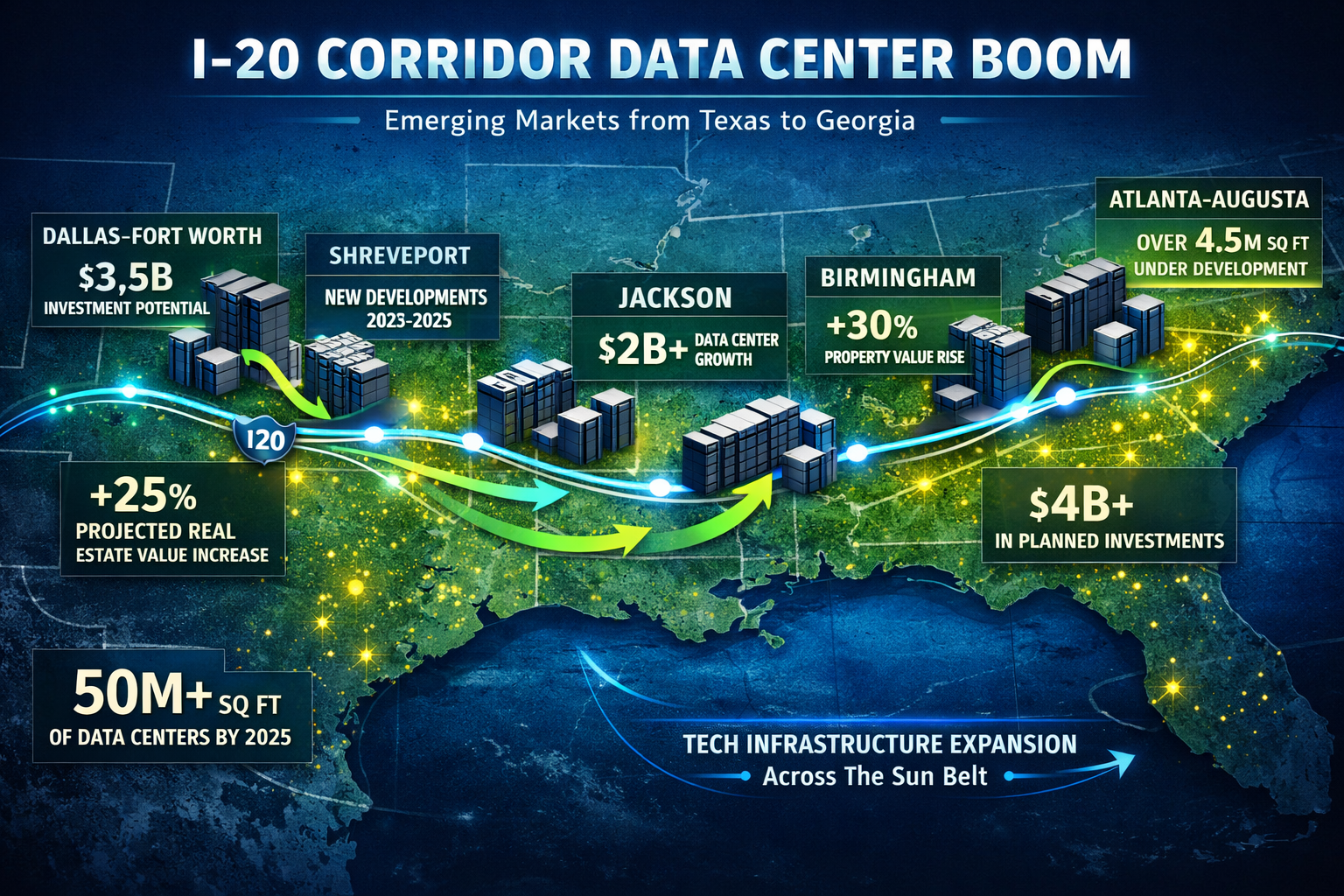
The Data Center Boom's Ripple Effect: 2026 Demand Driving Real Estate in Emerging Sun Belt Markets represents one of the most significant real estate trends of the decade. With record construction investments, historic pre-leasing rates, and fundamental shifts in site selection criteria, the opportunities for informed real estate professionals are extraordinary.
The I-20 corridor and surrounding Sun Belt markets are experiencing transformation that will reshape regional economies for generations. From Abilene's $500 billion Stargate project to the hundreds of smaller facilities sprouting across Texas, Georgia, Alabama, and the Carolinas, this infrastructure buildout creates ripple effects touching every real estate sector.
For agents, investors, and home buyers willing to do the research and move strategically, 2026 offers a rare opportunity to position ahead of the crowd. The smart money isn't chasing overheated primary markets—it's identifying secondary cities with power capacity, regulatory flexibility, and room for growth.
Your Next Steps
Ready to capitalize on this trend? Here's your action plan:
- Research your local market: Identify data center projects planned or under construction within 50 miles of your target investment area
- Analyze power infrastructure: Contact local utilities to understand power delivery capacity and timelines
- Monitor pre-leasing activity: High pre-leasing rates signal sustained demand and reduced development risk
- Build your knowledge base: Stay informed about market trends and investment strategies through trusted resources
- Take action: Whether buying your first home or building a commercial portfolio, the best time to position for data center-driven growth is now
The data center boom isn't coming—it's already here. The question is whether you'll be positioned to benefit from the ripple effects transforming Sun Belt real estate markets in 2026 and beyond.
References
[1] 2026 Predictions Multifamily Office Retail Interest Rates Data Centers 132521 – https://www.bisnow.com/national/news/commercial-real-estate/2026-predictions-multifamily-office-retail-interest-rates-data-centers-132521
[2] Us Real Estate Market Outlook 2026 Ai Power Data Centers – https://www.raveum.com/resources/blog/us-real-estate-market-outlook-2026-ai-power-data-centers
[3] 2026 Commercial Real Estate Trends – https://www.northspyre.com/blog/2026-commercial-real-estate-trends/
[7] Data Center Growth Could Take Widely Divergent Paths Fed Says – https://www.costar.com/article/918246333/data-center-growth-could-take-widely-divergent-paths-fed-says