

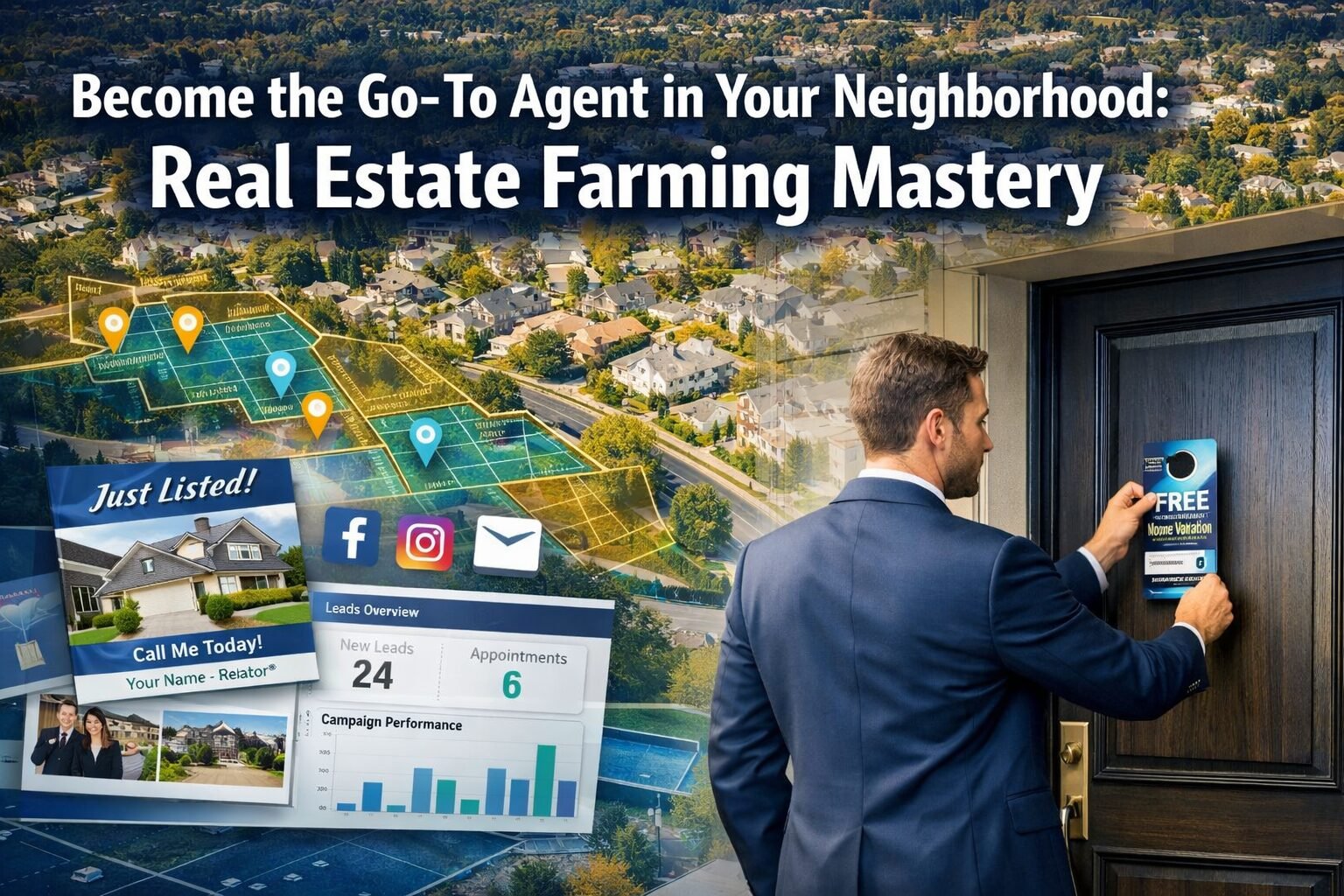
Picture this: You're scrolling through Instagram, and you see yet another agent posting generic "Just Sold!" graphics with zero neighborhood context. Meanwhile, Mrs. Johnson down the street is selling her home of 30 years, and she doesn't even know your name—despite living just four blocks away. That's the reality for most agents in 2026. But here's the extraordinary truth: Real Estate Farming isn't just some old-school tactic your broker mentioned once at a training seminar. It's the most dope, data-driven strategy to absolutely dominate your local market and become the neighborhood expert everyone calls first.

Real Estate Farming is the strategic practice of targeting a specific geographic area—typically 250 to 500 homes—with consistent, multi-channel marketing designed to position you as the go-to local authority[6]. Think of it as planting seeds of trust, watering them with valuable content and genuine relationship-building, and harvesting listings when homeowners are ready to sell. In an era where AI tools and digital marketing have transformed lead generation, farming remains one of the highest-ROI strategies for agents who execute it correctly.
This comprehensive guide will walk you through everything from selecting your farm area using live turnover data to implementing automated engagement systems that track exactly which homeowners are interested in selling. Whether you're a new agent looking to establish your territory or a veteran broker ready to scale your business, this roadmap will show you how to build a farming system so based that competitors won't even know what hit them.
Key Takeaways
- Real Estate Farming targets 250-500 homes in a specific neighborhood with consistent marketing to establish local authority and generate predictable listing opportunities
- Realistic ROI requires 6-9 months of consistent effort; a farm area with 20 annual transactions at $7,500 average commission generates approximately $150,000 in total annual commission income
- Modern farming combines traditional direct mail with digital strategies including QR-coded postcards, automated seller valuations, social media engagement, video marketing, and CRM automation
- Data-driven selection is critical: Use MLS research to identify neighborhoods with strong turnover rates, low agent saturation, and demographic alignment with your expertise
- Multi-channel consistency beats sporadic effort: Implement 12-month coordinated campaigns across postcards, door hangers, email, social media, and community events to build trust over time
What Is Real Estate Farming? (And Why It Still Works in 2026)
Real Estate Farming is the strategic process of selecting a specific geographic area and consistently marketing to homeowners within that zone to establish yourself as the neighborhood's trusted real estate expert. Unlike broad-spectrum lead generation that casts a wide net hoping to catch anyone, farming is hyperlocal—focusing your time, budget, and expertise on becoming impeccable within a defined territory.
The Core Concept: Geographic Dominance Through Consistency
At its foundation, farming operates on a simple psychological principle: familiarity breeds trust. When homeowners see your face, your brand, and your market insights month after month—whether through postcards in their mailbox, posts in their social feed, or door hangers on their entrance—you become the obvious choice when they decide to sell[3].
Here's what makes farming so powerful in 2026:
🎯 Predictable Pipeline: Unlike chasing Zillow leads or cold-calling expired listings, farming creates a consistent flow of opportunities from homeowners who already know and trust you.
📊 Measurable ROI: Modern farming tools now track exactly which homeowners engage with your materials, scan your QR codes, or request property valuations—turning what was once guesswork into data-driven strategy[4].
🏡 Local Authority Positioning: When you're the agent who knows every street, every school district change, and every comparable sale in the neighborhood, you're not just another agent—you're the neighborhood expert.
💰 Higher Conversion Rates: Warm leads from your farm area convert at significantly higher rates than cold prospects because you've already invested months building trust and demonstrating expertise.
Why Traditional Farming Failed (And How 2026 Approaches Fix It)
Let's be real: plenty of agents tried farming in the past and quit after three months because "it didn't work." Here's why the old approach failed—and how modern strategies solve these problems:
Old Problem #1: Unrealistic Farm Sizes
Agents would try to farm 5,000 homes, spreading their budget so thin that homeowners barely noticed them[6].
2026 Solution: Focus on 250-500 homes where you can afford meaningful touchpoints 12+ times per year[6]. Quality over quantity wins every time.
Old Problem #2: Direct Mail Only
Sending postcards alone in 2026 is like showing up to a party and just standing in the corner—you're present but not engaging.
2026 Solution: Multi-channel integration combining direct mail with social media, email automation, video content, and community engagement creates omnipresence[7].
Old Problem #3: No Tracking or Data
Agents had no idea if anyone even looked at their postcards, making it impossible to measure effectiveness or adjust strategy.
2026 Solution: QR codes linked to Automated Seller Valuations (ASV) let you track exactly who's interested, when they engaged, and what properties they're curious about[4].
Old Problem #4: Generic Messaging
Cookie-cutter postcards with stock photos and "I can sell your home!" messages got tossed immediately.
2026 Solution: Hyper-relevant, data-driven content showing actual neighborhood sales, price trends, and local market insights positions you as an authority rather than just another salesperson[3].
For agents looking to understand how modern technology transforms traditional strategies, check out our guide on AI tools that actually close deals.
The Psychology Behind Successful Farming
Understanding why farming works helps you execute it better. Here are the psychological principles at play:
Mere Exposure Effect: People develop preference for things simply because they're familiar with them. Your consistent presence—even when homeowners aren't actively looking to sell—builds positive associations.
Authority Bias: When you consistently demonstrate local market knowledge through data, insights, and expertise, homeowners perceive you as the authority and defer to your judgment.
Reciprocity Principle: Providing valuable information (market updates, neighborhood news, home maintenance tips) without asking for anything creates psychological debt—homeowners feel inclined to reciprocate by choosing you when they need an agent.
Social Proof: Showcasing recent sales, client testimonials, and neighborhood success stories from within the farm area proves you're the agent everyone else trusts.
Step 1: Choosing Your Real Estate Farming Area (On Your Marks)
Selecting the right farm area is the single most critical decision in your entire farming strategy. Choose poorly, and you'll waste months of effort and thousands of dollars. Choose strategically, and you'll build a predictable listing pipeline that generates income for years.
The Goldilocks Zone: 250-500 Homes
Forget what you've heard about farming thousands of homes. The realistic, manageable, and profitable sweet spot is 250 to 500 homes[6]. Here's why:
Budget Efficiency: With 250-500 homes, you can afford to send quality materials 12-24 times per year without breaking the bank. At approximately $0.50-$1.00 per postcard (including design and postage), you're looking at $3,000-$12,000 annually—a manageable investment with clear ROI.
Mental Bandwidth: You can actually learn the neighborhood at this scale—the streets, the schools, the local businesses, the community vibe. This knowledge becomes your competitive advantage.
Meaningful Presence: Homeowners will actually notice and remember you when you're reaching them monthly versus quarterly.
Achievable Market Share: Capturing even 20-30% of the annual transactions in a 250-500 home farm creates a solid income stream.
The MLS Research Framework: Finding High-Turnover, Low-Competition Zones
Here's the step-by-step process to identify your ideal farm area using data rather than guesswork:
Step 1: Pull MLS Data on Annual Turnover
Log into your MLS and run reports for neighborhoods you're considering. You're looking for:
- Total number of homes in the area
- Number of sales in the past 12 months (turnover rate)
- Average sale price and resulting commission
- Days on market (faster is better)
- List-to-sale price ratio (higher indicates strong demand)
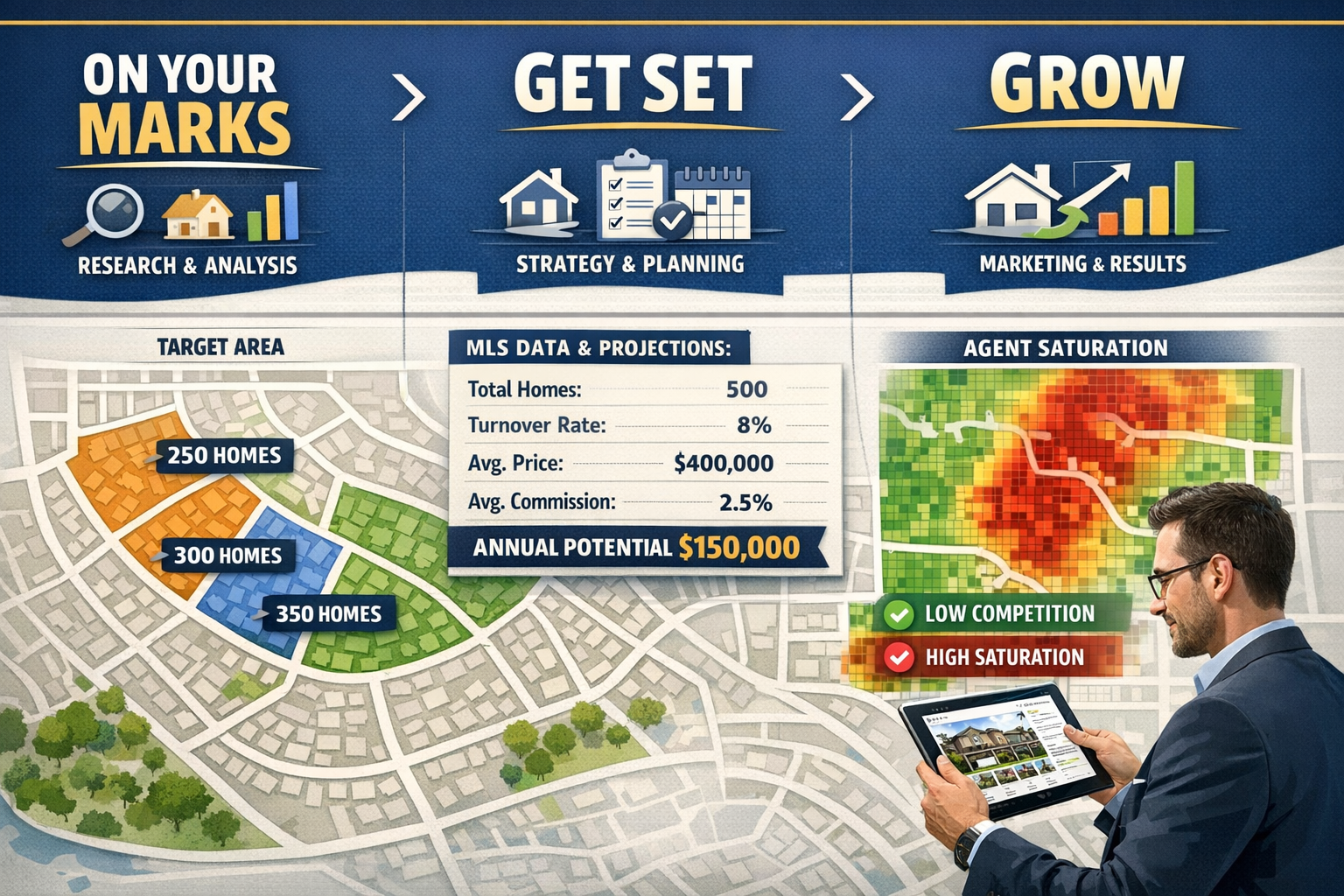
Target Metric: Look for neighborhoods with 4-8% annual turnover. In a 500-home farm, that's 20-40 transactions per year[1].
Step 2: Calculate Potential Annual Commission Income
Let's do the math on a realistic scenario:
- Farm Size: 500 homes
- Annual Turnover: 5% = 25 sales per year
- Average Sale Price: $450,000
- Average Commission: 2.5% buyer's side = $11,250 per transaction
- Your Market Share Goal: 30% (conservative)
- Your Annual Transactions: 25 × 0.30 = 7.5 transactions
- Your Annual Commission Income: 7.5 × $11,250 = $84,375
Even capturing just 20% of a farm area with 20 transactions at $7,500 average commission generates approximately $30,000 in annual farm income[1]. Stack that with your other lead sources, and farming becomes a foundational pillar of your business.
Step 3: Assess Agent Saturation
Pull data on how many agents are actively farming the area. Look for:
- Number of recent listings by the same agents (indicates established farmers)
- Frequency of direct mail from competitors (check with homeowners or local businesses)
- Social media presence of other agents in that neighborhood
- "For Sale" sign dominance by specific brokerages
Red Flag: If one or two agents dominate 60%+ of listings, you're facing entrenched competition. Consider adjacent neighborhoods or areas with more fragmented market share.
Green Light: Neighborhoods with diverse agent representation and no clear dominant farmer offer the best opportunity[4].
Step 4: Demographic Alignment
Choose neighborhoods where the homeowner demographics align with your expertise and personality:
Price Point: Farm areas where you're comfortable and credible. If you're new, starting in ultra-luxury might be challenging. If you're experienced, starter-home neighborhoods might not maximize your commission potential.
Homeowner Age: Neighborhoods with aging homeowners (60+) tend to have higher turnover as residents downsize or move to assisted living.
Family Status: Areas with young families see turnover as kids age and families need more space or relocate for schools.
Property Type: Single-family homes, condos, townhouses—choose what you know best and can speak to with authority.
For more insights on analyzing local markets effectively, explore our guide on how to analyze a local real estate market with AI.
Geographic Considerations: Boundaries Matter
Define clear, logical boundaries for your farm area:
✅ Natural Boundaries: Major roads, rivers, parks, or school district lines create clear mental boundaries for both you and homeowners.
✅ Walkable/Drivable: Choose an area you can easily visit for door-knocking, community events, or property previews.
✅ Community Identity: Neighborhoods with a strong identity (historic districts, HOA communities, waterfront areas) create natural affinity and pride—homeowners want "their" agent.
❌ Avoid Scattered Pockets: Don't farm three disconnected subdivisions just because they fit your price point. Cohesive geography builds stronger brand recognition.
The "Test and Expand" Strategy
Not sure which neighborhood to commit to? Start with a pilot farm of 250 homes for 6 months. Track:
- Response rates to your mailings
- Social media engagement from that area
- Actual conversations or leads generated
- Your comfort level and knowledge growth
If it's working, expand to 500 homes. If not, pivot to a different area before you've invested heavily.
Step 2: Developing Your Real Estate Farming Marketing Plan (Get Set)
Now that you've selected your farm area, it's time to build a comprehensive, multi-channel marketing plan that establishes you as the neighborhood authority. This isn't about random acts of marketing—it's about strategic, coordinated campaigns that build trust over time.
The 12-Month Farming Calendar: Consistency Is King
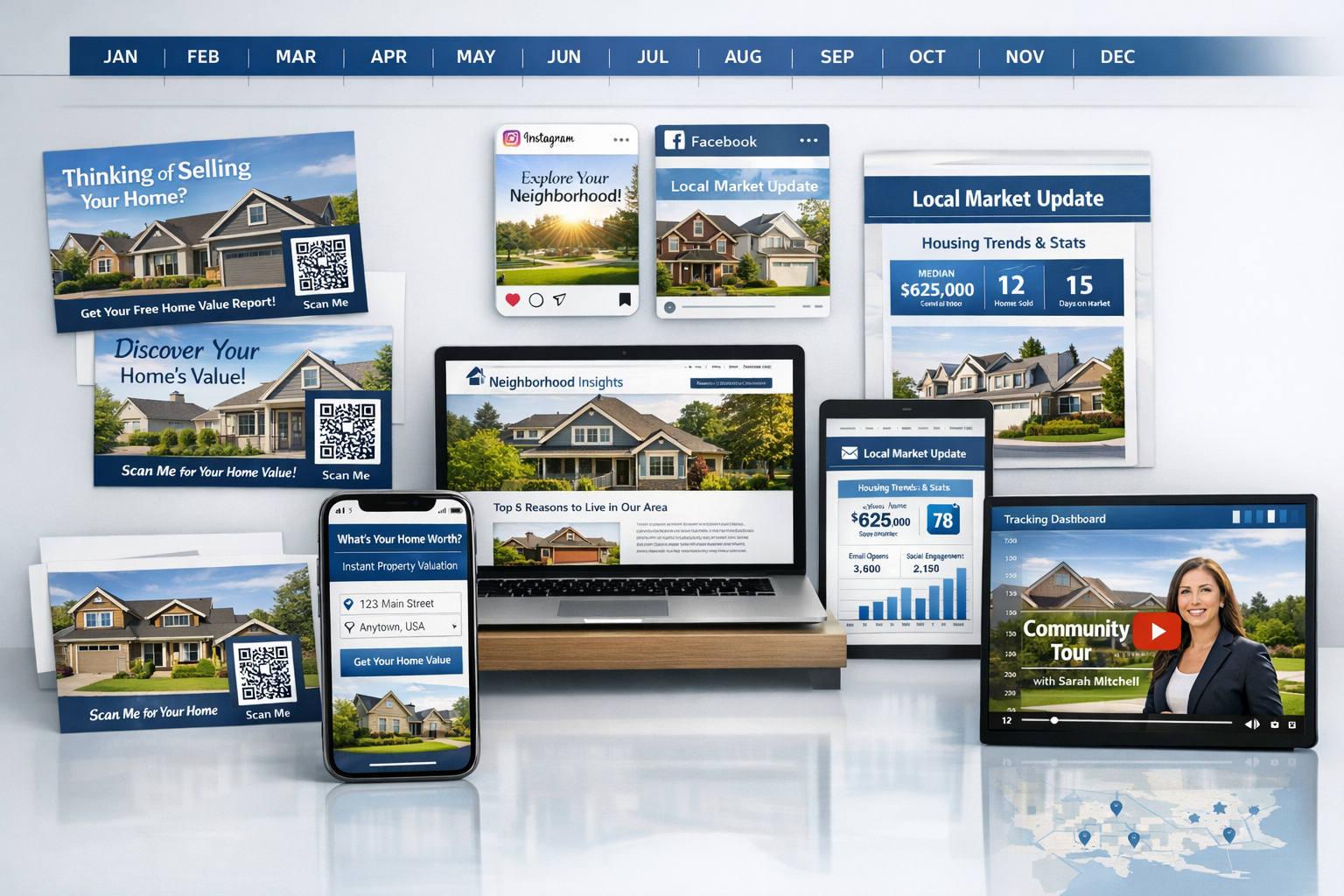
The biggest mistake agents make is inconsistent communication. Homeowners need to see you at least 12 times per year to remember you when they're ready to sell[2]. Here's how to structure your annual calendar:
Monthly Direct Mail Touchpoints
Postcards remain the foundation of farming because they're:
- Tangible and hard to ignore
- Cost-effective at scale
- Easy to track with QR codes
- Perfect for showcasing local market data
12-Month Postcard Themes:
- January: New Year Market Forecast
- February: Valentine's Day "Love Your Home" Home Maintenance Tips
- March: Spring Market Preview
- April: Tax Season Home Value Update
- May: Summer Selling Season Kickoff
- June: Neighborhood Sales Recap
- July: 4th of July Community Celebration + Market Update
- August: Back-to-School Neighborhood Guide
- September: Fall Market Trends
- October: Halloween Safety + Home Security Tips
- November: Thanksgiving Gratitude + Year-End Market Review
- December: Holiday Wishes + New Year Preview
Pro Tip: Use services like PostcardMania or ProspectsPLUS! to design, print, and mail professional campaigns with built-in tracking[2].
Quarterly Door Hangers and Letters
Supplement postcards with door hangers (great for immediate visibility) and personalized letters (higher perceived value):
Q1: Hand-deliver door hangers with your photo, contact info, and a QR code to your neighborhood market report.
Q2: Mail a personalized letter introducing yourself as the neighborhood specialist with your recent sales and testimonials.
Q3: Door hanger with summer safety tips and your contact information.
Q4: Year-end letter with neighborhood statistics, your achievements, and appreciation for the community.
Tool Recommendation: Coffee & Contracts offers ready-made letter templates specifically designed for farming campaigns.
Digital Marketing Integration: The Modern Farming Advantage
Direct mail alone won't cut it in 2026. You need omnipresence across digital channels where homeowners spend their time.
Social Media: Become the Neighborhood Influencer
Platform Priority: Focus on Facebook and Instagram for maximum neighborhood reach.
Content Strategy (post 3-5 times per week):
📍 Neighborhood Spotlights: Feature local businesses, parks, schools, and community events.
📊 Market Updates: Share monthly sales data, price trends, and inventory levels specific to your farm area.
🏡 Just Sold/Just Listed: Showcase your transactions within the neighborhood (with client permission).
💡 Home Tips: Maintenance advice, seasonal checklists, and home improvement ideas.
🎉 Community Events: Attend and post about local festivals, fundraisers, and gatherings.
Engagement Tactics:
- Create a Facebook Group for your neighborhood (e.g., "Oakwood Estates Neighbors")
- Use Instagram Stories with location tags for your farm area
- Go Live from community events or open houses
- Run hyper-targeted Facebook ads to homeowners in your farm zip codes
For comprehensive strategies on social media marketing, check out our guide on how to use social media and AI tools to sell real estate.
Email Marketing: Nurture with Value
Build an email list of homeowners in your farm area and send monthly newsletters featuring:
- Neighborhood-specific market reports
- Recent sales and active listings
- Local events and news
- Home maintenance tips
- Exclusive content (market forecasts, investment insights)
List Building Strategies:
- Offer a free home valuation via your website
- Create a neighborhood guide as a lead magnet
- Host community events requiring email registration
- QR codes on direct mail linking to email signup
Tool Recommendation: LionDesk offers CRM and email automation specifically designed for real estate professionals.
Video Marketing: Show Your Expertise
Video is the most engaging content format in 2026. Create:
Neighborhood Tours: Walk or drive through your farm area highlighting features, amenities, and recent sales.
Market Update Videos: Monthly 2-3 minute videos breaking down local market trends.
Home Seller Tips: Educational content on preparing homes for sale, pricing strategies, and market timing.
Client Testimonials: Video testimonials from satisfied sellers in your farm area.
Distribution: Post on YouTube, Facebook, Instagram, and embed in your email newsletters.
The QR Code Revolution: Trackable Engagement
Here's where 2026 farming gets fresh: Automated Seller Valuation (ASV) QR codes on your direct mail pieces let you track exactly which homeowners are interested in their home's value[4].
How It Works:
- Include a prominent QR code on your postcard: "Scan to see what your home is worth"
- Homeowner scans with their smartphone
- They're directed to a landing page where they enter their address
- They instantly receive an automated valuation report
- You receive a notification with their name, address, and engagement timestamp
- Your CRM automatically adds them to a "hot lead" follow-up sequence
Why This Is So Based:
- You know exactly who's thinking about selling
- You can prioritize follow-up with engaged homeowners
- You provide value (free valuation) before asking for anything
- You capture contact information for ongoing nurture
Tool Recommendation: Market Leader and AgentFire both offer ASV landing pages with CRM integration.
Content Marketing: Establish Thought Leadership
Create a neighborhood-specific landing page on your website featuring:
- Interactive map of your farm area
- Recent sales data and market trends
- School ratings and district information
- Local amenities, restaurants, and attractions
- Neighborhood history and demographics
- Free resources (buyer/seller guides, market reports)
- Lead capture forms for home valuations
SEO Strategy: Optimize the page for "[Neighborhood Name] real estate agent" and related local search terms. This captures homeowners researching agents in your area.
Tool Recommendation: Easy Agent Pro specializes in neighborhood-specific websites with lead capture functionality.
Budget Breakdown: What Real Estate Farming Actually Costs
Let's talk numbers. Here's a realistic annual farming budget for a 500-home area:
| Expense Category | Frequency | Cost Per | Annual Total |
|---|---|---|---|
| Postcards (design, print, mail) | 12/year | $500/mailing | $6,000 |
| Door Hangers | 4/year | $200/drop | $800 |
| Personalized Letters | 2/year | $300/mailing | $600 |
| Social Media Ads | Monthly | $150/month | $1,800 |
| CRM/Automation Tools | Monthly | $100/month | $1,200 |
| Website/Landing Pages | Annual | $1,000/year | $1,000 |
| Video Production | Quarterly | $200/video | $800 |
| Community Event Sponsorships | 2-3/year | $500/event | $1,500 |
| TOTAL ANNUAL INVESTMENT | $13,700 |
ROI Calculation:
If you capture just 20% of 25 annual transactions at $7,500 average commission, that's 5 deals = $37,500 in gross commission income.
Net Profit: $37,500 – $13,700 = $23,800
And that's a conservative first-year estimate. As your brand recognition grows, your market share increases, and your cost per acquisition drops dramatically.
For agents navigating challenging market conditions, our article on strategies for real estate agents in any market provides additional context.
Step 3: Implementing and Growing Your Farm (Grow)
You've chosen your area, you've built your marketing plan—now it's time to execute with precision and track your progress. This is where most agents fail: they start strong but lose momentum after a few months. Here's how to maintain consistency and scale your farming success.
The First 90 Days: Setting the Foundation
Your first three months are critical for establishing presence and credibility.
Week 1-2: Database Setup and Research
Action Items:
- Import all homeowner addresses from your farm area into your CRM
- Tag each contact with "Farm Area – [Neighborhood Name]"
- Research recent sales, active listings, and market trends
- Identify community leaders, HOA boards, and local business owners
- Join neighborhood Facebook groups and follow local pages
Tool Setup:
- Configure LionDesk or your CRM with automated drip campaigns
- Set up AgentFire neighborhood landing page
- Create social media business pages if you haven't already
- Order your first batch of marketing materials
Week 3-4: Initial Outreach Blitz
Action Items:
- Send your first postcard introducing yourself as the neighborhood specialist
- Hand-deliver door hangers to every home in your farm (yes, all 250-500)
- Post your first neighborhood content on social media
- Send your first email newsletter to any addresses you've collected
Introduction Postcard Template:
- Front: Professional photo of you + "Your [Neighborhood Name] Real Estate Expert"
- Back: Brief bio, recent sales in the area, QR code for free home valuation, contact information
Month 2-3: Establish Rhythm and Engagement
Action Items:
- Continue monthly postcards and weekly social media posts
- Attend at least one community event and document it
- Knock on doors (aim for 20-30 per week) to introduce yourself personally
- Follow up with anyone who scanned your QR code or engaged with your content
- Send personalized thank-you notes to anyone you meet in person
Door Knocking Script:
"Hi, I'm [Your Name], and I'm your neighbor here in [Neighborhood]. I specialize in helping homeowners in our area, and I wanted to introduce myself personally. I'm not here to sell you anything—I just want to be a resource if you ever have real estate questions. I send out monthly market updates about our neighborhood—would you like me to add you to the list?"
Months 4-6: Building Momentum and Trust
By month four, homeowners should start recognizing your name and face. Now it's time to deepen relationships.
Community Involvement Strategy
Sponsor Local Events: Little League teams, school fundraisers, neighborhood block parties—put your name and logo where residents gather.
Host Your Own Events:
- Quarterly "Neighborhood Market Update" coffee meetups at a local café
- Annual community shred day (homeowners bring documents to shred for free)
- Holiday food drive or toy collection
- Summer ice cream social in a local park
Volunteer: Join the HOA board, volunteer at community cleanups, participate in local charity events.
Why This Works: People do business with people they know, like, and trust. Community involvement builds all three[3].
Content Amplification
Leverage Testimonials: As you close deals in your farm area, ask for video testimonials and feature them prominently in your marketing.
Case Studies: Create detailed "success stories" showing how you helped neighbors sell quickly or for top dollar.
Neighborhood News: Share local news, business openings, school achievements, and community milestones—position yourself as the neighborhood's information hub.
Months 7-12: Harvesting Results and Scaling
If you've been consistent, you should start seeing tangible results by month six to nine[1][6].
Lead Follow-Up System
Hot Leads (scanned QR code, requested valuation, responded to outreach):
- Call within 24 hours
- Send personalized video message via text
- Add to weekly email nurture sequence
- Mail personalized letter with market analysis
Warm Leads (engaged on social media, attended event, opened emails):
- Monthly check-in call or text
- Bi-weekly email nurture
- Quarterly personalized postcard
Cold Leads (no engagement yet):
- Continue monthly postcards
- Weekly social media content
- Quarterly door hangers
CRM Automation: Use LionDesk to automate reminders, drip campaigns, and follow-up tasks so nothing falls through the cracks.
Tracking and Optimization
Key Metrics to Monitor:
📊 Response Rate: What percentage of homeowners are engaging with your materials?
- Target: 2-5% response rate on direct mail with QR codes[4]
📊 Cost Per Lead: Total marketing spend ÷ number of leads generated
- Target: $50-$150 per lead depending on your market
📊 Conversion Rate: Leads generated ÷ actual listings secured
- Target: 10-20% conversion rate from engaged leads
📊 Market Share: Your transactions ÷ total neighborhood transactions
- Year 1 Target: 10-15%
- Year 2+ Target: 25-40%
📊 ROI: Gross commission income from farm ÷ total marketing investment
- Target: 3:1 minimum (every dollar invested generates three dollars in commission)
Monthly Review Process:
- Pull metrics from your CRM and marketing platforms
- Identify what's working (high engagement content, best-performing postcards)
- Identify what's not working (low open rates, ignored campaigns)
- Adjust your strategy accordingly
- Test new approaches (different postcard designs, new content topics, varied QR code offers)
Advanced Strategies: Taking Your Farm to the Next Level
Once you've established consistent presence and generated your first farm listings, consider these advanced tactics:
Hyper-Personalization with Data
Use live data platforms to track individual property characteristics and personalize outreach[4]:
- Target homeowners who've owned for 7+ years (higher likelihood of selling)
- Identify homes with recent building permits (renovation = potential sale)
- Track properties with tax delinquency or estate situations
- Monitor homes with significant equity growth
Automated Drip Campaigns by Homeowner Segment
Create separate nurture sequences for:
Empty Nesters: Content about downsizing, retirement communities, and simplifying
Young Families: School district guides, family-friendly neighborhoods, upsizing strategies
Investors: Rental market data, appreciation trends, investment opportunities
Luxury Homeowners: High-end market trends, luxury marketing strategies, exclusive listings
Multi-Neighborhood Scaling
Once you've dominated one farm area (30%+ market share), consider:
Adjacent Expansion: Add a neighboring 250-home area with similar demographics
Vertical Expansion: Farm a different price tier in the same general area
Team Delegation: Hire a buyer's agent or assistant to handle leads while you focus on listings and expansion
For insights on building your team, check out our guide on how to hire a virtual assistant for your real estate business.
Technology Integration for Competitive Advantage
AI-Powered Insights: Use AI tools to analyze neighborhood trends, predict hot pockets, and identify likely sellers.
Predictive Analytics: Platforms like Market Leader now offer predictive scoring to identify homeowners most likely to sell in the next 6-12 months[7].
Automated Video Creation: Tools can automatically generate personalized video market updates for each homeowner in your farm.
Chatbots and SMS: Implement automated chat and text responses to capture and qualify leads 24/7.
For a comprehensive look at modern real estate technology, explore our AI tools that actually close deals.
Tools and Technology to Power Your Real Estate Farming System

The difference between agents who succeed at farming and those who quit after three months often comes down to the tools they use. Here's the essential technology stack for modern real estate farming in 2026.
CRM and Automation Platforms
LionDesk ⭐ (Highly Recommended)
- Purpose: Contact management, automated follow-up, drip campaigns
- Key Features: Text and email automation, video messaging, lead tracking, transaction management
- Farming Application: Segment your farm area contacts, set up automated touchpoint sequences, track engagement
- Pricing: $25-$99/month depending on features
- Why It's Dope: Built specifically for real estate with farming-focused features
Market Leader
- Purpose: Lead generation and marketing automation
- Key Features: Predictive analytics, automated seller valuations, CRM integration, direct mail coordination
- Farming Application: Identify likely sellers, automate multi-channel campaigns, track ROI
- Pricing: Custom pricing based on market size
- Why It's Extraordinary: Combines lead gen with farming tools in one platform
Direct Mail and Print Services
PostcardMania
- Purpose: Professional postcard design, printing, and mailing
- Key Features: Templates, custom design, mailing list management, tracking
- Farming Application: Monthly postcard campaigns with consistent branding
- Pricing: Approximately $0.50-$1.00 per postcard including postage
- Why It Works: Turnkey solution from design to delivery
ProspectsPLUS!
- Purpose: Door hangers, postcards, and direct mail campaigns
- Key Features: Real estate-specific templates, QR code integration, tracking
- Farming Application: Quarterly door hanger drops, seasonal campaigns
- Pricing: Competitive bulk rates
- Why It's Fresh: Specializes in real estate marketing materials
Website and Landing Page Builders
AgentFire
- Purpose: Branded agent websites with SEO optimization
- Key Features: Neighborhood-specific pages, IDX integration, lead capture, blog platform
- Farming Application: Create dedicated landing pages for your farm area with market data and lead magnets
- Pricing: $199-$399/month
- Why It's Impeccable: SEO-focused design ranks your neighborhood pages in local search
Easy Agent Pro
- Purpose: Neighborhood websites and lead capture
- Key Features: Pre-built neighborhood templates, automated valuations, CRM integration
- Farming Application: Launch professional neighborhood sites quickly with minimal technical knowledge
- Pricing: $99-$299/month
- Why It's Based: Specifically designed for geographic farming strategies
Lead Generation and Market Visibility
Zillow
- Purpose: Online real estate marketplace and agent advertising
- Key Features: Premier Agent program, homeowner touchpoints, market visibility
- Farming Application: Dominate your farm area's Zillow presence, capture homeowners researching their home values
- Pricing: Variable based on market and competition
- Why It Matters: Homeowners start their research on Zillow—be the agent they see
Content and Campaign Resources
Coffee & Contracts
- Purpose: Done-for-you farming letters and content ideas
- Key Features: Pre-written letters, postcard templates, campaign calendars
- Farming Application: Save time with professional copy you can customize
- Pricing: Subscription-based
- Why It's Helpful: Eliminates writer's block and ensures consistent communication
Analytics and Market Data
Local MLS Platforms
- Purpose: Real-time market data and transaction history
- Key Features: Sales data, active listings, market trends, agent statistics
- Farming Application: Pull neighborhood-specific data for market reports and presentations
- Why It's Essential: Data credibility comes from official MLS sources
Cloud CMA and Similar Tools
- Purpose: Comparative market analysis and property valuations
- Key Features: Professional CMA reports, automated valuations, presentation tools
- Farming Application: Create impressive market reports for homeowners in your farm
- Why It Works: Professional presentation builds trust and authority
Social Media Management
Hootsuite or Buffer
- Purpose: Social media scheduling and management
- Key Features: Multi-platform posting, content calendar, analytics
- Farming Application: Schedule consistent neighborhood content across Facebook and Instagram
- Pricing: $15-$99/month
- Why It's Necessary: Consistency requires planning and automation
Canva
- Purpose: Graphic design for social media and marketing
- Key Features: Real estate templates, brand kits, easy editing
- Farming Application: Create professional social posts, infographics, and market update graphics
- Pricing: Free to $12.99/month for Pro
- Why It's Dope: Professional designs without hiring a designer
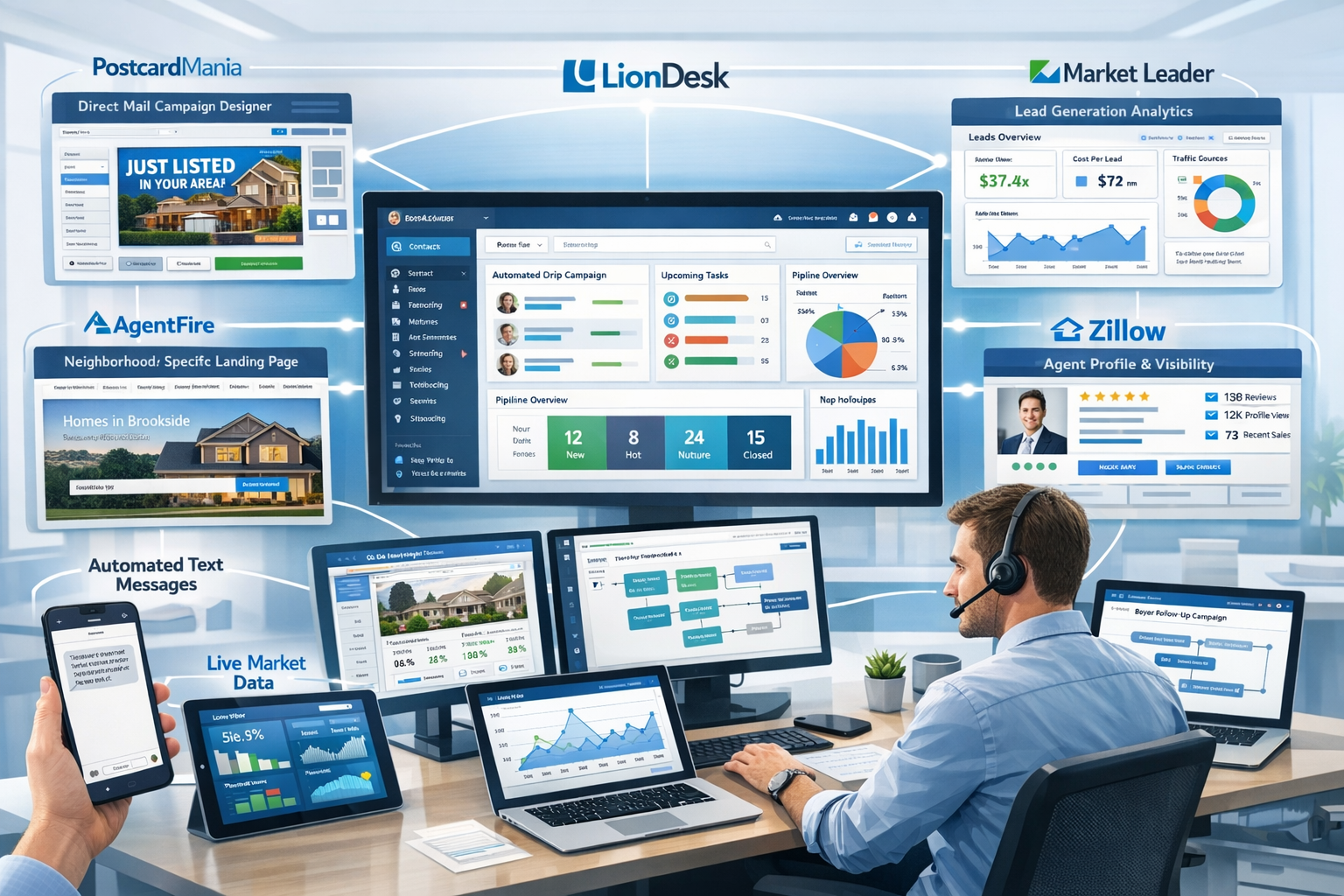
The Integrated Tech Stack: How It All Works Together
Here's how a modern farming system flows:
- Homeowner receives postcard (PostcardMania) with QR code
- Scans QR code linking to neighborhood landing page (AgentFire)
- Requests home valuation captured in CRM (LionDesk)
- Automated email sequence begins with market insights
- Agent receives notification and makes personal follow-up call
- Homeowner added to social media retargeting ads (Facebook)
- Monthly touchpoints continue via email, social, and direct mail
- When ready to sell, homeowner contacts you—the only agent they know
This integrated approach is what separates top-performing farmers from agents still using 2010 strategies.
Real Estate Farming Success Stories and ROI Examples
Let's look at real-world examples of agents who've built extraordinary businesses through strategic farming.
Case Study 1: The Suburban Specialist
Agent Profile: Sarah, 3 years licensed, suburban market outside major metro
Farm Area: 400 single-family homes, $350K-$550K price range
Strategy:
- Monthly postcards with neighborhood sales data
- Bi-weekly Facebook posts in neighborhood group
- Quarterly door-knocking campaigns
- Sponsored local youth sports team
- Hosted annual community garage sale
Timeline and Results:
Year 1:
- Investment: $12,000
- Listings from farm: 3
- Gross commission: $28,500
- ROI: 2.4:1 (break-even year)
Year 2:
- Investment: $12,000
- Listings from farm: 8
- Gross commission: $76,000
- ROI: 6.3:1
- Market share: 22%
Year 3:
- Investment: $15,000 (expanded to 500 homes)
- Listings from farm: 14
- Gross commission: $133,000
- ROI: 8.9:1
- Market share: 35%
Key Takeaway: Patience and consistency pay off exponentially. Sarah's income from her farm area nearly quintupled from year one to year three while her marketing investment remained relatively stable.
Case Study 2: The Urban Condo Farmer
Agent Profile: Marcus, 7 years licensed, downtown condo market
Farm Area: 300 condo units in three adjacent buildings
Strategy:
- Monthly elevator ads and lobby displays
- Quarterly "Condo Market Report" printed newsletters
- Active in building Facebook groups
- Hosted quarterly resident happy hours
- Partnered with building management for exclusive access
Timeline and Results:
Year 1:
- Investment: $8,000
- Listings from farm: 5
- Gross commission: $37,500
- ROI: 4.7:1
Year 2:
- Investment: $10,000
- Listings from farm: 12
- Gross commission: $90,000
- ROI: 9:1
- Market share: 40%
Key Takeaway: High-density farming (condos, apartment conversions) can generate faster results because residents see your marketing more frequently and community is tighter-knit.
Case Study 3: The Luxury Neighborhood Specialist
Agent Profile: Jennifer, 10 years licensed, luxury market
Farm Area: 200 homes, $800K-$2M+ price range
Strategy:
- High-quality quarterly magazines (not postcards)
- Exclusive neighborhood events (wine tastings, art shows)
- Personal handwritten notes for birthdays and anniversaries
- Sponsored neighborhood beautification projects
- Video market updates via email
Timeline and Results:
Year 1:
- Investment: $25,000
- Listings from farm: 2
- Gross commission: $75,000
- ROI: 3:1
Year 2:
- Investment: $28,000
- Listings from farm: 5
- Gross commission: $187,500
- ROI: 6.7:1
- Market share: 25%
Key Takeaway: Luxury farming requires higher investment per homeowner but generates significantly higher commission per transaction. The strategy must match the market's expectations for quality and exclusivity.
The Common Success Factors
Across all successful farming stories, these patterns emerge:
✅ Realistic Timeframe: All agents committed to at least 12 months before expecting significant results
✅ Consistent Presence: Monthly touchpoints minimum, across multiple channels
✅ Community Integration: Active participation beyond just marketing
✅ Data-Driven Adjustments: Tracking what works and doubling down on successful tactics
✅ Personal Touch: Combining automation with genuine human connection
✅ Market Expertise: Deep knowledge of neighborhood trends, values, and dynamics
For additional strategies on building your real estate business, check out our networking secrets top agents swear by.
Common Real Estate Farming Mistakes to Avoid
Even with the best intentions, agents make predictable mistakes that sabotage their farming efforts. Here's what to avoid and how to course-correct.
Mistake #1: Choosing Too Large a Farm Area
The Problem: Trying to farm 1,000+ homes spreads your budget so thin that homeowners barely notice you.
The Fix: Start with 250-500 homes where you can afford meaningful, frequent touchpoints[6].
Why It Matters: It's better to dominate a small area than be invisible in a large one.
Mistake #2: Inconsistent Communication
The Problem: Sending postcards for three months, stopping for two months, then resuming sporadically.
The Fix: Commit to a 12-month calendar and stick to it religiously. Use automation to maintain consistency even during busy periods.
Why It Matters: Homeowners need repeated exposure to remember you. Inconsistency resets your progress to zero.
Mistake #3: Generic, Sales-Focused Messaging
The Problem: Every postcard screams "List with me!" without providing any value.
The Fix: Follow the 80/20 rule—80% valuable content (market data, home tips, community news), 20% promotional.
Why It Matters: People hate being sold to but love receiving valuable information. Build trust before asking for business.
Mistake #4: Ignoring Digital Integration
The Problem: Relying solely on direct mail in 2026 when homeowners spend hours daily on social media.
The Fix: Integrate social media, email, video, and digital ads with your direct mail for omnipresence[7].
Why It Matters: Multi-channel presence reinforces your brand and reaches homeowners where they're most engaged.
Mistake #5: No Tracking or Measurement
The Problem: Sending marketing materials with no way to measure engagement or ROI.
The Fix: Use QR codes, unique phone numbers, dedicated landing pages, and CRM tracking to measure every campaign[4].
Why It Matters: You can't improve what you don't measure. Data tells you what's working and what's wasting money.
Mistake #6: Quitting Too Soon
The Problem: Expecting results in 60-90 days and quitting when they don't materialize.
The Fix: Commit to at least 6-9 months before evaluating effectiveness[1][6]. Farming is a long-term strategy, not a quick fix.
Why It Matters: Trust and brand recognition take time to build. Most agents quit right before they would have seen results.
Mistake #7: Farming Where You Don't Want to Work
The Problem: Choosing a farm area based solely on turnover data without considering if you actually enjoy working there.
The Fix: Choose neighborhoods where you genuinely connect with the community, price point, and homeowner demographics.
Why It Matters: Authenticity shows. If you don't genuinely care about the neighborhood, homeowners will sense it.
Mistake #8: Neglecting Personal Relationships
The Problem: Relying entirely on automated marketing without personal connection.
The Fix: Combine automation with personal touches—handwritten notes, phone calls, in-person visits, community involvement.
Why It Matters: Real estate is still a relationship business. Technology amplifies but doesn't replace human connection.
Mistake #9: Ignoring Compliance and Legal Requirements
The Problem: Violating do-not-mail requests, fair housing laws, or local solicitation ordinances.
The Fix: Maintain proper do-not-contact lists, ensure all marketing complies with fair housing regulations, and understand local laws regarding door-knocking and solicitation.
Why It Matters: Legal violations can result in fines, license suspension, and reputation damage that destroys your farming investment.
Mistake #10: Not Differentiating from Competitors
The Problem: Using the same generic postcards and messaging as every other agent.
The Fix: Develop a unique brand voice, provide exclusive insights, and create memorable experiences that set you apart.
Why It Matters: If you're indistinguishable from competitors, homeowners have no reason to choose you specifically.
Frequently Asked Questions About Real Estate Farming
What is real estate farming?
Real Estate Farming is a targeted marketing strategy where agents focus on a specific geographic area—typically 250 to 500 homes—and consistently market to homeowners within that zone to establish themselves as the neighborhood's trusted real estate expert[6]. The goal is to build brand recognition and trust over time so that when homeowners decide to sell, you're the obvious choice.
How long does it take to see results from real estate farming?
Realistic results require 6 to 9 months of consistent effort, with some agents needing up to a year before seeing significant listing activity[1][6]. The timeline depends on factors like market turnover rate, competition, quality of your marketing, and consistency of implementation. Most successful farmers report their first listing from the farm area between months 4-8, with momentum building substantially in year two.
How much does real estate farming cost?
A comprehensive farming campaign for 250-500 homes typically costs $8,000-$15,000 annually, depending on your market and marketing mix[1]. This includes direct mail (postcards, letters, door hangers), digital marketing (social media ads, email automation), CRM tools, website/landing pages, and community event sponsorships. The investment can generate significant ROI—even capturing 20% of 20 annual transactions at $7,500 average commission yields $30,000 in gross income.
What's the ideal size for a real estate farm area?
The sweet spot is 250 to 500 homes[6]. This size allows you to:
- Afford meaningful touchpoints (12+ per year) without breaking your budget
- Actually learn the neighborhood intimately
- Build genuine relationships rather than just blasting marketing
- Achieve measurable market share (20-40% is realistic)
Avoid farming thousands of homes—you'll spread yourself too thin and fail to make a memorable impact.
How do I choose the best neighborhood to farm?
Select your farm area based on these criteria:
- Annual turnover rate of 4-8% (20-40 transactions per year in a 500-home area)
- Low agent saturation (no single agent dominating 60%+ of listings)
- Price point alignment with your experience and target commission income
- Demographic fit with your expertise and personality
- Geographic boundaries that are clear and logical
- Community identity that creates natural affinity
Use MLS data to research turnover, average sale prices, and days on market. Calculate potential annual commission income before committing[1].
What marketing materials work best for real estate farming?
The most effective farming campaigns use a multi-channel approach[7]:
Direct Mail:
- Monthly postcards with market data and QR codes
- Quarterly personalized letters
- Seasonal door hangers
Digital:
- Weekly social media posts (Facebook, Instagram)
- Monthly email newsletters
- Video market updates
- Neighborhood-specific landing pages with lead capture
Community:
- Event sponsorships
- Personal attendance at local gatherings
- Handwritten notes and personal calls
The combination creates omnipresence—homeowners see you everywhere, building trust and recognition.
Should I focus on direct mail or digital marketing for farming?
Both. The most successful farming strategies in 2026 integrate traditional direct mail with modern digital tactics[7]. Direct mail (postcards, letters) provides tangible, hard-to-ignore touchpoints that homeowners physically handle. Digital marketing (social media, email, video) offers frequent, low-cost engagement and allows for real-time interaction and tracking.
The integration is powerful: a postcard with a QR code drives homeowners to your digital landing page where you capture their information and continue nurturing via email and social media retargeting.
How do I track ROI on my farming investment?
Track these key metrics:
Investment Side:
- Total marketing spend (direct mail + digital + tools + events)
Return Side:
- Number of leads generated from farm area
- Number of listings secured from farm area
- Gross commission income from farm transactions
ROI Formula: (Gross Commission Income – Marketing Investment) ÷ Marketing Investment × 100
Example: $50,000 commission income – $12,000 investment = $38,000 profit
$38,000 ÷ $12,000 = 3.17 or 317% ROI
Use CRM tracking, QR code analytics, and unique phone numbers to attribute leads accurately to your farming efforts[4].
Can new agents succeed at real estate farming?
Absolutely. Farming is actually ideal for new agents because it:
- Provides a focused strategy rather than scattered lead chasing
- Builds expertise in a specific area quickly
- Creates predictable pipeline over time
- Doesn't require a large sphere of influence or past client database
- Levels the playing field against experienced agents through consistency and innovation
New agents should start with a smaller farm area (250 homes), commit to at least 12 months, and be patient as results build over time.
For new agents looking to establish themselves, check out our guide on how realtors generate leads without relying on friends and family.
What's the difference between real estate farming and sphere of influence marketing?
Real Estate Farming targets a specific geographic area of homeowners you may not know personally, building relationships through consistent marketing and community involvement.
Sphere of Influence (SOI) Marketing focuses on people you already know—friends, family, past clients, professional contacts—nurturing those existing relationships for referrals and repeat business.
Both strategies are valuable and complementary. Farming builds new relationships in a targeted area, while SOI leverages existing relationships. Successful agents typically invest in both.
How do I compete with established agents already farming my target neighborhood?
Competing with entrenched farmers requires differentiation and superior execution:
Provide Better Value: Offer more detailed market insights, better design, more valuable content than competitors.
Increase Frequency: If competitors mail quarterly, you mail monthly. If they post weekly, you post daily.
Leverage Technology: Use QR codes, automated valuations, video, and data analytics that older farmers may not employ[4][7].
Personal Connection: Attend more community events, knock more doors, and build genuine relationships beyond marketing materials.
Niche Positioning: Specialize in a specific homeowner segment (downsizers, first-time sellers, luxury) rather than trying to be everything to everyone.
Be Patient: Established agents may have years of brand equity, but consistent superior marketing will gradually shift market share in your favor.
Conclusion: Your Real Estate Farming Action Plan
Real Estate Farming isn't some gatekeeping secret that only top-producing agents know—it's a proven, data-driven strategy that any agent can implement to build a predictable listing pipeline and dominate their local market. But here's the thing: knowing the strategy and actually executing it are two very different things.
The extraordinary agents who succeed at farming share common traits: they're patient, they're consistent, they're genuinely invested in their communities, and they leverage modern technology to amplify their efforts. They understand that farming is a long-term investment that compounds over time, not a quick fix for next month's production goals.
Your Next Steps: The 30-Day Farming Launch Plan
Ready to become the go-to agent in your neighborhood? Here's your action plan for the next 30 days:
Week 1: Research and Selection
- Pull MLS data for 3-5 potential farm areas
- Calculate annual turnover and potential commission income for each
- Assess agent saturation and competition
- Choose your 250-500 home farm area
- Define clear geographic boundaries
Week 2: Infrastructure Setup
- Set up or optimize your CRM (LionDesk recommended)
- Import all homeowner addresses into your database
- Create neighborhood-specific landing page (AgentFire or Easy Agent Pro)
- Design your first postcard with QR code (PostcardMania)
- Set up social media business pages if needed
Week 3: Content and Calendar Creation
- Develop your 12-month marketing calendar
- Create your introduction postcard and letter
- Design door hanger template
- Plan first month of social media content
- Write your first email newsletter
- Record your first neighborhood video
Week 4: Launch and Execute
- Mail your first postcard to all homes in farm area
- Hand-deliver door hangers to every address
- Post your first neighborhood content on social media
- Join local Facebook groups and community pages
- Attend your first community event
- Set up automated follow-up sequences in CRM
The Farming Mindset: Think Like a Farmer, Not a Hunter
Hunters chase individual prey, expending energy on each pursuit with unpredictable results. Farmers plant seeds, nurture growth, and harvest predictable yields season after season. Real Estate Farming requires the farmer's mindset:
🌱 Plant: Establish your presence through consistent marketing and community involvement
💧 Nurture: Provide value, build relationships, and demonstrate expertise over time
🌾 Harvest: Capture listings when homeowners are ready to sell, having already chosen you as their trusted advisor
The agents who quit farming after three months are hunters at heart—they want immediate results and move on when they don't get them. The agents who build six-figure farm incomes understand that the real harvest comes in years two, three, and beyond.
The 2026 Competitive Advantage
Here's the fresh reality: most agents still aren't farming strategically. They're chasing Zillow leads, buying aged internet leads, or hoping their sphere of influence magically generates business. That's your opportunity.
By implementing a modern, data-driven, multi-channel farming strategy, you're positioning yourself ahead of 90% of agents in your market. When you combine traditional direct mail with digital automation, QR code tracking, video marketing, and genuine community involvement, you create an impeccable system that competitors can't easily replicate.
The tools exist. The strategy is proven. The only variable is your commitment to consistent execution.
Final Thoughts: Build Your Real Estate Empire One Neighborhood at a Time
Real Estate Farming isn't just a lead generation tactic—it's a business-building strategy that creates long-term equity in your brand and market position. When you own a neighborhood, you own a predictable income stream that grows year after year with relatively stable marketing investment.
Imagine walking through your farm area a year from now and having homeowners wave, call you by name, and introduce you to their neighbors as "our real estate expert." Imagine your phone ringing with listing appointments from homeowners who've been following your content for months and are ready to sell. Imagine building a business where 30-40% of your annual income comes from one focused neighborhood where you're the undisputed authority.
That's the power of Real Estate Farming done right.
Now stop reading and start farming. Your future listings are waiting in that neighborhood you've been thinking about. The question is: will you be the agent who claims them, or will you let another agent who actually commits to the strategy harvest the rewards?
The choice is yours. The time is now. Your neighborhood is waiting.
For more expert guidance on building your real estate business, visit Real Estate Rank IQ for step-by-step strategies, market insights, and actionable training from licensed brokers with over 15 years of experience.
References
[1] Real Estate Farming – https://www.marketleader.com/blog/real-estate-farming/
[2] Watch – https://www.youtube.com/watch?v=pt1wTJY4q18
[3] Real Estate Farming Ideas – https://www.asreb.com/blog/real-estate-farming-ideas/
[4] Powerfarm Guide – https://wisepelican.com/powerfarm-guide/
[5] Real Estate Farming – https://www.xara.com/blog/real-estate-farming/
[6] Farming Isnt Dead Here Are 5 Strategies That Work In 2026 – https://www.inman.com/2026/01/20/farming-isnt-dead-here-are-5-strategies-that-work-in-2026/
[7] Farming In Real Estate The Smarter Automated Way To Dominate Your Market In 2026 – https://harvist.com/farming-in-real-estate-the-smarter-automated-way-to-dominate-your-market-in-2026/
[8] Real Estate Farming Strategies How To Consistently Stay In Front Of Your Audience – https://elmstreet.com/blog/real-estate-farming-strategies-how-to-consistently-stay-in-front-of-your-audience
[9] Ultimate Guide Geographic Farming – https://blog.narrpr.com/tips/ultimate-guide-geographic-farming/