




Last updated: February 28, 2026
Key Takeaways
- GCI (Gross Commission Income) is the single most important performance metric for real estate agents, and consistent prospecting is the engine that drives it.
- Expired listings, circle prospecting, and FSBO outreach remain among the highest-converting lead sources in 2026's stabilizing market.
- AI-assisted outreach tools can boost lead qualification by an estimated 30% and improve closure rates by 10–15% compared to cold calling alone.
- Inventory is rising nationally (up roughly 10% year-over-year as of January 2026), which means more seller opportunities for agents who prospect proactively.
- Hyper-local content, community events, and social media relationship-building are outperforming generic mass marketing for top-producing agents.
- A daily 90-minute prospecting block focused on high-ROI activities is a strategy endorsed by leading coaches for hitting $200K–$300K+ annual GCI targets.
- Tracking which prospecting channels actually convert — not just which feel comfortable — is what separates six-figure agents from the rest.
Quick Answer

The 15 clever real estate prospecting ideas to boost your GCI covered in this guide include expired listings, FSBO outreach, circle prospecting, AI-powered lead tools, social media relationship-building, community events, video marketing, referral systems, database reactivation, open house funnels, and more. Each tactic is designed to generate consistent, closeable leads rather than just activity. The agents who win in 2026 are the ones who combine smart targeting with genuine relationship-building.
Try the GCI Goal Calculator First
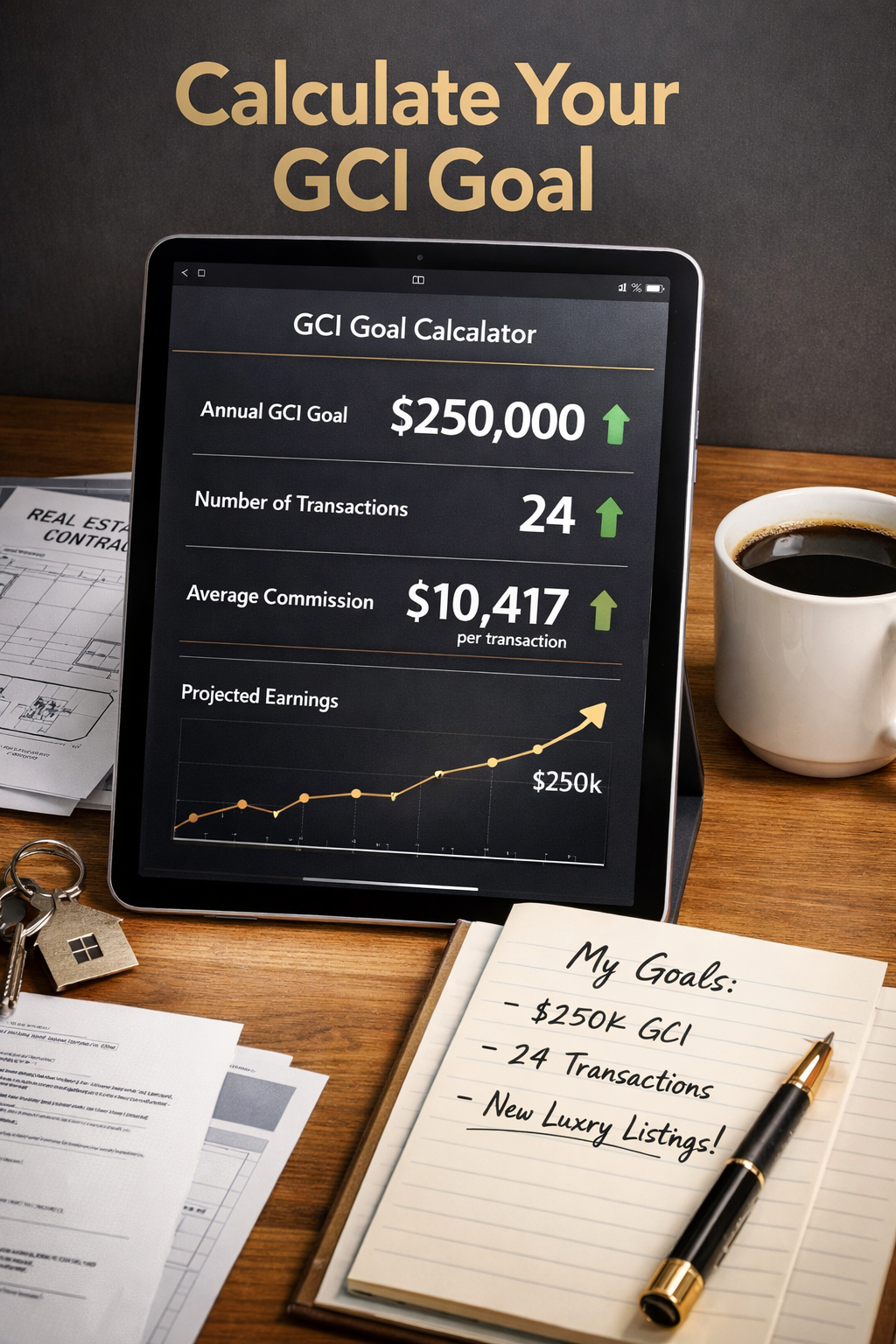
Before diving into the strategies, get clear on your actual GCI target. Use the calculator below to see exactly what it takes to hit your income goal.
Why GCI Is the Only Metric That Actually Matters
GCI, or Gross Commission Income, is the total commission revenue an agent earns before splits, fees, and expenses. It's the clearest measure of production — and the number every serious agent should be building their prospecting plan around.
Tom Ferry, one of the most recognized real estate coaches in the industry, has been direct about this in 2026: daily 90-minute prospecting blocks focused on high-ROI activities are what separate agents hitting $200K–$300K+ GCI from those stuck in the $80K–$100K range. The difference isn't talent. It's consistency and targeting.
Here's the math that makes prospecting non-negotiable:
| Market Price | Commission Rate | Deals/Year | Projected GCI |
|---|---|---|---|
| $350,000 | 2.5% | 20 | $175,000 |
| $450,000 | 2.5% | 24 | $270,000 |
| $600,000 | 2.5% | 30 | $450,000 |
| $800,000 | 2.5% | 36 | $720,000 |
More deals = more GCI. And more deals start with smarter prospecting.
15 Clever Real Estate Prospecting Ideas to Boost Your GCI
These strategies are ranked by conversion potential and practical ease of implementation. Mix and match based on your market, budget, and personality.
1. 🔍 Work Expired Listings Like a Detective
Expired listings are one of the highest-converting prospecting sources available to agents — and most agents are still using generic scripts that go nowhere.
The approach that actually works in 2026's balanced market is what some veteran brokers call "forensic analysis." Before calling, study the listing: What were the photos like? Was the pricing off from the start? Did it sit too long before a price cut? When you call with a truth-based audit instead of a sales pitch, sellers listen.
Why it works: These sellers already want to sell. They're frustrated, not uninterested. Showing up with answers — not just enthusiasm — builds instant credibility.
"Agents who convert expired listings in 2026 aren't the loudest callers. They're the most prepared ones."
2. 🏘️ Circle Prospect Around New Listings and Sales
Every time a home lists or sells in a neighborhood, the surrounding homeowners get curious. Circle prospecting means contacting 50–100 homes around that activity with a simple, relevant message: "A home just sold on your street. Want to know what it means for your home's value?"
With active listings in markets like Los Angeles rising 13.2% year-over-year as of January 2026, there's more inventory to prospect around than there's been in years. That's an extraordinary opportunity for agents willing to put in the work.
Best practice: Combine door-knocking with a follow-up mailer. Face-time builds deeper trust than digital-only outreach, even if digital retargeting is cheaper per impression.
3. 📞 FSBO Outreach with a Collaboration Frame
For Sale By Owner sellers aren't anti-agent — they're anti-commission. The agents who convert FSBOs position themselves as partners, not competitors.
Lead with value: offer a free comparative market analysis, share data on how FSBOs typically net less than agent-represented sales, and offer to bring a buyer. Don't pitch your listing services on the first call. Build rapport first.
4. 🤖 Use AI Tools for Smarter Lead Identification
AI-assisted prospecting tools can analyze behavioral signals — like repeated visits to listing pages, mortgage calculator use, or neighborhood search patterns — to flag leads who are close to making a move. According to industry estimates, AI chatbots and lead qualification tools can improve closure rates by 10–15% compared to cold outreach alone, with 24/7 coverage that no human team can match.
Check out this breakdown of AI-driven real estate lead generation tools that top agents are using right now.
Choose this if: You have a database of 500+ contacts and want to prioritize who to call first.
5. 📱 Build Relationships Through Social Media (Not Just Followers)
Social media prospecting isn't about posting listings. It's about showing up where your ideal clients already are and becoming a recognizable, trustworthy presence.
One impactful tactic: follow hashtags where your target clients are active. For example, a Manhattan broker who follows #nycmoms can spot parents posting about needing more space — a fresh signal that a move might be coming. This kind of relationship-building reportedly yields significantly higher engagement than cold outreach.
For a complete playbook on this, see how to use social media and AI tools to sell real estate.
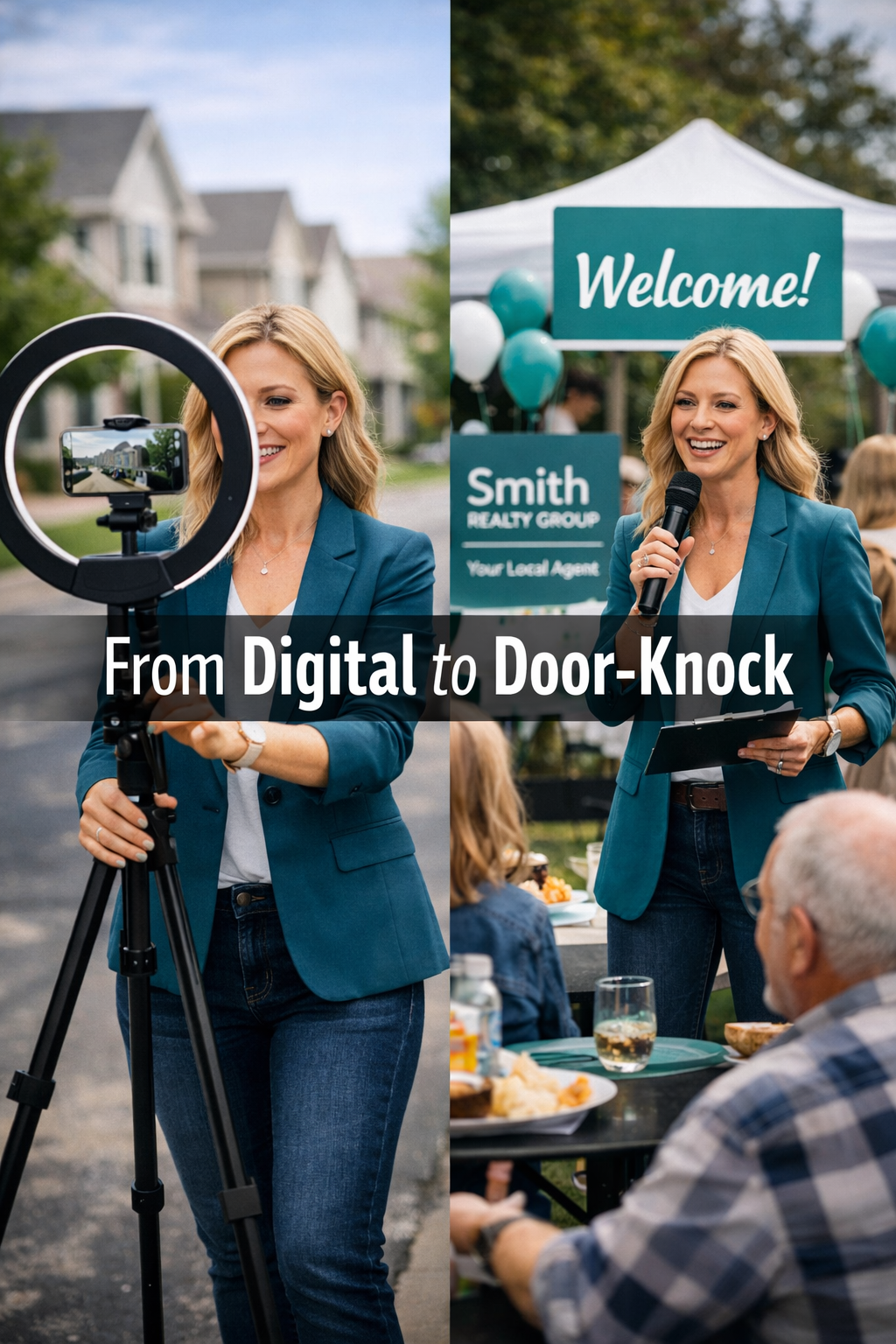
6. 🎥 Hyperlocal Video Content
Short-form video — think neighborhood tours, "just sold" recaps, and market update reels — is one of the most effective ways to build authority in a specific area. Agents who post consistent hyperlocal content become the default expert in buyers' and sellers' minds before they ever pick up the phone.
Pro tip: Don't overthink production quality. A well-lit, clearly spoken 60-second neighborhood update shot on a smartphone outperforms a polished corporate video with no personality.
Pair your video strategy with AI marketing tools for real estate agents to automate distribution and repurposing.
7. 🏡 Open House Funnels (Not Just Open Houses)
Open houses are prospecting gold — but only if you treat every visitor as a future client, not just a one-time interaction. The goal is to capture contact information and start a follow-up sequence that converts over time.
Use a digital sign-in app, send a same-day follow-up text, and add every visitor to a drip campaign. The agents who win from open houses are the ones with a system, not just a sign.
Explore the best open house apps that tech-savvy agents use to get more leads to level up your process.
8. 📬 Database Reactivation Campaigns
Most agents have hundreds of past clients and leads sitting dormant in their CRM. A database reactivation campaign — a simple, personalized message checking in with a relevant market update — can generate listings and referrals from people who already know and trust you.
The message that works: "Hey [Name], home values in [neighborhood] have shifted recently. I thought of you — happy to pull a quick update on your home's current value if that's helpful."
No pitch. Just value.
9. 🤝 Build a Referral Network with Local Professionals
Mortgage brokers, divorce attorneys, estate attorneys, CPAs, and financial planners all work with people who are about to buy or sell real estate. Building genuine relationships with these professionals — not just handing them your card — creates a steady stream of warm referrals.
How to start: Invite one local professional to coffee per week. Ask about their clients' needs. Show up as a resource, not a salesperson.
10. 🏙️ Become the Neighborhood Expert
Agents who position themselves as hyper-local market experts win listings in stabilizing markets. This means knowing the micro-trends: which blocks are appreciating fastest, which schools are drawing buyers, what the average days-on-market looks like street by street.
A RISMedia webinar in early 2026 highlighted that agents who create opportunities by owning neighborhood expertise are outperforming those relying on broad market messaging. So based on what the data shows, specificity wins.
Use AI tools to analyze your local real estate market and pull the micro-data that makes you sound like the only agent who actually knows the neighborhood.
11. 🎉 Host Community Events
Sponsored community events — a neighborhood block party, a first-time buyer workshop, a "what's your home worth?" pop-up — put your name and face in front of dozens of potential clients in a low-pressure setting.
California broker Marc Azfal has pointed out that sponsored events, despite feeling uncomfortable for many agents, consistently deliver high response rates when tracked against other prospecting channels. The discomfort is worth it. Let it cook.
12. 💌 Handwritten Notes and Direct Mail (Still Works)
In a world of automated emails and text blasts, a handwritten note stands out. Sending a brief, personalized note to a past client, a new neighbor, or a FSBO seller takes five minutes and creates a memorable impression.
Direct mail — especially postcards with real neighborhood data — also continues to perform well for circle prospecting and geographic farming.
13. 📊 Track Your Prospecting Data Like a Business
This one isn't glamorous, but it's what separates agents who grow their GCI from those who stay flat. Track every prospecting activity: calls made, doors knocked, emails sent, appointments set, and contracts signed.
Then double down on what's actually converting. If your community events generate five listings per year and your cold calls generate one appointment per 209 dials (a ratio cited in prospecting research), the math tells you where to spend your time.
14. 🔄 Leverage Relisted and Price-Reduced Listings
Homes that have been relisted or had price reductions are often owned by highly motivated sellers who are frustrated with their current agent. These are impeccable prospecting targets because the seller's pain point is clear and recent.
Check out why relisted homes often get more offers than new ones — and use that insight to frame your outreach.
15. 🌐 Build Your Sphere of Influence Systematically
Your sphere of influence (SOI) — friends, family, past clients, neighbors, and acquaintances — is your most reliable source of referrals and repeat business. But "staying in touch" casually isn't a strategy. A real SOI system includes regular touchpoints: monthly market updates, birthday messages, annual home anniversary notes, and check-in calls.
For a complete guide on this, see how to build and grow your real estate sphere of influence with modern strategies that actually move the needle.
Which Prospecting Strategies Work Best in 2026's Market?
The 2026 market is characterized by rising inventory (up roughly 10% nationally year-over-year as of January 2026), cautious buyer activity, and seller hesitation in many price ranges. That combination means agents need to prospect smarter, not just harder.
What's working right now:
- Expired listings and price-reduced homes — motivated sellers with a clear pain point
- Circle prospecting — more inventory means more listing activity to prospect around
- Hyperlocal content and neighborhood expertise — differentiation in a crowded agent market
- AI-assisted lead identification — prioritizing warm leads over cold outreach
- Database reactivation — low-cost, high-trust, high-conversion
What's less efficient:
- Generic cold calling without research or targeting
- Mass email blasts with no personalization
- Social media posting without engagement or follow-up
Common Prospecting Mistakes That Kill GCI Growth
Even experienced agents make these errors. Avoid them and you're already ahead of most of the competition.
- Prospecting inconsistently. One good week followed by three slow weeks produces nothing. Daily or weekly consistency is what builds pipeline.
- Sticking to comfortable tactics only. If cold calling makes you anxious, that's fine — but don't avoid every slightly uncomfortable strategy. Community events and FSBO calls are worth the discomfort.
- Not tracking results. Gut feelings about what's working are almost always wrong. Data tells the real story.
- Pitching too early. Most prospecting conversations should be 80% listening and 20% talking. Sellers and buyers need to feel heard before they trust you.
- Ignoring past clients. The easiest GCI to earn is from people who already know you. Neglecting your database is gate-keeping your own success from yourself.
FAQ: Real Estate Prospecting and GCI
What does GCI mean in real estate?
GCI stands for Gross Commission Income — the total commission an agent earns before deducting splits, brokerage fees, or business expenses. It's the standard measure of an agent's production.
How many prospecting calls should a real estate agent make per day?
There's no universal number, but leading coaches recommend a dedicated 90-minute prospecting block daily. Quality of targeting matters more than raw call volume — 20 well-researched calls outperform 100 generic ones.
What is circle prospecting in real estate?
Circle prospecting means contacting homeowners within a defined radius (typically 50–100 homes) around a new listing, recent sale, or price change. The message is relevant and timely, which is why it converts better than cold outreach.
Is cold calling still effective for real estate prospecting?
Cold calling has declining efficiency on its own — research has suggested it can take hundreds of calls to set a single appointment. It works better when combined with research, targeting, and a value-first approach rather than a pitch.
How long does it take to see results from real estate prospecting?
Most prospecting activities take 30–90 days to convert into appointments, and 60–180 days to convert into closed transactions. Consistency over 6–12 months is what builds a reliable pipeline.
What is the best prospecting strategy for new real estate agents?
New agents should start with their sphere of influence (people who already know them), open house hosting, and social media relationship-building. These require low budget and build on existing trust.
How do I calculate my GCI goal?
Multiply your average home price by your commission rate (as a decimal) by the number of transactions you want to close. Example: $450,000 × 0.025 × 24 = $270,000 GCI. Use the calculator at the top of this article.
What is the difference between prospecting and lead generation?
Prospecting is proactive outreach — you initiate the contact. Lead generation is creating systems (ads, content, referrals) that bring contacts to you. Both are necessary for a healthy pipeline.
How much should I spend on real estate prospecting?
A common benchmark is 10–15% of GCI reinvested into marketing and prospecting. For a $150,000 GCI agent, that's $15,000–$22,500 per year, or roughly $1,250–$1,875 per month.
What is a sphere of influence in real estate?
Your sphere of influence is everyone who knows you personally or professionally — past clients, friends, family, neighbors, and business contacts. It's typically the most cost-effective prospecting source for most agents.
Conclusion: Start Prospecting Like You Mean It
The 15 clever real estate prospecting ideas to boost your GCI covered in this guide aren't theory — they're the tactics that top-producing agents in 2026 are actually using to build consistent, closeable pipelines.
Here's the honest truth: most agents know what they should be doing. The gap between knowing and doing is where GCI gets left on the table.
Your next steps:
- Use the GCI calculator above to set a clear income target for 2026.
- Pick two or three prospecting strategies from this list that match your market and personality.
- Block 90 minutes on your calendar every weekday for prospecting — and protect that time.
- Track your results weekly. Double down on what converts.
- Revisit your database. There are warm leads in there right now who just need a reason to reach out.
The market is shifting, inventory is rising, and motivated sellers are out there. The agents who show up with impeccable preparation, fresh energy, and a real system will capture the GCI that others leave behind.
For more agent growth strategies, explore Real Estate Rank IQ's complete resource library — built by licensed brokers with over 15 years of experience.