




Last updated: March 19, 2026
Quick Answer: Spring 2026 is delivering some of the sharpest regional splits in recent memory. Midwest states like North Dakota, Illinois, Wisconsin, and Michigan are posting the strongest price gains in the country, while Sun Belt markets — especially Florida, Louisiana, and parts of Texas — are seeing notable price pullbacks. National home prices rose just 1.8% year-over-year through Q4 2025, but that average masks extraordinary divergence at the state level. Where you live (or invest) right now matters more than the national headline number. [1]
🔑 Key Takeaways
- National median list price fell 2.1% YoY to $403,450 in February 2026, even as active listings climbed 7.9% year-over-year. [2]
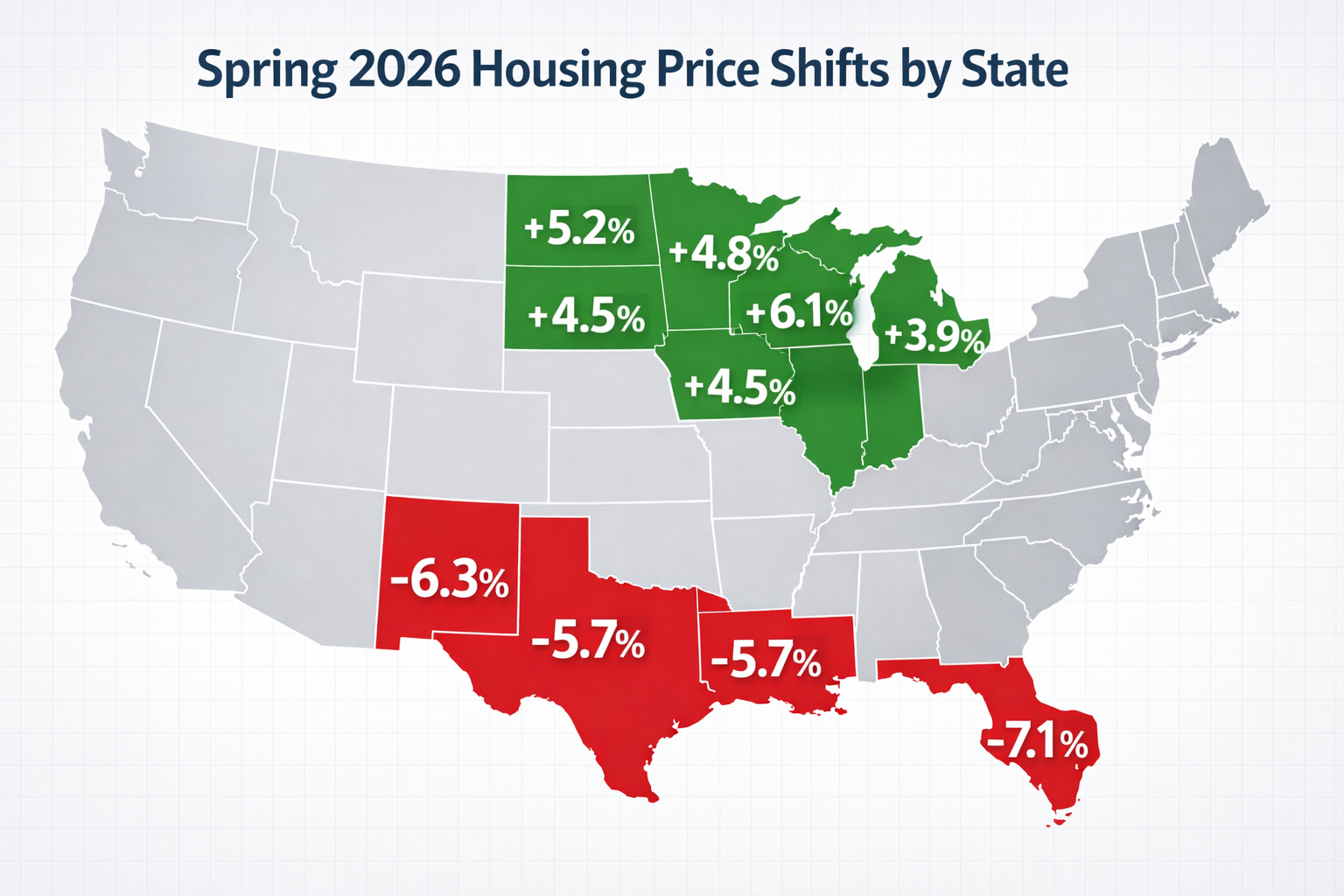
- FHFA data confirms North Dakota (+6.4%), Delaware (+6.3%), Illinois (+6.1%), Wisconsin (+5.7%), and Michigan (+5.5%) are the top appreciating states from Q4 2024 to Q4 2025. [1]
- Florida dropped 2.7% in the same period — one of only a handful of states posting outright declines. [1]
- The Midwest is leading YoY growth at 3.56% as of January 2026, driven by Illinois (+4.91%) and Wisconsin (+4.78%). [Cotality, March 2026]
- Austin, TX is down an estimated -3.5% and Denver around -4% in median home values, per CoStar analysis from February 2026.
- Louisiana metros face steep projected declines — Houma (-5.5%), Lake Charles (-4.9%), and New Orleans (-3.8%) among the most at-risk markets. [2]
- Purchase mortgage applications showed positive year-over-year growth for nine consecutive weeks entering spring 2026, signaling real buyer demand is building. [3]
- J.P. Morgan analysts project national prices to stall near 0% growth for 2026, with West Coast and Sun Belt markets most vulnerable to new construction oversupply. [7]
- The Northeast and Midwest are seeing price-per-square-foot gains of +3.3% and +2.1%, respectively, while the South is down 3.0% and the West is off 1.3%. [2]
- Home sales in 50 major metros were down 3.2% YoY in February 2026, but jumped 11.1% month-over-month — a fresh sign that spring momentum is real. [RE/MAX, March 2026]
What Do the Real Estate Market Trends Actually Show for Spring 2026?
Spring 2026 real estate market trends reveal a country divided — not politically, but geographically in terms of home values. The national average is nearly flat, but individual states are moving in dramatically opposite directions.
The Federal Housing Finance Agency (FHFA) reported that U.S. house prices rose 1.8% year-over-year from Q4 2024 to Q4 2025, with prices increasing in 41 of 50 states. [1] That sounds encouraging until you look at the spread: the top-performing state (North Dakota, +6.4%) and the worst-performing (Florida, -2.7%) are nearly 9 percentage points apart. [1]
CoStar data from February 2026 puts the national median home price at roughly $375,885 — up just 0.2% year-over-year. Meanwhile, Realtor.com's March 2026 report shows the national median list price dropped 2.1% to $403,450, with active inventory up 7.9% year-over-year. [2] These aren't contradictory — they reflect different data methodologies and the fact that listed prices are softening faster than closed prices in many markets.
The bottom line for buyers, sellers, and investors: The national number is almost irrelevant. Your state, your city, and even your zip code is what determines whether spring 2026 is a boom or a bust.
Which States Are Gaining the Most Value Right Now?
The Midwest is the clear winner of spring 2026, and it's not particularly close. According to FHFA data released February 23, 2026, the top five appreciating states from Q4 2024 to Q4 2025 were: [1]
| State | YoY Price Change |
|---|---|
| North Dakota | +6.4% |
| Delaware | +6.3% |
| Illinois | +6.1% |
| Wisconsin | +5.7% |
| Michigan | +5.5% |
Cotality's March 2026 analysis adds more detail: the Midwest as a region led all areas with 3.56% YoY growth in January 2026, with Illinois posting +4.91% and Wisconsin +4.78%. At the city level, CoStar points to Chicago at approximately +4.5% and Kansas City at around +3.7% — steady, impeccable appreciation driven by genuine affordability relative to coastal markets.
Why the Midwest? A few factors explain it:
- Relative affordability is pulling buyers priced out of coastal markets
- Low new construction inventory means supply hasn't outpaced demand
- Strong job markets in healthcare, manufacturing, and logistics
- Migration patterns from higher-cost states continue to fuel demand
Delaware's strong showing (+6.3%) reflects its proximity to Philadelphia and the DC corridor, where remote workers are still trading down in cost without trading down in lifestyle. [1]
💡 So based: If you've been gate-keeping Midwest real estate from your investment portfolio, the data says it's time to reconsider.
For a deeper look at how these dynamics are shaping the broader spring season, see our Spring 2026 Housing Market overview on lower rates and rising inventory.
Which States Are Seeing the Biggest Price Drops This Spring?
Florida leads the declines among major states, down 2.7% year-over-year per FHFA data through Q4 2025. [1] But several Sun Belt and Gulf Coast markets are facing even steeper projected drops heading into spring and summer 2026.
Zillow and Mortgage Research Network forecasts highlight Louisiana as particularly vulnerable: [2]
- Houma, LA: Projected -5.5%
- Lake Charles, LA: Projected -4.9%
- New Orleans, LA: Projected -3.8%
CoStar's February 2026 analysis also flags Austin, TX (estimated -3.5%) and Denver, CO (estimated -4%) as markets where a surge of new construction has tilted the balance decisively toward buyers.
Realtor.com's Jake Krimmel noted in March 2026 that the South is seeing price-per-square-foot declines of approximately -3.0% and the West around -1.3%, driven largely by inventory surges in markets that boomed during 2020-2022. [2] Austin's median list price is reportedly down around -8.8% year-over-year, and Miami is off approximately -2.9%. [2]
Common mistake: Assuming a price drop means a market is "bad" for investors. In some of these markets, rent levels haven't fallen as sharply as prices — which can actually improve cash-flow math for buy-and-hold investors willing to wait out the correction.
Choose this market if: You're a long-term investor with a 5+ year horizon and strong cash reserves. Avoid if you're a short-term flipper counting on appreciation to make the deal work.
For a closer look at which markets are most at risk, Redfin's 2026 market predictions and the great housing reset offers excellent context on the inventory correction underway.
Why Are the Northeast and Midwest Outperforming the Sun Belt?
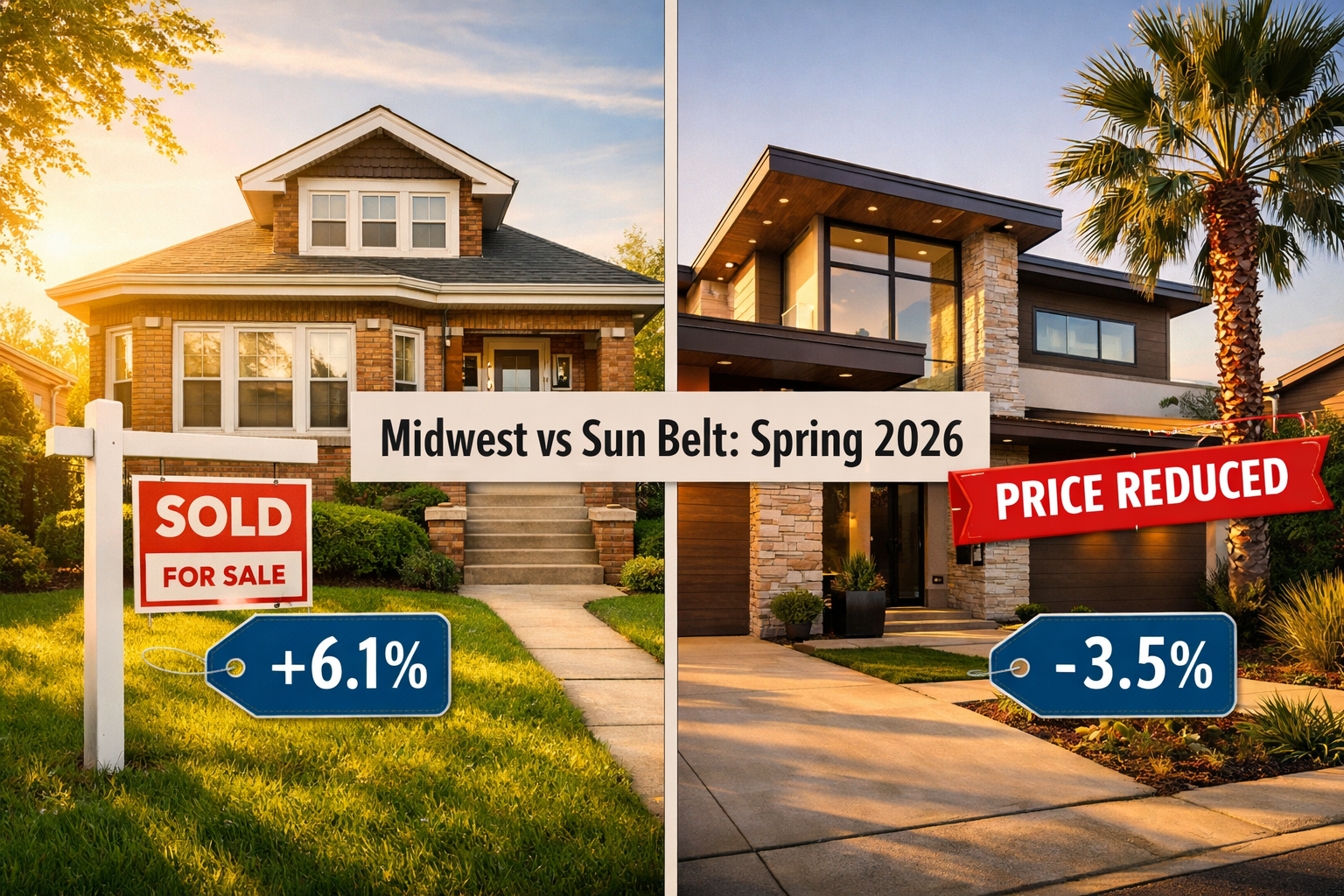
The short answer: supply and demand are still tilted in favor of sellers across the Northeast and Midwest, while the Sun Belt is working through a construction hangover.
Realtor.com data from March 2026 shows the Northeast posting price-per-square-foot gains of +3.3% year-over-year, while the Midwest is up +2.1%. [2] Both regions benefit from constrained housing supply — zoning restrictions, geographic limits, and slower builder activity have kept inventory tight even as demand has moderated.
The Sun Belt story is different. Markets like Austin, Phoenix, and parts of Florida saw extraordinary builder activity from 2020 through 2023. That new supply is now hitting the market just as pandemic-era migration demand has cooled. The result is a buyer's market in many of these cities, with sellers competing on price.
Key regional breakdown for spring 2026:
- Northeast: Tight inventory, strong job markets, price-per-sq-ft up ~3.3% [2]
- Midwest: Affordability-driven demand, low new supply, leading regional appreciation [1]
- South: Inventory surge in former hot spots, prices softening in TX, FL, LA [2]
- West: Mixed picture — coastal CA still holding, but Denver and inland markets softening [2]
J.P. Morgan's housing research team projected in January 2026 that national prices would stall near 0% growth for the year, with West Coast and Sun Belt markets most exposed to new home supply pressure. [7] That forecast is tracking closely with what's actually happening on the ground this spring.
Understanding these regional real estate market trends is essential before making any move — whether you're buying, selling, or repositioning a portfolio. Our guide on 9 signs your local housing market is heating up can help you read your specific market's signals.
What's Driving Buyer Demand Despite High Mortgage Rates?
Mortgage rates hit 2026 highs in recent weeks, yet purchase applications have shown positive year-over-year growth for nine consecutive weeks entering spring 2026. [3] That's not a contradiction — it's a sign that buyers are adjusting to the rate environment rather than waiting for a rescue.
Several forces are pulling buyers off the sidelines:
- Pent-up demand from buyers who paused in 2023-2024 is releasing
- Inventory is rising (up 7.9% YoY nationally), giving buyers more choices [2]
- Price corrections in Sun Belt markets are improving affordability in formerly expensive cities
- Life events (job changes, marriages, growing families) don't pause for rate cycles
- Rent costs in many markets remain high, making ownership more competitive
RE/MAX's February 2026 report across 50 metros showed home sales down 3.2% year-over-year but up 11.1% month-over-month — a fresh signal that spring momentum is building. [RE/MAX, March 2026]
For buyers navigating this environment, understanding your mortgage options matters enormously. Our breakdown of 15-year vs. 30-year mortgage rates in 2026 walks through the long-term cost differences at current rate levels.
📌 Edge case: In markets where prices are falling (Austin, Denver, parts of Florida), buyers who can lock in now may be purchasing near a local bottom — especially if rate cuts materialize in the second half of 2026.

How Should Home Sellers Adjust Their Strategy in Spring 2026?
Sellers in appreciating Midwest and Northeast markets are in a strong position — but sellers in softening Sun Belt markets need a completely different playbook.
If you're selling in a gaining market (Midwest, Northeast):
- Price aggressively at market value; don't leave money on the table with under-pricing
- Expect multiple offers if the home is priced correctly and well-presented
- Don't over-improve — buyers in these markets are often competing on speed, not condition
- Review our home sellers pricing strategies for 2026 to position correctly from day one
If you're selling in a softening market (Florida, Texas, Louisiana):
- Price below comparable sales, not at them — the market is moving down, not sideways
- Offer seller concessions proactively; buyers have leverage and they know it
- Avoid the most common spring home selling mistakes that cost sellers real money
- Consider timing: if you can wait 12-18 months, the correction may stabilize
The universal rule for spring 2026: Overpricing is the fastest way to sit on the market and eventually sell for less than you would have with correct initial pricing. Inventory is up nationally, and buyers have options. [2]
🔥 Let it cook: Sellers who price right from day one and let the market work are consistently outperforming those who test high and chase the market down with price cuts.
What Do These Real Estate Market Trends Mean for Investors?
For real estate investors, spring 2026 is presenting genuinely extraordinary opportunities — but only if you know which direction to look.
Midwest markets offer:
- Strong appreciation (Illinois +6.1%, Wisconsin +5.7%, Michigan +5.5%) [1]
- Relatively low entry prices compared to coastal markets
- Stable rental demand from a workforce that isn't leaving
- Chicago (+4.5%) and St. Louis (+8.1%) as standout metro performers
Sun Belt markets offer a different kind of opportunity:
- Price corrections in Austin (-3.5%), Denver (-4%), and Florida markets create potential buy-low scenarios
- Rental demand remains solid in many of these cities even as prices soften
- New construction glut may take 18-24 months to absorb — patience required [7]
Louisiana is the highest-risk zone for investors right now. Projected declines of -5.5% in Houma and -4.9% in Lake Charles reflect a combination of economic challenges, insurance cost escalation, and population outflows that go beyond a simple inventory correction. [2]
Investor decision rule:
- Buy in the Midwest if you want appreciation + cash flow with lower volatility
- Buy in the Sun Belt only if you have a 5+ year hold strategy and strong cash flow from day one
- Avoid Louisiana metros unless you have deep local market knowledge and a specific distressed-asset strategy
For investors looking at broader portfolio strategy, our analysis of 2026 real estate trends and how stable rates are reshaping buyer and seller strategies is worth a read.

FAQ: Spring 2026 Housing Price Shifts by State
Q: Which state has the highest home price appreciation in spring 2026?
North Dakota leads with +6.4% year-over-year appreciation from Q4 2024 to Q4 2025, followed closely by Delaware (+6.3%) and Illinois (+6.1%), per FHFA data. [1]
Q: Which states are seeing home prices fall the most?
Florida is the most notable major state with a -2.7% decline. Louisiana metros (Houma, Lake Charles, New Orleans) face projected drops of -3.8% to -5.5%. Austin, TX and Denver, CO are also softening significantly. [1][2]
Q: Is the national housing market going up or down in 2026?
It's essentially flat. FHFA reports +1.8% YoY through Q4 2025, while CoStar puts February 2026 at +0.2% YoY. J.P. Morgan projects 0% national price growth for full-year 2026. [1][7]
Q: Why is the Midwest outperforming the Sun Belt in 2026?
The Midwest has constrained supply, genuine affordability, and steady demand. The Sun Belt is working through a new construction oversupply problem that has shifted pricing power to buyers in markets like Austin and parts of Florida. [2]
Q: Are mortgage rates hurting spring 2026 home sales?
Less than expected. Purchase applications have shown positive year-over-year growth for nine consecutive weeks entering spring 2026, suggesting buyers are adapting to current rate levels rather than waiting for cuts. [3]
Q: Is spring 2026 a good time to buy a home?
It depends heavily on location. In softening markets (Sun Belt, Louisiana), buyers have real negotiating power. In appreciating markets (Midwest, Northeast), waiting may cost more than acting. [1][2]
Q: What's happening to home prices in Florida specifically?
Florida dropped 2.7% year-over-year per FHFA Q4 2025 data, and Miami median list prices are off approximately -2.9% year-over-year per Realtor.com's February 2026 report. [1][2]
Q: Should investors buy in Austin or Denver right now?
Only with a long-term strategy. CoStar's February 2026 data shows Austin down approximately -3.5% and Denver around -4%. The correction may not be complete, so short-term flipping carries real risk.
Q: How much has national inventory changed in spring 2026?
Active listings are up 7.9% year-over-year nationally as of February 2026, giving buyers more choices than they've had in years. [2]
Q: What is the national median home price in early 2026?
Realtor.com reports the national median list price at $403,450 in February 2026 (down 2.1% YoY), while CoStar puts the median closed price at approximately $375,885 (up 0.2% YoY). [2]
Conclusion: Know Your Market Before You Move
The spring 2026 housing market isn't one story — it's fifty. The national average of roughly 1.8% appreciation masks a dramatic split between a thriving Midwest and a correcting Sun Belt. [1]
Here's what to do with this information:
- Home buyers: If you're in a softening market, this spring gives you negotiating power that hasn't existed in years. Use it. Get our 13 spring home buying tips for the 2026 U.S. market to build your strategy.
- Home sellers: Price based on where your market is going, not where it's been. Overpricing in a softening market is the single most expensive mistake you can make.
- Investors: The Midwest is fresh with opportunity right now — impeccable fundamentals, real appreciation, and affordability that still attracts tenants and buyers alike. Sun Belt plays require patience and cash flow discipline.
- Everyone: Stop relying on national headlines. Pull your state and metro-level data before making any decision.
The markets that are winning this spring aren't winning by accident. They have the supply constraints, affordability, and demand fundamentals to sustain it. The markets that are softening are working through a supply correction that takes time. Knowing which side of that line you're on is the most valuable thing you can do before spring buying season peaks.
For ongoing real estate market trends, news, and expert analysis, visit Real Estate Rank IQ or subscribe to the @Realestaterankiq YouTube channel.
References
[1] U.S. House Prices Rise 1.8 Percent Year Over Year, Up 0.8 Percent Quarter Over Quarter – https://www.fhfa.gov/news/news-release/u.s.-house-prices-rise-1.8-percent-year-over-year-up-0.8-percent-quarter-over-quarter
[2] Top 10 Housing Markets Expected To See Biggest Price Drops 2026 – https://www.mortgageresearch.com/articles/top-10-housing-markets-expected-to-see-biggest-price-drops-2026/
[3] YouTube: Housing Market Analysis – https://www.youtube.com/watch?v=WZ_q1qF91ow
[4] New States Emerge As Real Estate Hot Spots In 2026 As Americans Seek Affordability – https://beckerlawyers.com/new-states-emerge-as-real-estate-hot-spots-in-2026-as-americans-seek-affordability/
[5] Housing Market Forecast 2026: Price Declines, Real Estate, Mortgage – https://www.cbsnews.com/news/housing-market-forecast-2026-price-declines-real-estate-mortgage/
[6] 3 Big Signals Will Shape The 2026 Housing Market After A Volatile 2025 – https://www.edhat.com/national/news/3-big-signals-will-shape-the-2026-housing-market-after-a-volatile-2025/
[7] U.S. Housing Market Outlook – J.P. Morgan – https://www.jpmorgan.com/insights/global-research/real-estate/us-housing-market-outlook