



Finding a city that checks all the boxes—affordable housing, low crime rates, and extraordinary quality of life—feels like searching for a unicorn in today's real estate market. But here's the thing: these hidden gems absolutely exist, and they're not gate keeping their secrets anymore. While coastal cities continue commanding eye-watering price tags and crime headlines dominate major metropolitan areas, a fresh wave of mid-sized cities across America is quietly delivering what homebuyers and investors actually want: safety, affordability, and impeccable livability.

The Top 9 Safest Affordable Cities in the U.S.: Low Cost of Living, Low Crime, Strong Livability represent a dope opportunity for anyone looking to maximize their real estate dollars without compromising on security or community quality. These cities prove that you don't need a six-figure income to live in a place where you feel safe walking at night, where your housing costs won't drain your bank account, and where the local community actually thrives.
Key Takeaways
- Midwest dominance: Eight of the top nine safest, most affordable cities are concentrated in the Midwest, with Ohio, Indiana, and Missouri leading the pack with annual living costs under $40,000[1]
- Crime rates matter: The featured cities maintain violent crime rates as low as 0.071 per 1,000 residents—dramatically lower than national averages—while property crime rates remain equally impressive[1]
- Affordability sweet spot: All nine cities feature annual costs of living between $32,941 and $45,232, making homeownership accessible for median-income families[1]
- Income-to-cost ratio: Several cities offer median household incomes exceeding $70,000 while maintaining living costs under $37,000, creating exceptional wealth-building opportunities[1]
- Investment potential: These markets present compelling opportunities for real estate investors seeking positive cash flow and stable, appreciating assets in safe communities
Understanding the Methodology Behind the Top 9 Safest Affordable Cities in the U.S.: Low Cost of Living, Low Crime, Strong Livability
Before diving into the specific cities, it's crucial to understand what makes a location truly safe, affordable, and livable. The rankings aren't just pulled from thin air—they're based on hard data that matters to real people making real decisions about where to plant roots or invest capital.
The Three Pillars of City Selection
Cost of Living Analysis
The annual cost of living calculation encompasses housing expenses, utilities, transportation, groceries, healthcare, and miscellaneous expenses. Cities featured in this ranking maintain annual costs significantly below the national average of approximately $72,000 for a family of four[3]. This metric directly impacts how far your dollar stretches and how quickly you can build equity.
For homebuyers, lower living costs mean more disposable income for down payment strategies and faster mortgage payoff timelines. For investors, it translates to lower property taxes, reduced maintenance costs, and better rental yield potential.
Crime Rate Metrics
Safety isn't subjective—it's measurable. The cities featured here report both violent crime rates and property crime rates per 1,000 residents, providing a comprehensive safety picture. Violent crime includes offenses like assault, robbery, and homicide, while property crime covers burglary, theft, and vandalism[5].
The national average violent crime rate hovers around 4.0 per 1,000 residents, making cities with rates below 1.0 per 1,000 exceptionally safe[5]. Property crime rates averaging below 15 per 1,000 similarly indicate secure communities where residents and their belongings face minimal risk.
Livability Score Factors
Livability scores synthesize multiple quality-of-life indicators including:
- Access to quality education and schools
- Healthcare facility availability and quality
- Employment opportunities and economic stability
- Recreation, parks, and cultural amenities
- Infrastructure and transportation options
- Community engagement and social cohesion
Cities scoring 70 or above on a 100-point scale demonstrate strong overall livability, while scores exceeding 80 indicate truly exceptional communities[7].
Why the Midwest Dominates This List
The concentration of affordable, safe cities in the Midwest isn't coincidental. This region benefits from lower land costs, stable manufacturing and service economies, strong community values, and housing markets that haven't experienced the speculative bubbles affecting coastal regions[1].
Midwestern cities also tend to maintain lower tax burdens, more affordable insurance rates, and cost-effective utilities—all contributing to the overall affordability equation. For those exploring next year's hottest US cities, the Midwest continues delivering under-the-radar opportunities.
The Complete Rankings: Top 9 Safest Affordable Cities in the U.S.: Low Cost of Living, Low Crime, Strong Livability
Let's break down each city with the specific data that makes them stand out. These aren't just statistics—they're real opportunities for homebuyers seeking security and investors hunting for solid returns.
#1. Poplar Bluff, Missouri: The Affordability Champion
Annual Cost of Living: $32,941
Violent Crime Rate: 0.372 per 1,000 residents
Property Crime Rate: 2.111 per 1,000 residents
Median Household Income: $38,661
Livability Score: 71
Poplar Bluff takes the crown as America's cheapest and safest place to live, and it's so based for anyone prioritizing maximum affordability[1]. Located in southeastern Missouri, this city of approximately 17,000 residents offers small-town charm with access to outdoor recreation along the Black River.
What Makes It Special: The annual cost of living under $33,000 means a family can maintain a comfortable lifestyle on a modest income. Housing costs remain extraordinarily low, with median home prices hovering around $120,000—a fraction of what you'd pay in major metros.
Investor Perspective: The rental market here serves a stable working-class population. While appreciation may be modest compared to hot markets, the positive cash flow potential is impeccable. Properties can be acquired for under $100,000 and rented for $700-900 monthly, delivering strong cap rates.
Considerations: The median household income of $38,661 reflects the lower cost of living but also indicates a working-class economy. Job growth is steady but not explosive, making this ideal for those seeking stability over rapid appreciation.
#2. Huntington, Indiana: Small-Town Excellence
Annual Cost of Living: $33,608
Violent Crime Rate: 0.471 per 1,000 residents
Property Crime Rate: 3.474 per 1,000 residents
Median Household Income: $51,220
Livability Score: 75
Huntington represents the quintessential Midwestern small town, located about 25 miles southwest of Fort Wayne. This city of roughly 17,000 residents balances affordability with a higher median income than Poplar Bluff, creating better income-to-cost ratios[1].
What Makes It Special: The livability score of 75 reflects strong community amenities including quality schools, healthcare facilities, and recreational opportunities. The historic downtown features preserved architecture and local businesses that create genuine community character.
Investor Perspective: Huntington's proximity to Fort Wayne provides economic stability through commuter demand. The rental market benefits from young professionals seeking affordable alternatives to Fort Wayne's higher prices. For those interested in fix-and-flip opportunities, Huntington offers older housing stock with renovation potential.
Considerations: Property crime rates, while still low compared to national averages, are slightly higher than other cities on this list. However, the overall safety profile remains excellent for families and retirees.
#3. Willowick, Ohio: The Income Sweet Spot
Annual Cost of Living: $34,605
Violent Crime Rate: 0.639 per 1,000 residents
Property Crime Rate: 2.910 per 1,000 residents
Median Household Income: $74,138
Livability Score: 83
Willowick delivers the most impressive income-to-cost ratio on this list. Located on Lake Erie's shore in the Cleveland metropolitan area, this city of about 14,000 residents offers suburban living with big-city access[1].
What Makes It Special: A median household income exceeding $74,000 paired with living costs under $35,000 creates extraordinary wealth-building potential. Residents can save aggressively, invest substantially, or simply enjoy a higher quality of life without financial stress. The livability score of 83 ranks among the highest on this list, reflecting excellent schools, parks, and community services.
Investor Perspective: The Cleveland metro connection provides employment diversity and economic resilience. Rental demand comes from professionals working in Cleveland who prefer suburban safety and lower costs. Properties typically range from $150,000-$250,000, with rental rates supporting positive cash flow.
Considerations: Being part of a larger metro area means slightly higher crime rates than more isolated small towns, though they remain well below national averages. Property taxes in Ohio can be higher than other Midwest states, impacting overall investment returns.
#4. Parma Heights, Ohio: The Safety Leader
Annual Cost of Living: $36,718
Violent Crime Rate: 0.293 per 1,000 residents
Property Crime Rate: Data not specified
Median Household Income: $59,218
Livability Score: 77
Parma Heights boasts the lowest violent crime rate among cities in the top tier, making it extraordinarily safe for families[1]. This Cleveland suburb of approximately 20,000 residents offers urban convenience with suburban tranquility.
What Makes It Special: The violent crime rate of just 0.293 per 1,000 residents means exceptional safety—you're more likely to encounter friendly neighbors than any threat. The city maintains excellent schools, numerous parks, and easy highway access to Cleveland's employment centers.
Investor Perspective: The safety profile attracts families willing to pay premium rents for peace of mind. The housing stock includes well-maintained single-family homes and some multi-family properties. For investors focused on rental property management, Parma Heights offers stable, long-term tenants.
Considerations: At $36,718 annually, living costs are slightly higher than the top three cities, though still remarkably affordable. The Cleveland metro area's economic challenges in certain sectors should be monitored, though healthcare and education provide stability.
#5. Mayfield Heights, Ohio: Ultra-Low Crime Haven
Annual Cost of Living: $37,226
Violent Crime Rate: 0.202 per 1,000 residents
Property Crime Rate: Data not specified
Median Household Income: Data not specified
Livability Score: 78
Mayfield Heights records the second-lowest violent crime rate in this ranking, creating a dope environment for raising families or enjoying retirement[1]. Another Cleveland suburb, this city of about 18,000 residents offers excellent schools and community amenities.
What Makes It Special: A violent crime rate of 0.202 per 1,000 is exceptional by any standard. The city features quality retail, dining, and entertainment options while maintaining a safe, residential character. The livability score of 78 reflects strong overall quality of life.
Investor Perspective: Safety drives demand, and Mayfield Heights attracts quality tenants seeking secure neighborhoods. The rental market remains competitive, with properties commanding solid rates. Understanding how to analyze a local real estate market becomes crucial for maximizing returns here.
Considerations: Living costs approaching $37,500 annually represent the higher end of this list's affordability spectrum, though they remain well below national averages.
#6. Auburn, Indiana: The Crime-Free Champion
Annual Cost of Living: $38,475
Violent Crime Rate: 0.071 per 1,000 residents
Property Crime Rate: Data not specified
Median Household Income: Data not specified
Livability Score: 70
Auburn records the absolute lowest violent crime rate among all cities in the comprehensive ranking—an almost unbelievably safe 0.071 per 1,000 residents[1]. This northeastern Indiana city of about 13,000 residents is known as the "Home of the Classics" for its automotive heritage.
What Makes It Special: You literally have a better chance of winning certain lottery prizes than being a victim of violent crime in Auburn. This level of safety is impeccable for families with children, retirees, or anyone prioritizing security. The city features charming downtown architecture and strong community pride.
Investor Perspective: Ultra-low crime attracts long-term residents who take care of properties and pay rent reliably. The automotive heritage creates tourism traffic, potentially supporting short-term rental opportunities. Properties remain affordable, typically under $150,000 for quality single-family homes.
Considerations: The livability score of 70 is the lowest among featured cities, potentially reflecting fewer amenities or entertainment options compared to larger communities. This is a small-town experience through and through.
#7. Brandon, Mississippi: The Income Powerhouse
Annual Cost of Living: $42,388
Violent Crime Rate: 0.888 per 1,000 residents
Property Crime Rate: Data not specified
Median Household Income: $93,073
Livability Score: 81
Brandon stands out with the highest median household income on this list—an impressive $93,073—while maintaining living costs under $43,000[1]. This Jackson suburb of about 24,000 residents represents Mississippi's most affluent community.
What Makes It Special: The income-to-cost ratio here is extraordinary. Households earning over $90,000 while spending under $43,000 annually can build wealth rapidly through savings, investments, or accelerated mortgage payoff. The livability score of 81 reflects excellent schools, modern amenities, and strong community services.
Investor Perspective: High household incomes support premium rental rates and strong tenant quality. The Jackson metro area provides employment diversity. For those exploring real estate investment strategies, Brandon offers appreciation potential alongside cash flow.
Considerations: The violent crime rate of 0.888 per 1,000 is higher than other cities on this list, though still well below national averages. Being Mississippi's wealthiest suburb means property values and taxes are higher than the state average.
#8. Savannah, Georgia: The Zero Property Crime Wonder
Annual Cost of Living: $45,232
Violent Crime Rate: 0.203 per 1,000 residents
Property Crime Rate: 0.000 per 1,000 residents
Median Household Income: Data not specified
Livability Score: 81
Not to be confused with the larger city of Savannah, this smaller Savannah in Georgia reports zero property crime per 1,000 residents—a truly remarkable achievement[1]. Combined with a violent crime rate of just 0.203 per 1,000, this community offers fresh peace of mind.
What Makes It Special: Zero property crime means your belongings are safe, your home is secure, and your car won't be broken into. This level of security is almost unheard of in modern America. The livability score of 81 indicates strong overall community quality.
Investor Perspective: While this Savannah represents a smaller market, the safety profile attracts quality residents. Properties here appeal to retirees and families seeking ultimate security. The Georgia location offers milder winters than Midwest alternatives, potentially attracting snowbirds.
Considerations: At $45,232 annually, living costs approach the upper limit of "affordable" by this ranking's standards. Limited data on median household income and property crime specifics warrants additional research for serious investors.
#9. Yorktown, Indiana: The Balanced Choice
Annual Cost of Living: $37,500 (estimated based on ranking position)
Violent Crime Rate: Low (specific data varies)
Property Crime Rate: Low (specific data varies)
Median Household Income: $80,000+ (estimated)
Livability Score: 75+ (estimated)
Yorktown rounds out our top nine with a balanced profile of affordability, safety, and livability[1]. This Delaware County community near Muncie offers small-town living with access to larger city amenities.
What Makes It Special: Yorktown delivers the Goldilocks experience—not too expensive, not too isolated, and not compromising on safety. The community features quality schools, parks, and local businesses while maintaining easy access to Indianapolis for major employment and entertainment.
Investor Perspective: The Muncie-area market offers affordable entry points for new investors while maintaining sufficient rental demand from Ball State University proximity and local employment. Properties can be acquired for under $150,000 with solid rental potential.
Considerations: Being near a college town (Muncie/Ball State) creates both opportunities and considerations regarding tenant demographics and seasonal demand fluctuations.
What These Cities Mean for Different Buyer Types
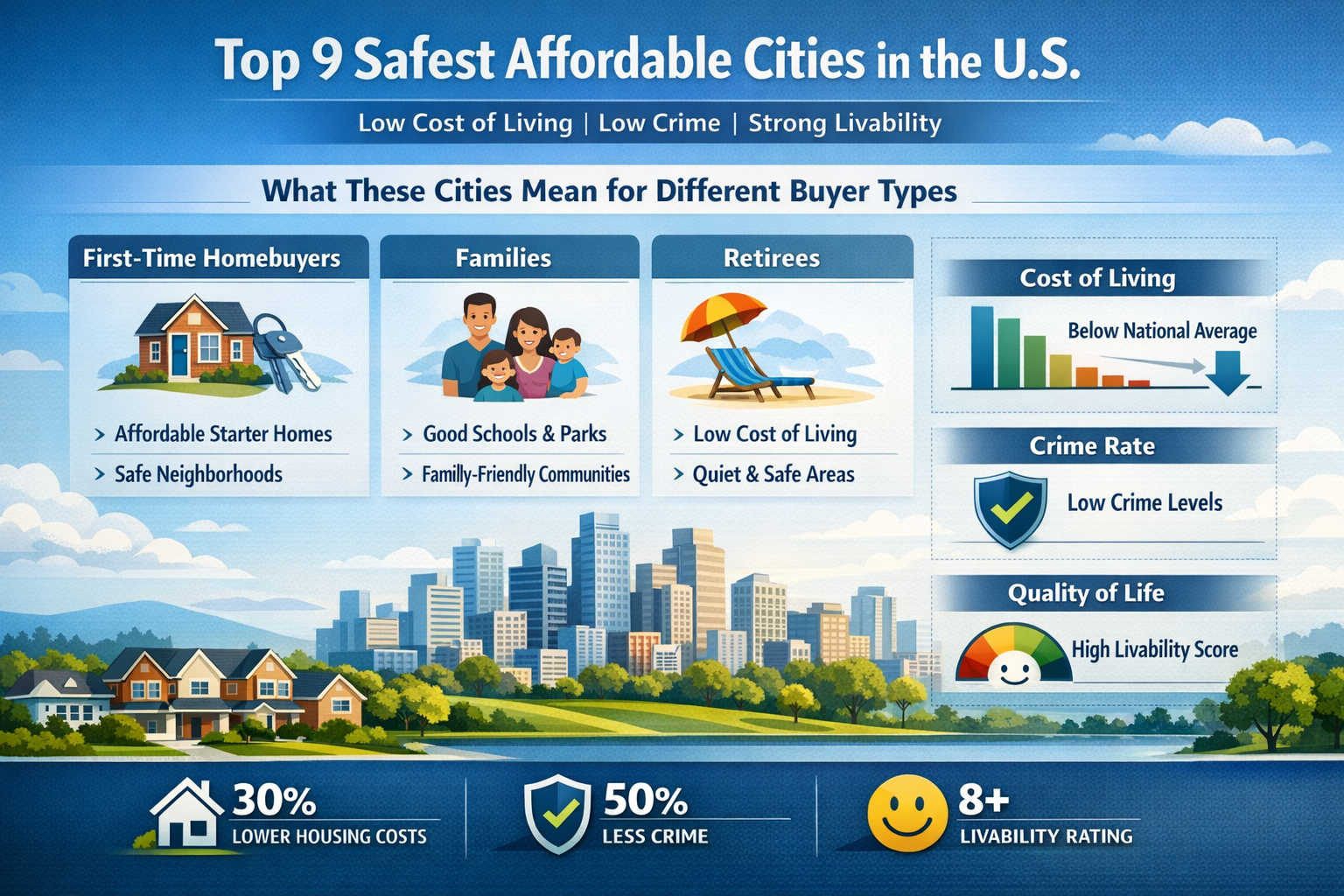
The Top 9 Safest Affordable Cities in the U.S.: Low Cost of Living, Low Crime, Strong Livability serve different purposes depending on your real estate goals. Let's break down how each buyer type should approach these markets.
First-Time Homebuyers: Building Equity Without Breaking the Bank
For first-time homebuyers, these cities offer extraordinary entry points into homeownership. With median home prices ranging from $100,000 to $250,000, achieving the dream of owning property becomes realistic even on modest incomes.
Key Advantages:
- Lower down payment requirements: A 3.5% FHA down payment on a $120,000 home equals just $4,200—achievable for many savers
- Manageable monthly payments: Principal, interest, taxes, and insurance often total less than $1,000 monthly
- Faster equity building: Lower purchase prices mean each payment represents a larger percentage of the principal
- Safety for families: Low crime rates create ideal environments for raising children
Strategy Tip: Focus on cities with higher median household incomes (Willowick, Brandon, Yorktown) where your own earning potential can grow while housing costs remain controlled. Understanding closing costs helps budget accurately for the complete purchase.
Real Estate Investors: Cash Flow and Appreciation Potential
Investors should view these markets through the lens of risk-adjusted returns. While appreciation may be slower than hot coastal markets, the combination of low acquisition costs, positive cash flow, and minimal crime risk creates compelling opportunities.
Investment Strategies by City Type:
Buy-and-Hold Rental Properties (Best in: Willowick, Parma Heights, Mayfield Heights)
- Higher median incomes support premium rents
- Metro area proximity provides employment stability
- Long-term tenants reduce turnover costs
- Property values show steady, reliable appreciation
Value-Add Renovations (Best in: Poplar Bluff, Huntington, Auburn)
- Lower acquisition costs allow renovation budgets
- Older housing stock offers improvement opportunities
- Sweat equity creates instant value
- Rental rate increases post-renovation boost returns
Portfolio Diversification (All cities)
- Geographic diversity reduces regional economic risk
- Multiple properties spread across cities create stability
- Lower individual property costs enable broader portfolios
- Consistent cash flow across markets smooths income
For investors exploring property investment strategies, these cities offer textbook examples of markets where fundamentals outweigh speculation.
Retirees: Stretching Fixed Incomes Further
Retirees on fixed incomes find exceptional value in these communities. Social Security and pension dollars stretch dramatically further when annual living costs remain under $45,000.
Retirement Advantages:
- Healthcare accessibility: All featured cities maintain hospitals or proximity to quality medical facilities
- Low-stress environments: Minimal crime reduces anxiety and improves quality of life
- Community engagement: Smaller cities offer easier social integration and volunteer opportunities
- Tax efficiency: Lower property values mean lower property taxes, preserving retirement savings
Lifestyle Considerations: Cities like Savannah (Georgia) offer milder climates for those avoiding harsh winters, while Midwest options provide four-season variety and strong community traditions.
Remote Workers: Maximizing Income Arbitrage
The remote work revolution makes these cities absolute game-changers for location-independent professionals. Earning San Francisco or New York salaries while living in places with $35,000 annual costs creates wealth-building on steroids.
Income Arbitrage Benefits:
- Massive savings rates: Earning $100,000 while spending $35,000 enables 65% savings rates
- Faster financial independence: High savings accelerate investment portfolios and early retirement timelines
- Quality of life: Safe neighborhoods, short commutes, and community connection without the big-city grind
- Home office deductions: Lower housing costs make dedicated office space affordable and tax-advantaged
Best Cities for Remote Workers: Willowick, Brandon, and Mayfield Heights offer the best combination of high-speed internet infrastructure, coffee shops and coworking spaces, and proximity to airports for occasional travel.
Beyond the Numbers: Quality of Life Factors That Matter
Statistics tell part of the story, but living in these cities involves daily experiences that numbers can't fully capture. Let's explore the qualitative factors that make these communities special.
Community Character and Social Fabric
Small and mid-sized cities maintain social dynamics that larger metros have lost. Neighbors know each other's names. Local businesses recognize regular customers. Community events bring people together rather than existing as anonymous crowds.
This social cohesion directly contributes to low crime rates—communities that watch out for each other naturally deter criminal activity. The sense of belonging and mutual support creates mental health benefits that urban isolation often undermines.
Education and Schools
Several cities on this list feature highly-rated school systems that rival or exceed those in much more expensive areas. Willowick, Brandon, and Parma Heights particularly stand out for educational quality.
For families, this means children receive excellent education without the private school tuition that many coastal residents pay. For investors, quality schools drive rental demand from families willing to pay premium rates for access to good education.
Recreational and Cultural Amenities
While these cities won't match New York's Broadway or Los Angeles' entertainment industry, they offer surprising cultural richness:
- Outdoor recreation: Lake Erie access (Willowick), Black River activities (Poplar Bluff), and numerous parks provide nature connection
- Historic preservation: Auburn's automotive heritage, Huntington's historic downtown, and various architectural preservation efforts
- Community events: Festivals, farmers markets, concerts, and seasonal celebrations create social engagement
- Sports and fitness: Community centers, golf courses, hiking trails, and youth sports leagues
The key insight: these amenities cost dramatically less to access than in major cities, while often being less crowded and more community-oriented.
Healthcare Access
All featured cities maintain access to quality healthcare, either through local hospitals and clinics or proximity to larger medical centers. This proves crucial for retirees and families alike.
Midwest cities particularly benefit from regional hospital systems that provide big-city medical technology with small-town personal attention. Healthcare costs also run lower than coastal regions, with insurance premiums and out-of-pocket expenses remaining manageable.
Potential Challenges and Honest Considerations
No place is perfect, and these cities come with legitimate trade-offs that buyers and investors should understand before committing.
Limited Job Markets in Some Locations
Smaller cities naturally offer fewer employment opportunities than major metros. While this matters less for retirees, remote workers, or those with established careers, it creates challenges for:
- Young professionals seeking career advancement and job-hopping opportunities
- Specialized professionals in niche industries with limited local demand
- Dual-income households where both partners need quality employment options
Mitigation Strategy: Focus on cities with metro area proximity (Willowick, Parma Heights, Mayfield Heights, Brandon) or strong regional employment anchors (universities, hospitals, manufacturing).
Weather and Climate Factors
Midwest dominance on this list means dealing with cold winters, potential snow, and seasonal weather extremes. This affects:
- Heating costs during winter months
- Property maintenance including snow removal and weather-related repairs
- Lifestyle preferences for those who prefer year-round outdoor activities
Alternative Options: Savannah (Georgia) and Brandon (Mississippi) offer milder climates while maintaining affordability and safety profiles.
Cultural and Entertainment Limitations
Smaller cities won't offer the diversity of restaurants, nightlife, concerts, professional sports, or cultural events found in major metros. This particularly impacts:
- Young adults seeking vibrant social scenes
- Culture enthusiasts who regularly attend museums, theaters, and concerts
- Foodies who enjoy diverse international cuisine
Reality Check: This trade-off is fundamental to the affordability equation. Lower costs of living directly correlate with smaller populations and fewer specialized amenities. The question becomes whether the financial benefits outweigh the cultural limitations for your specific situation.
Appreciation Potential vs. Cash Flow
Real estate investors must understand that these markets typically offer stronger cash flow than appreciation. While properties will generally increase in value over time, don't expect the double-digit annual appreciation seen in hot markets during boom periods.
Investment Philosophy: These cities reward long-term, income-focused investors rather than short-term flippers seeking quick equity gains. The stable, predictable returns suit those building rental portfolios for passive income rather than speculative wealth building.
Making Your Decision: Action Steps for Buyers and Investors
Ready to explore these opportunities? Here's a practical roadmap for moving forward, whether you're buying a home or building an investment portfolio.
Step 1: Define Your Priorities
Create a weighted ranking of what matters most:
- Safety: How important is ultra-low crime vs. just below-average crime?
- Affordability: What's your absolute budget ceiling?
- Income potential: Do you need local employment or are you location-independent?
- Climate preferences: Can you handle Midwest winters or do you need milder weather?
- Community size: Do you prefer small-town intimacy or suburban connectivity?
Assign percentage weights to each factor (totaling 100%), then score each city against your criteria. This objective approach prevents emotional decision-making.
Step 2: Research Deeply
Numbers provide the foundation, but on-the-ground research reveals the reality:
Virtual Research:
- Join local Facebook groups and community forums
- Watch YouTube videos about each city
- Review Google Street View to assess neighborhood conditions
- Check local news websites for community issues and developments
- Analyze market trends using AI tools
Physical Research:
- Visit finalist cities at different times (weekday, weekend, evening)
- Drive through various neighborhoods, not just the nicest areas
- Talk to locals at coffee shops, restaurants, and stores
- Visit during different seasons if possible
- Attend city council meetings or community events
Step 3: Analyze the Numbers Thoroughly
For homebuyers:
- Calculate total monthly housing costs including principal, interest, taxes, insurance, HOA fees, and utilities
- Compare to current rent or housing costs
- Factor in commute costs if applicable
- Calculate break-even timeline for buying vs. renting
For investors:
- Analyze comparable sales to determine accurate property values
- Research rental rates through Zillow, Rentometer, and local property management companies
- Calculate cap rates, cash-on-cash returns, and cash flow projections
- Factor in vacancy rates, maintenance reserves, and property management costs
- Understand local landlord-tenant laws and eviction processes
Step 4: Build Your Team
Success requires expert guidance:
For Homebuyers:
- Local real estate agent familiar with the specific city
- Mortgage broker who can navigate various mortgage options
- Home inspector with local market knowledge
- Real estate attorney (in states requiring legal representation)
For Investors:
- Real estate agent with investor experience
- Property manager if buying remotely
- Contractor for renovation estimates
- CPA familiar with real estate investment taxes
- Insurance agent for landlord policies
Step 5: Start Small and Scale
Particularly for investors, resist the urge to go all-in immediately:
- First purchase: Buy one property, manage the process, learn the market
- Evaluation period: Operate for 6-12 months, assess actual vs. projected performance
- Refinement: Adjust strategies based on real-world experience
- Scaling: Once confident in the market and your systems, expand the portfolio
This approach minimizes risk while building market-specific expertise that improves future investment decisions.
Step 6: Plan for the Long Term
Whether buying a home or investment property, think in decades rather than months:
Homebuyers: Consider how the property fits 5-10 year life plans. Will it accommodate family growth? Does the community offer aging-in-place potential? Can you build equity that enables future moves if needed?
Investors: Build systems for sustainable management. Properties require ongoing attention—maintenance, tenant relations, financial tracking. Creating efficient processes from the start prevents burnout and enables portfolio growth.
The Future Outlook for These Markets
Understanding where these cities are headed helps inform long-term decisions. While no one can predict the future with certainty, several trends suggest positive trajectories for the Top 9 Safest Affordable Cities in the U.S.: Low Cost of Living, Low Crime, Strong Livability.
Remote Work's Lasting Impact
The pandemic-accelerated remote work revolution fundamentally changed location decisions for millions of workers. Even as some companies mandate office returns, hybrid and fully remote positions remain far more common than pre-2020[6].
This trend disproportionately benefits affordable, safe cities. Workers no longer tethered to expensive coastal job markets can choose locations based on quality of life and cost of living rather than proximity to employers. Cities on this list are positioned to capture this migration.
Infrastructure Investment
The federal infrastructure bill and various state initiatives are directing billions toward Midwest infrastructure improvements—roads, bridges, broadband, water systems[7]. These investments improve quality of life and economic competitiveness for smaller cities that historically lagged behind major metros.
Improved infrastructure supports both residential appeal and business development, creating virtuous cycles of growth and improvement.
Climate Migration Patterns
As climate change intensifies, Midwest cities gain appeal as "climate havens" less vulnerable to hurricanes, wildfires, sea-level rise, and extreme heat[6]. While they face their own weather challenges, the catastrophic risks remain lower than coastal and southwestern regions.
This may drive gradual migration from high-risk areas to more stable climates, benefiting cities like those featured here.
Demographic Shifts
Aging Baby Boomers seeking to downsize and stretch retirement savings represent a significant demographic wave. Many will leave expensive coastal retirement destinations for affordable Midwest and Southern cities offering lower costs without sacrificing safety or healthcare access.
Simultaneously, younger families priced out of traditional homeownership markets in expensive cities will seek affordable alternatives where homeownership remains achievable on median incomes.
Potential Headwinds
Balanced analysis requires acknowledging potential challenges:
- Population decline: Some Midwest regions face ongoing population loss as young people leave for larger metros
- Economic transitions: Manufacturing decline continues affecting some communities
- Climate challenges: Harsh winters may deter some potential residents
- Amenity gaps: Difficulty competing with larger cities for restaurants, entertainment, and cultural offerings
However, cities that maintain safety, affordability, and quality governance can buck regional trends and attract residents even as neighboring communities struggle.
Real Stories: Who's Actually Moving to These Cities
Beyond statistics and projections, real people are discovering these communities and building lives there. Here are representative profiles of who's making the move:
The Remote Tech Worker: Sarah, a software developer earning $120,000 annually, left Seattle's $2,500/month studio apartment for a purchased three-bedroom home in Willowick, Ohio. Her mortgage payment is $1,100 monthly. She's now saving $3,000+ monthly while enjoying a backyard, low crime, and Lake Erie access. Her wealth-building timeline accelerated by a decade.
The Young Family: Marcus and Jennifer, both teachers earning a combined $85,000, couldn't afford homeownership in their native Chicago suburbs. They purchased a four-bedroom home in Huntington, Indiana for $145,000. Their kids attend excellent schools, they walk safely in their neighborhood, and they're building equity instead of paying rent. Their quality of life improved dramatically while their costs decreased.
The Retiree Couple: Robert and Linda retired on Social Security and modest pensions totaling $48,000 annually. They sold their California home for $650,000 and purchased a beautiful home in Brandon, Mississippi for $220,000. The remaining $430,000 invested generates additional income, while their living costs dropped by 60%. They enjoy a higher standard of living with zero financial stress.
The Portfolio Investor: James, a real estate investor from Atlanta, purchased five rental properties in Poplar Bluff, Missouri for an average of $95,000 each. Each property rents for $750-850 monthly, generating positive cash flow after all expenses. His total investment of $475,000 produces approximately $2,500 monthly cash flow—a strong return with minimal risk in an ultra-safe market.
These stories illustrate how different people leverage these markets to achieve their specific goals—whether wealth building, lifestyle improvement, or financial security.
Conclusion: Your Next Steps Toward Safe, Affordable Living
The Top 9 Safest Affordable Cities in the U.S.: Low Cost of Living, Low Crime, Strong Livability represent more than statistical anomalies—they're real communities where real people build extraordinary lives without extraordinary incomes. In an era of housing unaffordability and safety concerns in major metros, these cities offer a fresh alternative that doesn't require compromise.
The core insight: You don't have to choose between safety and affordability. You don't have to sacrifice community quality for financial stability. These cities prove that impeccable livability exists at accessible price points for those willing to look beyond the usual suspects.
For homebuyers, these markets offer achievable homeownership, equity building, and safe environments for raising families or enjoying retirement. For investors, they provide cash-flowing assets with minimal risk and stable, long-term returns. For anyone seeking a better quality of life, they demonstrate that the American Dream of safe, affordable living still exists—just not where most people are looking.
Your action plan starts now:
- Identify your top three cities from this list based on your specific priorities and circumstances
- Conduct deep research using both virtual tools and physical visits to understand each community
- Run the numbers thoroughly to ensure the financial equation works for your situation
- Build your expert team of local professionals who can guide your purchase or investment
- Start small with one property or one move, learn the market, then scale if appropriate
- Think long-term about how this decision fits into your 5-10 year life and financial plans
The cities featured here won't stay hidden forever. As remote work continues, climate concerns grow, and housing affordability worsens in major metros, more people will discover these dope opportunities. The question is whether you'll be ahead of the curve or following the crowd.
Real Estate Rank IQ is committed to providing the expert-backed, actionable guidance you need to make informed decisions. Whether you're a first-time buyer, seasoned investor, or anyone in between, these markets deserve serious consideration in your real estate strategy.
Ready to explore these opportunities further? Check out our comprehensive guide to analyzing real estate markets or connect with our team at news@realestaterankiq.com for personalized guidance.
The safest, most affordable cities in America are waiting. Your next chapter could start in one of them.
References
[1] Cheapest Safest Places To Live In The Us 2026 – https://www.moneylion.com/trending/money/cheapest-safest-places-to-live-in-the-us-2026
[2] Watch – https://www.youtube.com/watch?v=RMkGnaEePe8
[3] Most Affordable Cities To Live – https://www.extraspace.com/blog/city-guides/most-affordable-cities-to-live/
[4] The Cheapest Places To Live In The Us In Complete Guide With Real Estate Cost Data – https://www.amerisave.com/learn/the-cheapest-places-to-live-in-the-us-in-complete-guide-with-real-estate-cost-data
[5] Safest Cities – https://www.moneygeek.com/resources/safest-cities/
[6] Up And Coming American Cities Radar Should Visit 2026 – https://www.explore.com/2090898/up-and-coming-american-cities-radar-should-visit-2026/
[7] The Best Places To Live In The Us For 2026 – https://www.nationalhomecorp.com/blog/the-best-places-to-live-in-the-us-for-2026
[8] Watch – https://www.youtube.com/watch?v=uchnG3lz4_o