




Most real estate investing content falls into two camps: surface-level advice written by people who've never closed a deal, or paywalled research meant for institutional funds with eight-figure portfolios. Neither one helps the investor sitting at their kitchen table trying to figure out whether a duplex in Charlotte or a single-family rental in Tampa makes more sense right now.
That's the gap this hub was built to fill.
At Real Estate Rank IQ, our team has spent over 15 years in the field — closing over $100 million in real estate sales across multiple states, running fix-and-flip operations, building rental portfolios from scratch, and hiring the VAs and systems that keep it all moving. We've navigated bull markets, corrections, rate spikes, and everything in between.
This page is your central command for real estate investment strategies that work in today's market — backed by current data, organized by approach, and written by brokers who still have skin in the game. Whether you're exploring real estate investing for beginners or refining an existing portfolio, every section below is designed to deliver actionable intelligence — not filler.
Here's what you'll find:
- A 2026 market snapshot with verified data on mortgage rates, home prices, inventory, and rental demand
- A complete breakdown of proven real estate investment strategies — from buy-and-hold to REITs to wholesale
- Tools and resources for smarter deal analysis, property management, and market research
- Market signals experienced investors monitor before committing capital
- FAQ section answering the most common questions about how to invest in real estate
Let's get into it.
Where the Market Stands Right Now (2026 Snapshot)
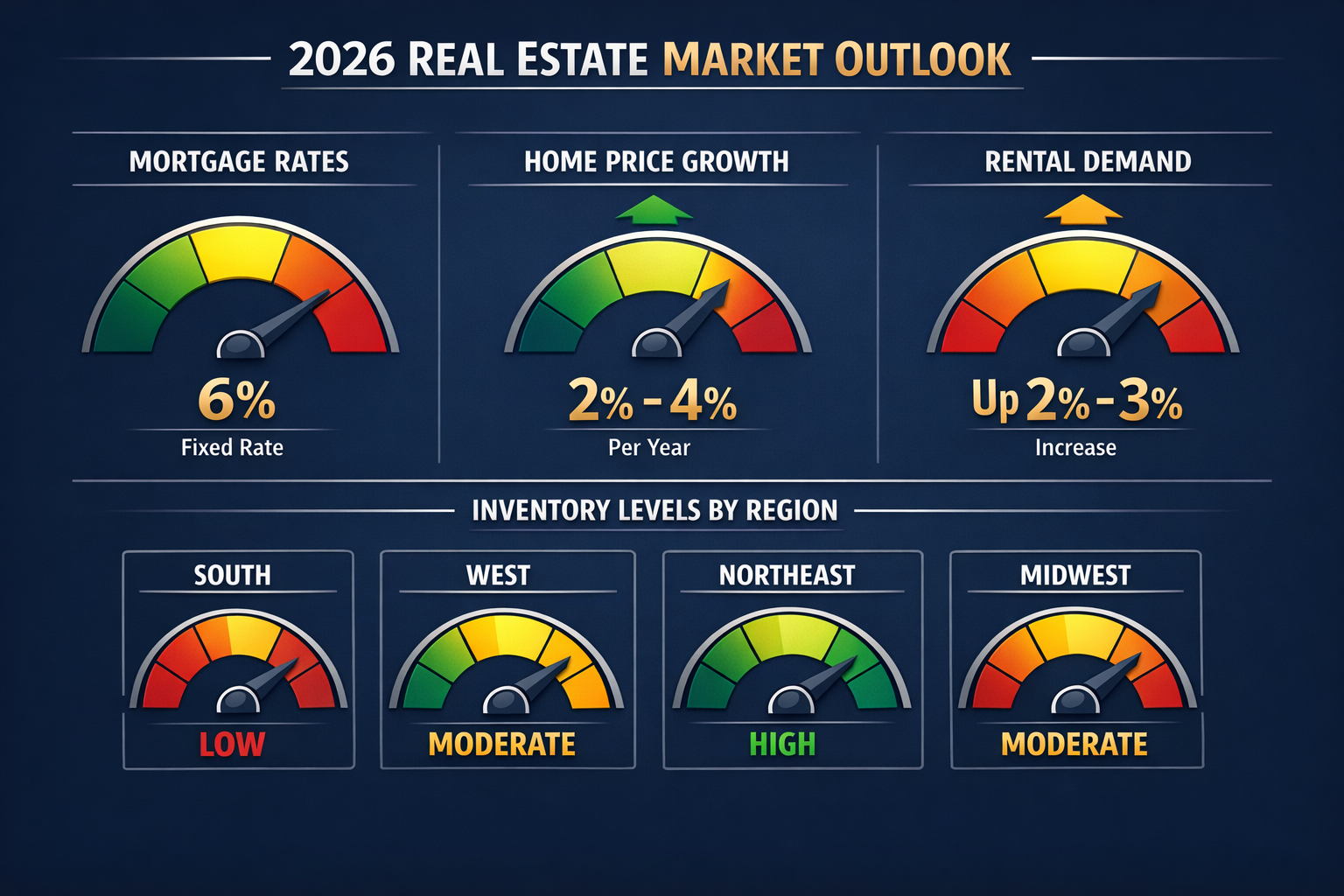
You can't pick a strategy without knowing the field you're playing on. Before diving into specific real estate investment strategies, you need a clear picture of current conditions. Here's what the numbers say heading into 2026.
Mortgage Rates: Easing, but Not Cheap
Mortgage rates are sitting in the low-to-mid 6% range. The National Association of Realtors (NAR) projects rates will average around 6% for 2026, down from roughly 6.7% in 2025. Wells Fargo's economic group expects 30-year fixed rates to bottom near 6.1% in Q1 2026.
That's not a dramatic drop, but it's enough to shift the financing math on rental properties and flip margins. For investors evaluating mortgage rates for investment properties, keep in mind that investment loans typically carry a 0.5%–0.75% premium over owner-occupied rates. That puts investor financing closer to 6.5%–6.75% in early 2026.
What this means for you: Deals need to pencil at current rates — not hypothetical future rates. If your investment thesis requires a rate drop to 5% to work, it's not a deal. It's a bet.
For a deeper look at how stable rates are reshaping strategy, see our analysis of how 6% rates are reshaping buyer and seller strategies in 2026.
Home Prices: Climbing Slowly
Home prices are still rising — but the pace has decelerated significantly:
- NAR forecasts a 4% median price increase nationally
- Redfin is more conservative at 1%
- Fannie Mae splits the difference at 2.4%
The takeaway: prices aren't crashing, but the days of double-digit annual gains are over. That actually benefits disciplined investors who buy on cash flow rather than speculation. When appreciation slows, the market rewards operators who understand income fundamentals — not those chasing price momentum.
Inventory: Improving in Pockets
Inventory levels vary dramatically by region:
- South and West: Construction has kept pace with demand in many Sun Belt markets, creating more buying opportunities for investors. New listings are rising, and builders are offering incentives.
- Northeast and Midwest: These regions remain tighter, which means stronger pricing power for sellers and higher entry costs for investors.
For investors asking "is real estate a good investment in 2026?" — the answer depends heavily on where you're buying. Regional variation is the defining feature of this market cycle.
Rental Demand: Structurally Strong
Redfin projects rent increases of 2–3% by end of 2026. Two demographic forces are fueling this:
- Gen Z households entering the housing market — many priced out of homeownership and renting longer
- Baby Boomers downsizing into flexible rental options, particularly single-family rentals
Rental property investing benefits from this dual demand engine. Single-family rentals are a standout category, with occupancy rates above 95% in most major metros.
The Global Picture
The global real estate market hit $4.34 trillion in 2025, according to JLL, and Precedence Research projects growth to $4.58 trillion in 2026. Morgan Stanley's 2026 outlook notes that assets repriced 20–25% over the past three years are now creating favorable acquisition conditions as debt markets reopen.
Translation: Capital is moving again, and the window to buy before pricing fully adjusts is narrowing. Understanding housing supply and demand dynamics at both the macro and local level is essential for timing your entry.
Real Estate Investment Strategies
This is the core of the hub. Not every strategy fits every investor. Your available capital, risk tolerance, time commitment, and local real estate market trends all play a role. Below, we break down the types of real estate investments that are producing real returns in 2026 — and what you need to know before committing a dollar.
Whether you're learning how to invest in real estate for the first time or evaluating which approach to add to an existing portfolio, this section covers the full spectrum from active to passive strategies.
Buy-and-Hold Rental Properties
This is the bedrock strategy for building long-term wealth through real estate. You buy a property, rent it out, and hold it while the tenant pays down your mortgage and the asset appreciates over time. It's the foundation of nearly every serious real estate portfolio building plan.
Why it works in 2026:
Housing supply still lags behind demand in most U.S. markets. NAR economists point to a structural housing deficit — estimated at 3.8 million units — that persists even as inventory slowly improves. That imbalance supports occupancy rates and rent growth, the two metrics every landlord watches most closely.
Where to focus:
Markets with strong population growth, diversified job creation, and relative affordability. Key indicators to evaluate:
- Population growth rate above the national average (0.5%+)
- Median home price-to-rent ratio below 15 (indicating favorable rental yields)
- Job growth across multiple sectors (not dependent on a single employer)
- Landlord-friendly legal environment (important for eviction timelines and rent regulations)
States like Florida, Arizona, Texas, and Colorado are still absorbing listings fast. NAR data shows roughly 2–2.4% of homes in high-growth states sell within 90 days. Raleigh/Durham, Tampa, and Palm Beach scored high on the PwC/ULI Emerging Trends survey for apartment acquisition interest.
What to watch for:
Cash flow is king. With rates in the 6% range, your purchase price and rental income need to produce positive monthly cash flow after mortgage, taxes, insurance, and maintenance. The standard rule of thumb:
Monthly rent should be at least 1% of the purchase price (the "1% rule") for a property to have a reasonable chance of cash flowing positively.
In 2026, hitting the 1% rule is difficult in many primary markets. That's pushing savvy investors toward secondary cities and suburbs where price-to-rent ratios are more favorable.
If the numbers only work on appreciation, you're speculating — not investing. Understanding the difference between appreciation vs. cash flow investing is critical for long-term success.
Example scenario:
A $250,000 single-family home in a secondary Florida market renting for $2,200/month. With 25% down ($62,500), a 6.5% rate on a 30-year fixed mortgage, taxes of $3,000/year, insurance at $1,800/year, and a 10% maintenance/vacancy reserve:
- Monthly mortgage (P&I): ~$1,185
- Taxes + Insurance: ~$400
- Maintenance/Vacancy reserve: ~$220
- Total monthly cost: ~$1,805
- Net cash flow: ~$395/month ($4,740/year)
- Cash-on-cash return: ~7.6%
That's a real return — not spectacular, but consistent and building equity simultaneously.
For investors weighing long-term holds against tax implications, understanding 1031 exchange rules, timelines, and common mistakes is essential for preserving gains when you eventually sell.
Fix-and-Flip
Buy a distressed property, renovate it, and sell it at a profit. It's the strategy that launched a thousand HGTV shows — and bankrupted plenty of investors who skipped the math.
Why it works in 2026:
Moderate home price growth (2–4% nationally) means your renovated property still has upside, especially if you're buying in markets where comparable sales support a strong after-repair value (ARV). Builders are offering incentives and price cuts on new construction, which can actually help flippers by giving buyers more confidence in overall market stability.
ATTOM Data Solutions reported that gross flipping profits averaged approximately $67,000 per flip nationally in late 2025, though margins vary dramatically by market. The key is buying at a deep enough discount that your profit doesn't depend on market appreciation.
Where the risk sits:
- Higher borrowing costs eat into margins. Hard money loans and bridge financing carry rates of 10–14% in 2026 — significantly steeper than the 7–9% range of 2020–2021.
- Renovation budget overruns are the #1 profit killer. Materials costs have stabilized somewhat from their 2022 peak but remain elevated.
- Holding costs can erase profits in weeks if a project drags. Every month you hold a flip property, you're paying interest, insurance, utilities, and taxes with no income.
The fix-and-flip formula:
Maximum Purchase Price = ARV × 70% – Renovation Costs
This is the "70% rule" that experienced flippers use as a starting filter. If a home's ARV is $350,000 and it needs $60,000 in renovations, your maximum offer should be around $185,000.
Our take:
Fix-and-flip still works if you have contractor relationships, local market knowledge, and disciplined underwriting. It's not a beginner strategy in a 6% rate environment. Run your numbers conservatively, pad your renovation budget by 15–20%, and know your exit before you close.
When evaluating buy and hold vs. fix and flip real estate, consider your timeline, capital, and appetite for active management. Flipping generates lump-sum profits but no ongoing income. Buy-and-hold builds wealth slowly but creates monthly cash flow and long-term appreciation.
For financing options specific to renovation projects, explore our guide to the best loans for flipping houses in any market.
Single-Family Rentals (SFR) and Build-to-Rent
Single-family rentals have become one of the fastest-growing segments in residential investing. Institutional capital has poured into the space — Invitation Homes and American Homes 4 Rent collectively own over 150,000 properties — but individual investors still have a significant edge in secondary and tertiary markets where large operators don't play.
Why it matters in 2026:
Elevated home prices and tighter mortgage affordability are pushing many households to rent single-family homes rather than buy. Morgan Stanley's 2026 outlook specifically calls out SFR as a priority acquisition category, alongside multifamily and student housing, in markets with clear demand-supply imbalances.
Key advantages of SFR over traditional multifamily:
- Lower tenant turnover — families renting houses tend to stay 3–5 years vs. 1–2 years in apartments
- Tenants often handle yard maintenance and minor repairs
- Appreciation tracks residential home prices, which historically outpace apartment building values
- Easier financing — conventional 30-year mortgages are available (unlike commercial loans for larger multifamily)
Single family rental vs. multifamily investment:
| Factor | Single-Family Rental | Multifamily (5+ units) |
|---|---|---|
| Entry cost | Lower ($150K–$400K) | Higher ($500K–$2M+) |
| Financing | Conventional 30-year | Commercial (20–25 year, balloon) |
| Tenant turnover | Lower (3–5 years avg.) | Higher (1–2 years avg.) |
| Management complexity | Lower per unit | Higher, but economies of scale |
| Cash flow per unit | Moderate | Often higher per unit |
| Scalability | Slower (one at a time) | Faster (multiple units per deal) |
Build-to-rent (BTR) communities — where developers construct entire neighborhoods specifically for renters — are gaining traction in Sun Belt markets. If you're an investor with access to land or development capital, BTR offers a recurring income model with less tenant turnover than traditional apartments. Markets like Phoenix, Dallas, and Nashville are seeing significant BTR development activity.
House Hacking
Live in one unit of a multi-unit property and rent out the others. It's one of the most accessible entry points for new investors and a cornerstone strategy for anyone learning how to start investing in real estate with little money.
What is house hacking in real estate?
At its simplest, house hacking means purchasing a property where you live in one portion and rent out the rest. Common approaches include:
- Buying a duplex, triplex, or fourplex — live in one unit, rent the others
- Renting out rooms in a single-family home
- Converting a basement or garage into a rentable ADU (accessory dwelling unit)
Why this still makes sense in 2026:
- The conventional loan limit jumped to $832,750 for 2026, opening higher-cost markets to buyers using low down payment options
- FHA loans allow as little as 3.5% down on properties up to four units, as long as you occupy one unit
- VA loans offer 0% down for eligible veterans on up to four-unit properties
If you can find a duplex, triplex, or fourplex where the rental income covers most of your mortgage, you're building equity while dramatically reducing your living expenses.
Example:
A $400,000 triplex purchased with an FHA loan (3.5% down = $14,000). You live in one unit and rent the other two for $1,400 each ($2,800/month total rental income). Your total PITI (principal, interest, taxes, insurance) plus FHA mortgage insurance is approximately $3,100/month. Your effective housing cost: $300/month — while building equity in a $400,000 asset.
Bonus: You gain landlord experience with built-in proximity to your tenants — a faster learning curve than managing properties remotely. Many of today's most successful real estate investors started with exactly this approach.
REITs (Real Estate Investment Trusts)
Not everyone wants to unclog toilets at midnight. REITs let you invest in real estate through publicly traded companies that own income-producing properties — from data centers to apartment complexes to logistics warehouses. This is the most accessible form of passive real estate investing available.
How to invest in REITs for beginners:
- Publicly traded REITs — Buy shares through any brokerage account, just like stocks. Minimum investment: the price of one share (often $20–$100).
- REIT mutual funds and ETFs — Diversified exposure to dozens or hundreds of REITs in a single purchase. Popular options include Vanguard Real Estate ETF (VNQ) and Schwab U.S. REIT ETF (SCHH).
- Non-traded REITs — Private offerings with higher minimums ($1,000–$25,000) and less liquidity, but potentially higher yields.
2026 context:
Nareit's outlook notes that U.S. REIT valuations spent much of 2025 stuck in a gap between REIT prices and broader equity market multiples — a divergence comparable to the 2008 financial crisis and early COVID period. That gap is expected to close, which means REIT investors who buy now may see outsized returns as valuations normalize.
Global REIT performance (2025):
- U.S. REITs: 4.5% total return
- Asia REITs: 28% total return
- Europe REITs: 19.9% total return
If you're open to international exposure, global REIT diversification is a real consideration this cycle.
Real estate vs. stocks:
REITs offer a useful comparison point. Over the past 25 years, U.S. equity REITs have delivered average annual returns of approximately 10–12%, comparable to the S&P 500 but with lower correlation — meaning they can reduce overall portfolio volatility. REITs also offer dividend yields typically between 3–5%, which is significantly higher than the S&P 500's ~1.3% yield.
For investors who want real estate exposure without the operational demands of direct ownership, REITs and real estate crowdfunding platforms provide compelling alternatives.
Wholesale Real Estate
Find deeply discounted properties, get them under contract, and assign that contract to another buyer for a fee — without ever owning the property yourself. It's a low-capital strategy that rewards hustle and market knowledge over net worth.
How it works:
- Find a motivated seller (pre-foreclosure, probate, divorce, tax delinquent)
- Negotiate a purchase contract at a significant discount to market value
- Find an end buyer (typically a flipper or landlord) willing to pay more
- Assign your contract to the end buyer for an assignment fee ($5,000–$25,000 is typical)
Best for: Investors who want to generate deal flow and income without taking on debt or renovation risk. Wholesale works best in markets with high distressed inventory or motivated sellers.
Reality check: Wholesale is legal, but regulations vary by state. Some states (Illinois, Ohio, Oklahoma) require a real estate license to assign contracts or market properties you don't own. Know your local laws before you start marketing deals. Violations can result in fines and legal liability.
Wholesale as a stepping stone: Many investors use wholesale profits to fund their first rental property purchase or flip. It's a legitimate path for learning how to invest in real estate when starting capital is limited.
Best Real Estate Investment Strategies for Beginners
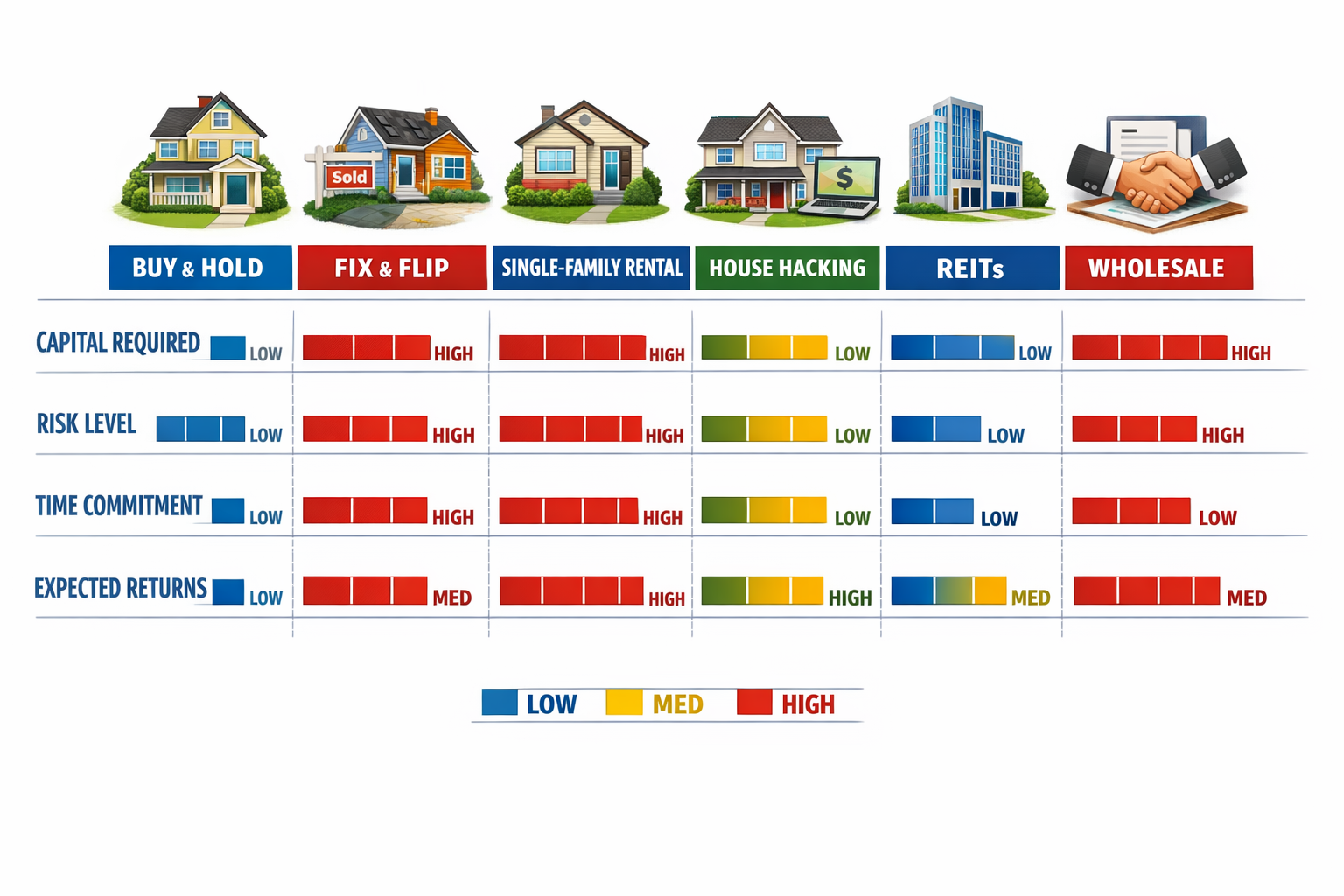
If you're new to real estate investing, the number of options can feel overwhelming. Here's a practical framework for choosing your first strategy based on your resources:
Starting with Limited Capital (Under $25,000)
- House hacking with an FHA loan (3.5% down)
- Wholesale to generate income and learn deal analysis
- REIT investing through a brokerage account (start with any amount)
- Real estate crowdfunding platforms with minimums as low as $500
Starting with Moderate Capital ($25,000–$100,000)
- Single-family rental in a secondary market with 20–25% down
- House hacking a duplex or triplex in a mid-priced market
- Fix-and-flip partnership (contribute capital while a partner manages renovation)
Starting with Significant Capital ($100,000+)
- Multiple rental properties across markets for diversification
- Small multifamily (5–20 units) with commercial financing
- Build-to-rent development in high-growth Sun Belt markets
- Syndication investments as a limited partner
The best real estate investment strategies for beginners share common traits: they minimize downside risk, provide education through direct experience, and create a foundation for scaling. Don't try to do everything at once. Master one approach, build systems around it, then expand.
Real Estate Investment Tips for New Investors
- Start with education, but don't stay there. Analysis paralysis kills more investing careers than bad deals. Set a deadline to make your first offer.
- Build your team before you need them. Identify a real estate agent who works with investors, a lender who understands investment property loans, a property inspector, and a CPA with real estate experience.
- Learn to analyze deals ruthlessly. Every property should pass your financial filters before you visit it in person. This saves enormous time and prevents emotional buying.
- Understand your local market deeply. National trends matter, but real estate is hyper-local. Know your target neighborhoods at the street level.
- Start with one market and one strategy. Geographic and strategic focus accelerates your learning curve and builds local expertise that creates competitive advantages.
How to Analyze a Rental Property
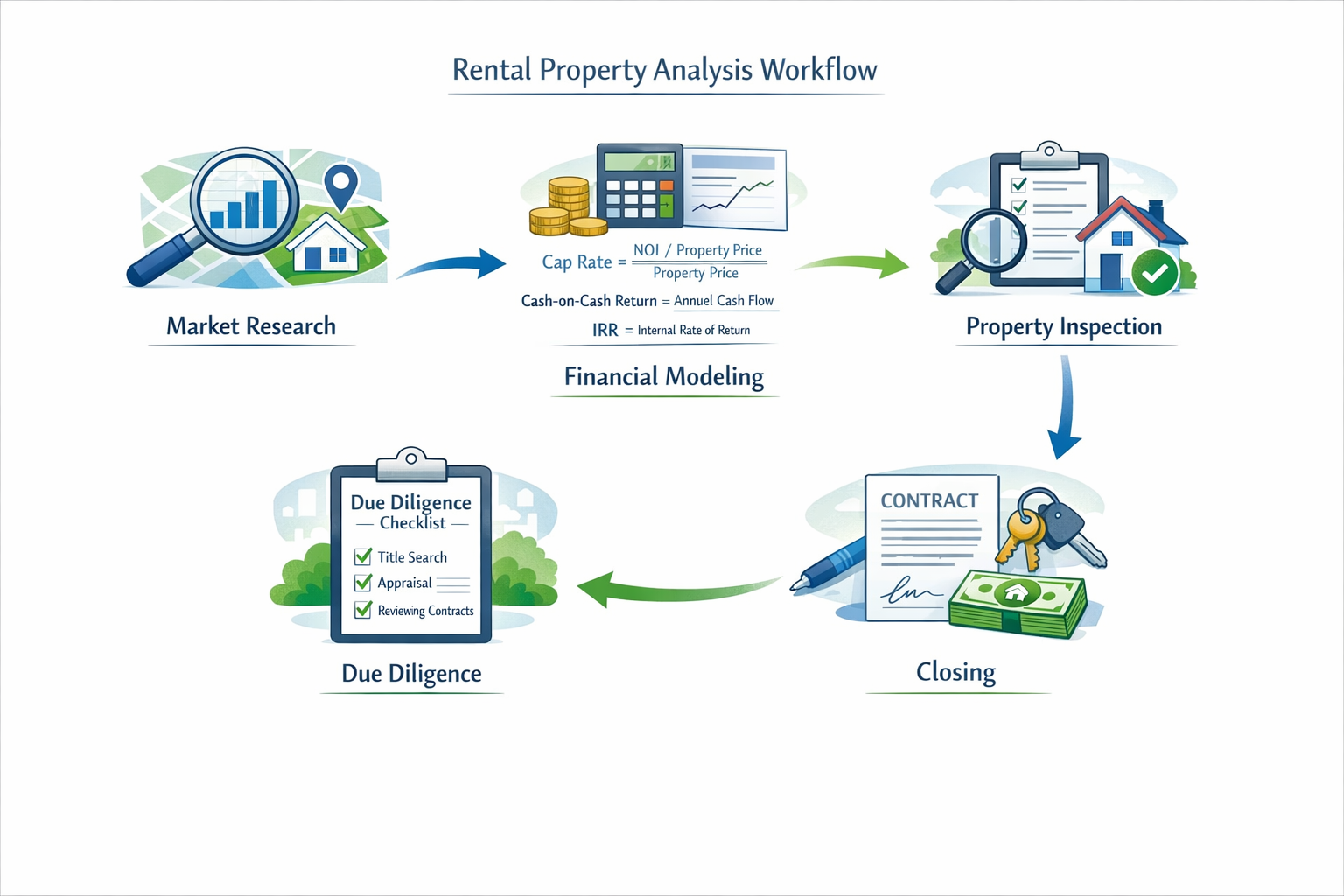
Sound real estate due diligence starts with the numbers. Here's the framework experienced investors use to evaluate every potential acquisition.
Key Metrics Every Investor Should Know
Cap Rate (Capitalization Rate):
Cap Rate = Net Operating Income (NOI) ÷ Property Value
A property generating $18,000/year in NOI with a value of $250,000 has a cap rate of 7.2%. Higher cap rates indicate higher returns relative to price — but also typically higher risk or less desirable locations.
Cash-on-Cash Return:
Cash-on-Cash Return = Annual Pre-Tax Cash Flow ÷ Total Cash Invested
This measures the return on your actual out-of-pocket investment, accounting for leverage. A property producing $4,800/year in cash flow on a $60,000 total investment (down payment + closing costs + repairs) delivers an 8% cash-on-cash return.
Cap rate vs. cash-on-cash return — what's the difference? Cap rate measures the property's return independent of financing. Cash-on-cash measures your return based on how much cash you actually invested. Both matter, but cash-on-cash is more relevant for leveraged investors.
Internal Rate of Return (IRR):
IRR accounts for the time value of money across your entire hold period, including cash flow, principal paydown, appreciation, and sale proceeds. It's the most comprehensive return metric but requires assumptions about future performance.
Gross Rent Multiplier (GRM):
GRM = Property Price ÷ Annual Gross Rent
A quick screening tool. Lower GRM = better value relative to rental income. In most markets, a GRM under 10 suggests a property worth deeper analysis.
The Rental Property Analysis Checklist
Before making an offer on any cash flow rental property, run through this checklist:
- Comparable sales — What have similar properties sold for in the last 6 months?
- Comparable rents — What are similar properties renting for? (Use Rentometer, Zillow Rent Zestimate, and local Craigslist/Facebook listings)
- Property condition — What repairs or capital expenditures are needed in the next 1–5 years?
- Operating expenses — Taxes, insurance, property management (8–10% of rent), maintenance (5–10% of rent), vacancy allowance (5–8%)
- Financing terms — Rate, term, down payment, closing costs
- Cash flow projection — Monthly and annual, using conservative assumptions
- Exit strategy — How will you profit if you need to sell? What's the minimum hold period for positive returns?
Tools and Resources for Smarter Investing
Data changes your odds. Here are the best real estate investing tools worth your attention in 2026.
Market Analysis Tools
- Redfin, Zillow, and Realtor.com — Free data on comparable sales, days on market, and price trends at the ZIP code level
- ATTOM Data Solutions — Property data and analytics for investors who need deeper research on foreclosures, equity, and ownership history
- Rentometer — Rental comps by address, showing where a property's rent falls relative to the local market
- Census Bureau / BLS data — Population growth, employment statistics, and migration patterns for real estate market analysis
- CoStar / LoopNet — Commercial property data for multifamily and mixed-use investors
For buyers comparing platforms, our guide to the best home buying sites in the U.S. for 2026 covers the major portals in detail.
Financial Modeling Tools
Run your numbers on every deal. No exceptions.
- BiggerPockets Calculators — Free tools for modeling cash flow, cap rate, cash-on-cash return, and IRR on rental properties and flips
- DealCheck — Mobile-friendly rental property calculator with detailed analysis reports
- Stessa (free) — Income and expense tracking for rental portfolios, with tax-ready reports
If you're not running these numbers before making an offer, you're guessing — and guessing in a 6% rate environment is expensive.
Property Management Software
For landlords scaling beyond a handful of units, property management software handles the operational complexity:
- Buildium — Full-featured platform for portfolios of 20+ units
- AppFolio — Strong for mid-size portfolios with maintenance coordination
- TenantCloud — Budget-friendly option for smaller landlords (free tier available)
- Stessa — Best for tracking financials on 1–20 unit portfolios
AI-Powered Analysis
AI-driven valuation models, predictive analytics, and digital platforms are improving transparency across the investing space. Tools that flag market anomalies, predict rent growth corridors, or identify undervalued assets are becoming standard — not optional.
Platforms like HouseCanary, Reonomy, and Mashvisor use machine learning to surface investment opportunities that would take hours to find manually. For a look at how AI is changing the search process, see our piece on AI hacks to beat house hunting fatigue.
Best Markets for Real Estate Investing 2026
Location determines returns more than almost any other variable. Here are the markets generating the most investor interest heading into 2026, based on the PwC/ULI Emerging Trends in Real Estate report, NAR data, and institutional capital flows.
Top Markets by Overall Investment Outlook
| Rank | Market | Key Drivers |
|---|---|---|
| 1 | Dallas/Fort Worth | Corporate relocations, population growth, diversified economy |
| 2 | Nashville | Healthcare/tech employment, tourism, affordability relative to peers |
| 3 | Miami | International capital, population influx, luxury + workforce housing demand |
| 4 | Raleigh/Durham | Research Triangle tech jobs, university pipeline, quality of life |
| 5 | Tampa | Affordability migration from Northeast, strong rental demand |
| 6 | Phoenix | Semiconductor manufacturing investment, continued population growth |
| 7 | Charlotte | Financial services hub, infrastructure investment, cost of living advantage |
What Makes a Market "Investor-Friendly"
Beyond economic fundamentals, regulatory environment matters enormously:
- Texas: No state income tax, landlord-friendly eviction process (typically 30–45 days), no rent control
- Florida: No state income tax, strong property rights protections, homestead exemption benefits for house hackers
- Tennessee: No state income tax on wages, moderate regulatory burden
- Oregon/New York: Statewide rent control provisions, longer eviction timelines (90+ days), more complex landlord-tenant regulations
Choosing the right market is a form of real estate due diligence that many beginners overlook. A property with identical financials can produce vastly different real-world returns depending on the regulatory environment it operates in.
For a comprehensive look at property categories and how they perform across markets, explore our guide to the essential property types for investments.
Signals to Watch Before You Buy
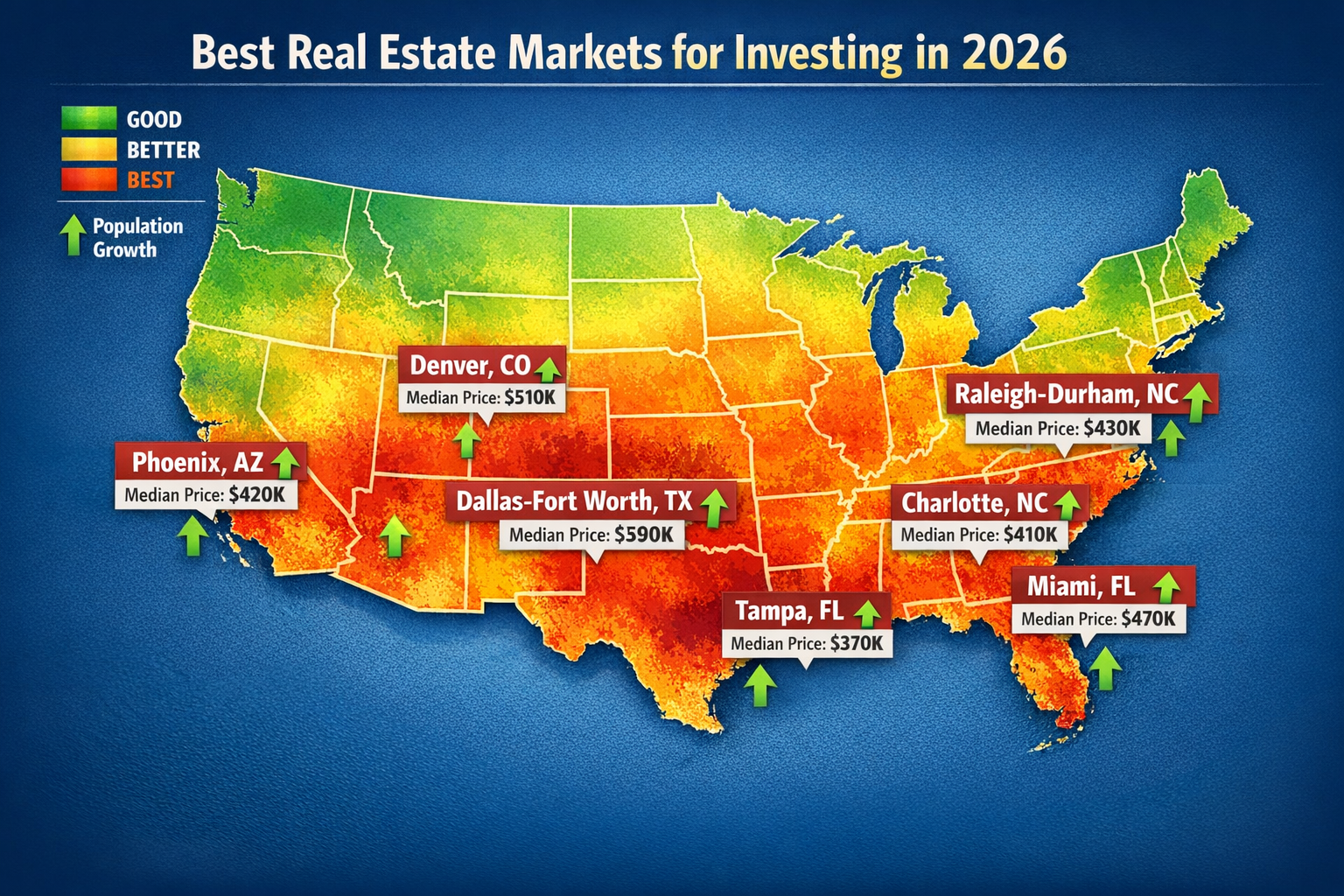
Every investment decision starts with signals. Here's what experienced investors monitor before committing capital — the real estate investment tips that separate professionals from amateurs.
Job Growth
Where jobs go, renters and buyers follow. Markets with diversified employment bases — not dependent on a single employer or industry — are safer bets. Track:
- Bureau of Labor Statistics (BLS) monthly employment reports by metro
- Major employer announcements (new headquarters, manufacturing plants, distribution centers)
- Unemployment rate trends relative to the national average
Permit and Construction Activity
- Rising building permits can signal future supply increases that cool rent growth
- Declining permits can signal tightening inventory and rising prices
- Both data points matter for timing your entry and projecting future competition
The Census Bureau publishes monthly building permit data by metro area — it's free and invaluable.
Population Migration Trends
Remote work continues to reshape where people live. Smaller cities like Boise, Charlotte, and secondary Florida markets are still absorbing population growth from higher-cost metros.
PwC's 2026 Emerging Trends report confirms this pattern: the top-ranked investment markets are almost exclusively in the Sun Belt and Southeast, driven by domestic migration from California, New York, and Illinois.
Debt Market Conditions
As the Fed continues easing, financing conditions are gradually loosening:
- Cap rates may stabilize after quarters of expansion
- CMBS activity is recovering, signaling improved liquidity for commercial real estate
- Bank lending standards are beginning to relax — when banks start competing for real estate loans again, deal flow accelerates
Watch the Federal Reserve's Senior Loan Officer Opinion Survey (SLOOS) quarterly for shifts in bank lending appetite.
Local Regulation and Landlord-Tenant Law
Rent control, eviction protections, and zoning changes can directly impact your real estate investment returns. A property in an investor-friendly state like Texas operates under very different rules than one in New York or Oregon.
Before investing in any new market, review:
- Eviction process timeline and costs
- Rent control or stabilization ordinances
- Security deposit regulations
- Required landlord disclosures
- Zoning restrictions on short-term rentals
How to Build a Real Estate Portfolio
Scaling from one property to a diversified portfolio requires intentional strategy. Here's the framework that works for real estate portfolio building in 2026.
Phase 1: Foundation (Properties 1–3)
- Focus on a single market and single strategy (typically buy-and-hold SFR or house hacking)
- Build relationships with local agents, lenders, contractors, and property managers
- Establish systems for tenant screening, rent collection, and maintenance
- Reinvest cash flow and build reserves (6 months of expenses per property minimum)
Phase 2: Scaling (Properties 4–10)
- Consider expanding to a second market for geographic diversification
- Evaluate whether to add a second strategy (e.g., adding flips to generate capital for more rentals)
- Transition from self-management to professional property management (typically makes sense at 5+ units)
- Explore portfolio lending or DSCR loans for faster acquisition without traditional income verification
Phase 3: Optimization (10+ Properties)
- Implement 1031 exchanges to defer capital gains when selling underperforming assets
- Evaluate entity structuring (LLCs, series LLCs) for liability protection
- Consider syndication — either as a limited partner in others' deals or as a general partner raising capital
- Diversify across asset classes: SFR, small multifamily, REITs, and potentially commercial
The key to sustainable portfolio growth is maintaining cash flow discipline at every stage. Overleveraging to acquire properties faster is the most common mistake that derails otherwise promising portfolios.
What Comes Next
This hub is a living resource. As market conditions shift, we'll update the data, add new strategy breakdowns, and publish deep-dives into specific markets, asset classes, and tools. Every spoke article linked from this page is built to give you actionable, specific intelligence on a single topic — so you can go as deep as you need without wading through filler.
Real estate investment strategies evolve with market conditions, but the fundamentals remain constant: buy right, manage well, and hold for the long term. Whether you're exploring passive real estate investing through REITs or building an active rental portfolio one property at a time, the principles of sound analysis, conservative underwriting, and market awareness will serve you in any environment.
Real estate investing isn't passive, and it isn't simple. But with the right strategy, current data, and a clear-eyed read on your local market, it's still one of the most reliable ways to build wealth in America.
We're brokers. We've done this. And we'll show you exactly how.
Frequently Asked Questions
What are the best real estate investment strategies?
The best real estate investment strategies depend on your capital, timeline, and risk tolerance. For beginners, house hacking (living in one unit of a multi-unit property while renting the others) and REIT investing offer the lowest barriers to entry. For investors with moderate capital, buy-and-hold rental properties — particularly single-family rentals in high-growth markets — remain the most reliable wealth-building approach. Fix-and-flip works for experienced investors with contractor networks and strong local market knowledge. In 2026, the most successful investors typically combine multiple strategies: using flips or wholesale to generate capital, then deploying that capital into long-term rental holdings.
How to start investing in real estate?
To start investing in real estate, follow these steps: (1) Educate yourself on the core strategies — buy-and-hold, house hacking, flipping, REITs, and wholesale. (2) Assess your financial position — available capital, credit score, debt-to-income ratio, and risk tolerance. (3) Choose one market and one strategy to start. (4) Build your team: investor-friendly agent, lender, inspector, and CPA. (5) Learn to analyze deals using cap rate, cash-on-cash return, and cash flow projections. (6) Make your first offer. For those with limited capital, FHA-financed house hacking (3.5% down) or REIT investing through a brokerage account are the most accessible starting points.
Is real estate a good investment in 2026?
Yes, real estate remains a strong investment in 2026, though strategy selection matters more than in previous years. Mortgage rates in the low-to-mid 6% range mean deals must cash flow at current rates — not speculative future rates. Rental demand is structurally strong due to Gen Z household formation and Baby Boomer downsizing. Home prices are rising moderately (2–4% nationally), which favors cash-flow-focused investors over speculators. Morgan Stanley notes that assets repriced 20–25% over the past three years are creating favorable acquisition conditions. The key is disciplined underwriting and market selection.
How to start investing in real estate with little money?
The most effective ways to start investing in real estate with limited capital include: House hacking with an FHA loan (3.5% down on properties up to four units), wholesale real estate (assigning contracts for fees without purchasing properties), REIT investing (buy shares for as little as $20–$100), and real estate crowdfunding (platforms with minimums as low as $500). House hacking is particularly powerful because it combines reduced living expenses with equity building and landlord experience — all with minimal upfront investment.
What is the difference between cap rate and cash-on-cash return?
Cap rate measures a property's return independent of financing: Net Operating Income divided by property value. It tells you how the property performs as an asset regardless of how you pay for it. Cash-on-cash return measures your return based on actual cash invested: annual pre-tax cash flow divided by total cash out of pocket (down payment, closing costs, repairs). Cash-on-cash accounts for leverage — a property with a 6% cap rate might deliver a 10%+ cash-on-cash return when financed with a mortgage. Both metrics are essential for evaluating real estate investment returns, but cash-on-cash is more relevant for leveraged investors.
What are the best markets for real estate investing in 2026?
Based on the PwC/ULI Emerging Trends report and institutional capital flows, the top markets for real estate investing in 2026 include Dallas/Fort Worth (ranked #1 overall), Nashville, Miami, Raleigh/Durham, Tampa, Phoenix, and Charlotte. These markets share common traits: strong population growth, diversified employment, relative affordability compared to coastal metros, and landlord-friendly regulatory environments. The best market for your investment depends on your strategy, budget, and whether you're investing locally or remotely.
Should I choose fix-and-flip or buy-and-hold?
The fix-and-flip vs. buy-and-hold decision depends on your goals. Flipping generates lump-sum profits (typically $30,000–$80,000 per deal) but requires active management, contractor relationships, and carries higher risk in a 6% rate environment. Buy-and-hold generates monthly cash flow, builds equity through mortgage paydown, and benefits from long-term appreciation — but returns are slower. Many successful investors use both: flipping to generate capital, then deploying profits into rental properties for long-term wealth building. In 2026's market, buy-and-hold is generally lower risk, while flipping rewards experienced operators with strong local knowledge.
How do I analyze a rental property before buying?
To analyze a rental property, calculate these key metrics: (1) Gross Rent Multiplier (property price ÷ annual gross rent) for quick screening. (2) Cap rate (net operating income ÷ property value) to assess the asset's return. (3) Cash-on-cash return (annual cash flow ÷ total cash invested) to measure your leveraged return. (4) Monthly cash flow after all expenses (mortgage, taxes, insurance, maintenance, vacancy, management). Use tools like DealCheck, BiggerPockets calculators, and Rentometer for rental comps. A property should produce positive cash flow using conservative assumptions — if it only works with optimistic rent projections or low vacancy estimates, pass.