

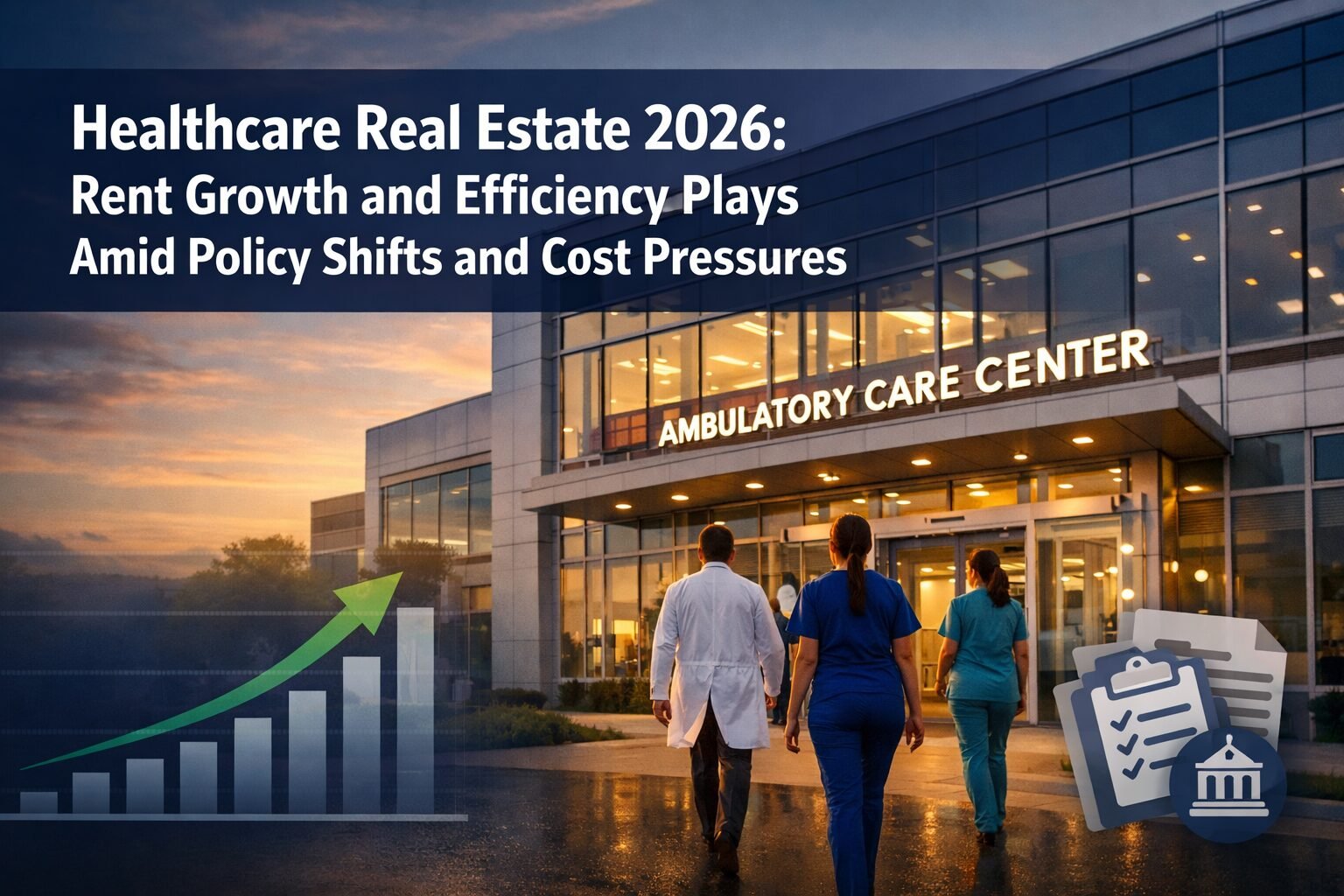

The healthcare real estate market is experiencing something extraordinary in 2026. While most commercial real estate sectors struggle with oversupply and softening demand, medical office buildings are quietly crushing it with 93% occupancy rates—the highest level in over a decade.[1] This isn't just a statistical anomaly; it's the result of a perfect storm of demographic shifts, federal policy changes, and strategic capital allocation that's reshaping where and how Americans receive medical care.
Healthcare Real Estate 2026: Rent Growth and Efficiency Plays Amid Policy Shifts and Cost Pressures represents more than just another investment thesis—it's a fundamental restructuring of the healthcare delivery system that's creating fresh opportunities for savvy investors, real estate agents, and healthcare systems alike. With new CMS policies accelerating the migration from inpatient to outpatient settings, limited new construction keeping supply tight, and an aging population driving sustained demand, this sector is positioned to outperform as a core defensive asset.[2]
Let's break down exactly what's happening, where the money is flowing, and how you can position yourself to capitalize on these shifts.
Key Takeaways
- Medical office building occupancy hit 93% in 2026, the highest in a decade, with limited new supply expected to maintain upward rent pressure through 2027[1][2]
- CMS eliminated 285 procedures from the inpatient-only list, accelerating the shift to lower-cost outpatient settings and driving massive ambulatory care expansion[1]
- An $8+ per square foot rent gap exists between market segments, creating data-driven opportunities for investors and property owners to capture additional revenue[2]
- M&A activity is replacing new construction as health systems prioritize acquiring and retrofitting existing facilities over expensive ground-up development[3]
- Compliance with Stark Law and Anti-Kickback Statute is now a competitive advantage, with systems that embed regulatory requirements into real estate planning experiencing faster growth and better capital protection[1]
The Supply Crunch Driving Healthcare Real Estate 2026: Rent Growth and Efficiency Plays
Why Medical Office Buildings Are Outperforming Everything Else
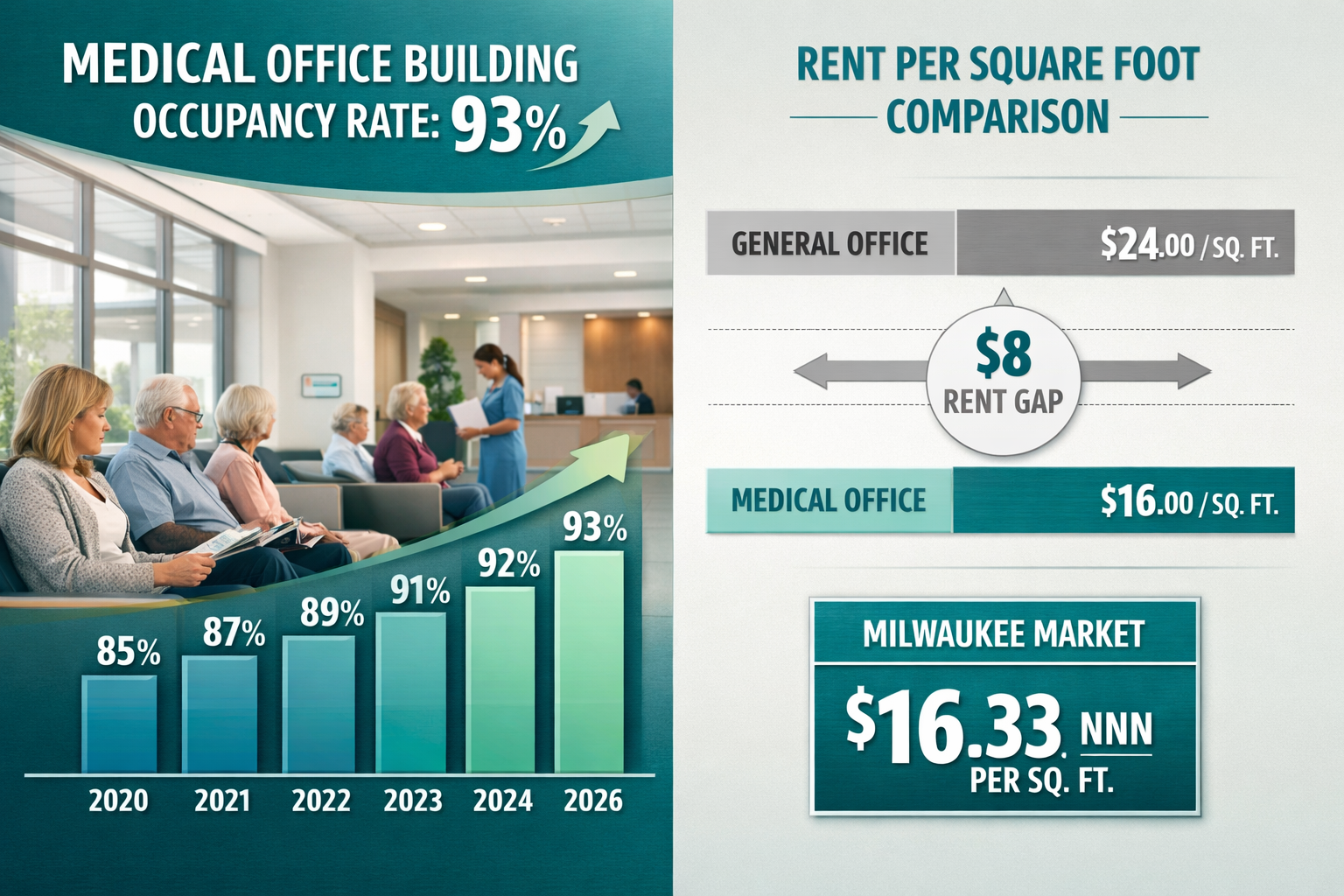
The numbers are so based right now. Medical office building (MOB) occupancy reached 93% in 2026, and here's the kicker—this isn't because of a temporary spike in demand. It's because the supply pipeline has essentially dried up.[1][2] Construction costs have skyrocketed, making new ground-up development financially impractical for most health systems. At the same time, the existing inventory is being absorbed at record rates.
This supply-demand imbalance is creating sustained upward pressure on rents that's expected to continue well into 2027.[2] For real estate investors and agents working with healthcare clients, this represents an impeccable opportunity to lock in favorable terms before the market tightens further.
The $8 Rent Gap Nobody's Talking About
Here's where things get interesting: there's a rent gap of over $8 per square foot between different market segments in the medical office space.[2] This isn't just a pricing anomaly—it's a roadmap for strategic investment.
| Market Segment | Average NNN Rent/SF | Opportunity Type |
|---|---|---|
| Premium Urban MOBs | $24-32 | Stable income, limited upside |
| Secondary Markets | $16-20 | High growth potential |
| Suburban Outpatient | $18-24 | Balanced risk/reward |
| Rural Specialty Centers | $14-18 | Emerging opportunities |
Milwaukee, for example, represents a strong secondary market opportunity with 78,945 square feet of trailing-twelve-month net absorption and an average NNN rent of just $16.33 per square foot.[2] Compare that to premium urban markets, and you're looking at serious upside potential for rent growth as these markets mature.
For investors exploring real estate investment strategies in different market conditions, understanding these rent dynamics is crucial for maximizing returns.
Limited New Supply = Pricing Power
The construction pipeline for medical office buildings has slowed to a crawl, and that's not changing anytime soon. Rising material costs, labor shortages, and stringent regulatory requirements have made new development prohibitively expensive. Health systems are doing the math and realizing that acquiring and retrofitting existing facilities makes more financial sense than breaking ground on new construction.[3]
This shift is creating a fascinating dynamic: existing property owners are sitting on increasingly valuable assets with growing pricing power. If you own medical office space in markets with strong healthcare demand, you're essentially gatekeeping access to premium healthcare real estate—and that position is only getting stronger.
Policy Shifts Reshaping Healthcare Real Estate 2026: Rent Growth and Efficiency Plays
The CMS Game-Changer: 285 Procedures Moving Outpatient
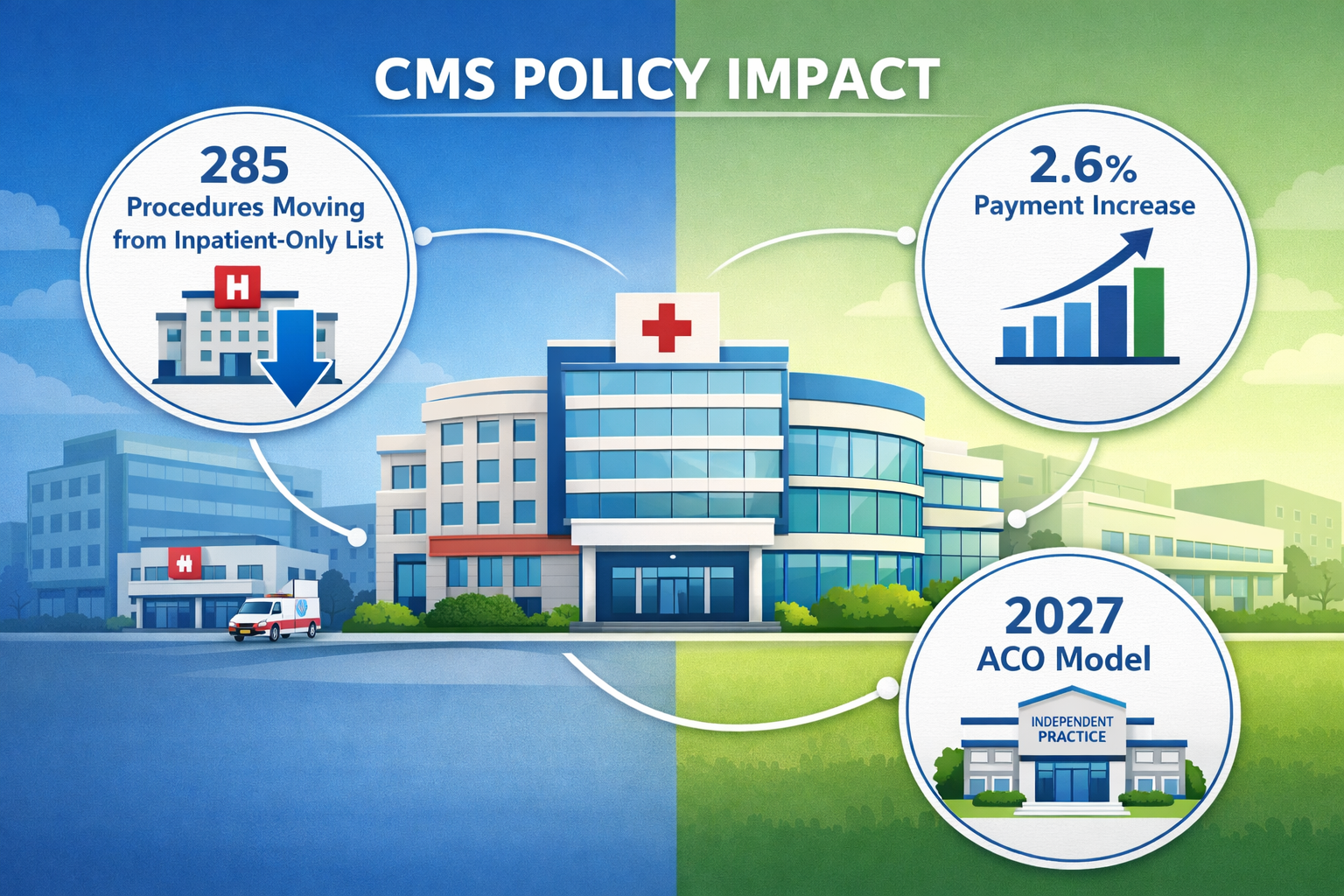
The Centers for Medicare & Medicaid Services (CMS) just dropped one of the most significant policy changes in recent healthcare history. They're eliminating 285 procedures from the Inpatient-Only (IPO) list in 2026, which means procedures that previously required hospital admission can now be performed in ambulatory surgical centers and outpatient facilities.[1]
Let it cook for a second—this is massive. We're talking about everything from certain cardiac procedures to orthopedic surgeries that can now legally be performed in lower-cost outpatient settings. This policy shift is accelerating the migration of care away from expensive hospital towers and into medical office buildings and ambulatory surgical centers.
For health systems, this means an urgent need to expand ambulatory care capacity. For real estate investors and developers, it means unprecedented demand for appropriately zoned and equipped medical office space.
The 2.6% Payment Increase and What It Really Means
CMS finalized a 2.6% increase to the Outpatient Prospective Payment System (OPPS) and Ambulatory Surgical Center (ASC) payment rates for 2026.[3] While that might not sound revolutionary, when you combine it with the elimination of the IPO list, you're looking at a deliberate policy framework designed to incentivize care delivery in lower-cost settings.
This creates a financial incentive structure that aligns perfectly with real estate fundamentals:
✅ Higher reimbursement rates for outpatient procedures
✅ Lower facility costs compared to hospital-based care
✅ Improved patient satisfaction with convenient locations
✅ Better margins for healthcare providers
The result? Health systems are racing to secure medical office space, and they're willing to pay premium rents for well-located, properly equipped facilities.
The 2027 ACO Model Supporting Independent Practices
Here's something fresh that's flying under the radar: CMS is launching a new accountable care organization (ACO) model in 2027 that's explicitly designed to support independent, rural, and specialty practices.[6]
Research shows that independent physician-led ACOs actually demonstrate stronger cost performance than hospital-integrated models, despite mixed evidence on quality improvements across all integration models.[6] This is significant because it's creating a counterbalance to the hospital consolidation trend that's dominated healthcare for the past decade.
For real estate investors, this means opportunities beyond just hospital-affiliated medical office buildings. Independent physician groups are going to need space, and they're going to need it in strategic locations that serve their patient populations effectively.
If you're a real estate agent working with medical professionals, understanding these policy dynamics can help you build trust and grow your sphere of influence by providing genuine strategic value beyond just property transactions.
Investment Strategies for Healthcare Real Estate 2026: Rent Growth and Efficiency Plays Amid Cost Pressures
M&A Over New Construction: The Capital Allocation Shift
The math has fundamentally changed. Health systems are increasingly choosing to acquire and retrofit existing facilities rather than build new ones.[3] This shift is driven by several factors:
🏗️ Construction costs have increased 30-40% since 2020
📍 Geographic expansion is faster through acquisition
⚡ Time to market is significantly shorter with existing buildings
💰 Regional synergies are easier to capture through consolidation
For investors, this creates opportunities on both sides of the transaction. If you're holding medical office properties in markets where health systems are expanding, you're sitting on increasingly valuable assets. If you're looking to acquire, focus on facilities that could be attractive acquisition targets for growing health systems.
The trend toward real estate investment property management excellence becomes even more critical in this environment, as well-maintained properties with strong tenant relationships command premium valuations.
The GLP-1 Infrastructure Build-Out
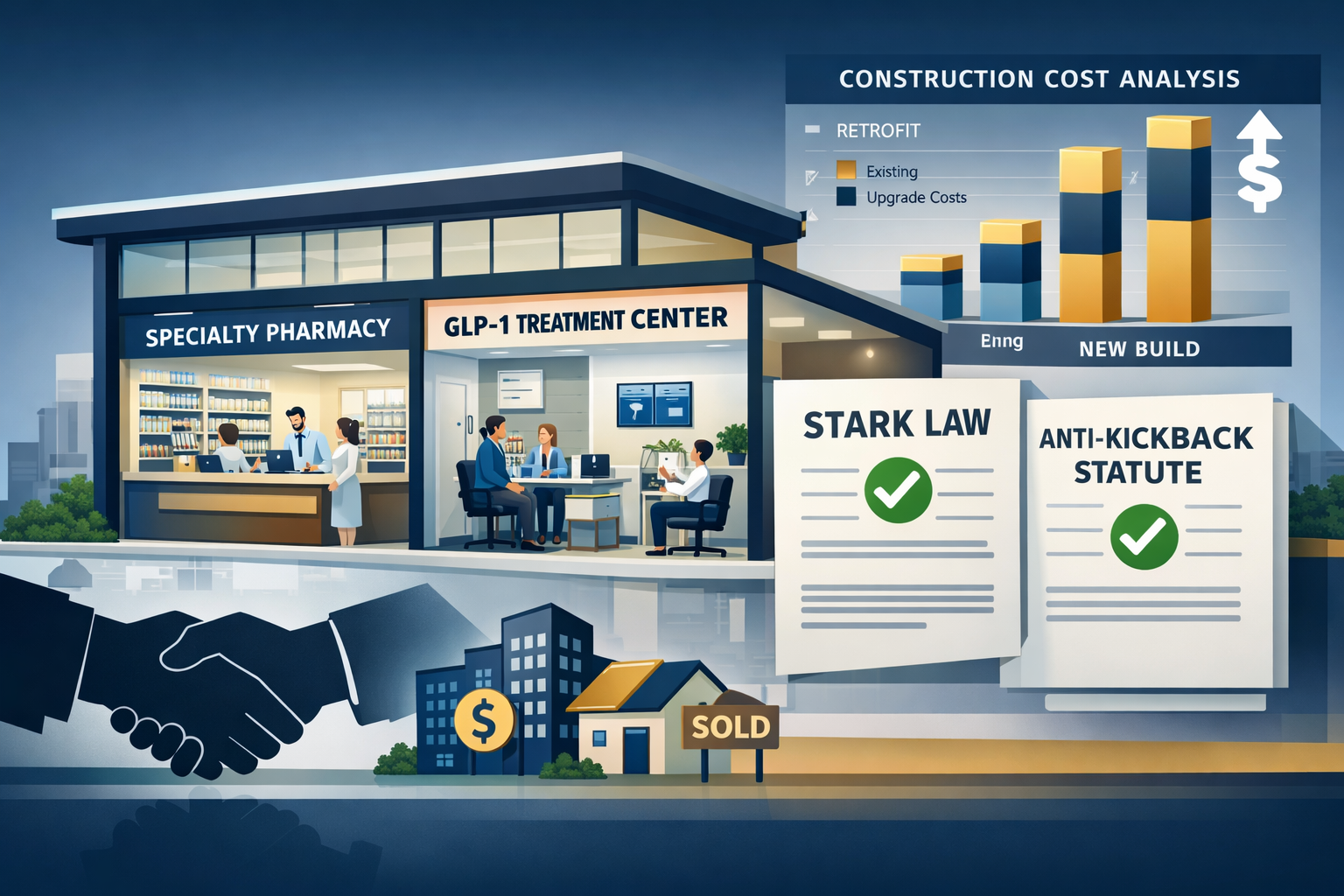
Here's something that's creating extraordinary opportunities right now: the explosion of GLP-1 drugs (think Ozempic, Wegovy, and similar medications). Health systems are building or owning on-campus specialty pharmacies as separate suites to preserve capture and comply with 340B and contract-pharmacy dynamics.[3]
This represents a completely new category of medical office demand. These specialty pharmacy suites require:
- Climate-controlled storage for temperature-sensitive medications
- Secure dispensing areas with controlled access
- Patient consultation spaces for medication education
- Compliance infrastructure for regulatory requirements
If you're developing or retrofitting medical office space, incorporating specialty pharmacy capabilities can significantly increase the property's value and rental potential. This is the kind of forward-thinking approach that separates good real estate investors from great ones.
Secondary Market Opportunities: The Milwaukee Example
While everyone's chasing premium urban medical office buildings, impeccable opportunities exist in secondary markets. Milwaukee provides a perfect case study: 78,945 square feet of net absorption in the trailing twelve months, with an average NNN rent of just $16.33 per square foot.[2]
Compare that to top-tier markets where rents can exceed $30 per square foot, and you're looking at significant upside potential as these markets mature. The key is identifying secondary markets with:
✅ Strong demographic fundamentals (aging population, population growth)
✅ Established healthcare systems actively expanding
✅ Limited existing supply of modern medical office space
✅ Favorable regulatory environment for healthcare development
For investors exploring emerging markets and global real estate opportunities, the same principles apply—look for markets where supply constraints meet growing demand.
Compliance as Competitive Advantage
This might sound boring, but stay with me—it's actually where fortunes are made and lost. Compliance with Stark Law and Anti-Kickback Statute requirements is becoming a competitive strategic advantage rather than merely a legal constraint.[1]
Hospital systems that embed compliance into real estate planning from the outset experience:
- Fewer transaction delays due to regulatory review
- Better capital protection from legal exposure
- Stronger physician relationships built on transparent arrangements
- Faster growth initiatives without compliance bottlenecks
What does this mean for real estate investors and agents? If you can demonstrate expertise in healthcare real estate compliance, you become exponentially more valuable to healthcare clients. This includes:
📋 Centralized lease administration systems
💵 Current fair market value certifications for all arrangements
🔄 Consistent transaction processes that satisfy regulatory scrutiny
📊 Commercial reasonableness documentation for all deals
Real estate decisions now carry heightened regulatory and financial exposure.[1] Hospital systems securing medical office space, expanding ambulatory care, or entering joint ventures must demonstrate compliance to avoid financial penalties and delayed growth initiatives.
Understanding how politics shapes real estate trends and regulatory frameworks can help you anticipate these compliance requirements and position yourself as a trusted advisor.
Navigating Cost Pressures and Efficiency Plays in 2026
The Construction Cost Reality Check
Let's talk about the elephant in the room: construction costs are absolutely wild right now. Materials, labor, permitting—everything has gotten more expensive. This is why health systems are pivoting toward acquisition and retrofit strategies rather than ground-up development.[3]
But here's the opportunity: existing medical office buildings that can be retrofitted for modern healthcare delivery are commanding premium valuations. If you own a property that can be converted or upgraded to meet current healthcare standards, you're sitting on a valuable asset.
Key retrofit opportunities include:
🏥 Converting traditional office space to medical office use
⚡ Upgrading HVAC systems to meet healthcare air quality standards
🚪 Reconfiguring layouts for improved patient flow
💻 Installing healthcare IT infrastructure for telehealth and EHR integration
For investors considering real estate investment technology solutions, healthcare properties offer unique opportunities to add value through strategic upgrades.
Efficiency Plays: Maximizing Revenue Per Square Foot
In a market characterized by Healthcare Real Estate 2026: Rent Growth and Efficiency Plays Amid Policy Shifts and Cost Pressures, the name of the game is maximizing revenue per square foot. Health systems and property owners alike are getting creative with space utilization.
Emerging efficiency strategies include:
Flexible Space Design: Modular exam rooms that can be reconfigured for different specialties
Shared Services: Centralized registration, lab, and imaging services serving multiple tenant practices
Extended Hours: Facilities operating 12-14 hours daily to maximize utilization
Telehealth Integration: Hybrid spaces supporting both in-person and virtual care delivery
Properties that can accommodate these efficiency plays command higher rents and attract more stable, long-term tenants. If you're developing or repositioning medical office space, designing for flexibility and efficiency should be top priorities.
The Defensive Asset Play
One of the most compelling aspects of healthcare real estate in 2026 is its role as a core defensive asset.[2] While other commercial real estate sectors face headwinds from remote work, changing consumer behavior, and economic uncertainty, healthcare real estate benefits from:
📈 Demographic tailwinds from an aging population
🏥 Non-discretionary demand for healthcare services
💪 Recession resistance compared to retail or office
🔒 Long-term lease structures providing stable cash flow
For investors concerned about real estate investment risks in an uncertain economic environment, healthcare properties offer a compelling risk-adjusted return profile.
Capital Markets Easing: The 2026 Investment Window
Investor activity is expected to strengthen in 2026 as capital markets ease and confidence builds around the sector's long-term growth trajectory.[2] This creates a window of opportunity for strategic acquisitions before competition intensifies.
Smart money is moving into healthcare real estate right now because:
✅ Cap rates remain attractive compared to other core assets
✅ Rent growth potential is supported by supply constraints
✅ Tenant quality is generally strong with healthcare providers
✅ Long-term fundamentals are rock-solid
For real estate agents working with investors, understanding these market dynamics can help you identify and close deals that align with client objectives. Tools like AI-driven market analysis can help you provide data-backed recommendations that demonstrate your expertise.
Practical Action Steps for Investors, Agents, and Healthcare Systems
For Real Estate Investors
If you're looking to capitalize on Healthcare Real Estate 2026: Rent Growth and Efficiency Plays Amid Policy Shifts and Cost Pressures, here's your playbook:
1. Target Secondary Markets with Supply Constraints
Focus on markets like Milwaukee where occupancy is high, rents are below national averages, and healthcare systems are actively expanding. The upside potential is significant.
2. Prioritize Properties with Retrofit Potential
Look for buildings that can be converted to medical office use or upgraded to accommodate specialty services like GLP-1 pharmacies. These properties will command premium rents.
3. Build Healthcare Compliance Expertise
Differentiate yourself by understanding Stark Law, Anti-Kickback Statute, and fair market value requirements. This knowledge makes you infinitely more valuable to healthcare clients.
4. Focus on Outpatient-Oriented Facilities
With 285 procedures moving from inpatient to outpatient settings, ambulatory surgical centers and medical office buildings near population centers are positioned for sustained demand.
5. Consider REIT Exposure
For diversified exposure without direct property management, REIT real estate investments focused on healthcare properties offer attractive risk-adjusted returns.
For Real Estate Agents
Healthcare real estate represents a specialized niche that can significantly elevate your practice. Here's how to position yourself:
1. Develop Healthcare Market Intelligence
Stay current on CMS policy changes, health system expansion plans, and demographic trends in your market. This knowledge makes you an invaluable advisor.
2. Build Relationships with Healthcare Decision-Makers
Hospital CFOs, medical group administrators, and physician practice managers are key relationships. Attend healthcare industry events and join relevant professional organizations.
3. Leverage Technology for Market Analysis
Use AI marketing tools to analyze healthcare real estate trends and provide data-driven recommendations to clients.
4. Create Healthcare-Specific Marketing Materials
Develop case studies, market reports, and educational content that demonstrates your healthcare real estate expertise. This positions you as the go-to agent in your market.
5. Consider Hiring Support
As your healthcare real estate practice grows, hiring a virtual assistant can help you manage the increased workload while maintaining service quality.
For Healthcare Systems and Providers
If you're a healthcare administrator or physician practice manager, here's how to navigate the real estate landscape in 2026:
1. Embed Compliance from Day One
Don't treat Stark Law and Anti-Kickback Statute compliance as an afterthought. Build it into your real estate planning process from the beginning to avoid delays and legal exposure.
2. Evaluate Acquisition vs. New Construction
Run the numbers on acquiring and retrofitting existing facilities versus ground-up development. In most cases, acquisition will be faster and more cost-effective.
3. Plan for Specialty Pharmacy Infrastructure
If you're prescribing GLP-1 drugs or other specialty medications, incorporate pharmacy space into your facility planning to preserve revenue capture.
4. Optimize for Efficiency
Design spaces for maximum utilization with flexible layouts, shared services, and extended hours capability. Every square foot should generate revenue.
5. Secure Space Now
With 93% occupancy and limited new supply, waiting to secure medical office space will only get more expensive. Lock in favorable lease terms while you still can.
The Road Ahead: What to Watch in Late 2026 and Beyond
As we move through 2026, several trends will shape the healthcare real estate landscape:
Policy Evolution: Watch for additional CMS policy changes that could further accelerate outpatient migration. The 2027 ACO model launch will be particularly significant for independent practices.
Technology Integration: Telehealth, remote monitoring, and AI-driven diagnostics will continue to influence space requirements and facility design.
Demographic Acceleration: The aging baby boomer population will drive sustained demand for healthcare services and the real estate to deliver them.
Capital Market Dynamics: As interest rates stabilize and capital becomes more available, expect increased investment activity and potentially higher valuations.
Consolidation Trends: M&A activity among health systems will create both opportunities and disruption in local markets.
The healthcare real estate market in 2026 represents one of the most compelling opportunities in commercial real estate. The combination of supply constraints, favorable policy changes, demographic tailwinds, and defensive characteristics creates a perfect environment for strategic investors and knowledgeable real estate professionals.
Whether you're an investor looking to capitalize on rent growth potential, a real estate agent building expertise in a specialized niche, or a healthcare provider navigating facility decisions, understanding the dynamics of Healthcare Real Estate 2026: Rent Growth and Efficiency Plays Amid Policy Shifts and Cost Pressures is essential for success.
Conclusion
The healthcare real estate market in 2026 is experiencing a once-in-a-decade alignment of favorable conditions. With 93% occupancy rates, limited new supply, supportive federal policies, and an aging population driving sustained demand, this sector is positioned to outperform as a core defensive asset with significant rent growth potential.[1][2]
The elimination of 285 procedures from the inpatient-only list, coupled with a 2.6% payment increase for outpatient services, is fundamentally reshaping where and how Americans receive medical care.[1][3] This policy shift is creating unprecedented demand for medical office buildings and ambulatory surgical centers, particularly in secondary markets where rent growth potential remains strong.
For investors, the message is clear: act now while opportunities remain accessible. Focus on secondary markets with supply constraints, prioritize properties with retrofit potential, and build expertise in healthcare compliance to differentiate yourself in this specialized market.
For real estate agents, healthcare real estate represents a high-value niche that can significantly elevate your practice. Develop market intelligence, build relationships with healthcare decision-makers, and leverage technology to provide data-driven recommendations.
For healthcare systems and providers, strategic real estate decisions are more critical than ever. Embed compliance from the beginning, evaluate acquisition versus new construction carefully, and secure space now before the market tightens further.
The opportunities in Healthcare Real Estate 2026: Rent Growth and Efficiency Plays Amid Policy Shifts and Cost Pressures are extraordinary, but they won't last forever. As capital markets ease and investor confidence builds, competition will intensify and valuations will rise. The time to position yourself is now.
Ready to explore healthcare real estate opportunities in your market? Start by analyzing local occupancy rates, health system expansion plans, and demographic trends. Connect with healthcare decision-makers and build relationships before you need them. And most importantly, commit to continuous learning about this dynamic sector—the knowledge you gain today will pay dividends for years to come.
For more insights on real estate market trends and investment opportunities, explore our comprehensive guides and expert analysis at Real Estate Rank IQ.
References
[1] Healthcare Real Estate Strategy In 2026 Navigating Hospital Growth Outpatient Demand And Compliance Risk – https://lpc.com/insights-research/healthcare-real-estate-strategy-in-2026-navigating-hospital-growth-outpatient-demand-and-compliance-risk/
[2] Medical Office – https://www.pwc.com/us/en/industries/financial-services/asset-wealth-management/real-estate/emerging-trends-in-real-estate-pwc-uli/property-type-outlook/medical-office.html
[3] What To Build And Where In 2026 2783977 – https://www.jdsupra.com/legalnews/what-to-build-and-where-in-2026-2783977/
[6] Health Care Industry Trend Watch Week Of Feb 9 2026 – https://realeconomy.rsmus.com/health-care-industry-trend-watch-week-of-feb-9-2026/