


Last updated: January 15, 2026

Buying a second home as an investment property feels extraordinary until the first tenant calls at 11 PM about a broken water heater, or the rent check bounces for the third month in a row, or the eviction paperwork sits on the kitchen counter because nobody explained the 14-day notice rule in your state. That dream of passive rental income can turn into a second job real fast.
For first-time second-home investors, the decision to hire a property management company or self-manage is one of the most impactful choices in determining whether the investment builds wealth or just builds stress. This First-Time Second-Home Investor's Guide to Property Management breaks down exactly what property managers do, what they charge across different U.S. markets in 2026, and how to evaluate whether professional management makes financial sense when you own just one rental property. By the end, readers will know how to shop for, compare, and negotiate with property management companies—and whether paying 8-12% of monthly rent is worth the time, legal protection, and peace of mind.
Most residential property management firms charge between 8-12% of monthly rent collected, with 10% serving as the industry benchmark[5]. But that percentage tells only part of the story. Leasing fees, maintenance markups, renewal charges, and setup costs can push the all-in annual expense to 10-15% of gross rental income. The U.S. property management sector reached $136.9 billion in 2025, growing at a steady 2.3% annually[1]—proof that more landlords are choosing to delegate rather than DIY.
Key Takeaways
- Property management companies typically charge 8-12% of monthly rent as a management fee, plus one-time leasing fees of 50-100% of one month's rent when placing new tenants[5].
- Costs vary by region: East Coast markets like Florida and North Carolina average 8-12%, while West Coast cities such as California and Washington run 9-12% due to higher labor and compliance costs[5].
- Professional management saves 5-10 hours per month on showings, maintenance coordination, tenant communication, and legal compliance—time that can justify the fee even for single-property owners.
- 93% of property management companies experienced cost increases in 2025, driven by rising insurance premiums (up 26%), maintenance expenses (up 12%), and vendor costs[1][2].
- First-time investors benefit most when the property is out-of-state, in a high-regulation market, or when the owner works full-time and lacks a local contractor network.
Who This First-Time Second-Home Investor's Guide to Property Management Is For
This guide is designed for two specific groups: people who just bought a second home and aren't sure how to turn it into a rental, and small landlords with one property trying to decide if paying for professional management makes sense.
First-Time Second-Home Investors
First-time second-home investors typically purchase a vacation property, future retirement house, or starter rental without a clear plan for day-to-day operations. The property might be in a resort town two states away, a college neighborhood near a university, or a suburban single-family home that's too nice to leave empty. The question becomes: manage it yourself or hire a property management company?
Common scenarios include:
- Vacation rental conversion: Owners who used the home seasonally but now want year-round rental income.
- Out-of-state purchase: Investors who bought remotely based on cashflow projections but have no local presence.
- Accidental landlords: People who inherited a property or relocated for work and decided to rent instead of sell.
Each scenario shares a learning curve around tenant screening, lease agreements, maintenance vendor networks, and local landlord-tenant law.
Small Landlords With One Rental
Owning one rental property creates different needs than managing a 10-unit portfolio. Small landlords often have:
- Full-time jobs that limit availability for showings, inspections, and emergency repairs.
- No contractor network in the property's city, making every plumbing or HVAC issue a scramble.
- Low tolerance for tenant drama, especially if this is their first experience with late rent, lease violations, or eviction procedures.
- Distance challenges: the property is more than an hour away, making in-person tasks expensive and time-consuming.
These stress points frequently push one-property owners toward professional management, even though the percentage fee feels higher when spread across a single unit instead of multiple doors. For more foundational guidance on getting started, check out our comprehensive real estate investment property management strategies.
What a Residential Property Management Company Actually Does
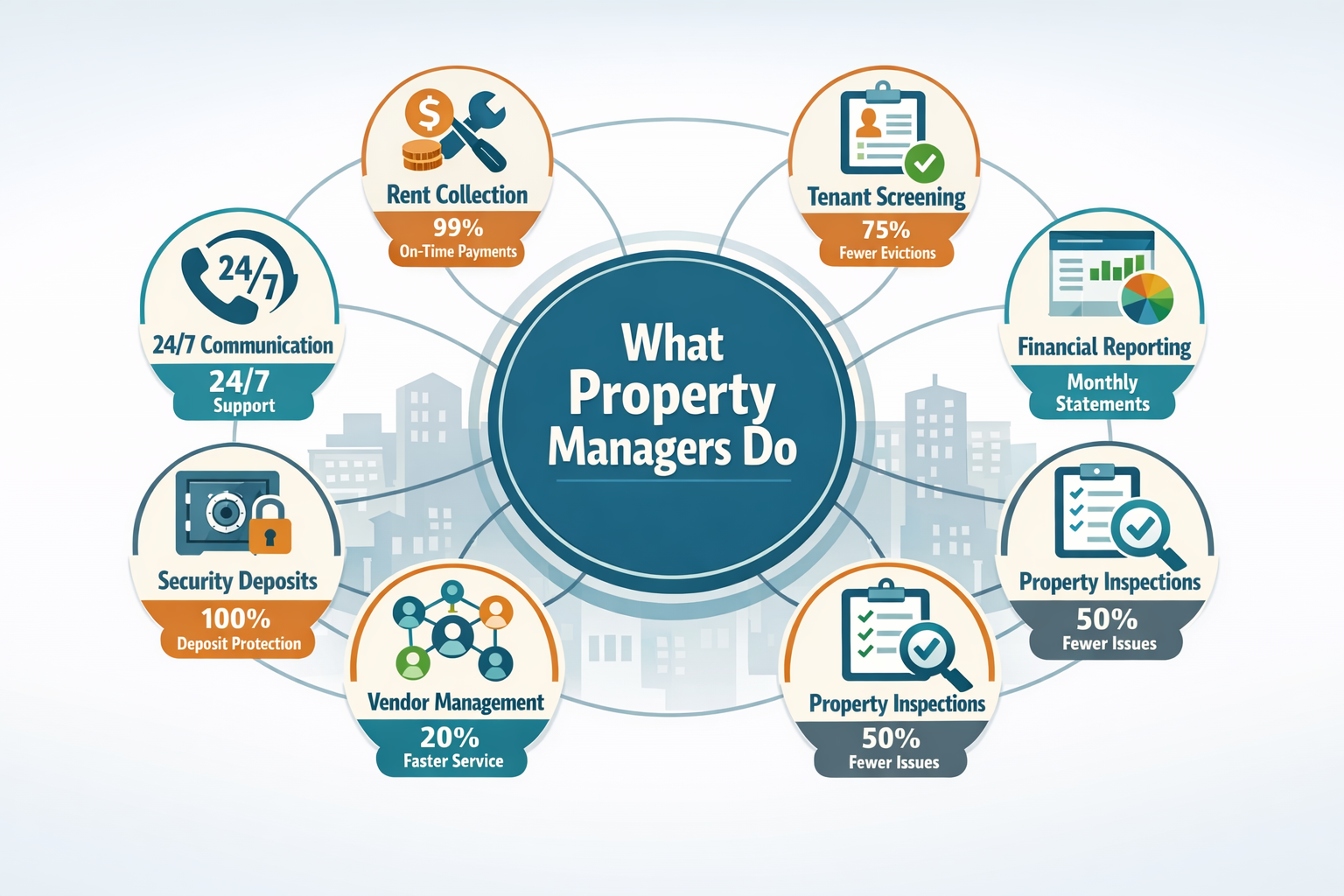
Property management companies handle the operational, financial, and legal tasks required to keep a rental occupied, maintained, and profitable. For first-time second-home investors, understanding exactly what's included in the monthly fee versus what costs extra is critical to evaluating value.
Core Day-to-Day Services (Usually Included in Monthly Fee)
Most property management agreements bundle these services into the standard monthly percentage fee:
Rent Collection & Accounting
- Collects rent via online portals, ACH transfers, or checks.
- Sends automated late notices and applies late fees per the lease.
- Tracks payments and maintains ledgers for owner and tenant accounts.
Tenant Communication
- Handles routine calls, emails, and maintenance requests.
- Mediates minor disputes over noise, parking, or neighbor complaints.
- Serves as the buffer between owner and tenant, reducing direct conflict.
Maintenance Coordination
- Receives work orders through tenant portals or phone lines.
- Screens issues to determine urgency (emergency vs routine).
- Dispatches licensed, insured vendors for repairs.
- Common jobs: leaky pipes, clogged drains, broken appliances, HVAC tune-ups.
Vendor Management
- Maintains a network of vetted contractors (plumbers, electricians, landscapers, HVAC techs).
- Ensures work completion and reviews invoices for accuracy.
- Some firms mark up vendor costs by 5-15% as a project-management fee; others pass through costs at net[5].
Property Inspections
- Move-in inspection: detailed condition report with photos documenting pre-existing damage.
- Periodic inspections: quarterly or semi-annual walk-throughs during the lease to catch maintenance issues early.
- Move-out inspection: itemized damage documentation to support security deposit deductions.
Security Deposit Handling
- Holds deposits in separate trust or escrow accounts as required by state law.
- Itemizes deductions for damages beyond normal wear and tear.
- Refunds remaining balance within statutory deadlines (typically 14-30 days post-move-out).
Financial Reporting
- Monthly owner statements showing rent collected, expenses paid, and net proceeds.
- Year-end summaries and 1099 forms for tax filing.
- Online portals for real-time access to transactions and documents.
Leasing / Tenant Placement Services (Usually Separate Fee)
Tenant placement is almost always billed separately from the monthly management fee. This one-time charge covers the intensive work of filling a vacancy:
- Market rent analysis: comparative market analysis (CMA) to set competitive pricing.
- Professional listing: high-quality photos, property description, and syndication to Zillow, Apartments.com, and local MLS.
- Showings: in-person tours or self-show technology (smart locks, scheduled access).
- Screening: credit checks, criminal background, income verification (typically 3x rent minimum), eviction history, and prior landlord references.
- Lease drafting: state-compliant lease agreements with addendums for pets, parking, utilities, etc.
- Move-in orientation: key handoff, lease signing, security deposit collection, and property walk-through.
Typical leasing fee: 50-100% of one month's rent[5]. In a market where rent is $2,000/month, expect to pay $1,000-$2,000 each time a new tenant moves in. Some firms offer lower leasing fees (or even free placement) if the monthly management percentage is higher, so compare the all-in cost structure.
Extra / Add-On Services
Beyond core management and leasing, many companies offer optional services for additional fees:
- Eviction support: filing paperwork, court coordination, and lockout assistance (legal fees and court costs are separate).
- Project management: oversight for larger repairs, renovations, or capital improvements (often 10-20% of project cost).
- Vacant watch services: periodic check-ins, mail collection, and utilities monitoring for properties between tenants.
- Rent guarantee or eviction protection plans: insurance-like products that cover lost rent during eviction or tenant default (monthly premium).
Understanding what's included versus what's extra prevents surprise bills and helps first-time investors budget accurately. For a side-by-side breakdown of two popular platforms, see our Airbnb vs Vacasa property management cost comparison.
What Does Property Management Cost in the US?
Property management fees in 2026 follow predictable patterns, but the all-in cost depends on lease turnover frequency, maintenance intensity, and local market conditions. This section provides a national snapshot and then breaks down regional differences.
National Snapshot
Monthly Management Fee (Residential Single-Family/Small Multifamily)
- Percentage-based: 8-12% of monthly rent collected, with 10% as the industry standard[5].
- Flat-fee alternative: $100-$150/month for single-family homes in many markets, more common in lower-rent areas where 10% would be under $100.
Leasing / Tenant Placement Fee
- Typical range: 50-100% of one month's rent[5].
- Example: $2,500/month rent = $1,250-$2,500 leasing fee per new tenant.
Other Common One-Time Fees
- Setup/onboarding: $100-$500 to load the property into the system, photograph the unit, and create owner accounts.
- Lease renewals: $150-$400 to process lease extensions, adjust rent, and update paperwork.
- Maintenance markup: 0-15% of vendor invoice, depending on the firm's business model[5].
Simple Cost Example
Let's walk through a real-world scenario for a first-time second-home investor:
Property Details:
- Monthly rent: $3,600
- Lease term: 12 months
- Tenant turnover: every 2 years (industry average)
Scenario A: 8% Management Fee
- Monthly management fee: $3,600 × 8% = $288/month
- Annual management cost: $288 × 12 = $3,456
- Leasing fee (every 2 years at 75% of one month's rent): $3,600 × 75% = $2,700
- Amortized annual leasing cost: $2,700 ÷ 2 = $1,350/year
- Total annual cost: $3,456 + $1,350 = $4,806 (≈11.1% of annual rent)
Scenario B: 10% Management Fee
- Monthly management fee: $3,600 × 10% = $360/month
- Annual management cost: $360 × 12 = $4,320
- Leasing fee (same): $1,350/year amortized
- Total annual cost: $4,320 + $1,350 = $5,670 (≈13.1% of annual rent)
Scenario C: 12% Management Fee
- Monthly management fee: $3,600 × 12% = $432/month
- Annual management cost: $432 × 12 = $5,184
- Leasing fee (same): $1,350/year amortized
- Total annual cost: $5,184 + $1,350 = $6,534 (≈15.1% of annual rent)
Takeaway: Even though the monthly percentage feels small, the all-in annual cost including leasing and other fees typically lands between 10-15% of gross rental income for single-family properties with normal turnover[5].
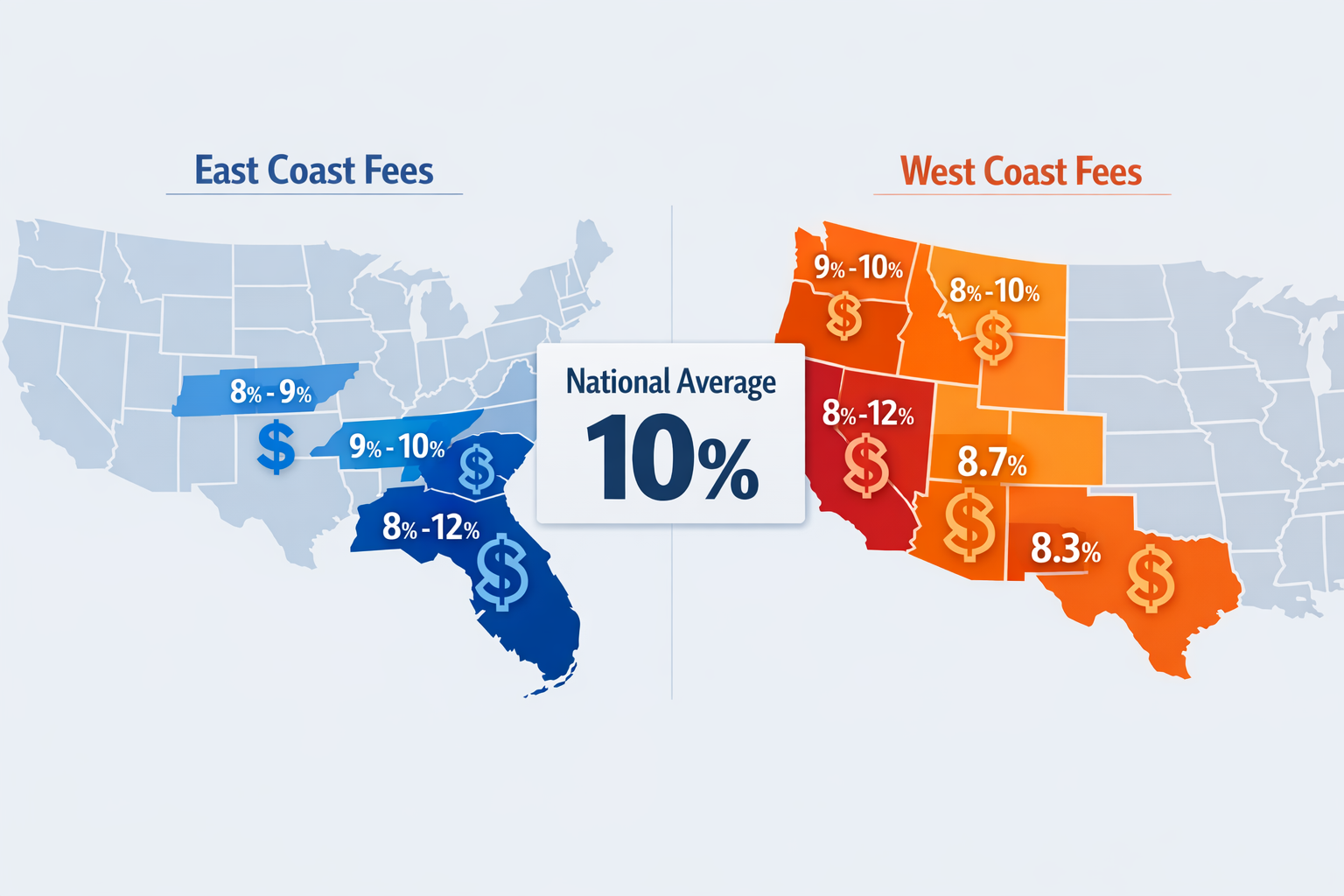
East Coast vs West Coast: Property Management Cost Ranges by State
Regional differences in property management fees reflect local labor costs, regulatory complexity, and market competition. Coastal, high-regulation cities lean toward the upper end of the 8-12% range, while smaller inland markets trend lower.
East Coast / Southeast Snapshot
Florida
- Management fee: 8-12% of monthly rent collected[5].
- Leasing fee: 50-100% of one month's rent.
- Renewal fee: $150-$300.
- Maintenance markup: 0-15% common.
- Notes: High-volume vacation rental markets (Orlando, Tampa, Miami) often have specialized short-term rental managers charging 20-30% for Airbnb-style properties, but traditional long-term residential management stays in the 8-12% band.
North Carolina
- Management fee: 8-9% of monthly rent[5].
- Setup fee: around $300.
- Renewal fee: ≈$150.
- Notes: Charlotte and Raleigh markets are competitive, keeping fees on the lower end. Smaller college towns may charge flat fees around $100-$125/month.
South Carolina
- Management fee: 9-10% of monthly rent[5].
- Flat-fee option: $85-$90/month in some markets.
- Renewal fee: ≈$230 or 10% of monthly rent.
- Notes: Charleston and Greenville have higher fees due to tourism and short-term rental crossover.
Tennessee
- Management fee: 8-9% of monthly rent[5].
- Setup fee: $150-$500.
- Renewal fee: ≈$180-$190.
- Notes: Nashville's hot rental market supports the higher end of the range; Memphis and Knoxville trend lower.
Northeast (New York, Boston, Philadelphia)
- Management fee: 10-12%+ due to higher labor costs and complex rent-control or tenant-protection laws[5].
- Leasing fee: often 100% of one month's rent or 15% of annual rent.
- Notes: Heavily regulated cities require licensed property managers and strict compliance with security deposit, lead paint, and habitability rules, driving up operational costs.
West Coast / Western States Snapshot
California (San Diego, Los Angeles, San Francisco)
- Management fee: 8-12% of monthly rent collected[5].
- Leasing fee: 50-100% of first month's rent.
- Maintenance markup: 5-15% of vendor cost common.
- Notes: California's landlord-tenant law is among the most tenant-friendly in the U.S., with strict notice requirements, just-cause eviction rules, and security deposit caps. Compliance complexity pushes fees toward 10-12% in major metros.
Washington (Seattle, Tacoma)
- Management fee: 9-10% of monthly rent[5].
- Flat-fee option: $100-$150/month.
- Renewal fee: around $200 or a percentage of rent.
- Notes: Seattle's rental regulations (including first-in-time screening rules and just-cause eviction) add compliance work, justifying higher fees.
Oregon (Portland)
- Management fee: 8-10% for single-family homes[5].
- Leasing fee: 50-100% of first month's rent.
- Renewal fee: $150-$399 range.
- Notes: Oregon's statewide rent control and tenant protections require careful lease administration, keeping fees near the middle to upper range.
Arizona (Phoenix, Tucson)
- Management fee: average ≈8.7%, range 6-12%[5].
- Leasing fee: around 50% of one month's rent for full-service clients.
- Notes: Arizona is landlord-friendly with fewer regulations, allowing competitive pricing. Phoenix's investor-heavy market keeps fees moderate.
Texas (Houston, Dallas, Austin)
- Management fee: average ≈8.3%, range 6-13%[5].
- Leasing fee: typically one month's rent.
- Notes: Texas has minimal state-level landlord-tenant regulation, and high competition among property managers keeps fees on the lower end. Austin's hot rental market supports slightly higher fees than Houston or Dallas.
General Pattern: Coastal, high-regulation cities (California, New York, Washington) lean toward 10-12%, while landlord-friendly states (Texas, Arizona, Florida outside vacation zones) cluster around 8-9%. Labor costs, insurance premiums (which jumped 26% in the last year[1]), and compliance requirements all factor into regional pricing.
Is a Property Manager Worth the Cost If You Own Just One Property?
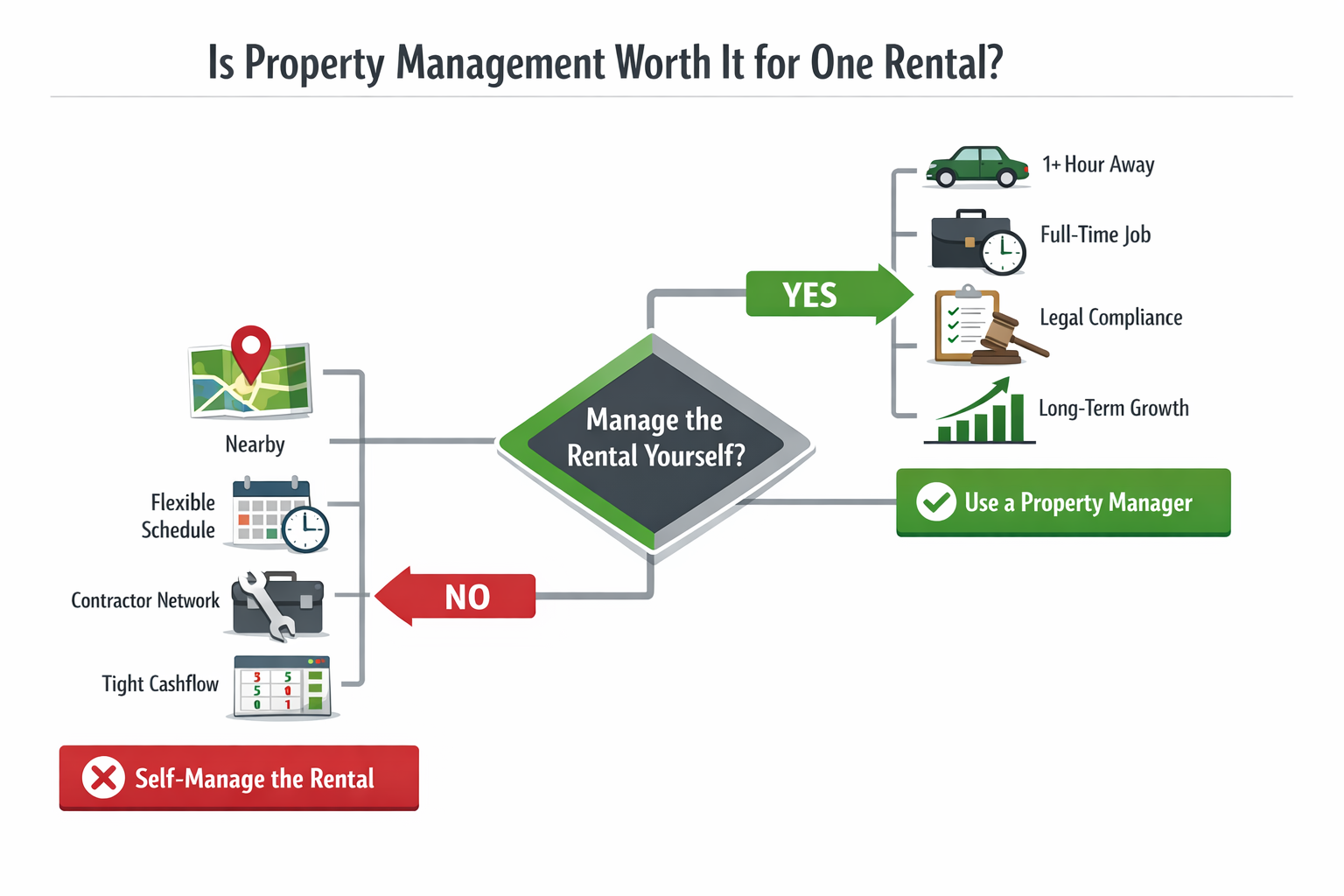
For first-time second-home investors, the decision to hire professional management often comes down to three factors: distance, time, and expertise. Here's how to evaluate whether the 8-12% fee makes sense when you own a single rental.
When It Usually Makes Sense
You live out-of-state or more than an hour away.
- Driving 90+ minutes each way for a showing, inspection, or emergency repair turns a $50 plumbing fix into a half-day event.
- Out-of-state owners face even higher costs: flights, hotels, or paying local handymen premium rates for last-minute work.
Your second home is in a high-regulation city where compliance mistakes are expensive.
- Cities like San Francisco, New York, Seattle, and Los Angeles have strict rules on security deposits, eviction notices, habitability standards, and rent control.
- A single procedural error (wrong notice period, improper deposit handling) can void an eviction or trigger penalties.
- Professional managers stay current on local ordinances and reduce legal risk.
You work full time and can't show homes, coordinate contractors, or chase late rent.
- Showings happen during business hours; maintenance emergencies don't wait for weekends.
- Tenant screening, lease drafting, and move-in coordination require 10-20 hours of focused work during a vacancy.
- If your day job pays well, the opportunity cost of DIY management exceeds the fee.
You're not comfortable with landlord-tenant law and eviction procedures.
- Evictions require precise legal steps: proper notice format, timelines, court filings, and lockout procedures.
- Mistakes can delay the process by months and cost thousands in lost rent.
- Managers handle evictions routinely and know the local court system.
You want this property to be a long-term asset, not a second job.
- Real estate investing should build wealth and passive income, not consume nights and weekends.
- If the goal is portfolio growth, delegating operations frees time to find the next deal.
When Self-Managing Might Be Fine
Your rental is nearby, and you have flexible hours.
- If the property is 15 minutes away and you control your schedule, handling showings and minor repairs is manageable.
You already have trusted contractors and handyman contacts.
- A reliable plumber, electrician, and HVAC tech eliminate the scramble when something breaks.
- Vendor relationships are one of the biggest value-adds managers provide; if you already have that network, you're halfway there.
You're comfortable learning local landlord laws and using software for rent collection.
- Platforms like TurboTenant, Avail, or Landlord Studio offer free or low-cost tools for rent collection, lease templates, and maintenance tracking.
- If you're willing to read your state's landlord-tenant statutes and stay organized, software can replace some management functions.
The rent is lower and the margin is thin, so fees would wipe out cashflow.
- On a $1,200/month rental, a 10% management fee ($120) plus $100/month in reserves leaves little room for profit.
- In low-rent markets, self-management or a flat-fee arrangement may be the only way to preserve cashflow.
Simple Rule of Thumb
If management fees plus reserves cut your monthly cashflow below a range you're comfortable with, self-managing or using a cheaper hybrid solution (software + à-la-carte leasing) may be better.
Run the numbers:
- Gross rent: $3,000/month
- Mortgage, taxes, insurance: $2,200/month
- Management (10%): $300/month
- Maintenance reserve (10%): $300/month
- Net cashflow: $200/month
If $200/month feels too thin, consider self-managing to reclaim the $300 fee. If $200/month is acceptable for truly passive income, the fee is worth it.
For more on evaluating whether to self-manage or hire help, see our complete guide to real estate investment property management.
How Much Time and Money Can a Property Manager Save You?
Understanding the value proposition of property management requires quantifying both time savings and financial benefits. Let's break down each.
Time Savings
Without a Manager: Estimated Time Per Month
- During vacancy (tenant search): 15-30 hours total over 2-4 weeks.
- Listing creation, photo editing, ad posting: 3-5 hours.
- Showings (assume 10 showings at 30 min each): 5 hours.
- Screening applications, calling references, running background checks: 4-6 hours.
- Lease drafting, negotiation, signing, move-in walk-through: 3-4 hours.
- During occupancy (steady state): 2-10 hours/month.
- Rent collection follow-up, late notices: 1-2 hours.
- Maintenance requests, getting quotes, coordinating vendors: 2-5 hours.
- Periodic inspections, tenant communication: 1-3 hours.
- During turnover or eviction: 20-40 hours total.
- Move-out inspection, damage documentation, deposit itemization: 3-5 hours.
- Cleaning, repairs, contractor coordination: 10-20 hours.
- Eviction paperwork, court appearances: 10-15 hours (if needed).
With a Manager: Estimated Time Per Month
- Steady state: 1-2 hours/month reviewing statements, approving major repairs, and checking in.
- Vacancy or turnover: 2-3 hours total for approving pricing, reviewing lease terms, and final inspections.
Net Time Savings: 5-10 hours per month on average, more during vacancies and turnovers.
Value of Time Calculation:
If you value your time at $75/hour (a reasonable estimate for professionals), saving 5-10 hours/month equals $375-$750 of implicit value versus a $300-$360 management fee on a $3,600/month rental. The fee pays for itself if you use the reclaimed time productively (career advancement, family, finding the next investment).
Money Savings (Where Pros Can Actually Add Value)
Better Pricing
- Experienced managers know hyperlocal rent comps and can push pricing 3-5% higher without causing long vacancy.
- On a $3,000/month rental, that's an extra $90-$150/month ($1,080-$1,800/year), which more than covers the management fee.
Lower Vacancy Through Professional Marketing and Screening
- National median rent hit $1,964.80 in 2024, up 3.4% year-over-year[1]. Vacancy costs compound fast.
- A property vacant for 30 extra days costs one month's rent. Professional listing, photography, and syndication reduce time-to-lease.
- Rigorous screening lowers the risk of problem tenants who stop paying or damage the property.
Fewer Legal Mistakes
- Incorrect eviction notices, improper security deposit handling, or fair-housing violations can cost thousands in legal fees, penalties, or lost rent.
- Managers stay current on local ordinances and follow compliance checklists.
Better Vendor Pricing (Sometimes)
- Managers with volume relationships may negotiate 10-20% discounts with plumbers, electricians, and HVAC techs.
- However, some firms mark up vendor invoices by 5-15%, so the net savings depend on the firm's business model[5].
Reduced Tenant Turnover
- The average cost of tenant turnover is approximately $1,750 per unit[1], including cleaning, repairs, lost rent, and re-leasing fees.
- Professional property management improves tenant satisfaction through responsive maintenance and clear communication, extending lease terms.
Operational Efficiency Gains
- Organizations using AI and automation in property management report 20-30% improvement in operational efficiency[1].
- AI can reduce errors in lease administration by up to 42% and save property managers up to 10 hours per week[1].
- While these stats apply to larger firms, first-time investors benefit indirectly when their manager uses modern software for rent collection, maintenance tracking, and financial reporting.
Bottom Line: Professional management can add value through higher rent, lower vacancy, fewer legal errors, and reduced turnover—but only if the manager is competent and the fee structure is reasonable. Compare the all-in cost (management + leasing + markups) against the time and risk savings to determine ROI.
Where to Find the Best Property Management Company for Your First-Time Second-Home Investment
Finding the right property management company requires a mix of professional directories, online reviews, and local referrals. Here's where to start.
Professional Directories
NARPM (National Association of Residential Property Managers)
- Website: narpm.org
- Filter by city, state, and designations (MPM®, RMP®, CPM®).
- NARPM members adhere to a code of ethics and pursue continuing education.
- Look for the RMP® (Residential Management Professional) or MPM® (Master Property Manager) designations as signals of experience and professionalism.
IREM (Institute of Real Estate Management)
- Website: irem.org
- More common with larger multifamily, commercial, or mixed-use properties, but some single-family managers hold the CPM® (Certified Property Manager) credential.
- Useful if your second home is a condo or part of a small multifamily building.
Online Platforms & Reviews
Google Maps + Google Reviews
- Search "[your city] property management company" and filter by 4.3★ or higher.
- Read recent reviews (last 6-12 months) to gauge responsiveness, transparency, and tenant/owner satisfaction.
- Look for patterns: consistent complaints about hidden fees, slow maintenance, or poor communication are red flags.
BiggerPockets Forums
- Active community of real estate investors sharing local manager recommendations.
- Search for your city in the forums or post a request for referrals.
- Investors tend to give honest feedback because their money is on the line.
Local Landlord Facebook Groups & Reddit City Subreddits
- Search Facebook for "[city] landlords" or "[city] real estate investors."
- Reddit city subs (r/YourCity) often have threads asking for property manager recommendations.
- Filter feedback: tenant reviews focus on responsiveness; owner reviews focus on fees, transparency, and financial performance.
Local Real Estate Investment Associations (REIAs)
- Most metro areas have monthly REIA meetups where landlords and investors network.
- Ask attendees which managers they use and trust.
- REIAs often have preferred vendor lists with vetted property managers.
Referral Sources
Investor-Friendly Real Estate Agents
- Agents who specialize in investment properties work with property managers regularly and can recommend firms with strong track records.
- Ask your buyer's agent (if you used one) or find a local investor-focused agent through BiggerPockets or NARPM.
Other Landlords in Your Market
- If you know other rental property owners in the area, ask who they use and whether they'd recommend them.
- Landlords are often brutally honest about manager performance because poor management hits their bottom line.
Your CPA or Real Estate Attorney
- Tax professionals and real estate lawyers see the financial and legal outcomes of property management relationships.
- They can identify firms that provide clean, accurate financial reporting and avoid compliance issues.
For additional context on evaluating property management options, explore our Airbnb vs Vacasa cost comparison.
Questions to Ask Your Next Property Management Company (First-Time Second-Home Investor's Guide Edition)
Interviewing property management companies is like hiring an employee who will handle tens of thousands of dollars of your money each year. Ask detailed questions and compare written answers across multiple firms.
Fees and Structure
What is your monthly management fee, and is it based on rent collected or rent due?
- "Rent collected" means you only pay when the tenant pays. If rent is late or unpaid, you don't owe the management fee.
- "Rent due" means you pay the fee even if the tenant doesn't pay, which shifts risk to the owner.
- Most firms use "rent collected," but confirm in writing.
What are your leasing / tenant placement fees and renewal fees?
- Get exact dollar amounts or percentages.
- Example: "Leasing fee is 75% of one month's rent; renewal fee is $250."
- Ask if the leasing fee includes advertising, screening, and lease drafting, or if those are separate line items.
Do you charge setup or onboarding fees? How much?
- Typical range: $100-$500.
- Some firms waive this for multi-year contracts or multiple properties.
Do you mark up maintenance invoices or charge a project-management fee?
- Common markups: 5-15% of vendor cost[5].
- Some firms pass through vendor invoices at net and charge a flat monthly fee instead.
- Ask for transparency: "Will I see the original vendor invoice or just a summary?"
Maintenance and Repairs
What is my repair approval limit before you need my permission?
- Common thresholds: $200-$500.
- Higher limits give the manager flexibility to fix urgent issues fast; lower limits give you more control.
- Set a limit that matches your risk tolerance and the property's condition.
Do you have an in-house maintenance team or use third-party vendors?
- In-house teams can respond faster and may cost less, but third-party vendors provide specialization and licensing.
- Ask if vendors are licensed, insured, and background-checked.
Do you offer 24/7 emergency response, and how is that billed?
- True emergencies (burst pipes, gas leaks, lockouts) need immediate response.
- Ask if after-hours calls incur extra fees or if emergency response is included in the monthly fee.
Tenant Screening and Leasing
What is your screening criteria (credit score, income multiple, eviction history)?
- Industry standard: minimum credit score 600-650, income 3x monthly rent, no evictions in the last 3-5 years.
- Confirm the manager follows Fair Housing laws and applies criteria consistently.
How quickly do you usually fill vacancies in this area?
- Ask for average days-on-market for similar properties.
- Compare against local market data (Zillow, Apartments.com) to verify.
Can I see a sample lease agreement?
- Review the lease for state compliance, clarity, and landlord-friendly terms.
- Check for clauses on late fees, maintenance responsibilities, lease violations, and early termination.
Communication and Reporting
Who will be my main point of contact as an owner?
- Will you have a dedicated account manager, or will you email a general inbox?
- Ask for the contact's name, phone number, and typical response time.
How often do I receive statements and reports?
- Monthly statements are standard.
- Ask if you get real-time access to an online portal showing transactions, maintenance tickets, and documents.
How quickly do you respond to owner emails or calls?
- Look for commitments like "within 24 business hours" or "same-day for urgent issues."
- Test responsiveness during the interview process: if they're slow to reply now, expect the same later.
Legal and Compliance
How do you handle late payers and evictions?
- Ask about the timeline: when do late notices go out, when does eviction filing happen, and who coordinates with the attorney?
- Confirm the manager uses licensed eviction attorneys and follows state-specific procedures.
How do you manage security deposits to comply with state law?
- Deposits must be held in separate trust or escrow accounts in most states.
- Ask if interest is paid (required in some states) and how itemized deductions are documented.
Are you licensed and insured in this state?
- Many states require property managers to hold a real estate broker license.
- Ask for proof of errors-and-omissions (E&O) insurance to protect against mistakes.
For more on evaluating real estate professionals, see our guide to hiring the right contractors for renovations.
Tricks and Tips to Get the Best Deal on Property Management
Negotiating with property management companies is so based when you know what levers to pull. Here's how to maximize value and minimize all-in cost.
Compare the All-In Cost, Not Just the Percentage
Don't get anchored on the monthly percentage alone. Add up:
- Monthly management fee (percentage or flat)
- Leasing / tenant placement fee (per new tenant)
- Setup / onboarding fee (one-time)
- Renewal fee (per lease extension)
- Maintenance markup or project-management fee (percentage of repairs)
Example Comparison:
| Firm | Monthly Fee | Leasing Fee | Setup | Renewal | Maintenance Markup | Est. Annual Cost (2-year tenant) |
|---|---|---|---|---|---|---|
| A | 8% ($288) | 100% ($3,600) | $300 | $200 | 10% | $5,256 + markup |
| B | 10% ($360) | 50% ($1,800) | $0 | $150 | 0% | $5,670 |
| C | 12% ($432) | 75% ($2,700) | $500 | $300 | 5% | $7,034 + markup |
Firm B has the highest monthly percentage but the lowest all-in cost because of lower leasing fees and no markup. Run this calculation for each quote.
Ask for Volume or Longevity Discounts
Multi-Property Discount
- If you plan to add more rentals, ask: "What's your fee structure if I bring you a second property in the next 12 months?"
- Many firms reduce the percentage to 7-9% once you have 2-3 doors with them.
Long-Term Contract Discount
- Offer to sign a 2-year agreement in exchange for waived setup fees or a 0.5-1% reduction in the monthly rate.
- Managers value stable, long-term clients and may negotiate to secure the contract.
Negotiate Caps and Thresholds
Maintenance Approval Cap
- Set a threshold (e.g., $300) below which the manager can approve repairs without calling you.
- This speeds up response time and reduces decision fatigue.
- For major repairs (e.g., HVAC replacement), require written quotes and owner approval.
Cap Maintenance Markups
- If the firm marks up vendor invoices, negotiate a cap: "No more than 10% markup on repairs under $1,000."
- Or ask for net pass-through (no markup) in exchange for a slightly higher monthly fee.
Waive or Discount Setup Fees
- Setup fees are often negotiable, especially if you're signing a multi-year agreement or bringing multiple properties.
- Ask: "Can you waive the $500 setup fee if I commit to a 2-year contract?"
Use Competition
Get 3-5 Written Quotes
- Collect detailed fee schedules from at least three firms.
- Use a spreadsheet to compare apples-to-apples.
Share the Best Offer
- Once you have a preferred firm, share the competitor's lower offer: "Firm X is offering 8% with no setup fee. Can you match or beat that?"
- Managers know the market is competitive and may adjust to win your business.
Leverage NARPM Membership
- NARPM members often compete on service quality and ethics, not just price.
- If a non-NARPM firm quotes lower fees, ask your preferred NARPM manager if they can adjust to stay competitive while maintaining higher standards.
For additional strategies on negotiating real estate costs, check out our negotiation power moves to save thousands.
Step-by-Step Checklist for First-Time Second-Home Investors Hiring a Property Manager
Turn everything above into a simple, scannable action plan:
Phase 1: Financial Analysis (Week 1)
-
Run cashflow projections with and without a manager.- Calculate net income at 8%, 10%, and 12% management fees.
- Include leasing fees, maintenance reserves, and vacancy estimates.
- Determine your minimum acceptable monthly cashflow.
-
Decide if your time, distance, and stress level justify professional management.- Estimate hours per month you'd spend self-managing.
- Value your time at your hourly rate or opportunity cost.
- Compare time value against management fee.
Phase 2: Research and Shortlist (Week 2)
-
Shortlist 3-5 companies via NARPM/IREM, online reviews, and referrals.- Search NARPM directory for local members.
- Read Google reviews (4.3★ minimum).
- Ask investor friends, agents, or REIAs for recommendations.
-
Collect written fee schedules from each company.- Request detailed breakdowns: monthly fee, leasing fee, setup, renewals, markups.
- Ask for sample owner agreements and lease templates.
Phase 3: Interviews and Due Diligence (Week 3)
-
Use the question list above in every interview.- Fees and structure (4 questions).
- Maintenance and repairs (3 questions).
- Tenant screening and leasing (3 questions).
- Communication and reporting (3 questions).
- Legal and compliance (3 questions).
-
Compare all-in annual cost (not just the percentage fee).- Build a comparison table (see example above).
- Include leasing, setup, renewals, and estimated maintenance markups.
Phase 4: Negotiation and Contract (Week 4)
-
Negotiate approval limits, markups, and setup fees.- Set maintenance approval cap ($200-$500).
- Cap or eliminate maintenance markups.
- Ask to waive setup fees for multi-year contracts.
-
Use competition to get the best offer.- Share the lowest all-in quote with your preferred firm.
- Ask if they can match or beat it.
-
Start with a 1-year agreement and set a calendar reminder to review performance before renewing.- Avoid long-term contracts until you've tested the relationship.
- Schedule a 10-month check-in to evaluate: responsiveness, financial accuracy, tenant satisfaction, and maintenance quality.
Phase 5: Onboarding and Monitoring (Month 1-3)
-
Provide all property documents, keys, and vendor contacts.- Lease agreements, warranties, HOA rules, inspection reports.
- Existing vendor list (if any).
-
Review first 3 months of statements closely.- Check for accuracy in rent collection, expense tracking, and owner distributions.
- Flag any discrepancies or unclear line items immediately.
-
Test communication responsiveness.- Send a non-urgent question and track response time.
- If response times exceed 48 hours, address it in writing.
For more on preparing your property for professional management, see our expert tips for preparing your home to attract buyers (many of the same principles apply to rental-ready condition).
Understanding the 2026 Property Management Landscape: Trends Impacting First-Time Investors
The property management industry is evolving rapidly in 2026, driven by rising costs, technology adoption, and shifting tenant expectations. First-time second-home investors should understand these trends to make informed decisions.
Rising Operational Costs
Insurance Premiums Surge
- Insurance premiums jumped 26% in the last year, driven by climate-related claims, inflation, and carrier exits from high-risk markets[1].
- Property managers pass these costs through to owners, either directly or by raising fees to cover their own business insurance (which also increased).
Maintenance Expenses Up 12%
- The average cost of property maintenance increased 12% in 2024[1], driven by labor shortages, material costs, and inflation.
- Expect higher vendor invoices for HVAC, plumbing, electrical, and appliance repairs.
93% of Firms Report Cost Increases
- 93% of property management companies experienced expense increases over the past year, primarily in vendor costs, materials, and business insurance[2].
- These increases justify fee hikes or new line items (e.g., administrative fees, technology fees).
Occupancy and Rent Growth Concerns
43% Worry About Occupancy
- In 2025, 43% of property managers worry about maintaining high occupancy rates (up from 35% in 2024)[1].
- Multifamily unit deliveries are expected to fall 20% in 2025 to 497,000 units, which should tighten supply and support rent growth, but managers remain cautious about economic headwinds[1].
Rent Growth Continues
- National median rent increased 3.4% in 2024 to $1,964.80—a 32% increase over five years[1].
- Higher rents directly translate into higher percentage-based management fees, benefiting managers but also reflecting the value they deliver in maximizing rent.
85% of Landlords Raised Rents
- 85% of landlords raised rents in 2024 to combat rising operational costs[1].
- This trend reflects market leverage but also increases tenant turnover risk if rents outpace local wage growth.
Technology and Automation
AI and Automation ROI
- Organizations using AI in property management report a 20-30% improvement in operational efficiency[1].
- AI can reduce errors in lease administration by up to 42% and save property managers up to 10 hours per week[1].
- First-time investors benefit when their manager uses modern software for rent collection, maintenance tracking, and financial reporting.
Software Market Growth
- The property management software market reached $6.13 billion in 2024 and expects to hit $13.20 billion by 2032, growing at a 10.14% CAGR[1].
- Platforms like Buildium, AppFolio, and Rent Manager are becoming industry standards, improving transparency and owner access to real-time data.
Tenant Expectations
- Tenants increasingly expect online portals for rent payment, maintenance requests, and lease documents.
- Managers who don't offer digital tools risk higher vacancy and lower tenant satisfaction.
Tenant Turnover and Retention
Turnover Costs $1,750 Per Unit
- The average cost of tenant turnover runs approximately $1,750 per unit[1], including cleaning, repairs, lost rent, and re-leasing fees.
- Professional property management improves tenant retention through responsive maintenance, clear communication, and fair treatment, extending lease terms and reducing turnover frequency.
For more on market trends affecting real estate investors, explore our real estate market trends and mortgage options for new buyers.
Common Mistakes First-Time Second-Home Investors Make When Hiring Property Managers
Avoid these pitfalls to protect your investment and relationship with your manager.
Mistake 1: Choosing Based on the Lowest Fee Alone
Why it's a problem: A firm charging 6% with poor tenant screening, slow maintenance response, and sloppy accounting will cost more in vacancy, turnover, and legal issues than a 10% firm that fills vacancies fast and retains good tenants.
Fix: Compare all-in cost (fees + leasing + markups) and evaluate service quality through reviews, references, and interview questions.
Mistake 2: Not Reading the Management Agreement
Why it's a problem: Buried in the fine print are clauses about early termination fees, automatic renewals, owner responsibilities, and dispute resolution.
Fix: Read the entire agreement before signing. Flag unclear terms and ask for written clarification. Negotiate unfavorable clauses (e.g., 90-day termination notice instead of 180 days).
Mistake 3: Failing to Set Clear Maintenance Approval Limits
Why it's a problem: Without a written approval threshold, managers may either call you for every $50 repair (decision fatigue) or approve $2,000 jobs without permission (budget shock).
Fix: Set a cap in writing (e.g., "Manager may approve repairs up to $300 without owner approval; anything above requires written quote and owner sign-off").
Mistake 4: Ignoring Red Flags During the Interview
Why it's a problem: Slow email responses, vague answers about fees, reluctance to provide references, or unprofessional communication during the sales process signal how the relationship will go.
Fix: Trust your gut. If a manager is unresponsive or evasive before you sign, walk away.
Mistake 5: Not Monitoring Financial Statements
Why it's a problem: Errors, unauthorized charges, or even fraud can go undetected if you don't review monthly statements.
Fix: Review every statement for the first 3-6 months. Check rent collected, expenses paid, and owner distributions. Flag discrepancies immediately.
Mistake 6: Signing a Long-Term Contract Without Testing the Relationship
Why it's a problem: A 3-year contract locks you in even if service quality declines.
Fix: Start with a 1-year agreement. Negotiate a 30-60 day termination clause for the first year. Renew only after confirming performance.
For more on avoiding common real estate mistakes, see our guide to avoiding pricing pitfalls when valuing your home.
Frequently Asked Questions (FAQ)

What is the average property management fee in the US?
The average property management fee for residential single-family homes is 8-12% of monthly rent collected, with 10% serving as the industry benchmark[5]. Fees vary by region, property type, and services included.
Do property managers charge extra for tenant placement?
Yes. Most property managers charge a separate leasing or tenant placement fee of 50-100% of one month's rent to cover marketing, showings, screening, and lease drafting[5]. This is a one-time fee per new tenant.
Is property management worth it for one rental property?
It depends on distance, time, and expertise. Property management is usually worth it if the property is out-of-state, you work full-time, the market has complex regulations, or you lack a local contractor network. Self-managing may be fine if the property is nearby, you have flexible hours, and you're comfortable with landlord-tenant law.
How do I find a reputable property management company?
Start with professional directories like NARPM (National Association of Residential Property Managers) and IREM (Institute of Real Estate Management). Read Google reviews (4.3★ minimum), ask for referrals from investor-friendly agents or local landlords, and interview at least 3-5 firms before deciding.
What questions should I ask a property management company before hiring?
Ask about monthly fees (percentage or flat), leasing and renewal fees, setup costs, maintenance markups, repair approval limits, screening criteria, vacancy fill time, communication protocols, financial reporting frequency, eviction procedures, security deposit handling, and licensing/insurance.
Can I negotiate property management fees?
Yes. Negotiate by comparing 3-5 written quotes, asking for volume or longevity discounts, capping maintenance markups, waiving setup fees, and using competition to get the best offer. Most firms will adjust fees to win or retain business.
What is included in a typical property management agreement?
Typical agreements include rent collection, tenant communication, maintenance coordination, vendor management, property inspections, security deposit handling, and financial reporting. Leasing/tenant placement is usually a separate fee. Read the agreement carefully for exclusions and owner responsibilities.
How much does tenant turnover cost?
The average cost of tenant turnover is approximately $1,750 per unit[1], including cleaning, repairs, lost rent during vacancy, and re-leasing fees. Professional management can reduce turnover by improving tenant satisfaction and retention.
Do property managers mark up maintenance costs?
Some do. Maintenance markups of 5-15% of vendor cost are common[5]. Some firms pass through vendor invoices at net and charge a flat monthly fee instead. Ask for transparency and negotiate caps or elimination of markups.
What is the difference between a flat fee and percentage-based property management?
Percentage-based fees (8-12% of monthly rent) scale with rent and align the manager's incentive with maximizing rent. Flat fees ($100-$150/month) provide predictable costs but may not incentivize rent optimization. Flat fees work better in lower-rent markets; percentage fees are standard in higher-rent areas.
How long does it take to fill a vacancy?
Average time-to-lease varies by market, season, and rent price. Professional managers typically fill vacancies in 14-30 days in competitive markets with strong marketing and pricing. Ask your manager for local averages and compare against their track record.
Can I fire my property manager if I'm unhappy?
Yes, but check your management agreement for termination clauses. Most require 30-90 days written notice. Some charge early termination fees. Start with a 1-year agreement and negotiate a shorter termination window for flexibility.
Key Takeaways: First-Time Second-Home Investor's Guide to Property Management
- Property management fees typically range from 8-12% of monthly rent, with 10% as the national benchmark, plus one-time leasing fees of 50-100% of one month's rent when placing new tenants[5].
- All-in annual costs usually run 10-15% of gross rental income when you include monthly fees, leasing, renewals, setup, and maintenance markups[5].
- Regional differences matter: East Coast markets (Florida, North Carolina) average 8-12%, while West Coast cities (California, Washington) trend 9-12% due to higher labor and compliance costs[5].
- Professional management saves 5-10 hours per month on showings, maintenance, tenant communication, and legal compliance—time that can justify the fee even for single-property owners.
- Operational costs are rising fast: insurance premiums jumped 26%, maintenance costs increased 12%, and 93% of property management companies experienced expense increases in 2025[1][2].
- Tenant turnover costs approximately $1,750 per unit, making tenant retention and professional screening critical to profitability[1].
- Technology adoption is accelerating: AI and automation improve efficiency by 20-30%, reduce lease administration errors by 42%, and save managers up to 10 hours per week[1].
- Professional management makes sense when: the property is out-of-state, you work full-time, the market has complex regulations, or you lack a local contractor network.
- Self-managing may be better when: the property is nearby, you have flexible hours, you already have trusted contractors, or the rent is low and margins are thin.
- Negotiate for the best deal: compare 3-5 written quotes, ask for volume or longevity discounts, cap maintenance markups, waive setup fees, and use competition to drive down all-in costs.
Conclusion: Making the Right Property Management Decision for Your Second Home
Owning a second home as a rental property can be an impeccable wealth-building strategy, but only if the day-to-day operations don't consume your time, energy, and sanity. For first-time second-home investors, the decision to hire a property management company versus self-managing comes down to a simple calculation: does the 8-12% fee deliver more value in time savings, legal protection, and financial performance than it costs?
The answer depends on your distance from the property, your availability, your comfort with landlord-tenant law, and your long-term goals. If the property is out-of-state, you work full-time, or the market has complex regulations, professional management is usually worth every penny. If the property is nearby, you have flexible hours, and you're willing to learn the ropes, self-managing with good software can preserve cashflow and build valuable skills.
Next Steps:
-
Run the numbers. Calculate your net cashflow at 8%, 10%, and 12% management fees, including leasing, renewals, and maintenance reserves. Determine your minimum acceptable monthly profit.
-
Shortlist 3-5 firms. Use NARPM, Google reviews, and local referrals to identify reputable managers in your market.
-
Interview and compare. Use the question list above to evaluate service quality, fee structure, and communication style. Build a comparison table to see the all-in annual cost.
-
Negotiate. Ask for volume discounts, cap markups, waive setup fees, and use competition to get the best deal.
-
Start with a 1-year agreement. Test the relationship before committing long-term. Set a calendar reminder to review performance at 10 months.
-
Monitor closely. Review financial statements monthly for the first 3-6 months. Flag errors or unclear charges immediately.
The property management industry is evolving in 2026, with rising costs, technology adoption, and shifting tenant expectations. First-time investors who choose the right partner, negotiate smart, and stay engaged will turn their second home into a truly passive income stream. Let it cook, stay informed, and don't let anyone gatekeep the knowledge you need to succeed.
For more real estate investment strategies, explore our complete guide to real estate investment property management and our expert tips on maximizing rental property returns.
References
[1] Property Management Industry Statistics – https://www.revenuememo.com/p/property-management-industry-statistics
[2] 2026 Property Management Industry Trends – https://www.buildium.com/blog/2026-property-management-industry-trends/
[5] Property Management Fees By State – https://www.doorloop.com/blog/property-management-fees-by-state