






Here's the thing about flipping houses — finding the right property is only half the battle. The real game-changer? Securing the right financing. Whether the market is red-hot or cooling off, the best loans for flipping houses can make or break a deal before a single wall gets demo'd. And in 2026, with new capital flooding the fix-and-flip space, loosening inventory, and regulatory shifts shaking things up, the financing landscape looks more extraordinary than it has in years.
According to JBR Financial, 71% of flippers plan to increase their purchases in 2026, fueled by price stabilization and lower financing costs from new institutional capital [6]. That's a massive signal. Whether someone is a seasoned investor eyeing their 20th flip or a first-timer ready to swing a sledgehammer, understanding the financing options available is absolutely essential.
This guide breaks down every major loan type for house flipping, compares costs and timelines, explains the 2026 regulatory changes that matter, and delivers actionable strategies to help investors pick the impeccable financing match for their next project. Let it cook. 🔥
Key Takeaways
- Hard money loans remain the fastest option for flippers, with some lenders closing in as few as 7 days — but rates typically range from 9.5% to 15% [1].
- HELOCs and home equity loans offer the lowest rates (averaging around 8.5%) and are used by roughly 35% of flippers who finance their deals.
- 2026 brings fresh opportunities: Kiavi's $350M securitization and growing institutional capital are improving financing conditions for fix-and-flip investors [10].
- New regulations like FinCEN's Residential Real Estate Reporting Rule (effective March 1, 2026) require awareness, though mortgage-financed deals are generally exempt [8].
- Avoiding common financing mistakes — like having no exit strategy or underestimating rehab costs — is just as important as choosing the right loan [7].
Understanding the Best Loans for Flipping Houses: Your Complete Options

Not all flip financing is created equal. Each loan type comes with its own speed, cost, and risk profile. Here's a comprehensive breakdown of the best loans for flipping houses available in 2026.
Hard Money Loans
Hard money loans are the bread and butter of house flipping. These are short-term loans (typically 6–18 months) issued by private lenders who focus on the property's value rather than the borrower's credit score.
Why flippers love them:
- ⚡ Speed: Some lenders, like Kiavi, can close in as few as 7 days [10]
- 🏚️ Distressed property friendly: Banks won't touch properties in rough shape, but hard money lenders will
- 📊 ARV-based lending: Borrow based on the After-Repair Value, not the current condition
The catch:
- Interest rates typically range from 9.5% to 15% [1]
- Origination fees run 2–3% of the loan amount
- Short repayment windows mean no room for delays
💡 Pro Tip: Hard money makes the most sense for experienced flippers who can execute quickly. The speed advantage often outweighs the higher cost when competing for distressed properties.
Home Equity Loans & HELOCs
For investors who already own property with equity, home equity loans and HELOCs (Home Equity Lines of Credit) are so based as a financing strategy. AmeriSave's Jon Kollman highlights these as top choices for the 35% of flippers who use financing, citing significantly lower rates compared to hard money options [1].
| Feature | Home Equity Loan | HELOC |
|---|---|---|
| Average Rate | ~8.5% | ~8.5% (variable) |
| Structure | Lump sum | Revolving credit line |
| Best For | Known rehab budgets | Flexible spending needs |
| Risk | Primary home as collateral | Primary home as collateral |
⚠️ Important warning: Casey Foster at AmeriSave cautions that using a cash-out refinance or HELOC puts the primary home at risk if the flip goes sideways [1]. That's a risk worth taking seriously.
For those exploring mortgage fundamentals, the guide to types of mortgage loans and comparing lenders provides a solid foundation.
Bridge Loans / Rehab Loans
Bridge loans sit in a sweet spot between hard money and traditional financing. They're specifically designed for the buy-rehab-sell cycle and offer some unique advantages:
- ARV-based funding: Up to 75–90% of the After-Repair Value
- Draw schedules: Renovation funds released in stages as work is completed
- Typical rates: Around 11%, which is lower than pure hard money [1]
- Timeline: Slightly slower than hard money (2–3 weeks to close vs. 7–10 days)
These loans work well for flippers tackling larger renovation projects where the rehab budget needs structured disbursement.
Conventional Bank Loans
Traditional bank loans offer the lowest interest rates but come with the most hoops to jump through. Most banks require:
- Strong credit scores (680+)
- 20–25% down payment
- Full income documentation
- The property to be in livable condition
The Federal Reserve signaled regulatory changes in February 2026 to ease bank capital rules on mortgage servicing rights, which could encourage banks to re-enter mortgage origination more aggressively — potentially benefiting flip financing indirectly.
Private Money Loans
Private money comes from individuals — friends, family, or private investors — rather than institutions. Terms are fully negotiable, which makes this option extraordinarily flexible.
- No standardized qualification requirements
- Interest rates vary wildly (6% to 15%+)
- Relationship-driven lending
- Can be structured creatively (profit-sharing, equity stakes, etc.)
Business Lines of Credit
For established flippers running multiple projects, a business line of credit provides revolving capital. It's not ideal for first-time flippers, but for portfolio investors, it's a game-changer for managing cash flow across simultaneous deals.
How to Choose the Best Loans for Flipping Houses in 2026
Choosing the right loan isn't just about finding the lowest rate. It's about matching the financing to the specific deal, timeline, and risk tolerance. Here's a framework that works in any market condition.
Match the Loan to the Deal Type
Different flip scenarios call for different financing:
| Scenario | Best Loan Type | Why |
|---|---|---|
| Quick cosmetic flip (30–60 days) | Hard money | Speed to close, short hold |
| Major renovation (4–6 months) | Bridge/rehab loan | Draw schedules, ARV-based |
| Investor with home equity | HELOC | Lowest rates, flexible draws |
| First flip, strong credit | Conventional | Lowest cost, longer timeline |
| Experienced, multiple flips | Business line of credit | Revolving capital, efficiency |
Factor in Total Cost, Not Just Interest Rate
A common mistake? Fixating on the interest rate while ignoring the total cost of the loan. Here's what to calculate:
- Origination fees (1–3% of loan amount)
- Interest cost (rate × loan amount × hold time)
- Closing costs and appraisal fees
- Prepayment penalties (some lenders charge them)
- Extension fees if the project runs long
For example, a hard money loan at 12% held for 4 months might actually cost less than a bridge loan at 10% that takes 3 weeks to close — because those extra weeks of holding costs on the property (taxes, insurance, utilities) add up fast.
Speed vs. Cost Trade-Off
Dominion Financial views the 2026 flip market as particularly opportunistic for disciplined investors using short-term loans, noting that lower competition creates better buying conditions [3]. When there's less competition, the urgency to close in 7 days diminishes — which means investors might save money by choosing slightly slower but cheaper financing.
However, in hot markets where multiple offers are common, the ability to close fast with hard money can be the difference between winning and losing a deal. Investors tracking local market conditions can use tools like those covered in our guide to analyzing local real estate markets with AI.
The Exit Strategy Question
RCN Capital experts emphasize that poor exit strategies are one of the most dangerous fix-and-flip financing mistakes in 2026 [7]. Before signing any loan, every flipper needs a clear answer to: "How am I paying this back?"
The three main exit strategies are:
- Sell the property (most common for flippers)
- Refinance into a long-term rental loan (BRRRR strategy)
- Pay off with proceeds from another asset sale
🔑 Gate keeping this knowledge helps no one: Always have a backup exit strategy. If the property doesn't sell at the target price, can it be rented profitably? Can the loan be extended? Planning for the worst case is what separates successful flippers from cautionary tales.
For those considering the refinance-to-rent exit, understanding current mortgage rate trends is critical for running the numbers.
2026 Market Conditions & Regulatory Changes Affecting Flip Financing

The financing environment for house flippers is shifting in some extraordinary ways heading through 2026. Here's what every investor and real estate professional needs to know.
Expanding Capital Markets = Better Loan Terms
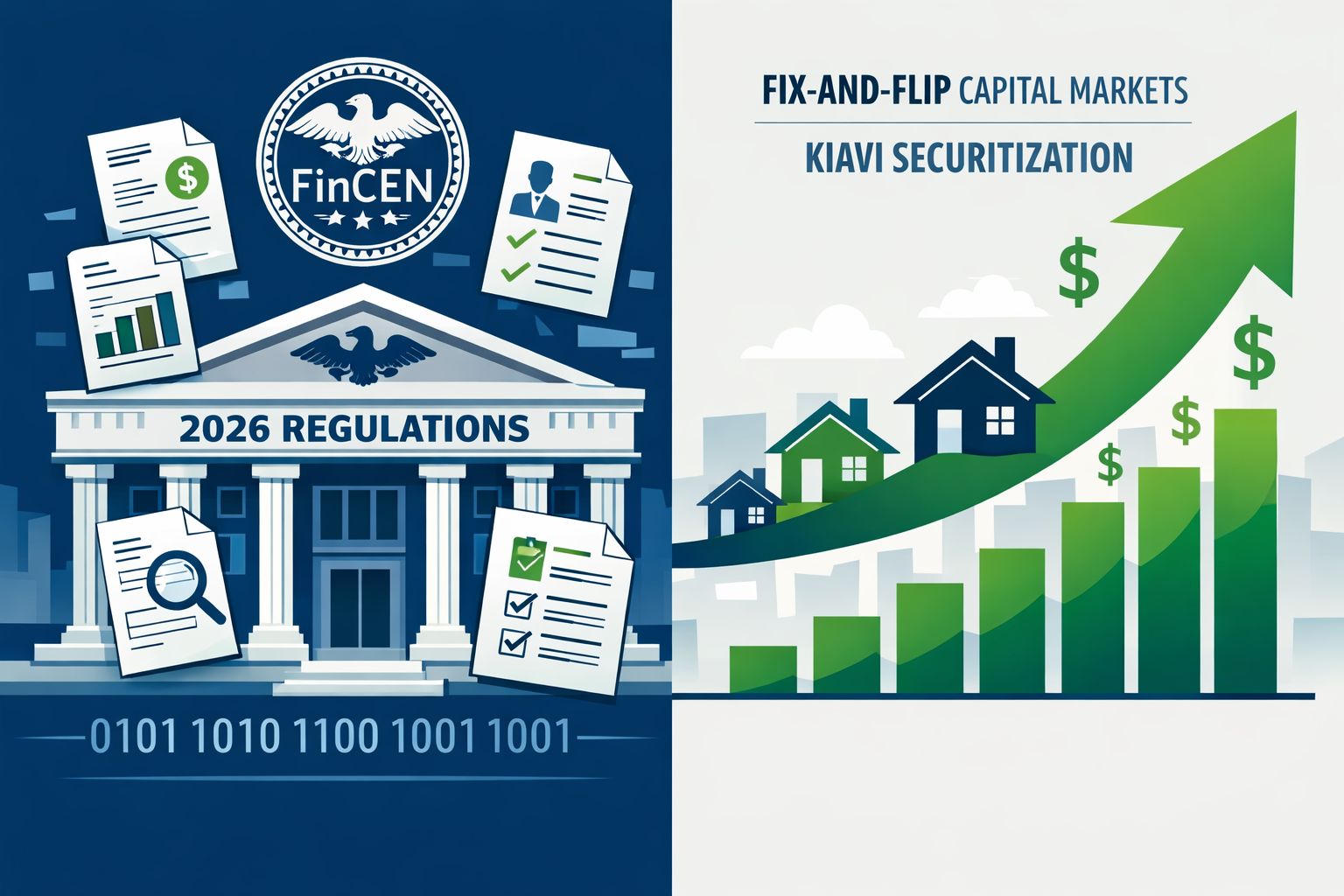
One of the biggest stories in flip financing this year is the flood of institutional capital entering the space. Kiavi closed a massive $350 million securitization in February 2026, directly boosting capital availability for fix-and-flip loans [10]. What does this mean for everyday flippers?
- More competition among lenders = better rates and terms
- Faster approvals as lenders have more capital to deploy
- Lower barriers to entry for newer investors
HousingWire reports that fix-and-flip is poised for a 2026 breakout due to expanding capital, loosening inventory, and renovation cost advantages. The market is fresh with opportunity.
FinCEN's New Reporting Rule
Effective March 1, 2026, FinCEN finalized a new Residential Real Estate Reporting Rule requiring federal reporting for certain residential transactions to combat money laundering [8]. Here's the key detail:
Mortgage-financed deals are generally exempt from the new reporting requirements [8].
This means most flippers using any of the loan types discussed in this article won't be directly affected. However, all-cash transactions — common among some experienced flippers — will face new reporting obligations. The rule primarily targets transactions designed to obscure beneficial ownership.
For a deeper dive into regulatory impacts, the March 2026 regulatory update from Ncontracts provides comprehensive coverage [4].
Homebuyers Privacy Protection Act
Also taking effect in March 2026, this act limits mortgage "trigger leads" — the practice where applying for a mortgage triggers competing lenders to contact the borrower. The new law requires stricter consent before outreach.
For flippers, this primarily affects refinance-related activities. If the exit strategy involves refinancing a flip into a rental property, expect fewer unsolicited lender calls but potentially slower comparison shopping.
Market Conditions Favor Disciplined Investors
The overall 2026 landscape is shaping up beautifully for flippers who do their homework:
- Price stabilization creates more predictable ARV calculations [6]
- Lower competition from reduced speculative activity [3]
- Tax deductions on renovation costs and loan interest remain favorable [6]
- Rising inventory means more properties to choose from
Investors keeping an eye on broader market dynamics will benefit from resources like the Spring 2026 housing market outlook on lower rates and rising inventory.
Best Cities for Flipping in 2026
Location matters enormously for flip profitability. Markets with strong job growth, rising home values, and affordable acquisition prices tend to produce the best returns. Check out the ranked list of best cities for fix-and-flip opportunities to identify where the numbers work best.
Avoiding Critical Financing Mistakes & Maximizing Flip Profits
Even with the perfect loan, mistakes in execution can destroy a flip's profitability. Here are the pitfalls that trip up investors — and how to avoid them.
The 8 Most Common Fix-and-Flip Financing Mistakes
RCN Capital's experts identified these critical errors that brokers and investors must avoid in 2026 [7]:
- No clear exit strategy — Already covered, but it bears repeating
- Underestimating rehab costs — Always add a 15–20% contingency buffer
- Overestimating ARV — Use conservative comps, not best-case scenarios
- Ignoring holding costs — Every month of delays eats into profit
- Choosing the wrong loan type — Speed isn't always worth the premium
- Poor documentation — Slows closings and kills deals
- Not building lender relationships — Repeat borrowers get better terms
- Overleveraging — Taking on too much debt across multiple projects
The Rehab Budget Reality Check
Here's a fresh perspective on budgeting that experienced flippers swear by:
| Renovation Category | Typical Cost Range | ROI Impact |
|---|---|---|
| Kitchen remodel | $15,000–$40,000 | High |
| Bathroom update | $8,000–$20,000 | High |
| Flooring replacement | $5,000–$15,000 | Medium-High |
| Exterior/curb appeal | $3,000–$10,000 | High |
| HVAC/electrical/plumbing | $5,000–$25,000 | Necessary but low visible ROI |
| Cosmetic (paint, fixtures) | $2,000–$8,000 | Highest ROI per dollar |
For detailed guidance on which improvements deliver the best returns, the best home improvements before selling with top ROI projects ranked is an impeccable resource.
Building a Financing Strategy That Scales
For investors planning to flip more than one or two properties, the financing approach needs to evolve:
Phase 1 — First 1-3 Flips:
- Use HELOCs or hard money
- Build track record and lender relationships
- Keep detailed records of every project
Phase 2 — Flips 4-10:
- Negotiate better terms based on track record
- Consider private money partnerships
- Explore portfolio lending options
Phase 3 — 10+ Flips:
- Establish business lines of credit
- Build relationships with multiple hard money lenders
- Consider forming an LLC for liability protection and easier financing
The Numbers That Matter
Before committing to any loan, run these calculations:
- Maximum Allowable Offer (MAO): ARV × 70% – Rehab Costs = MAO
- Profit Margin Target: Aim for minimum 15% net profit after ALL costs
- Holding Cost Per Month: Loan interest + taxes + insurance + utilities
- Break-Even Timeline: How many months before holding costs eat all profit?
📊 Let it cook with the data: The most successful flippers in 2026 aren't the ones swinging the biggest hammers — they're the ones running the tightest spreadsheets. Every dollar of financing cost that gets shaved off goes straight to the bottom line.
Leveraging Technology for Better Decisions
In 2026, smart investors are using AI and data tools to analyze deals faster and more accurately. From automated comp analysis to renovation cost estimators, technology is leveling the playing field. The top real estate AI tools for investors can help streamline everything from deal sourcing to exit strategy planning.
Quick-Reference: Best Loans for Flipping Houses Comparison Table
| Loan Type | Interest Rate | Speed to Close | LTV/ARV | Best For | Biggest Risk |
|---|---|---|---|---|---|
| Hard Money | 9.5%–15% | 7–14 days | 65–75% ARV | Fast closings, distressed properties | High cost, short terms |
| HELOC | ~8.5% (variable) | 2–4 weeks | Up to 85% LTV | Investors with home equity | Primary home at risk |
| Home Equity Loan | ~8.5% (fixed) | 2–4 weeks | Up to 85% LTV | Known budget, equity available | Primary home at risk |
| Bridge/Rehab | ~11% | 2–3 weeks | 75–90% ARV | Major renovations | Draw schedule delays |
| Conventional | 6–8% | 30–45 days | 75–80% LTV | Strong credit, livable properties | Slow, strict requirements |
| Private Money | 6–15%+ | Varies | Negotiable | Flexible terms, relationships | Less legal protection |
| Business LOC | 7–12% | Pre-approved draws | Varies | Multiple simultaneous flips | Requires business history |
Conclusion
The best loans for flipping houses in 2026 aren't one-size-fits-all — they're deal-specific, market-specific, and investor-specific. The extraordinary growth in institutional capital (like Kiavi's $350M securitization [10]), combined with lower competition and stabilizing prices [3][6], creates a genuinely fresh environment for disciplined flippers.
Here are the actionable next steps:
- Assess current resources — Do you have home equity? Business credit? Cash reserves? Start with what's available.
- Match the loan to the deal — Use the comparison table above to narrow options based on the specific property and timeline.
- Build lender relationships now — Don't wait until a deal is on the table. Get pre-qualified with 2–3 lenders so you can move fast when opportunity strikes.
- Run the numbers conservatively — Use the MAO formula and always include a contingency buffer for rehab costs and timeline overruns.
- Plan the exit before the entry — Know exactly how the loan gets repaid before signing anything [7].
- Stay current on regulations — The FinCEN reporting rule and Homebuyers Privacy Protection Act are just the beginning of 2026's regulatory shifts [8].
The fix-and-flip market rewards preparation, speed, and financial discipline. With the right financing locked in, the hardest part of the flip — finding the deal and executing the renovation — becomes a whole lot more manageable.
For more investment strategies, market analysis, and real estate education, visit Real Estate Rank IQ or subscribe to @Realestaterankiq on YouTube. Questions? Reach out at news@realestaterankiq.com. 📩
References
[1] Types Of Loans For Flipping A House – https://www.amerisave.com/learn/types-of-loans-for-flipping-a-house
[2] House Flipping Loans Your Complete Financing Guide For Fixandflip Success – https://www.amerisave.com/learn/house-flipping-loans-your-complete-financing-guide-for-fixandflip-success
[3] House Flipping Market 2026 Opportunity In A Lower Competition Cycle – https://dominionfinancialservices.com/house-flipping-market-2026-opportunity-in-a-lower-competition-cycle/
[4] March 2026 Regulatory Update – https://www.ncontracts.com/nsight-blog/march-2026-regulatory-update
[5] Best Investment Property Lenders – https://www.business.org/finance/investing/best-investment-property-lenders/
[6] Fix And Flip Market Set For Growth In 2026 – https://jbrec.com/insights/fix-and-flip-market-set-for-growth-in-2026/
[7] 8 Fix Flip Financing Mistakes Brokers Must Help Investors Avoid In 2026 – https://rcncapital.com/blog/8-fix-flip-financing-mistakes-brokers-must-help-investors-avoid-in-2026
[8] Fincen Finalizes New Residential Real Estate Reporting Rule Effective March 1 2026 – https://www.coleschotz.com/fincen-finalizes-new-residential-real-estate-reporting-rule-effective-march-1-2026/
[9] Loans For Flipping Houses – https://www.rocketmortgage.com/learn/loans-for-flipping-houses
[10] Real Estate Market Trends Financing Rates February 2026 – https://www.kiavi.com/blog/real-estate-market-trends-financing-rates-february-2026
SEO Meta Title: Best Loans for Flipping Houses in Any Market (2026 Guide)
SEO Meta Description: Discover the best loans for flipping houses in 2026. Compare hard money, HELOCs, bridge loans & more with rates, timelines, and expert strategies for any market.