



Last updated: March 19, 2026
Quick Answer
The four main types of real estate investments are residential, commercial, industrial, and land. Each category carries its own risk profile, income potential, and management demands. Choosing the right type depends on your capital, goals, and how hands-on you want to be as an investor.
Key Takeaways
- Residential real estate (single-family homes, multifamily units, condos) offers the most accessible entry point for new investors and generates steady rental income.
- Commercial real estate (office, retail, mixed-use) typically delivers higher returns but requires more capital and carries longer vacancy risk.
- Industrial real estate (warehouses, distribution centers, data centers) is one of the fastest-growing sectors in 2026, driven by e-commerce and reshoring trends.
- Land is the purest form of real estate investment — no structures, no tenants, but significant upside if you buy in the path of development.
- CBRE forecasts a 16% rise in commercial real estate investment to $562 billion in 2026, signaling strong institutional confidence across property types.
- Mortgage rates dipped below 6% in early 2026 (averaging 5.98% as of late February), boosting residential investor interest and rental demand.
- REITs and real estate crowdfunding let investors access all four property types without direct ownership or property management responsibilities. [1]
- No single property type is universally "best" — the right choice depends on your budget, risk tolerance, and investment timeline.
What Are the 4 Types of Real Estate Investments? A Clear Breakdown
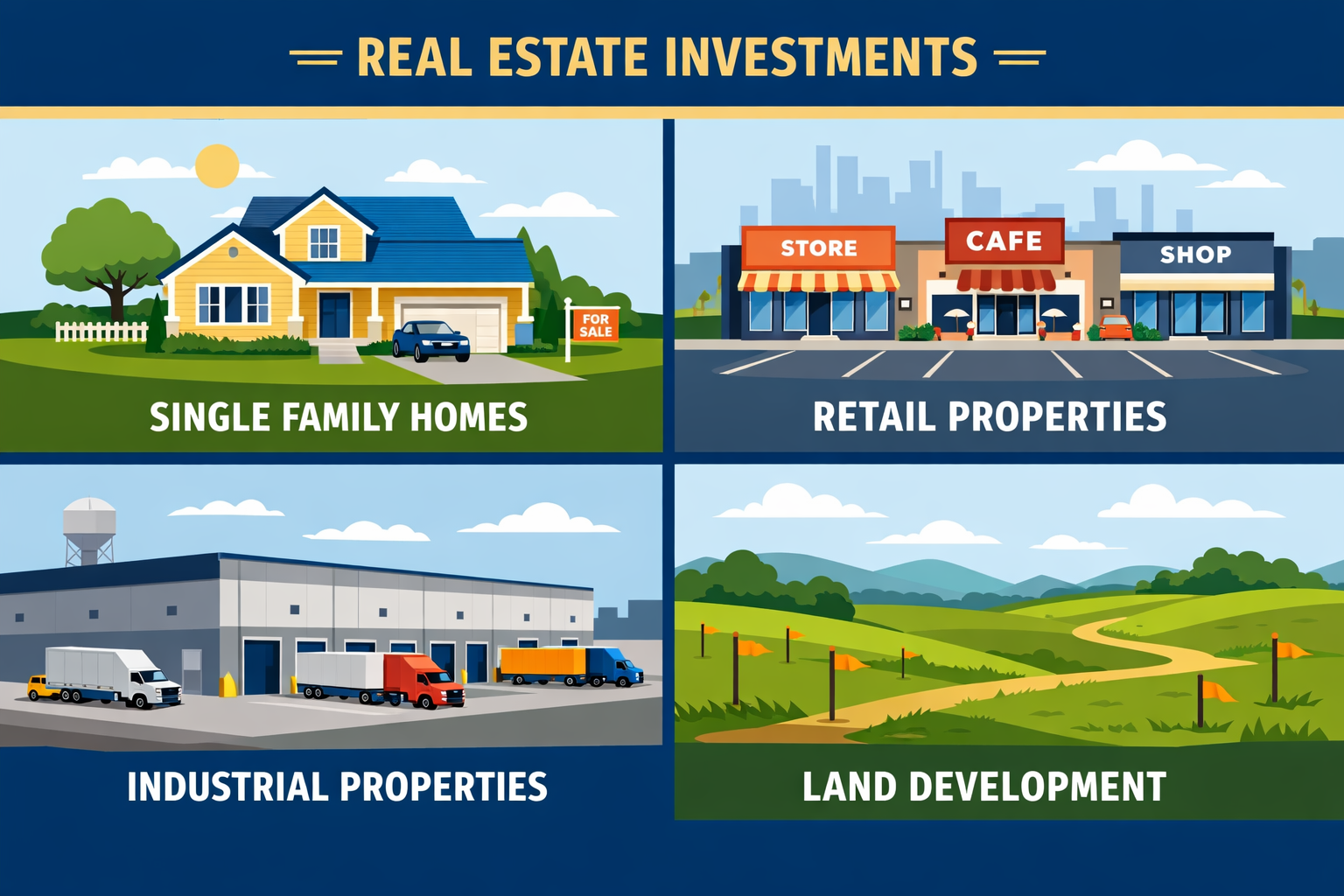
Real estate investing isn't one-size-fits-all. The four core property types — residential, commercial, industrial, and land — each function differently as investments, attract different tenants, and respond differently to economic cycles. [2]
Understanding these categories is the foundation of any serious investment strategy. Whether you're a first-time buyer eyeing a rental duplex or a seasoned investor exploring industrial assets, knowing what you're buying (and why) changes everything.
Here's a quick-reference comparison before diving deep:
| Property Type | Typical Entry Cost | Income Source | Risk Level | Best For |
|---|---|---|---|---|
| Residential | Low–Moderate | Rent from tenants | Low–Moderate | New investors, long-term wealth |
| Commercial | Moderate–High | Business leases | Moderate–High | Experienced investors, cash flow |
| Industrial | High | Long-term leases | Moderate | Institutional or syndicate investors |
| Land | Low–Moderate | Appreciation, sale, lease | High | Speculative or development-focused investors |
Residential Real Estate: The Most Accessible Investment Category
Residential real estate is the most common starting point for investors because it's familiar, financeable, and in constant demand. People always need places to live, which creates a relatively stable rental market even during economic downturns. [3]
What counts as residential?
- Single-family homes
- Duplexes, triplexes, and fourplexes (2–4 units)
- Condominiums and townhomes
- Multifamily apartment buildings (5+ units)
- Build-to-rent (BTR) communities
- Short-term rentals (Airbnb-style properties)
Why residential is still fresh in 2026
With mortgage rates averaging 5.98% as of late February 2026 — the first dip below 6% since 2022 — investor interest in residential rentals has picked up significantly. Improving affordability means more buyers are re-entering the market, which also keeps rental demand competitive.
The build-to-rent segment is particularly impactful right now. Nearly 39,000 new single-family rentals came online in 2024, with over 100,000 units in the pipeline heading into 2026. That's not a niche trend — it's a structural shift in how Americans rent. [3]
PwC's Emerging Trends 2026 report also ranks senior housing as a top residential subsector for investment, driven by baby boomers turning 80 and creating extraordinary demand for age-appropriate communities. For a deeper look at this opportunity, check out the Senior Housing Boom 2026: Top Investment Opportunities guide.
Residential investment: pros and cons
Pros:
- Easier to finance (conventional loans, FHA, VA)
- High demand in most markets
- Familiar asset class — easier to evaluate
- Multiple exit strategies (sell, rent, flip)
Cons:
- Tenant management can be time-intensive
- Subject to rent control laws in some markets
- Appreciation can be slower in saturated markets
Choose residential if: You're a first-time investor, want steady monthly cash flow, or prefer an asset you can physically inspect and understand. For guidance on managing a rental, see this First-Time Second-Home Investor's Property Management Guide.
Commercial Real Estate: Higher Stakes, Higher Rewards
Commercial real estate covers properties used for business purposes — office buildings, retail centers, hotels, and mixed-use developments. Leases tend to be longer than residential (often 3–10 years), which can mean more predictable income, but vacancies hit harder when they happen. [4]
What counts as commercial?
- Office buildings (Class A, B, C)
- Retail strips and shopping centers
- Hotels and hospitality properties
- Mixed-use developments (retail + residential)
- Medical offices and healthcare facilities
The 2026 commercial market: so based on data
Commercial real estate investment volume rose 29% year-over-year in Q4 2025 to $171 billion. Full-year 2025 activity came in at nearly $500 billion — up 22% from 2024 — with office up 25% and retail up 26%. CBRE forecasts that number climbing another 16% to $562 billion in 2026. That's not gatekeeping information — that's a clear signal that institutional money is moving back into commercial assets.
Key commercial investment metrics to know:
- Cap rate: Net operating income divided by purchase price. Higher cap rates generally mean higher risk and higher potential return.
- Net Operating Income (NOI): Revenue minus operating expenses (before debt service).
- Lease structure: Gross, net, or triple-net (NNN) leases shift different costs to tenants.
Common mistake
Many first-time commercial investors underestimate vacancy costs. A commercial property sitting empty for 6–12 months between tenants can wipe out a full year of projected returns. Always stress-test your numbers with a 10–15% vacancy assumption before buying.
For investors exploring commercial real estate investments, understanding lease structures and local market absorption rates is non-negotiable.
Choose commercial if: You have substantial capital (or access to partners/syndication), want longer lease terms, and are comfortable with more complex due diligence.
Industrial Real Estate: The Quiet Performer Investors Are Watching
Industrial real estate — warehouses, distribution centers, manufacturing facilities, and data centers — has been one of the strongest-performing property types over the past five years, and 2026 is shaping up as another impeccable year for the sector. [5]
What counts as industrial?
- Warehouses and fulfillment centers
- Light manufacturing facilities
- Cold storage and logistics hubs
- Flex space (office + warehouse hybrid)
- Data centers
Why industrial is having a moment
E-commerce growth, reshoring of manufacturing, and third-party logistics (3PL) outsourcing have all driven demand for industrial space. CBRE projects industrial leasing to tick up slightly in 2026, supported by reshoring trends and 3PL expansion.
The data center subsector deserves special attention. Record leasing is expected in 2026, with 100 gigawatts of new capacity projected to come online over the next five years. That pipeline could add an estimated $1–2 trillion in asset value to the industrial category — a number that's hard to ignore.
As of January 2026, NAR data shows the industrial sector entering a rebalancing phase: vacancy pressures are easing and rent growth has slowed after a period of rapid expansion. That stabilization is actually healthy — it signals a maturing market rather than a bubble. [6]
Industrial investment: what makes it different
- Long lease terms: Industrial tenants often sign 5–15 year leases, reducing turnover risk.
- Low management intensity: No residential tenant calls at midnight. Industrial properties are comparatively hands-off.
- High barriers to entry: Zoning restrictions and large lot requirements limit supply, which supports values.
Edge case: Data centers require specialized technical due diligence — power infrastructure, cooling systems, and fiber connectivity all affect value significantly. Don't approach this subsector without expert support.
Choose industrial if: You want long-term, low-maintenance leases and can access the higher capital required. REITs focused on industrial assets offer a lower-barrier entry point. Learn more about REIT real estate investments.
Land: Pure Potential With Real Risk
Raw land is the most speculative of the four real estate investment types — but in the right location, it can deliver extraordinary returns. There are no tenants to manage, no buildings to maintain, and no depreciation to calculate. What you're really buying is potential. [3]
What counts as land investment?
- Raw, undeveloped land
- Agricultural land (farmland, timberland)
- Infill lots in urban areas
- Entitled land (already zoned for development)
- Recreational land (hunting, fishing, camping)
How land investors make money
Land generates returns through several paths:
- Appreciation: Buy in the path of development, wait for growth to catch up.
- Development: Subdivide, entitle, and sell to builders or develop yourself.
- Lease income: Agricultural leases, cell tower ground leases, or billboard rights.
- Timber and mineral rights: Passive income from natural resources on the property.
According to Whitetail Properties, recreational land — including hunting and timber parcels — is among the most consistently in-demand land investment categories, particularly in rural markets. [8]
The honest risk profile of land
Land doesn't generate income while you hold it (in most cases). Property taxes still accrue. Financing is harder — most lenders require 25–50% down for raw land, and interest rates on land loans are typically higher than residential mortgages. Liquidity is also lower: land can take months or years to sell at fair value.
Choose land if: You have a long time horizon (5+ years), strong local market knowledge, and can carry the holding costs without needing immediate cash flow.
How Do Investors Choose Between the 4 Types of Real Estate Investments?
Choosing between residential, commercial, industrial, and land comes down to four factors: capital available, risk tolerance, time horizon, and desired involvement level. [9]
Here's a practical decision framework:
| If you… | Consider… |
|---|---|
| Have under $100K and want to start now | Residential rental (single-family or duplex) |
| Want passive income with minimal management | NNN commercial lease or industrial REIT |
| Have 10+ years and speculative appetite | Raw land in a growth corridor |
| Want institutional-grade returns with partners | Commercial syndication or industrial fund |
| Want diversification without direct ownership | REITs or real estate crowdfunding [1] |
The four real estate investment strategies (not just types)
It's worth noting that beyond the four property types, investors also choose between four investment strategies — core, core-plus, value-add, and opportunistic. These strategies apply across all four property types and reflect different risk/return profiles. [10]
- Core: Stabilized, low-risk assets with predictable cash flow (think: fully leased Class A office)
- Core-plus: Mostly stable with minor upside (light renovation potential)
- Value-add: Properties needing improvement — higher risk, higher reward
- Opportunistic: Ground-up development or distressed assets — highest risk, highest potential return
For investors building a portfolio from scratch, exploring real estate investment strategies in depth is a smart next step.
REITs and Passive Alternatives: Accessing All 4 Types Without Direct Ownership
Real Estate Investment Trusts (REITs) and crowdfunding platforms let investors access all four property types — residential, commercial, industrial, and land — without buying or managing a physical property. [1]
This matters because the biggest barrier for most investors isn't knowledge — it's capital and time. REITs solve both.
Invesco projects approximately 6.5% FFO (Funds From Operations) growth for U.S. REITs in 2026, above the 5.4% long-term average, driven by better supply-demand dynamics across property sectors. That's a meaningful return premium for a relatively passive investment.
REIT options by property type:
- Residential REITs: Apartment communities, single-family rentals, manufactured housing
- Commercial REITs: Office, retail, hotel, and mixed-use
- Industrial REITs: Warehouses, logistics, data centers
- Land/Specialty REITs: Timberland, farmland, cell towers
Private equity real estate funds, public debt, and private debt instruments also compete with direct property ownership — offering diversified exposure without the management overhead. [3]
For investors comparing insurance costs across property types, this Homeowners vs Rental Property Insurance: 2026 Cost Guide breaks down what you'll actually pay.
What Unique Characteristics Define Each Real Estate Property Type?
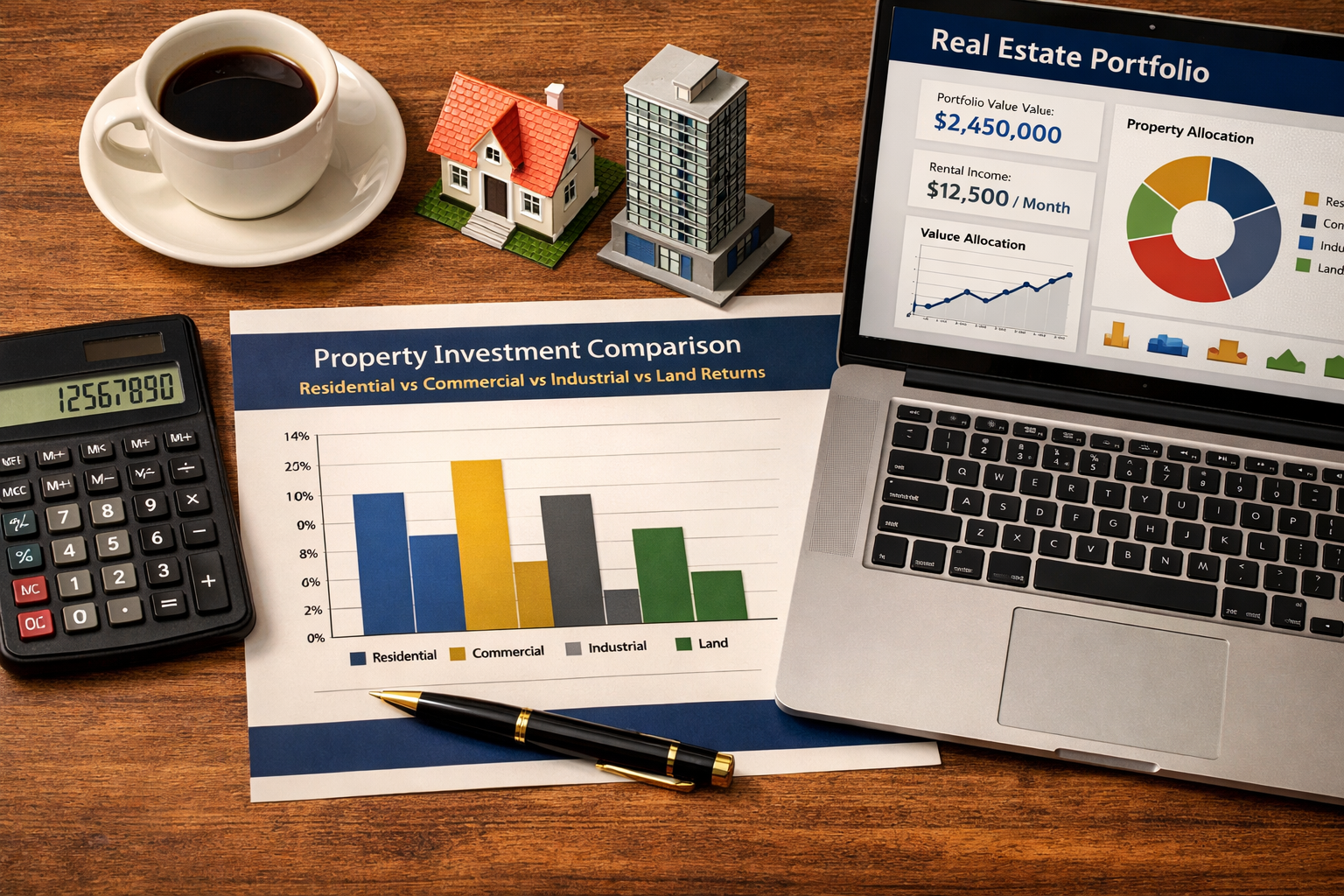
Each of the four real estate investment types has defining characteristics that affect how it's valued, financed, and managed. [7]
Residential:
- Valued using comparable sales (comps) and price-per-square-foot
- Financed through conventional, FHA, or portfolio loans
- Income driven by market rents and occupancy rates
- Regulated by landlord-tenant laws that vary by state
Commercial:
- Valued primarily using the income approach (NOI ÷ cap rate)
- Financed through commercial mortgages with stricter underwriting
- Leases often include rent escalation clauses and tenant improvement allowances
- More sensitive to local economic conditions and business cycles
Industrial:
- Valued by clear height, loading dock count, power capacity, and location to logistics hubs
- Long-term leases with creditworthy tenants (often national corporations)
- Lower operating expenses relative to other property types
- Increasingly tied to technology infrastructure (especially data centers)
Land:
- Valued by location, zoning, entitlements, and development potential
- Hardest to finance — most lenders require significant down payments
- No depreciation tax benefit (since there's no depreciable structure)
- Returns are almost entirely driven by appreciation or development profit [8]
Understanding these distinctions helps investors avoid the most common mistake: applying the wrong valuation method to the wrong property type. A residential investor who tries to evaluate a commercial property using comps will almost certainly underprice or overprice the deal.
For investors using technology to sharpen their analysis, tools like those covered in HouseCanary vs Skyline AI: Best Real Estate Analysis 2026 can help across all four property categories.
Frequently Asked Questions
Q: What are the 4 types of real estate investments?
A: The four main types are residential (homes, apartments), commercial (offices, retail), industrial (warehouses, data centers), and land (raw, agricultural, or entitled parcels). Each has distinct income sources, risk levels, and management demands. [2]
Q: Which type of real estate investment is best for beginners?
A: Residential real estate is generally the best starting point. It's easier to finance, more familiar to evaluate, and has consistent tenant demand. A single-family rental or small multifamily property is the most common first investment. [3]
Q: Can you invest in all 4 types of real estate without buying property directly?
A: Yes. REITs and real estate crowdfunding platforms provide exposure to all four property types with lower capital requirements and no property management responsibilities. [1]
Q: Is land a good real estate investment in 2026?
A: Land can be an extraordinary investment if you buy in a growth corridor with a long time horizon. However, it generates little to no income while you hold it and is harder to finance. It's best suited for experienced investors with strong local market knowledge. [8]
Q: What is the difference between commercial and industrial real estate?
A: Commercial real estate is used for business operations like offices, retail, and hospitality. Industrial real estate is used for manufacturing, storage, distribution, and data infrastructure. Industrial typically has longer leases and lower management costs than commercial. [6]
Q: How do cap rates differ across the 4 property types?
A: Cap rates vary by market and asset quality, but as a general rule: industrial and suburban commercial properties often carry higher cap rates than prime residential or Class A office. Higher cap rates signal higher risk and higher potential return. Always compare cap rates within the same market and property class.
Q: What financing options are available for each property type?
A: Residential properties can use conventional, FHA, or VA loans. Commercial and industrial properties require commercial mortgages with stricter terms. Land loans are the hardest to obtain and typically require 25–50% down. For a full breakdown, see this Guide to Types of Mortgage Loans & Comparing Lenders in 2026.
Q: Are REITs considered one of the 4 types of real estate investments?
A: REITs are a vehicle for investing in the four property types, not a separate type themselves. They're a passive, publicly traded way to own a share of residential, commercial, industrial, or land assets. [1]
Q: What is a build-to-rent community and which property type does it fall under?
A: Build-to-rent (BTR) communities are purpose-built single-family homes designed for long-term rental rather than sale. They fall under residential real estate and represent one of the fastest-growing subsectors in 2026.
Q: How does location affect which property type to invest in?
A: Location is critical for all four types but in different ways. Residential values track school districts and neighborhood quality. Commercial depends on foot traffic and business density. Industrial needs highway and port access. Land value is almost entirely about what's coming to the area — zoning changes, infrastructure, and population growth.
Conclusion: Let It Cook — Build Your Strategy Around the Right Property Type
Understanding what are the 4 types of real estate investments — residential, commercial, industrial, and land — is the first real step toward building a portfolio that works for your goals, not against them.
Here's the honest summary: there's no universally "best" property type. Residential is accessible and steady. Commercial offers scale and longer leases. Industrial is the sector institutions are quietly loading up on. Land is pure upside if you have the patience and local knowledge to play it right.
Actionable next steps:
- Define your budget and timeline before choosing a property type. Each category has different capital requirements and holding periods.
- Run the numbers honestly — use cap rates for commercial and industrial, rental yield for residential, and appreciation projections for land.
- Consider passive options first if you're new. REITs and crowdfunding let you learn the market before committing capital to direct ownership.
- Get the right insurance for whichever type you choose — costs and coverage differ significantly. The Homeowners vs Rental Property Insurance: 2026 Cost Guide is a practical starting point.
- Stay current on market trends — the 2026 market is moving fast across all four property types. Bookmark the Real Estate Rank IQ Investment Hub for ongoing updates.
Real estate investing rewards preparation. The investors who understand the fundamentals — including which of the four property types fits their situation — are the ones who build impeccable portfolios over time. Don't gatekeep this information from yourself by skipping the basics.
References
[1] Types Of Real Estate Investment – https://www.rocketmortgage.com/learn/types-of-real-estate-investment
[2] The 4 Main Types Of Real Estate Investment Properties – https://www.wisdomproperties.com/blog/the-4-main-types-of-real-estate-investment-properties
[3] The 4 Types Of Real Estate Investments Land Residential Commercial Industrial – https://towercorp.com/the-4-types-of-real-estate-investments-land-residential-commercial-industrial/
[4] Real Estate Types – https://www.peakframeworks.com/post/real-estate-types
[5] Unveiling The Real Estate Quadruplet Exploring The 4 Essential Property Types – https://www.hubkey.co/unveiling-the-real-estate-quadruplet-exploring-the-4-essential-property-types/
[6] Academy Module 002 Topic 001 Types Of Real Estate Assets Commercial Residential Industrial Retail Mixed Use – https://www.realvantage.co/insights/academy-module-002-topic-001-types-of-real-estate-assets-commercial-residential-industrial-retail-mixed-use/
[7] What Are The 4 Types Of Real Estate – https://www.rustomjee.com/blog/what-are-the-4-types-of-real-estate/
[8] Land Buying The 7 Best Property Types For Investing – https://www.whitetailproperties.com/knowledge-center/land-buying-the-7-best-property-types-for-investing
[9] Four Different Types Of Real Estate Investments – https://www.upliftdg.com/blog/four-different-types-of-real-estate-investments
[10] Understanding The Four Types Of Real Estate Investment Strategies – https://www.breneman.com/blog/understanding-the-four-types-of-real-estate-investment-strategies