


Picture this: You're sitting at your desk, coffee getting cold, staring at an empty pipeline while your competitors are closing deals left and right. Sound familiar? In the competitive world of commercial real estate, Commercial Real Estate Leads aren't just nice to have—they're the lifeblood of your business. Whether you're representing office buildings, retail spaces, industrial warehouses, or multifamily properties, the ability to consistently generate quality leads separates the extraordinary performers from those barely keeping the lights on.

The commercial real estate landscape has evolved dramatically. Gone are the days when a few networking events and cold calls could sustain a thriving business. Today's successful brokers and agents blend traditional relationship-building with cutting-edge digital strategies, creating a lead generation machine that works 24/7. This comprehensive guide breaks down the top 17 proven methods to fill your pipeline with qualified Commercial Real Estate Leads that actually convert.
Key Takeaways
- Multi-channel approach wins: Combining digital platforms with traditional networking creates a resilient lead pipeline that isn't vulnerable to market shifts
- Technology amplifies effort: CRM automation, chatbots, and AI-powered tools allow brokers to nurture more leads without proportionally increasing workload
- Expertise attracts clients: Demonstrating deep market knowledge through content marketing and thought leadership positions you as the go-to expert in your niche
- Referrals remain king: Systematically cultivating referral relationships delivers the highest-quality leads with the best conversion rates
- Targeted outreach beats spray-and-pray: Segmenting your audience and personalizing messaging dramatically improves response rates and ROI
Digital Platforms: Your 24/7 Lead Generation Engine for Commercial Real Estate Leads
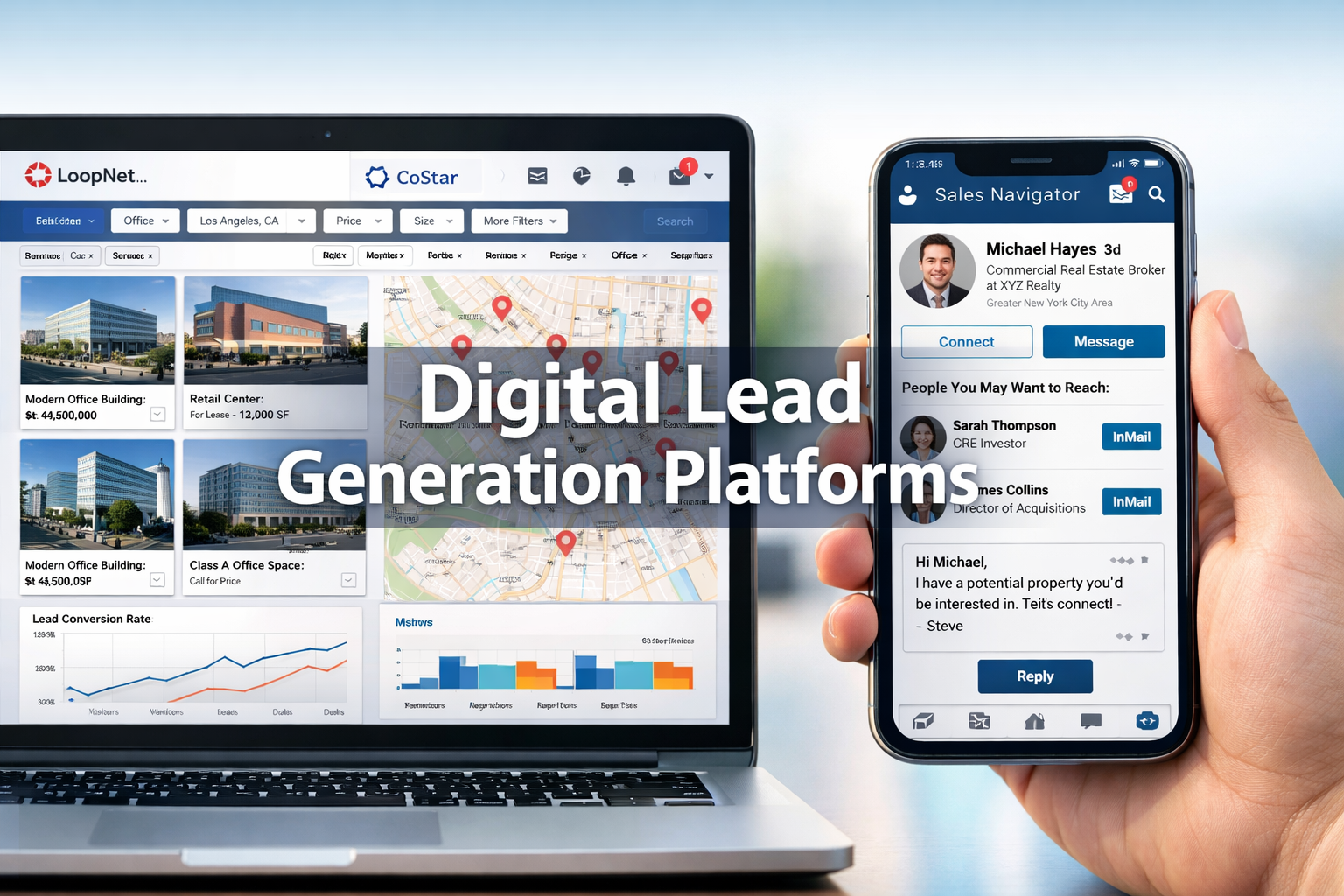
1. Master Internet Listing Services (ILSs) Like LoopNet and CoStar
Internet listing services consistently rank among the most efficient channels for generating commercial real estate leads online[1]. Platforms like LoopNet and CoStar attract pre-qualified prospects actively searching for properties, which means interested investors and tenants contact brokers directly rather than requiring cold outreach[1].
These platforms are so based because they solve the fundamental challenge of commercial real estate: connecting property owners with serious buyers and tenants at scale. When you list a property on LoopNet, you're not just posting an ad—you're placing your inventory in front of millions of monthly users specifically searching for commercial opportunities.
Why ILSs deliver extraordinary results:
- Pre-qualified traffic: Users on these platforms have clear intent and specific requirements
- Direct inquiries: Leads reach out to you, dramatically shortening the sales cycle
- Market visibility: Your listings gain exposure beyond your immediate network
- Analytics and insights: Track which properties generate the most interest and adjust your strategy accordingly
To maximize your ILS presence, invest in premium listings with professional photography, detailed property descriptions, and comprehensive financial information. The agents who dominate these platforms treat each listing like a mini marketing campaign, not just a database entry.
CoStar, the industry heavyweight, offers unparalleled market intelligence alongside listing capabilities. The platform's analytics help you identify emerging opportunities and market trends before your competitors catch on. For brokers serious about commercial real estate investments, CoStar's data becomes an indispensable competitive advantage.
2. Leverage Specialized Lead Generation Platforms
Beyond general listing services, specialized platforms like Reonomy, ProspectNow, and PropStream provide targeted lead generation capabilities that go deeper than traditional ILSs.
Reonomy excels at property intelligence, offering ownership information, sales history, and predictive analytics that help identify off-market opportunities. Instead of waiting for properties to hit the market, you can proactively reach out to owners who match your ideal seller profile.
ProspectNow focuses on property owner data, providing contact information and ownership details that fuel direct mail and cold calling campaigns. The platform's filtering capabilities allow you to segment by property type, size, location, and owner characteristics.
PropStream combines property data with marketing automation, enabling you to identify distressed properties, absentee owners, and other high-probability leads. The platform's skip tracing features help you reach decision-makers directly, bypassing gatekeepers and increasing connection rates.
These platforms represent a fresh approach to prospecting—data-driven, targeted, and efficient. Rather than casting a wide net and hoping for the best, you're using market intelligence to focus your efforts where they'll yield the highest returns.
3. Dominate LinkedIn Sales Navigator for B2B Networking
For commercial real estate professionals, LinkedIn Sales Navigator is absolutely impeccable for B2B lead generation. This premium tool transforms LinkedIn from a passive networking platform into an active prospecting powerhouse.
Sales Navigator allows you to:
- Identify decision-makers at companies expanding or relocating
- Track job changes that signal potential real estate needs (new CFOs, facility managers, etc.)
- Receive lead recommendations based on your ideal client profile
- Send InMail messages to prospects outside your network
- Monitor company growth signals like funding announcements or hiring sprees
The platform's advanced search filters let you target prospects by industry, company size, location, and job title. For example, you could search for "Director of Facilities" at companies with 200-500 employees in the Atlanta metro area that have posted job openings in the last 30 days—a strong signal they're growing and may need additional space.
Combine Sales Navigator with a consistent outreach strategy, and you've created a reliable pipeline of Commercial Real Estate Leads. The key is personalization—reference specific company news, growth indicators, or industry challenges in your messaging to stand out from the dozens of generic pitches your prospects receive daily.
4. Build a Professional Website That Converts Visitors to Leads
Your website serves as your digital storefront and credibility anchor. Digital channels form the basis of most marketing efforts, and a professional website with clear credentials and testimonials establishes trust before prospects ever speak with you[1].
Essential elements of a high-converting commercial real estate website include:
Property showcase: Feature your current listings with professional photography, virtual tours, and detailed financial information. Platforms like Placester offer real estate-specific website builders optimized for property display and lead capture.
Market insights hub: Publish regular content featuring market updates, price trends, and neighborhood spotlights to establish credibility and position yourself as a local market expert[1][9]. This content also improves your search engine rankings, driving organic traffic to your site.
Lead capture mechanisms: Strategically place contact forms, property inquiry buttons, and newsletter signups throughout your site. Offer valuable resources (market reports, investment calculators, tenant guides) in exchange for contact information.
Testimonials and case studies: Showcase successful transactions and client testimonials to build social proof. Video testimonials are particularly powerful for establishing authenticity.
Clear credentials: Display your licenses, certifications (CCIM, SIOR), awards, and years of experience prominently. Commercial clients want to work with established professionals, not newcomers.
Your website should work as hard as you do, capturing leads even while you sleep. Integrate it with your CRM to ensure immediate follow-up on inquiries—speed-to-lead is critical in competitive markets.
5. Invest Strategically in Google Ads for Immediate Visibility
While organic search engine optimization takes time, Google Ads delivers immediate visibility for high-intent commercial real estate searches. When someone searches "office space for lease downtown Chicago" or "industrial warehouse for sale Phoenix," your ad can appear at the top of results.
The key to profitable Google Ads campaigns is targeting specificity and landing page optimization:
Keyword strategy: Focus on high-intent, specific keywords rather than broad terms. "Class A office space Dallas" converts better than "commercial real estate." Use negative keywords to filter out irrelevant traffic (like residential searchers).
Geographic targeting: Limit your ads to your service areas to avoid wasting budget on clicks from locations you don't serve.
Landing page alignment: Create dedicated landing pages for each property type or service. Someone clicking an ad for "retail space for lease" should land on a page specifically about retail leasing, not your generic homepage.
Conversion tracking: Implement proper tracking to measure which keywords and ads generate actual leads, not just clicks. Optimize ruthlessly based on cost-per-lead, not just cost-per-click.
Remarketing campaigns: Target visitors who didn't convert on their first visit with follow-up ads showcasing your properties and expertise.
Google Ads works best as part of an integrated strategy. Use it to capture immediate demand while building your organic presence and referral network for long-term sustainability. For agents looking to expand their digital lead generation toolkit, our guide on how realtors generate leads without relying on friends, family, or referrals offers additional strategies.
Content Marketing: Establishing Authority to Attract Commercial Real Estate Leads
6. Maintain an Active Blog with Market Intelligence
Publishing regular content featuring market updates, price trends, and neighborhood spotlights establishes credibility and positions brokers as local market experts[1][9]. An active blog serves multiple purposes: it improves your search engine rankings, demonstrates your expertise, provides shareable content for social media, and gives prospects reasons to return to your website.
Effective commercial real estate blog topics include:
- Market trend analysis: Quarterly reports on vacancy rates, absorption, rental rates, and cap rates in your markets
- Neighborhood spotlights: Deep dives into emerging commercial districts, infrastructure improvements, and demographic shifts
- Property type guides: Educational content about investing in specific asset classes (multifamily, industrial, retail, office)
- Transaction case studies: Anonymized examples of successful deals you've closed, highlighting challenges overcome
- Regulatory updates: Changes to zoning laws, tax policies, or development incentives that impact commercial property owners
The brokers who absolutely crush it with content marketing publish consistently (at least twice monthly) and go deep rather than broad. A 2,000-word analysis of industrial market trends in a specific submarket is infinitely more valuable than a 300-word generic post about "why commercial real estate is a good investment."
Optimize each post for search engines by targeting specific long-tail keywords like "office space vacancy rates downtown Denver 2026" rather than impossible-to-rank terms like "commercial real estate." Include internal links to your property listings and service pages to guide readers toward conversion opportunities.
7. Create Downloadable Market Reports and Investment Guides
Gate-keeping valuable market intelligence behind lead capture forms is a proven strategy for building your email list with qualified prospects. Create comprehensive quarterly or annual market reports featuring:
- Supply and demand analysis for each property type in your markets
- Rental rate trends with historical comparisons and future projections
- Major transactions and notable deals from the period
- Development pipeline showing upcoming inventory additions
- Economic indicators affecting commercial real estate (employment growth, population trends, business formations)
These reports serve dual purposes: they position you as a market authority while capturing contact information from serious investors and occupiers researching your markets.
Beyond market reports, consider creating educational guides like:
- "The Complete Guide to 1031 Exchanges for Commercial Property Investors"
- "Tenant's Guide to Negotiating Commercial Leases"
- "How to Analyze Cap Rates and Investment Returns"
- "Commercial Property Due Diligence Checklist"
Promote these resources through your website, email signature, social media, and paid advertising. The leads you generate through valuable content tend to be more qualified and easier to convert than those from pure advertising, because they've already experienced value from your expertise.
8. Launch a YouTube Channel or Podcast for Deeper Engagement
Video and audio content create deeper connections than text alone. A YouTube channel or podcast allows prospects to get to know your personality, expertise, and communication style before ever meeting you—building trust and rapport that shortens the sales cycle.
YouTube channel ideas for commercial brokers:
- Property tour videos: Showcase listings with professional videography, highlighting unique features and investment potential
- Market update videos: Monthly or quarterly video reports on market conditions, easier to consume than written reports
- Expert interviews: Conversations with developers, investors, property managers, and other industry professionals
- Educational content: "How to" videos on topics like analyzing pro formas, understanding lease structures, or evaluating locations
Podcast concepts:
- Deal story podcast: Interview successful investors about their best (and worst) commercial real estate transactions
- Market insights podcast: Regular episodes analyzing trends, news, and opportunities in your markets
- Industry expert series: Conversations with lenders, attorneys, architects, and other professionals in the commercial real estate ecosystem
The beauty of podcasts and YouTube channels is their compounding value—content you create today continues attracting new leads months or years later. Plus, you can repurpose this content across multiple channels: turn podcast episodes into blog posts, create social media clips from YouTube videos, and transcribe interviews into downloadable guides.
Consistency matters more than production quality when starting out. A weekly podcast recorded on decent equipment beats a Hollywood-quality video you only produce twice a year. For inspiration on leveraging video content, check out the Real Estate Rank IQ YouTube channel for examples of engaging real estate content.
9. Develop Email Nurture Campaigns That Build Relationships
Email remains one of the highest-ROI marketing channels when done correctly. The key is nurturing relationships over time rather than immediately pushing for a sale.
Segment your email list based on:
- Property type interest (office, retail, industrial, multifamily, land)
- Role (investor, tenant, property owner, developer)
- Stage in buying cycle (just researching, actively looking, ready to transact)
- Geographic market
Create automated nurture sequences that deliver value over weeks or months:
New subscriber sequence: Welcome email → market overview → your unique value proposition → case study → call to action
Property type sequence: Educational content about the asset class → market trends → investment considerations → financing options → available listings
Geographic market sequence: Neighborhood overview → demographic and economic data → recent transactions → development pipeline → opportunities
Include a mix of educational content, market insights, property alerts, and occasional promotional messages. The ratio should heavily favor value-delivery over self-promotion—aim for 80% helpful content and 20% promotional.
Platforms like Market Leader and LionDesk offer real estate-specific CRM and email marketing tools with templates designed for property professionals. These platforms integrate with your website and listing platforms to automatically capture and nurture leads.
Traditional Networking: Time-Tested Methods for Quality Commercial Real Estate Leads

10. Master the Art of Referral Generation
Referrals remain one of the most effective commercial real estate lead sources, with referred clients far more likely to complete transactions[1]. The challenge is that most brokers approach referrals passively, hoping satisfied clients will spontaneously recommend them. The top performers systematize referral generation.
Systematic referral strategies include:
The direct ask: After successfully closing a transaction, explicitly request referrals. "I'm glad we could help you find the perfect warehouse. My business grows primarily through referrals from satisfied clients like you. Do you know anyone else who might benefit from my services—perhaps other business owners in your industry looking to expand?"
Business card strategy: Provide satisfied clients with a stack of your business cards and ask them to share with colleagues who might need commercial real estate services[1]. Make it easy for them to refer you.
Reciprocal referral relationships: Establish systematic referral exchanges with complementary professionals—residential agents, commercial brokers in other markets, business brokers, and commercial lenders[1]. When you send referrals to others, they'll reciprocate.
Client appreciation events: Host annual client appreciation events that encourage clients to bring guests. These events keep you top-of-mind and create natural opportunities for introductions.
Referral incentives: Consider offering referral bonuses, gift cards, or charitable donations for successful referrals. Ensure any incentive programs comply with local real estate regulations.
Stay-in-touch system: Maintain regular contact with past clients through market updates, holiday cards, and check-in calls. The brokers who consistently generate referrals remain visible long after transactions close.
The most impeccable referral sources are often other professionals who serve your target market: attorneys, accountants, wealth managers, business consultants, and commercial lenders. These professionals encounter clients with real estate needs regularly but can't serve those needs directly—making them perfect referral partners.
11. Dominate Industry Networking Events and Associations
Participating in real estate association meetings, CCIM events, and conferences enables face-to-face relationship building, which remains critical in commercial real estate[1]. Despite the digital transformation of lead generation, high-value commercial transactions still rely heavily on personal relationships and trust.
Key networking opportunities include:
CCIM (Certified Commercial Investment Member) chapter meetings: These monthly gatherings attract serious commercial real estate professionals and investors. Active participation in your local CCIM chapter provides consistent access to qualified prospects and referral sources.
SIOR (Society of Industrial and Office Realtors) events: If you specialize in industrial or office properties, SIOR membership and event attendance connect you with top-tier professionals and clients.
Local commercial real estate associations: Most major markets have commercial real estate organizations that host networking events, educational programs, and industry conferences.
Chamber of Commerce events: Business chamber events connect you with business owners and executives—many of whom have current or future real estate needs.
Industry-specific conferences: If you specialize in a particular property type or tenant industry (healthcare, hospitality, manufacturing), attend conferences serving those sectors.
Maximizing networking event ROI:
- Set specific goals: Aim to have meaningful conversations with 5-10 new contacts per event, not superficial exchanges with 50 people
- Ask questions: Focus on understanding others' needs rather than pitching your services
- Follow up systematically: Send personalized follow-up emails within 24 hours, referencing specific conversation points
- Provide value first: Share relevant market insights, make introductions, or offer helpful resources before asking for business
- Become a regular: Attend consistently to build recognition and deeper relationships over time
The brokers who extract maximum value from networking events treat them as relationship-building marathons, not transactional sprints. They show up consistently, contribute to the community, and nurture connections over months and years.
12. Implement Direct Prospecting Through Property Visits
Visiting properties, cold-walking commercial districts, and meeting business owners in person identifies opportunities that never appear online[1]. This old-school approach still works extraordinarily well because most brokers won't do it—giving you a competitive advantage.
Direct prospecting strategies:
Cold-walking commercial corridors: Visit retail strips, office parks, and industrial areas in person. Look for vacancy signs, businesses that appear to be struggling or expanding, and properties showing deferred maintenance (potential distressed sellers).
Door-knocking business owners: Visit businesses directly and introduce yourself. Ask about their current space, future plans, and whether they're considering expansion, relocation, or downsizing. Even if they're not currently in-market, you've established a relationship for when needs arise.
Property owner prospecting: Identify well-maintained properties and reach out to owners to discuss their portfolio strategy, potential acquisitions, or disposition opportunities. Use platforms like Property Radar or Batch Leads to identify owner contact information.
Expired listing follow-up: Contact owners of properties whose listings expired without selling. They still want to sell but may need a fresh approach or different broker.
Distressed property targeting: Identify properties with code violations, tax delinquencies, or visible neglect. These situations often motivate sellers to transact quickly.
The key to successful direct prospecting is volume and consistency. Set daily or weekly activity goals (e.g., 20 door-knocks per week, 50 property owner contacts per month) and track your results. This approach won't yield immediate results, but over time it builds a pipeline of opportunities your competitors never see.
For agents looking to expand their prospecting toolkit beyond commercial, our guide on qualified home buyer leads and networking strategies offers complementary approaches.
13. Build Strategic Partnerships with Complementary Businesses
Collaborating with complementary businesses and local organizations provides access to quality leads within your service area[4]. Strategic partnerships create win-win relationships where both parties benefit from mutual referrals and shared expertise.
High-value partnership opportunities:
Commercial lenders and banks: Lenders encounter businesses and investors seeking financing for acquisitions or refinances. Partner with commercial loan officers who can refer clients needing representation.
Business brokers: When someone sells their business, they often need to dispose of or acquire real estate. Business brokers make excellent referral partners.
Attorneys specializing in real estate or business law: Lawyers advising clients on real estate transactions, entity formation, or business sales can refer clients needing brokerage services.
Accountants and CPAs: Accountants advise clients on tax strategies, including 1031 exchanges and investment property acquisitions. They're well-positioned to identify clients with real estate needs. Learn more about 1031 exchange basics and strategies.
Property management companies: Property managers know which owners are considering selling and which tenants are outgrowing their space.
Commercial contractors and architects: Professionals involved in tenant improvements and building renovations often hear about upcoming real estate needs.
Economic development organizations: EDC professionals work with companies relocating or expanding in your market—perfect prospects for office, industrial, or retail space.
To build effective partnerships, focus on giving before receiving. Refer business to your partners consistently, share market insights they'll find valuable, and make yourself a resource they can rely on. The partnerships that generate the most Commercial Real Estate Leads are built on reciprocity and trust over time.
Technology and Automation: Scaling Your Commercial Real Estate Lead Generation
14. Implement CRM Automation to Nurture More Leads
CRM automation should be a starting point, including automated responses, follow-up reminders, templated nurture emails, and chatbots to pre-qualify prospects based on requirements[1]. Technology doesn't replace the personal relationships that drive commercial real estate, but it amplifies your ability to maintain those relationships at scale.
Essential CRM automation features:
Automated lead capture: Integrate your website, landing pages, and listing platforms with your CRM so every inquiry automatically enters your system with source tracking.
Instant response automation: Set up automated acknowledgment emails that respond within seconds of inquiry submission. Include your contact information, links to relevant resources, and an invitation to schedule a call.
Follow-up sequences: Create automated email sequences that nurture leads over time based on their interests and behaviors. If someone downloads your industrial market report, they enter a sequence focused on industrial properties.
Task automation: Generate automatic follow-up reminders based on lead activity, ensuring no prospect falls through the cracks.
Lead scoring: Implement systems that automatically score leads based on engagement level, property criteria, and readiness to transact, helping you prioritize your outreach.
Pipeline management: Track leads through each stage of your sales process with automated stage-change notifications and next-step recommendations.
Platforms like LionDesk, Market Leader, and industry-specific CRMs offer these capabilities with real estate-focused features. The investment in proper CRM implementation pays for itself many times over through increased conversion rates and time savings.
The goal isn't to automate the relationship—it's to automate the administrative tasks so you can spend more time on high-value activities like property tours, negotiations, and relationship building.
15. Deploy Website Chatbots for 24/7 Lead Qualification
Website chatbots pre-qualify prospects and capture contact information even when you're unavailable. Modern AI-powered chatbots can handle sophisticated conversations, answering common questions and gathering detailed requirements before handing off to human agents.
Effective chatbot use cases:
Property inquiries: When visitors view a listing, the chatbot can ask about their space requirements, timeline, budget, and contact information—qualifying the lead before you even speak with them.
Market information requests: Chatbots can provide basic market statistics, neighborhood information, and property availability while capturing visitor contact details.
Appointment scheduling: Allow prospects to book consultation calls directly through the chatbot, which integrates with your calendar.
After-hours engagement: Capture leads from visitors browsing your site outside business hours, ensuring you never miss an opportunity.
FAQ automation: Answer common questions about your services, markets, and process automatically, freeing your time for more complex conversations.
The key to successful chatbot implementation is balancing automation with human touch. Use chatbots for initial engagement and qualification, but ensure smooth handoffs to human agents for substantive conversations. Nobody wants to negotiate a million-dollar lease with a robot.
16. Leverage Data Analytics and Predictive Tools
Advanced platforms like Reonomy offer predictive analytics that identify properties likely to transact soon based on ownership patterns, financial indicators, and market conditions. This fresh approach to prospecting uses data science to focus your efforts on the highest-probability opportunities.
Predictive analytics applications:
Likely seller identification: Algorithms analyze factors like ownership duration, property performance, owner age, and market conditions to predict which properties may sell soon.
Expansion signals: Identify businesses showing growth indicators (hiring, revenue growth, permit applications) that suggest upcoming space needs.
Lease expiration tracking: Monitor upcoming lease expirations at properties in your market to identify tenants who'll need renewal representation or new space.
Portfolio analysis: Analyze property owner portfolios to identify acquisition targets, potential sellers, and consolidation opportunities.
Market timing: Use market cycle analytics to identify optimal times for client outreach based on property type and location.
Platforms like PropStream and Property Radar combine property data with analytics tools that help you identify distressed properties, absentee owners, and other high-probability leads. The brokers who master these tools gain significant competitive advantages over those relying on traditional prospecting alone.
17. Utilize Crowdfunding Platforms to Connect with Investors
Real estate crowdfunding platforms like Groundfloor and Fundrise have democratized commercial real estate investing, creating new pools of investors seeking opportunities. While these platforms compete with traditional brokerage in some ways, they also create partnership opportunities.
Strategies for leveraging crowdfunding platforms:
Investor networking: Many crowdfunding investors eventually want to invest directly in properties rather than through platforms. Position yourself as a resource for these investors when they're ready to transition.
Deal syndication: Partner with crowdfunding platforms or investors you meet through them to syndicate larger deals.
Market education: Create content explaining the differences between crowdfunding and direct property ownership, positioning yourself as an expert who can guide investors through both approaches.
Platform partnerships: Some crowdfunding platforms seek local market experts to source and evaluate deals. Becoming a platform partner can generate deal flow and fees.
The rise of crowdfunding has created a new generation of commercial real estate investors who may not have traditional industry connections. These investors need education, guidance, and eventually, representation for direct property acquisitions. Position yourself as the bridge between crowdfunding and traditional commercial real estate investing.
For more insights on alternative real estate investment strategies, explore our coverage of the best crowdfunding sites for investors.
Bringing It All Together: Your Commercial Real Estate Lead Generation Action Plan
Generating consistent, high-quality Commercial Real Estate Leads requires a multi-faceted approach that combines digital marketing, content creation, traditional networking, and technology automation. The most successful brokers don't rely on a single channel—they build diversified lead generation systems that work synergistically.
Your 90-day implementation roadmap:
Month 1: Foundation Building
- Set up or optimize your CRM system with automation workflows
- Claim and optimize your profiles on LoopNet, CoStar, and LinkedIn Sales Navigator
- Create your lead magnet (market report or investment guide) and landing page
- Identify your top 10 referral partner targets and schedule introduction meetings
Month 2: Content and Digital Presence
- Launch your blog with at least 4 comprehensive market insight posts
- Create your first downloadable resource and promote it through email and social media
- Set up Google Ads campaigns targeting your highest-value property types
- Attend at least 2 industry networking events and follow up with all new contacts
Month 3: Scaling and Optimization
- Implement direct prospecting with weekly property visit goals
- Launch your email nurture sequences for different audience segments
- Analyze your lead sources and double down on the highest-performing channels
- Establish systematic referral request processes for all closed transactions
Measuring success:
Track these key metrics monthly to evaluate your lead generation effectiveness:
- Total leads generated (by source)
- Lead quality score (percentage of leads that meet your ideal client criteria)
- Cost per lead (for paid channels)
- Conversion rate (leads to appointments, appointments to transactions)
- Pipeline value (total potential commission from active leads)
- Lead velocity (how quickly leads move through your pipeline)
Remember that commercial real estate sales cycles are long—often 6-18 months from initial contact to closing. Don't judge your lead generation efforts solely on immediate results. Focus on building a consistent pipeline of new prospects while nurturing existing relationships.
The competitive advantage of integration:
The brokers who dominate their markets don't just use these strategies—they integrate them into a cohesive system where each element reinforces the others:
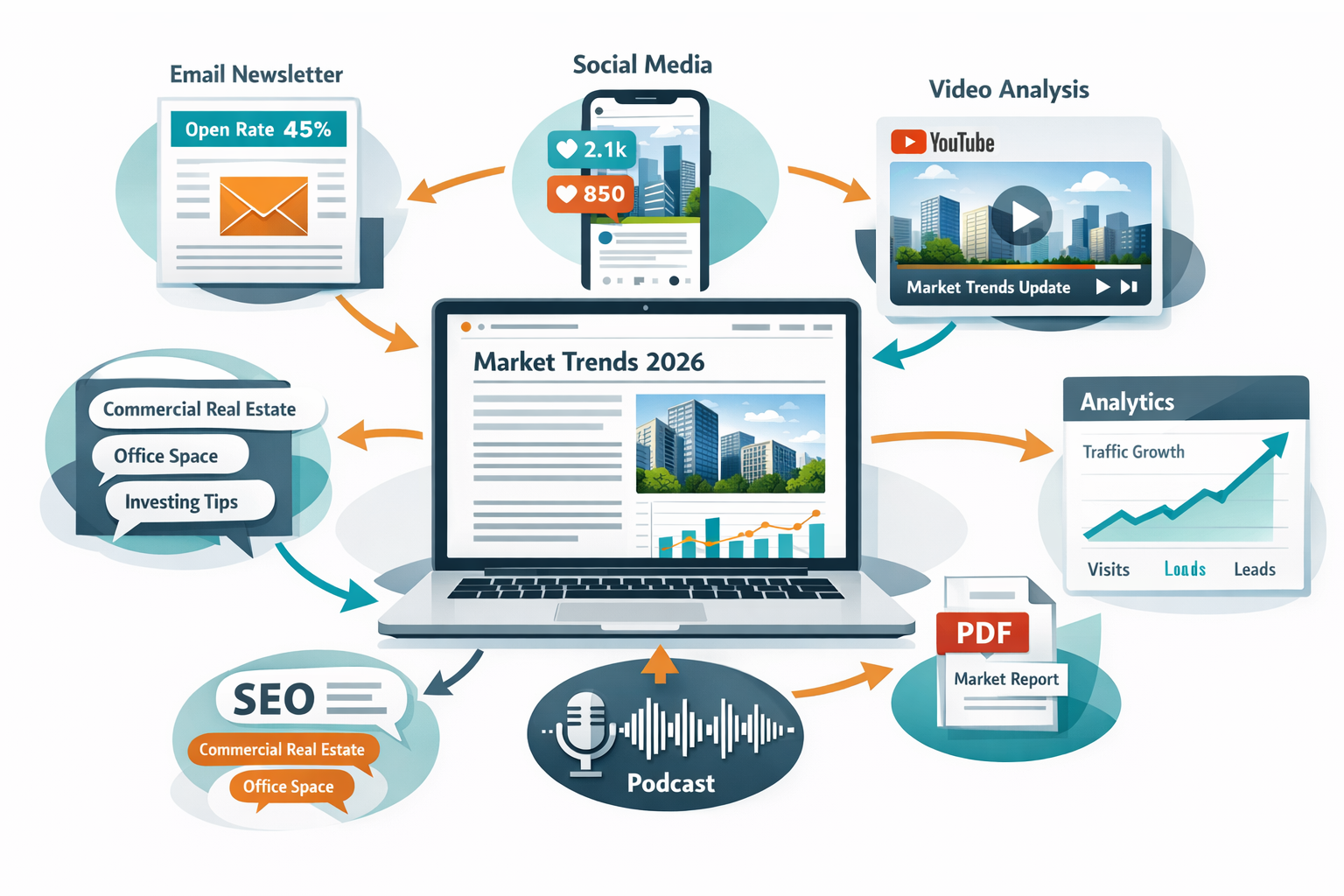
- Blog content drives website traffic and captures email subscribers
- Email nurture campaigns promote upcoming networking events
- Networking events generate referral partnerships
- Referral partners receive regular market updates via email
- Direct prospecting uncovers stories that become blog content
- LinkedIn connections receive invitations to download market reports
- Market reports showcase your listings and services
This integrated approach creates a flywheel effect where each activity amplifies the others, generating exponentially more Commercial Real Estate Leads than any single tactic could produce alone.
Avoiding common pitfalls:
As you implement these strategies, watch out for these frequent mistakes:
- Inconsistency: Starting strong but failing to maintain momentum over time
- Channel overload: Trying to execute all 17 strategies simultaneously instead of mastering a few
- Neglecting follow-up: Generating leads but failing to nurture them systematically
- Ignoring metrics: Not tracking results and optimizing based on data
- Selling too soon: Pushing for transactions before building trust and demonstrating value
The commercial real estate brokers and agents who consistently generate quality leads treat lead generation as a systematic business function, not a sporadic activity they do when the pipeline runs dry. They block time for prospecting, content creation, and networking just as rigorously as they schedule property tours and closing appointments.
Conclusion
The commercial real estate landscape in 2026 rewards brokers who blend traditional relationship-building skills with modern digital marketing sophistication. Commercial Real Estate Leads don't appear magically—they're the result of systematic effort across multiple channels, consistent execution over time, and genuine value delivery to your target market.
The 17 strategies outlined in this guide provide a comprehensive framework for building a lead generation machine that works for you 24/7. From leveraging platforms like LoopNet and LinkedIn Sales Navigator to implementing CRM automation and creating compelling content, each tactic plays a specific role in attracting, capturing, and nurturing prospects through your pipeline.
The key is to start where you are, focus on mastering a few core strategies before expanding, and maintain consistency even when immediate results aren't visible. Commercial real estate success is a marathon, not a sprint—but with the right lead generation system in place, you'll build a sustainable, growing business that thrives regardless of market conditions.
Your next steps:
- Audit your current lead sources: Identify which channels currently generate your best leads and which are underperforming or absent
- Choose your top 3 priorities: Select three strategies from this guide that align with your strengths and market position
- Create your 90-day action plan: Break down implementation into specific weekly tasks with deadlines
- Invest in the right tools: Allocate budget for essential platforms (CRM, listing services, lead generation tools)
- Block time for execution: Schedule recurring time blocks for prospecting, content creation, and networking
- Track and optimize: Measure your results monthly and adjust your approach based on data
The brokers who implement these strategies systematically will build extraordinary businesses that generate consistent, high-quality Commercial Real Estate Leads while their competitors struggle with feast-or-famine pipelines. The question isn't whether these strategies work—it's whether you'll commit to implementing them with the discipline and consistency they require.
For more expert guidance on building your real estate business, explore the comprehensive resources at Real Estate Rank IQ, where licensed brokers with over 15 years of experience share actionable strategies for success in any market.
The leads are out there. The tools are available. The strategies are proven. Now it's time to execute and build the commercial real estate business you've always envisioned. 🚀
References

[1] Commercial Real Estate Lead Generation Strategies – https://www.commercialcafe.com/blog/commercial-real-estate-lead-generation-strategies/
[2] 55 Proven Lead Generation Ideas For Real Estate Agents In 2026 – https://www.homestack.com/blog/55-proven-lead-generation-ideas-for-real-estate-agents-in-2026
[3] Lead Generation In 2026 Innovative Strategies Real Estate Agents Can T Afford To Miss – https://www.aretsifl.com/post/lead-generation-in-2026-innovative-strategies-real-estate-agents-can-t-afford-to-miss
[4] Lead Generation Strategies For Agents – https://www.pnc.com/insights/small-business/industry-insights/lead-generation-strategies-for-agents.html
[5] Watch – https://www.youtube.com/watch?v=Hy_CGm-yoZY
[6] The Definitive 2026 Real Estate Lead Generation Playbook – https://www.timandjulieharris.com/2026/01/05/the-definitive-2026-real-estate-lead-generation-playbook.html
[7] Real Estate Lead Generation Strategies – https://dbmarketingco.com/real-estate-lead-generation-strategies/
[8] 7 Lead Gen Strategies To Ignite Your Real Estate Business In 2026 – https://jorgensonrealestate.com/blog/7-lead-gen-strategies-to-ignite-your-real-estate-business-in-2026
[9] Real Estate Marketing Ideas – https://inmotionrealestate.com/resources/real-estate-marketing-ideas/