


Picture this: It's been 90 days since your "For Sale" sign went up, and the only traffic through your front door has been curious neighbors and one couple who thought they were at an open house down the street. Meanwhile, your broker keeps telling you everything is "fine" and that you just need to be "patient." Sound familiar? If your gut is screaming that something's off while your broker keeps insisting the market is to blame, you might be experiencing real estate gaslighting—and it's time to ask the 5 gaslighting questions to ask your real estate broker when your home isn't selling.

Real estate gaslighting happens when agents manipulate sellers into questioning their valid concerns about stagnant listings, poor marketing, or overpricing. Instead of taking accountability, these brokers deflect, minimize, and make homeowners feel unreasonable for expecting results. But here's the thing: extraordinary agents deliver extraordinary results, and if your home isn't moving, you deserve straight answers—not smoke and mirrors.
Key Takeaways
- Gaslighting in real estate occurs when brokers manipulate sellers into doubting legitimate concerns about their home's marketing, pricing, or lack of showings
- The five critical questions expose whether your broker is deflecting accountability or genuinely working to sell your home
- Days on market matter: Homes that sit too long become stigmatized, forcing eventual price cuts and attracting lowball offers
- Marketing accountability is non-negotiable—demand specific metrics, not vague promises about "exposure"
- You have options: Switching agents mid-listing is possible and sometimes necessary to protect your financial interests
Understanding Real Estate Gaslighting: When Your Broker Makes You Question Reality 🤔

Gaslighting in real estate isn't just about bad service—it's a form of psychological manipulation where brokers make sellers doubt their own perceptions, memories, and judgment. When homeowners raise legitimate concerns about lack of showings, weak marketing, or questionable pricing strategies, gaslighting agents respond with deflection tactics that shift blame away from their performance.
Common gaslighting phrases from brokers include:
- "You're being too emotional about this"
- "Every other seller is patient—why can't you be?"
- "The market is slow for everyone right now" (without data to back it up)
- "Your expectations are unrealistic"
- "I've been doing this for 20 years—trust me"
The danger? These tactics keep sellers trapped in ineffective listing agreements while their homes grow stale on the market. And in real estate, time literally costs money. According to 2025 housing market data, homes that sit beyond 60 days typically sell for 5-10% less than comparable properties that moved quickly.
The Psychology Behind Real Estate Gaslighting
Brokers who gaslight aren't necessarily malicious—many are simply protecting their ego or covering for skill gaps. They might lack the marketing expertise to generate buzz, the market knowledge to price correctly, or the courage to have difficult conversations about necessary changes. Rather than admit these limitations, they manipulate sellers into believing the problem lies elsewhere.
Red flags that you're being gaslit:
| Gaslighting Behavior | What It Sounds Like | The Reality |
|---|---|---|
| Deflecting to "the market" | "It's slow everywhere" | Other comparable homes in your area are selling |
| Minimizing your concerns | "You're overreacting" | Your concerns about zero showings are valid |
| Rewriting history | "You agreed to this price" | You agreed based on their expert recommendation |
| Shifting blame to the home | "Buyers just don't like your style" | Poor marketing isn't showcasing your home's strengths |
| Avoiding accountability | "I'm doing everything I can" | No metrics or proof of marketing efforts provided |
The good news? You can cut through the manipulation by asking direct, accountability-focused questions that force honest answers. Let's break down the 5 gaslighting questions to ask your real estate broker when your home isn't selling.
Question #1: "Show Me the Data—How Does My Home's Performance Compare to Similar Properties?" 📊
This question is so based because it demands objective evidence instead of subjective opinions. A competent broker should immediately pull up comparative market data showing how your listing performs against similar homes in terms of views, showings, and days on market.
What You're Really Asking
You're testing whether your broker:
- Actually tracks performance metrics
- Understands how to run proper comparable analysis
- Is willing to be transparent about underperformance
- Has a data-driven approach to selling homes
Impeccable brokers will pull up a detailed report within minutes showing:
- Online engagement metrics: How many views your listing has received on major platforms (Zillow, Realtor.com, MLS) compared to similar active and sold listings
- Showing statistics: Number of showings per week versus comparable properties
- Days on market comparison: Where you stand relative to neighborhood averages
- Price per square foot analysis: How your asking price compares to recently sold comps
Red Flag Responses That Indicate Gaslighting
🚩 "Every home is unique—you can't really compare"
Translation: They don't want to show you that comparable homes are outperforming yours.
🚩 "The data doesn't tell the whole story"
Translation: The data tells a story they don't want you to see.
🚩 "I don't focus on metrics—I focus on relationships"
Translation: They lack the analytical skills to market effectively in 2026.
🚩 "You need to trust my experience"
Translation: They're asking for blind faith instead of demonstrating competence.
What Fresh, Effective Brokers Do Differently
Top-performing agents in 2026 use technology and data analytics to provide sellers with weekly performance dashboards. They don't wait for sellers to ask—they proactively share:
- Heatmaps showing where online viewers are clicking (or not clicking) on listing photos
- Comparison charts showing your listing's performance trajectory
- Feedback compilation from showings with specific buyer concerns
- A/B testing results from different marketing approaches
If your broker can't provide this level of transparency, they're either gatekeeping information or don't have the systems in place to compete in today's market. Either way, that's a problem.
Understanding 7 pricing mistakes that trigger price cuts and lowball offers can help you interpret the data your broker should be providing and recognize when pricing is the real culprit behind slow sales.
Question #2: "What Specific Marketing Strategies Have You Implemented, and Can You Show Me the Results?" 🎯
This question separates the doers from the talkers. It's one thing for a broker to promise "full marketing exposure"—it's another to prove they've actually executed a comprehensive strategy and can demonstrate its impact.
Breaking Down the Marketing Accountability Test
When you ask this question, you're looking for specifics, not generalities. An effective broker should be able to walk you through:
Digital Marketing Execution:
- Which platforms are running your listing ads (Facebook, Instagram, Google, etc.)
- Ad spend allocation and targeting parameters
- Click-through rates and engagement metrics
- Retargeting campaigns for interested viewers
Professional Content Creation:
- Quality of listing photography (professional vs. smartphone shots)
- Video tours or virtual walkthroughs created
- Drone footage for exterior and neighborhood context
- 3D virtual tours or Matterport scans
Traditional Marketing Efforts:
- Open house frequency and attendance numbers
- Broker open events and agent feedback
- Print materials and direct mail campaigns
- Signage strategy and placement
Social Media Strategy:
- Posts featuring your property and their reach
- Stories and reels showcasing home highlights
- Influencer or local community partnerships
- Engagement rates and shares
The "Dope" Marketing That Actually Sells Homes in 2026
The real estate marketing game has evolved dramatically. Listings that move quickly in 2026 leverage strategies that make homes go viral within their target buyer demographic. This includes:
- AI-enhanced listing descriptions that speak to buyer emotions and lifestyle aspirations
- Targeted micro-campaigns on TikTok and Instagram Reels showing neighborhood lifestyle
- Interactive virtual staging allowing buyers to visualize different design aesthetics
- Neighborhood storytelling highlighting local amenities, schools, and community vibe
If your broker's marketing strategy consists solely of "putting it on the MLS and waiting," you're working with someone stuck in 2010. The MLS is the baseline—not the strategy. Learn more about modern approaches in how to make your home listing a thirst trap for social media.
Gaslighting Responses to Watch For
🚩 "I've marketed it everywhere—the problem is your house"
Translation: They haven't actually implemented a strategic marketing plan and are deflecting.
🚩 "Marketing doesn't matter as much as pricing"
Translation: They're lazy and don't want to do the work required to showcase your home properly.
🚩 "I have a huge network—word of mouth is the best marketing"
Translation: They're relying on passive referrals instead of active promotion.
🚩 "I don't believe in social media for real estate"
Translation: They're technologically behind and unwilling to adapt to where buyers actually are.
Demand the Receipts
Don't accept vague assurances. Ask to see:
- Screenshots of actual ads running
- Analytics dashboards showing impressions and engagement
- Examples of social media posts featuring your property
- Email campaign statistics showing how many agents received your listing
- Professional photos and videos created specifically for your home
If they can't produce evidence of these efforts, they're either not doing the work or doing it so poorly that they're embarrassed to show results. Neither scenario is acceptable when your largest financial asset is on the line.
Question #3: "How Many Showings Should I Expect Per Week, and What's Your Plan If We're Not Hitting That Number?" 📅
This question is brilliant because it forces your broker to commit to measurable expectations and outline contingency plans. It transforms the conversation from passive waiting to active problem-solving.
Why Showing Volume Matters
Showings are the lifeblood of home sales. Without consistent foot traffic, you can't generate offers—period. While showing frequency varies by market, price point, and season, your broker should be able to provide educated benchmarks based on:
- Local market velocity: How quickly homes in your price range typically sell
- Comparable property showing rates: What similar homes are experiencing
- Seasonal adjustments: Expected variations based on time of year
- Price point considerations: Luxury homes naturally have fewer but more qualified showings
General benchmarks for healthy showing activity:
| Market Condition | Expected Weekly Showings | Red Flag Threshold |
|---|---|---|
| Hot seller's market | 8-15+ showings | Less than 5 |
| Balanced market | 4-8 showings | Less than 2 |
| Buyer's market | 2-5 showings | Less than 1 |
| Luxury segment | 1-3 showings | Zero for 2+ weeks |
The Contingency Plan Test
Here's where you separate extraordinary brokers from mediocre ones. When you ask "what's your plan if we're not hitting that number," effective agents should immediately outline:
Immediate diagnostic actions:
- Review and refresh listing photos if current ones aren't generating clicks
- Analyze online listing performance to identify drop-off points
- Gather and compile showing feedback to identify patterns
- Conduct competitive pricing analysis to ensure market alignment
Strategic pivots:
- Adjust marketing channels and ad targeting
- Host broker events or twilight open houses
- Consider virtual staging or physical staging recommendations
- Explore price positioning adjustments if feedback indicates overpricing
Timeline commitments:
- Specific deadlines for implementing changes (e.g., "within 7 days")
- Follow-up meetings to review results of new strategies
- Clear communication cadence for progress updates
Gaslighting Red Flags in Response
🚩 "Showings don't matter—it only takes one buyer"
Translation: They're trying to normalize poor performance and avoid accountability.
🚩 "You can't predict showings—it's random"
Translation: They lack market knowledge and data to set realistic expectations.
🚩 "If we're not getting showings, it means the price is too high"
Translation: They're deflecting from potential marketing failures by blaming pricing (which they recommended).
🚩 "Good things come to those who wait"
Translation: They have no proactive strategy and are hoping the problem resolves itself.
The Fresh Approach: Proactive Showing Generation
Top agents in 2026 don't passively wait for showings—they actively generate them through:
- Agent-to-agent outreach: Directly contacting buyer's agents with clients in your price range
- Targeted buyer campaigns: Running ads specifically to pre-qualified buyers in your area
- Open house events: Creating experiences that drive traffic and social media buzz
- Broker incentives: Offering bonuses to buyer's agents who bring serious offers
If your broker isn't discussing these proactive tactics, they're playing defense when they should be playing offense. Understanding best marketing hacks for your home can help you evaluate whether your broker is using cutting-edge strategies.
Question #4: "What Feedback Have You Received from Showings, and How Are You Addressing the Concerns?" 💬
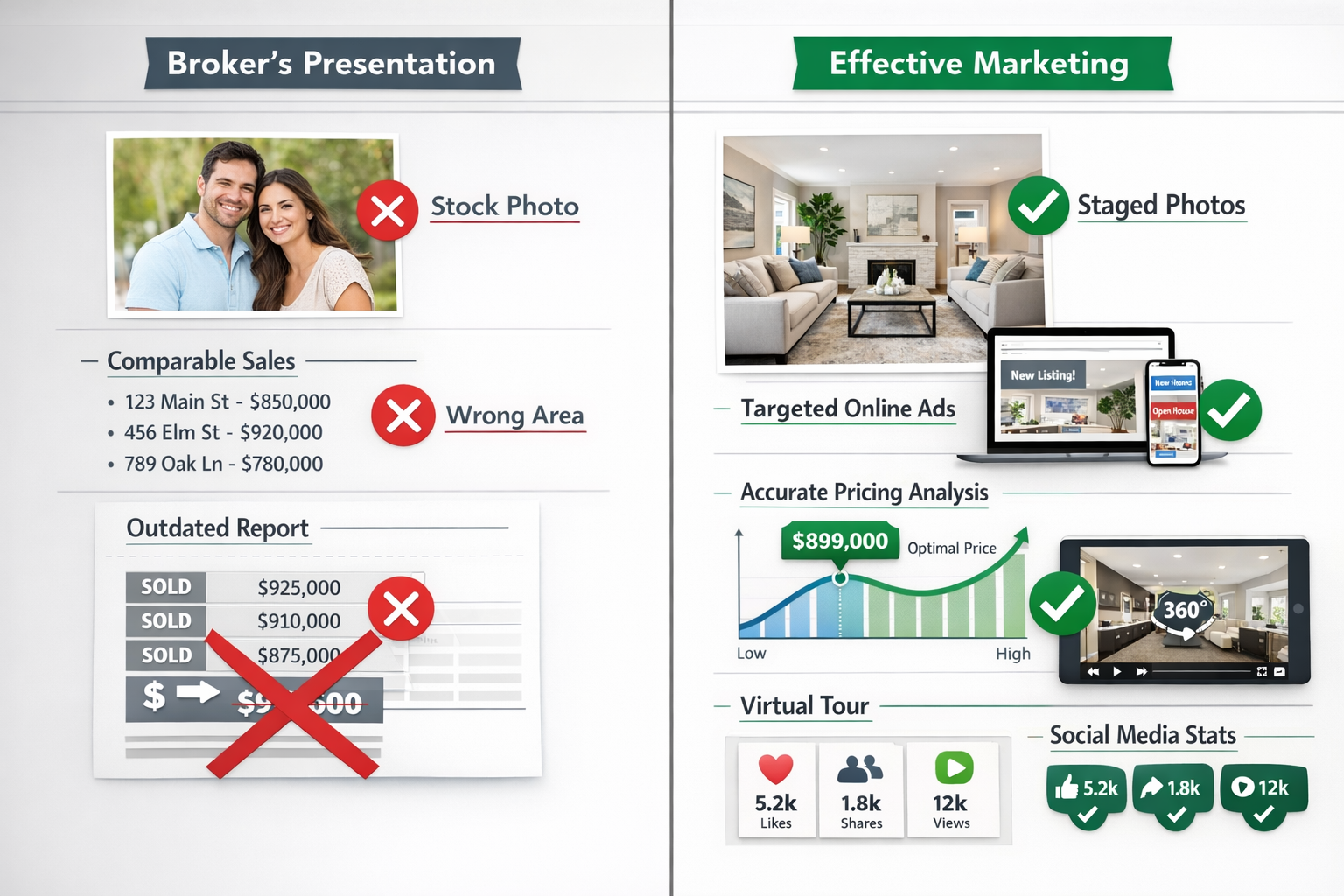
This question is impeccable for exposing whether your broker is actually collecting and acting on buyer feedback or just going through the motions. Feedback is gold—it tells you exactly why buyers are walking away instead of making offers.
The Feedback Collection Gap
Here's a dirty secret in real estate: many agents are terrible at collecting meaningful feedback. They might send a generic text to the buyer's agent asking "what did your clients think?" and accept vague responses like "nice house, not quite right for them" without digging deeper.
Effective feedback collection includes:
- Specific questioning: Asking about particular features, price perception, condition concerns, and comparison to other homes they've seen
- Timing: Following up within 24 hours while impressions are fresh
- Pattern recognition: Compiling feedback across multiple showings to identify recurring themes
- Honest communication: Sharing both positive and negative feedback with sellers, even when it's uncomfortable
Common Feedback Themes and What They Really Mean
| Feedback Phrase | What Buyers Actually Mean | Action Required |
|---|---|---|
| "It's priced a bit high" | Your home is overpriced for current condition/market | Pricing analysis and potential adjustment |
| "It needs too much work" | Deferred maintenance or dated finishes are deal-breakers | Consider pre-listing updates or price reduction |
| "The layout doesn't work for us" | Floor plan is genuinely problematic OR staging isn't showcasing flow | Better staging or virtual floor plan options |
| "We're looking at other options" | Your home isn't competitive against comparable listings | Competitive analysis and differentiation strategy |
| "We'll think about it" | They're not excited enough to act quickly | Marketing isn't highlighting unique value propositions |
How Extraordinary Brokers Use Feedback
Top-performing agents treat feedback as actionable intelligence. When they hear consistent themes, they:
For pricing concerns:
- Conduct fresh comparative market analysis
- Present data-driven pricing recommendations
- Discuss strategic price positioning to generate urgency
For condition issues:
- Recommend specific, high-ROI improvements
- Connect sellers with trusted contractors for estimates
- Discuss price adjustments versus improvement investments
For marketing/presentation problems:
- Refresh photography highlighting different features
- Adjust listing description to address misconceptions
- Recommend staging changes to improve flow and appeal
For competitive positioning:
- Identify what comparable homes offer that yours doesn't
- Develop messaging around unique advantages
- Create urgency through limited-time incentives or concessions
Gaslighting Responses That Should Alarm You
🚩 "Buyers never give real feedback—they're just making excuses"
Translation: They're not actually collecting feedback or don't want to share negative comments.
🚩 "Everyone loves your home—they're just not ready to buy"
Translation: They're either lying about feedback or only sharing positive comments while hiding concerns.
🚩 "Feedback doesn't matter—pricing is everything"
Translation: They're oversimplifying to avoid addressing multiple issues simultaneously.
🚩 "You shouldn't take feedback personally"
Translation: They're about to blame your home instead of acknowledging their marketing failures.
Demand Feedback Documentation
Ask your broker to provide:
- Written feedback summaries from each showing
- Compiled themes across all showings
- Specific action items based on patterns
- Timeline for implementing feedback-driven changes
If they can't produce this documentation, they're not doing the fundamental work required to sell your home effectively. Professional agents maintain detailed feedback logs and review them regularly with sellers.
For additional context on preparing your home based on buyer feedback, check out expert tips preparing your home to attract buyers.
Question #5: "If You Were Buying My Home Today, What Would Concern You Most, and Why Haven't We Addressed It?" 🏠
This is the ultimate accountability question—and it's absolutely dope for cutting through BS. It forces your broker to step into the buyer's shoes and admit what they've been avoiding telling you. It also reveals whether they've been strategically thinking about your listing or just autopiloting.
Why This Question Is So Powerful
When brokers are forced to answer as a hypothetical buyer, they can't hide behind professional jargon or market excuses. They have to confront the real barriers preventing your home from selling. Their response will reveal:
- Whether they've been honest with you about your home's challenges
- If they have the courage to have difficult conversations
- Whether they've been strategic about addressing known issues
- If they're truly invested in solving problems versus just waiting for a miracle buyer
What Honest Brokers Will Admit
Extraordinary agents will give you straight talk, even when it's uncomfortable:
Pricing reality checks:
"If I were buying, I'd be concerned that your home is priced $40K above comparable sales from the last 60 days. We haven't addressed it because I was hoping the market would catch up, but I now realize we need to have a serious pricing conversation."
Condition concerns:
"The dated kitchen would concern me as a buyer because I'd immediately calculate renovation costs. We haven't addressed it because I didn't want to suggest you invest more money before selling, but we should discuss either a price adjustment to account for this or a small refresh that could yield significant returns."
Marketing gaps:
"Your listing photos don't showcase the home's best features—the backyard and natural light. I should have insisted on a reshoot weeks ago. Let me schedule our photographer for this week."
Competitive positioning:
"Three comparable homes have sold in the past month with updated fixtures and neutral paint. If I were buying, I'd wonder why yours is priced similarly without those updates. We need to either differentiate on price or make strategic improvements."
The Strategic Follow-Up: "Why Haven't We Addressed It?"
This second part of the question is crucial. It prevents brokers from simply identifying problems without taking responsibility for solving them. Their answer should include:
- Acknowledgment of why the issue wasn't addressed earlier
- Ownership of any mistakes in initial strategy
- Action plan with specific steps and timeline
- Commitment to implementing changes immediately
Gaslighting Responses That Reveal Manipulation
🚩 "I wouldn't have any concerns—your home is perfect"
Translation: They're either lying or lack the critical thinking skills to identify real issues.
🚩 "The only concern is finding the right buyer—they're out there"
Translation: They're avoiding accountability by pretending no strategic changes are needed.
🚩 "We have addressed everything—you just need to be patient"
Translation: They're rewriting history and gaslighting you about past conversations.
🚩 "If I told you every little thing buyers might not like, you'd be overwhelmed"
Translation: They're patronizing you and withholding information you deserve to have.
🚩 "The concerns aren't things we can change, so there's no point discussing them"
Translation: They've given up and are waiting out the listing agreement.
What to Do With Their Answer
If your broker gives an honest, thoughtful response acknowledging real issues and proposing solutions, you might have a partnership worth continuing—with clear expectations and deadlines for improvement.
If they deflect, minimize, or refuse to identify any concerns, you're dealing with someone who either lacks competence or courage. In either case, it's time to seriously consider making a change.
For sellers struggling with pricing decisions based on broker feedback, avoid pricing pitfalls: how to value your home in any market offers valuable guidance on getting pricing right.
What to Do When Your Broker Fails the Gaslighting Question Test 🚨
You've asked the 5 gaslighting questions to ask your real estate broker when your home isn't selling, and the responses have confirmed your worst fears: your broker is deflecting, manipulating, or simply incompetent. Now what?
Your Rights as a Seller
First, understand that you have options. While listing agreements are contracts, they're not prison sentences. Depending on your situation, you can:
Request a listing agreement termination:
- Review your contract for termination clauses
- Document your broker's performance failures
- Request release in writing, citing specific concerns
- Be prepared to negotiate (some brokers will fight to keep the listing)
Wait out the agreement and switch:
- Note your contract end date
- Begin interviewing replacement agents 30 days before expiration
- Do not sign any extensions without significant strategy changes
- Ensure new agent understands why previous listing failed
Escalate to the broker's managing broker:
- If your agent works under a brokerage, contact their supervisor
- Present documentation of performance issues
- Request reassignment to a different agent within the firm
- This often works better than trying to break the contract entirely
Red Tape Reality Check
Breaking a listing agreement isn't always simple. Some contracts include:
- Protection periods: Clauses requiring you to pay commission if you sell to anyone who viewed during the listing period
- Marketing cost reimbursement: Requirements to reimburse certain marketing expenses
- Dual agency restrictions: Limitations on working with other agents from the same brokerage
Before making any moves:
- Read your listing agreement thoroughly
- Consult with a real estate attorney if the contract is complex
- Document all communication and performance issues
- Consider the financial implications of various options
Finding a Fresh Agent Who Actually Delivers
When interviewing replacement agents, use your experience to ask better questions:
Marketing accountability questions:
- "Show me examples of your listing marketing campaigns and their results"
- "What technology and platforms do you use to track listing performance?"
- "How do you differentiate homes in competitive markets?"
Communication and transparency questions:
- "How often will you provide performance updates, and in what format?"
- "What's your process for collecting and sharing buyer feedback?"
- "How quickly do you typically respond to seller questions?"
Strategy and problem-solving questions:
- "Tell me about a listing that wasn't selling—what did you do to turn it around?"
- "How do you determine optimal pricing strategy?"
- "What would you do differently than my previous agent?"
The Relisting Strategy
If you're switching agents, you'll need a fresh approach to overcome the stigma of being a stale listing:
Rebranding the listing:
- New professional photography from different angles
- Updated listing description with fresh perspective
- Different marketing channels and targeting
- Consider minor cosmetic updates to show change
Pricing strategy reset:
- Honest market analysis without ego or previous anchoring
- Strategic pricing to generate immediate interest
- Consider "new listing" pricing advantage
Timing considerations:
- Brief listing pause to reset days-on-market counter (if allowed in your MLS)
- Relaunch during optimal market timing
- Coordinate marketing push for maximum impact
Transparency about previous listing:
- Honest explanation of changes made since previous listing
- Emphasis on new pricing, marketing, or improvements
- Proactive addressing of buyer concerns about "why didn't it sell before"
For comprehensive guidance on selling strategies, explore home selling strategies that work in any market condition.
Prevention: How to Choose a Broker Who Won't Gaslight You From the Start 🛡️
The best way to avoid real estate gaslighting is to choose an exceptional broker from the beginning. Here's how to identify agents who deliver results instead of excuses:
Interview Multiple Agents (Seriously)
Don't hire the first agent who knocks on your door or your cousin's friend who "just got their license." Interview at least three agents and compare:
Their market knowledge:
- Recent sales in your neighborhood
- Understanding of current market dynamics
- Familiarity with your specific property type
- Knowledge of buyer demographics for your price point
Their marketing approach:
- Specific strategies they'll use for your home
- Technology and platforms they leverage
- Examples of successful campaigns
- Differentiation from competitors
Their communication style:
- How they handle difficult questions
- Willingness to provide data and evidence
- Transparency about challenges
- Responsiveness during interview process
Check Their Track Record
Don't just take their word for it—verify their performance:
Quantifiable metrics to request:
- Average days on market for their listings versus market average
- List-to-sale price ratio (how close to asking price do their homes sell?)
- Number of listings that expired or were withdrawn
- Client testimonials specifically about communication and results
Online research:
- Google reviews and ratings
- Zillow agent profile and reviews
- Social media presence and engagement
- Professional awards or recognition
Watch for Green Flags
Extraordinary agents demonstrate these qualities from the first conversation:
✅ Data-driven approach: They reference statistics, market trends, and comparable sales naturally
✅ Honest about challenges: They identify potential obstacles and how they'll address them
✅ Specific marketing plans: They outline detailed strategies, not vague promises
✅ Technology adoption: They use modern tools for marketing, communication, and analytics
✅ Clear communication: They explain complex concepts in accessible language
✅ Confidence without arrogance: They're assured but not dismissive of your input
✅ Questions about your goals: They seek to understand your priorities and timeline
Red Flags During Agent Selection
Avoid agents who display these warning signs:
❌ Pressure tactics: Pushing you to sign immediately without time to consider
❌ Unrealistic promises: Guaranteeing prices above market or impossibly quick sales
❌ Vague marketing plans: Can't articulate specific strategies beyond "MLS and open houses"
❌ Dismissive of your concerns: Makes you feel foolish for asking questions
❌ No performance metrics: Can't or won't provide data about their track record
❌ Poor communication: Takes days to respond during courtship phase
❌ One-size-fits-all approach: Uses identical strategy for every listing
The Contract Review Essential
Before signing any listing agreement:
Understand these critical terms:
- Listing duration: Typical is 6 months, but 3-4 months is reasonable in faster markets
- Commission structure: Standard rates and any negotiation flexibility
- Marketing commitments: What specific marketing is guaranteed in writing
- Performance metrics: Any agreed-upon benchmarks for success
- Termination clauses: Conditions under which you can exit the agreement
- Exclusivity: Whether you can sell yourself or if agent gets commission regardless
Negotiate for accountability:
- Performance review checkpoints (e.g., 30-day strategy assessment)
- Marketing deliverables in writing
- Communication frequency commitments
- Termination rights if specific benchmarks aren't met
Don't be afraid to request contract modifications. Professional agents understand that accountability protects both parties and will work with reasonable requests.
Taking Control: Your Action Plan When Your Home Isn't Selling ⚡

Knowledge is power, but action creates results. If you've identified gaslighting behavior or poor performance from your broker, here's your step-by-step action plan:
Immediate Actions (This Week)
Day 1-2: Document everything
- Compile all communication with your broker
- Screenshot marketing materials (or lack thereof)
- Note showing frequency and feedback received
- Review your listing agreement terms
Day 3-4: Ask the 5 gaslighting questions
- Schedule a formal meeting or call with your broker
- Ask each question and document responses
- Request written follow-up on any promises made
- Set specific deadlines for action items
Day 5-7: Evaluate the responses
- Assess whether broker took accountability
- Review any data or evidence they provided
- Determine if proposed solutions are adequate
- Decide whether to continue the relationship
Short-Term Strategy (Next 2-4 Weeks)
If continuing with current broker:
- Implement agreed-upon changes immediately
- Establish weekly check-in calls for updates
- Request performance dashboards showing progress
- Set clear benchmarks for continued partnership
If switching brokers:
- Interview replacement agents using improved criteria
- Consult attorney about listing agreement termination
- Develop transition plan to minimize market disruption
- Plan relisting strategy with new agent
Regardless of broker decision:
- Consider strategic home improvements that feedback indicates
- Research comparable sales yourself to verify pricing
- Explore interior design ideas that make your small living room look expensive for low-cost updates
- Review home decor swaps that make your place look designer on a Target budget
Long-Term Success (Next 1-3 Months)
Marketing optimization:
- Ensure professional photography showcases your home's best features
- Verify listing appears correctly on all major platforms
- Monitor online engagement and adjust strategy accordingly
- Leverage social media to expand reach beyond traditional channels
Pricing strategy:
- Conduct monthly pricing reviews based on market activity
- Be willing to adjust if data supports different positioning
- Understand that strategic price reductions can generate urgency
- Don't let ego prevent necessary corrections
Feedback integration:
- Address recurring buyer concerns proactively
- Make cost-effective improvements that remove objections
- Consider staging or virtual staging to improve presentation
- Highlight unique features that differentiate from competition
Maintain realistic expectations:
- Understand that some markets genuinely are slower
- Recognize that luxury homes naturally take longer to sell
- Balance patience with accountability—waiting is fine if strategy is sound
- Trust data over emotions when making decisions
The Bottom Line: You Deserve Accountability, Not Excuses 💪
Selling your home is one of the most significant financial transactions of your life. You deserve a real estate broker who treats it with the seriousness and professionalism it demands. The 5 gaslighting questions to ask your real estate broker when your home isn't selling aren't about being difficult—they're about demanding the accountability and transparency that should be standard in any professional relationship.
Remember these key principles:
- Your concerns are valid: If your gut tells you something is wrong, trust it and investigate
- Data beats deflection: Demand evidence, metrics, and comparable analysis
- Marketing matters: In 2026, comprehensive digital marketing isn't optional—it's essential
- Feedback is gold: Brokers who don't collect and act on feedback are failing at their job
- You have options: Listing agreements aren't permanent, and switching agents is possible
When to Fight, When to Pivot
Continue working with your broker if:
- They respond to tough questions with data and accountability
- They acknowledge mistakes and propose specific solutions
- They implement changes quickly and track results
- They communicate proactively and transparently
- Performance improves within agreed-upon timeframes
Make a change if:
- They deflect blame and avoid accountability consistently
- They can't provide evidence of marketing efforts
- They make you feel unreasonable for expecting results
- They refuse to adjust strategy despite poor performance
- You've lost trust in their competence or integrity
Your Next Steps
Don't let another week pass with a stagnant listing and a broker who makes excuses instead of results. Take action:
- Schedule a meeting with your broker this week
- Ask the 5 gaslighting questions and document responses
- Evaluate their answers against the red flags outlined in this article
- Make a decision about continuing or changing representation
- Implement changes immediately—time on market matters
The real estate market in 2026 is competitive, but it's also full of opportunity for sellers who have the right representation. Don't settle for mediocrity when your financial future is at stake.
For additional resources on navigating the current market, explore Real Estate Rank IQ's comprehensive guides on expert tips and strategies that can help you make informed decisions throughout your selling journey.
Remember: extraordinary results require extraordinary effort. If your broker isn't delivering both, it's time for a change. Your home deserves better, and so do you.
Conclusion
The 5 gaslighting questions to ask your real estate broker when your home isn't selling serve as your defense against manipulation and your pathway to accountability. By demanding specific data on comparable performance, concrete evidence of marketing execution, realistic showing expectations with contingency plans, documented buyer feedback with action items, and honest assessment of your home's challenges, you transform from a passive seller hoping for results into an empowered client demanding them.
Real estate gaslighting thrives in environments where sellers don't know what questions to ask or feel intimidated by "expert" authority. But armed with these questions and the knowledge of what constitutes legitimate versus manipulative responses, you can cut through the deflection and get to the truth about why your home isn't selling.
Whether you discover that your broker has been underperforming and needs to step up their game, or you realize it's time to make a change entirely, taking action is always better than accepting excuses. Your home is likely your largest financial asset—treat the process of selling it with the seriousness it deserves, and demand the same from the professionals you hire to represent you.
The market may have its challenges, but with the right broker using the right strategies, your home can sell for the price it deserves in a timeframe that works for you. Don't settle for gaslighting when you can have genuine partnership and results.
Ready to take control of your home sale? Start by asking these five questions today. Your future self—and your bank account—will thank you.