



Picture this: It’s your 23rd property viewing this month. Your feet hurt, your brain is mush, and every house is starting to blur together into one endless parade of beige walls and “cozy” kitchens. You’ve bookmarked 147 listings, driven through 12 neighborhoods, and somehow still feel no closer to finding “the one.” Sound familiar? Welcome to house hunting fatigue—the modern home buyer’s worst nightmare. But here’s the extraordinary news: 5 AI hacks to beat house hunting fatigue and find your dream home are revolutionizing how savvy buyers navigate the 2026 real estate market, and they’re about to change your entire search game.

House hunting in 2026 doesn’t have to feel like running a marathon in quicksand. While traditional methods leave buyers exhausted and overwhelmed, artificial intelligence is quietly transforming the search process from a draining slog into a streamlined, data-driven journey. These aren’t your basic Zillow alerts—we’re talking about next-level AI tools that learn your preferences, predict market movements, and essentially become your 24/7 digital real estate assistant.
Key Takeaways
- AI-powered search tools can reduce property browsing time by up to 70% by learning your preferences and filtering out mismatched listings automatically
- Virtual tour technology combined with AI analysis lets you tour 10-15 properties from your couch in the time it would take to visit just two in person
- Predictive analytics help identify emerging neighborhoods and future value opportunities before they hit mainstream buyer radar
- AI chatbots and virtual assistants provide instant answers to property questions 24/7, eliminating the wait time for agent responses
- Automated market analysis tools deliver personalized insights about pricing, competition, and optimal offer strategies in real-time
Understanding House Hunting Fatigue: Why Traditional Methods Are Exhausting
Let’s keep it real—house hunting has always been stressful, but the 2026 housing market has turned it into an Olympic-level endurance sport. Between limited inventory, competitive bidding wars, and the pressure of making the biggest financial decision of your life, it’s no wonder buyers are tapping out before they find their dream home.
The Traditional House Hunting Struggle Is Real:
- Spending 15-20 hours per week browsing listings across multiple platforms
- Driving to 30+ properties only to find they look nothing like the photos
- Waiting days for agent responses to basic questions
- Losing track of which house had the good kitchen and which had the sketchy basement
- Making emotional decisions based on incomplete information
- Experiencing decision paralysis from information overload
The psychological toll is even more dope than the time investment. Research shows that 67% of home buyers report significant stress during their search, with many citing exhaustion, anxiety, and relationship strain. When you’re juggling work, family, and trying to tour houses during narrow showing windows, something’s gotta give.
But here’s where it gets fresh: AI technology isn’t just making house hunting easier—it’s fundamentally reimagining what’s possible. Instead of you doing all the heavy lifting, intelligent algorithms work around the clock to surface the perfect properties, analyze market data, and even predict which homes will appreciate fastest. It’s like having a team of real estate analysts, data scientists, and personal assistants all rolled into one—minus the coffee runs.
Hack #1: Deploy AI-Powered Property Search Engines That Learn Your Preferences
Stop wasting time scrolling through hundreds of irrelevant listings. The first of our 5 AI hacks to beat house hunting fatigue and find your dream home involves leveraging machine learning algorithms that actually understand what you want—sometimes better than you do yourself.
How AI Search Engines Work Their Magic
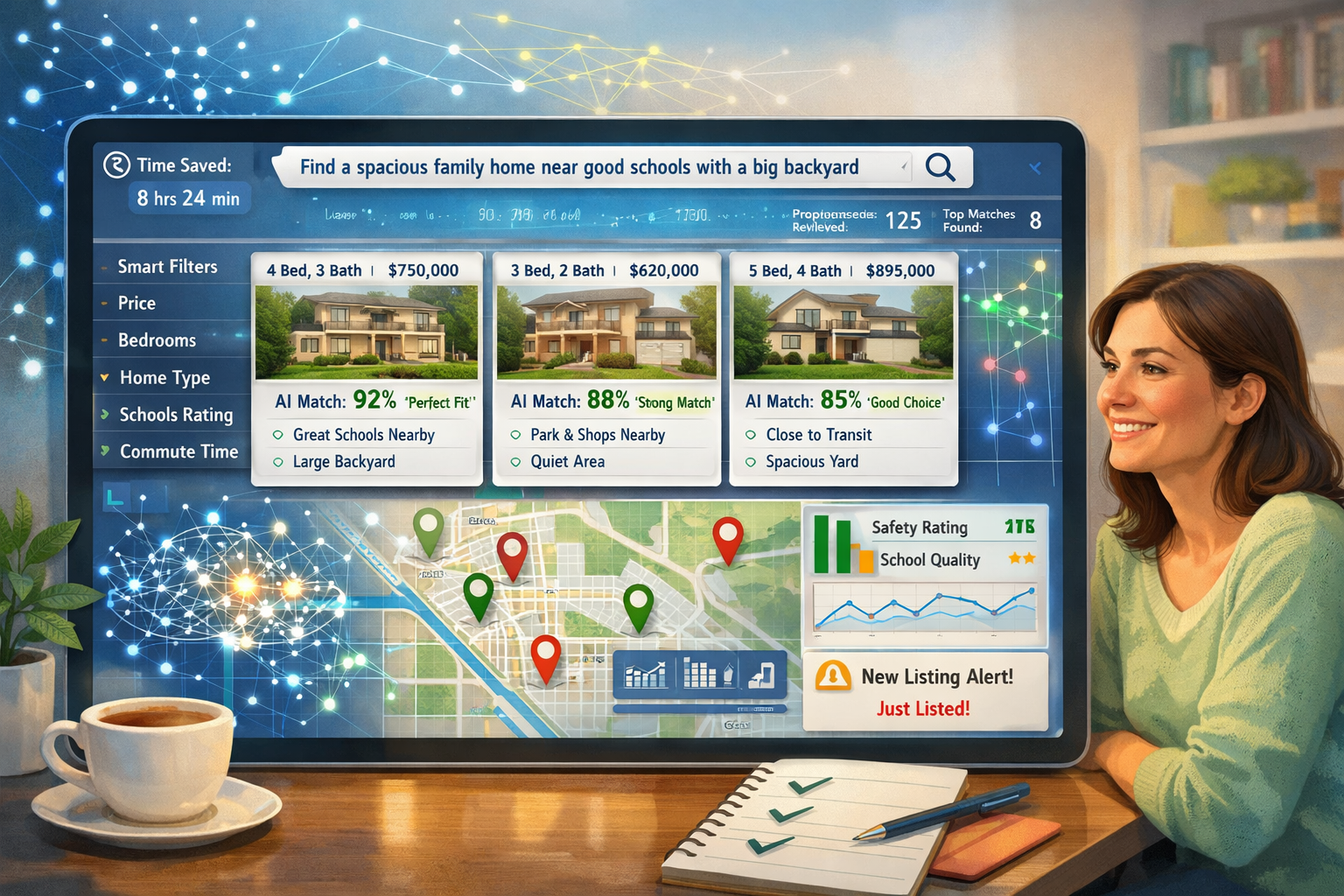
Modern AI property search platforms use natural language processing (NLP) to understand your search queries the way a human would. Instead of rigid filters like “3 bedrooms, 2 baths, $400K-$500K,” you can literally type: “I want a quiet neighborhood with good schools, walking distance to coffee shops, and a yard big enough for my golden retriever.”
The AI then:
- Analyzes your search patterns and click behavior to identify what features matter most
- Learns from your feedback when you save, skip, or heart listings
- Predicts compatibility scores for properties you haven’t even seen yet
- Automatically filters out deal-breakers without you having to manually exclude them every time
Top AI-Powered Search Platforms in 2026:
| Platform | Key AI Feature | Best For |
|---|---|---|
| Zillow’s Neural Search | Predictive matching based on browsing history | First-time buyers needing guidance |
| Redfin’s Smart Recommendations | Real-time inventory alerts with compatibility scores | Competitive markets |
| Realtor.com’s AI Assistant | Natural language search with neighborhood insights | Location-focused buyers |
| Homesnap’s Vision Search | Upload photos of homes you like; AI finds similar properties | Visual learners |
The Impeccable Results Speak for Themselves
Buyers using AI-powered search tools report finding their eventual home 40% faster than those using traditional methods. Why? Because the AI eliminates the noise. Instead of viewing 50 properties, you’re seeing the 12 that actually match your lifestyle, budget, and long-term goals.
Pro Tip: Train your AI assistant properly from day one. Spend 30 minutes on your first session actively liking, disliking, and commenting on properties. The more data you feed the algorithm, the smarter it becomes. Think of it like training a puppy—except this one finds you houses instead of chewing your shoes.
For real estate agents looking to level up their client service, integrating these AI tools into your workflow isn’t just helpful—it’s becoming essential. Clients increasingly expect this level of personalized, tech-enabled service.
Hack #2: Leverage Virtual Tours and AI-Enhanced Property Visualization
Remember when “virtual tour” meant a janky 360-degree photo that made you dizzy? Those days are so based—as in, based in the past. The second hack in our 5 AI hacks to beat house hunting fatigue and find your dream home arsenal involves immersive virtual experiences that save you countless hours of driving around.
The Virtual Tour Revolution
In 2026, AI-enhanced virtual tours have become so sophisticated they’re practically indistinguishable from in-person visits. We’re talking about:
- AI-powered 3D walkthroughs that let you navigate properties as if you’re actually there
- Virtual staging that shows you multiple furniture and design options in real-time
- Augmented reality (AR) features that let you visualize your own furniture in the space
- AI measurement tools that calculate room dimensions, ceiling heights, and even estimate renovation costs
- Drone footage integration that shows neighborhood context and property boundaries
The extraordinary part? You can tour 10-15 properties in two hours from your couch—in your pajamas, with snacks. No traffic, no awkward small talk with sellers, no rushing through because you have another showing across town in 20 minutes.
How AI Makes Virtual Tours Actually Useful
Here’s where AI takes virtual tours from “neat gimmick” to “game-changing tool”:
Smart Feature Detection: AI algorithms automatically identify and tag features like hardwood floors, granite countertops, updated appliances, and architectural details. You can search for “properties with original crown molding” and the AI knows which virtual tours to show you.
Comparative Analysis: Tour multiple properties back-to-back and the AI creates side-by-side comparisons of layouts, finishes, and features. No more trying to remember if House A or House C had the better kitchen.
Red Flag Identification: Advanced AI can spot potential issues during virtual tours—water stains, foundation cracks, outdated electrical panels—and flag them for your attention before you waste time on an in-person visit.
Neighborhood Context: Some platforms now integrate street-level AI analysis that shows you the actual neighborhood vibe—not just the curated property photos. Think walkability scores, noise levels, nearby amenities, and even parking availability.
The Strategic Approach to Virtual Tours
Don’t just randomly click through virtual tours. Use this strategic framework:
- Broad First Pass (30 minutes): Use AI filters to identify 20-30 potential properties
- Virtual Tour Deep Dive (2 hours): Take detailed virtual tours of your top 10, making notes in each
- AI-Assisted Comparison (30 minutes): Let the platform’s AI compare your favorites and highlight key differences
- Shortlist for In-Person (Result): Visit only the 3-5 properties that survived the virtual gauntlet
This approach means every in-person tour has a high probability of being “the one”—no more wasting entire Saturdays on properties that were never really contenders. For sellers wondering how to present their homes effectively, check out these real estate photos that sell to ensure your virtual tours showcase your property’s best features.
Hack #3: Use AI Market Analysis Tools for Data-Driven Decision Making

Gate keeping this information would be criminal, so let’s talk about the third hack: AI-powered market analysis tools that give you insider-level insights without needing a PhD in data science. This is where the 5 AI hacks to beat house hunting fatigue and find your dream home strategy gets seriously powerful.
Why Gut Feelings Aren’t Enough Anymore
Traditional house hunting relies heavily on emotion and surface-level information. You walk into a house, fall in love with the kitchen, and suddenly you’re ready to make an offer without considering whether you’re overpaying by $50K or buying in a neighborhood that’s peaked.
AI market analysis tools flip this script by providing:
📊 Real-Time Comparative Market Analysis (CMA): Instantly see how a property’s price compares to recent sales, active listings, and historical trends in the area.
📈 Predictive Price Modeling: AI algorithms analyze hundreds of variables to predict whether a property is likely to appreciate or depreciate over the next 5-10 years.
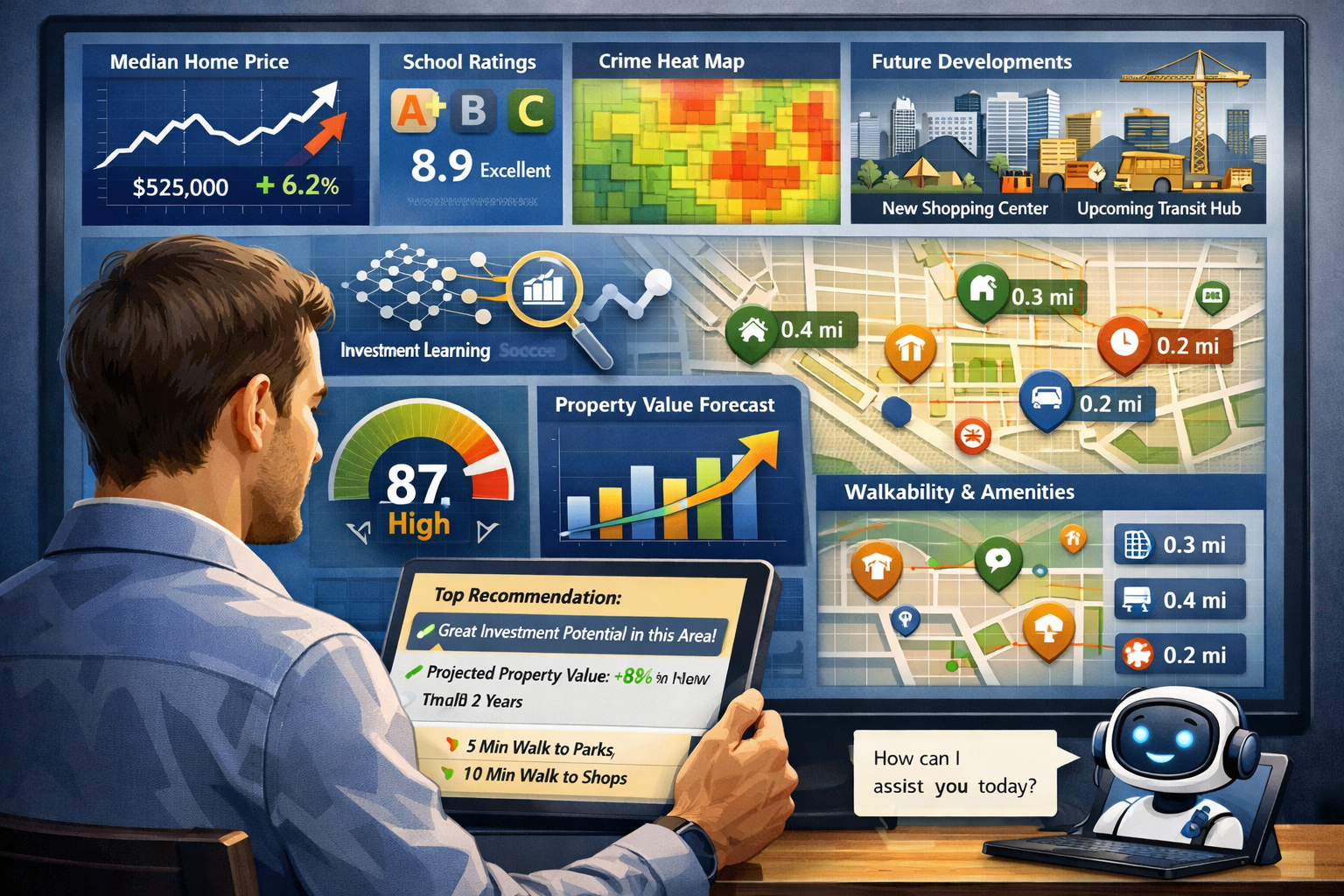
🏘️ Neighborhood Intelligence: Deep-dive analytics on school quality, crime trends, development plans, demographic shifts, and amenity proximity—all factors that impact long-term value.
💰 Investment Potential Scoring: Even if you’re buying a primary residence, AI can calculate the property’s potential as a future rental or resale opportunity.
🎯 Optimal Offer Recommendations: Based on market velocity, days on market, and seller motivation indicators, AI suggests the most strategic offer price and terms.
The AI Tools Making Waves in 2026
HouseCanary: Uses machine learning to provide property valuations and forecasts with impressive accuracy. Their AI considers over 1,000 property attributes and market factors.
Revaluate: Offers AI-driven investment analysis that’s particularly dope for buyers considering real estate investment strategies. It calculates cash flow projections, appreciation potential, and risk factors.
NeighborhoodScout: Employs AI to analyze crime data, school ratings, and demographic trends, giving you a comprehensive neighborhood risk and opportunity assessment.
Zillow’s Zestimate 3.0: Love it or hate it, Zillow’s AI-powered valuation tool has gotten significantly more accurate, incorporating real-time market data and machine learning refinements.
Putting AI Market Analysis to Work
Let’s walk through a real-world scenario. You find a charming 1920s bungalow listed at $475,000. Seems reasonable, but is it? Here’s how AI tools help you decide:
Step 1: Run the address through an AI valuation tool. It returns an estimated value of $455,000-$465,000 based on recent comps.
Step 2: Check the AI neighborhood analysis. It reveals that three major tech companies are opening offices within two miles in the next 18 months—a strong appreciation indicator the listing agent might be gatekeeping.
Step 3: Use AI investment calculators to project rental income if you need to relocate. The AI estimates $2,800/month rental potential with positive cash flow.
Step 4: Review the AI’s optimal offer recommendation: $460,000 with a request for seller-paid closing costs, based on the property’s 47 days on market and recent price reduction.
The Result: You make an informed offer backed by data, not just emotion. You know you’re getting a fair deal in an appreciating area with strong fundamentals.
This data-driven approach doesn’t remove the joy of finding your dream home—it just ensures you’re not making a $500,000 mistake based on pretty countertops. For those interested in understanding how location impacts value, dive into these amenity proximity secrets that AI tools help identify.
Hack #4: Implement AI Chatbots and Virtual Assistants for 24/7 Support
The fourth hack in our 5 AI hacks to beat house hunting fatigue and find your dream home toolkit addresses one of the most frustrating aspects of traditional house hunting: waiting. Waiting for your agent to respond. Waiting for listing agents to answer questions. Waiting for mortgage brokers to get back to you. In 2026, AI chatbots and virtual assistants have eliminated most of this waiting game.
The Always-On Advantage
AI-powered real estate chatbots aren’t the clunky, frustrating bots of yesteryear that could barely understand “hello.” Today’s AI assistants use advanced natural language processing and are trained on millions of real estate conversations. They can:
✅ Answer property-specific questions instantly (“Does this house have central air?” “When was the roof replaced?” “What’s included in the HOA fee?”)
✅ Schedule showings and coordinate with multiple parties without the back-and-forth email chains
✅ Provide mortgage pre-qualification estimates and connect you with lenders in real-time
✅ Explain complex real estate terms in plain English (What’s the difference between assessed value and market value? Check out this comprehensive breakdown)
✅ Track your entire search history and remind you of properties you liked weeks ago
✅ Alert you immediately when new properties matching your criteria hit the market
The Human-AI Partnership
Here’s what’s impeccable about 2026’s AI assistants: they know when to loop in humans. The best platforms use AI for routine questions and information gathering, but seamlessly transfer to human agents when complex negotiations, emotional support, or strategic advice is needed.
Example Workflow:
- 11 PM on Tuesday: You’re browsing listings and have questions about a property’s foundation. AI chatbot pulls the inspection report and explains the findings.
- 11:05 PM: You want to see the house. AI schedules a showing for Thursday at 6 PM and adds it to your calendar.
- Wednesday morning: AI sends you a prep package with neighborhood data, comparable sales, and suggested questions to ask during the tour.
- Thursday after showing: You love it and want to make an offer. AI connects you with your human agent for strategy discussion.
- Friday: Human agent and AI work together—agent handles negotiation while AI provides real-time market data and document management.
Top AI Assistant Platforms for Home Buyers
ChatGPT for Real Estate (Custom GPTs): Savvy buyers are creating custom GPT assistants trained on their specific preferences and local market data. These personalized AI assistants become intimately familiar with your search criteria.
Structurely: An AI-powered lead response and qualification platform that many agents use. As a buyer, this means instant responses to your inquiries—even at 2 AM.
Ylopo’s AI Assistant: Integrates with MLS data to provide instant property information and can even draft offer letters based on your input.
Roof AI: Specializes in answering technical questions about property conditions, necessary repairs, and maintenance costs.
Maximizing Your AI Assistant
To get the most from AI chatbots and virtual assistants:
- Be specific in your questions: Instead of “Is this a good house?”, ask “What are the major expenses I should budget for in the first three years based on the property’s age and condition?”
- Use them for research-heavy tasks: AI excels at pulling together information from multiple sources—school ratings, crime statistics, property history, etc.
- Let AI handle scheduling and logistics: Free up your mental energy for the big decisions by letting AI manage the calendar coordination.
- Combine AI insights with human expertise: Use AI for data and information, but rely on experienced agents for negotiation strategy and market nuance.
The bottom line? AI assistants handle the tedious, time-consuming aspects of house hunting so you can focus on the exciting parts—like imagining where your couch will go in that perfect living room. Speaking of which, once you find your home, these interior design ideas can help you make it look expensive without breaking the bank.
Hack #5: Harness AI for Personalized Neighborhood Discovery and Future Planning
The final hack in our 5 AI hacks to beat house hunting fatigue and find your dream home strategy is perhaps the most forward-thinking: using AI to identify not just the right house, but the right neighborhood for your future lifestyle and investment goals.
Beyond the Property: The Neighborhood Intelligence Revolution
Here’s a truth bomb: you’re not just buying a house—you’re buying into a neighborhood, a school district, a commute pattern, and a lifestyle. Traditional house hunting focuses 90% on the property itself and maybe 10% on location. AI flips this by providing deep neighborhood intelligence that would take you months to research manually.
What AI Neighborhood Analysis Reveals:
🎓 School Performance Trends: Not just current ratings, but AI-predicted trajectories based on funding, teacher retention, and demographic shifts. Crucial if you have kids or plan to.
🚗 Commute Pattern Analysis: AI calculates your actual commute time based on your work schedule, traffic patterns, and even weather data. That “30-minute commute” might be 55 minutes during your actual work hours.
🏗️ Development Pipeline Intelligence: AI scours city planning documents, zoning applications, and commercial real estate data to identify upcoming developments—both positive (new parks, shops) and negative (industrial facilities, high-density projects).
📈 Appreciation Potential Mapping: Machine learning models predict which neighborhoods are poised for growth based on hundreds of economic indicators, infrastructure investments, and demographic trends.
🛍️ Lifestyle Compatibility Scoring: AI analyzes your social media, purchase history (with permission), and stated preferences to match you with neighborhoods where you’ll actually enjoy living—not just surviving.
The AI Tools Revolutionizing Neighborhood Research
NeighborhoodScout Pro: Uses AI to provide detailed crime forecasts, school trajectory predictions, and real estate appreciation models at the block level.
Esri’s Tapestry Segmentation: Employs AI to classify neighborhoods into lifestyle segments, helping you find areas where people share your values, interests, and life stage.
Walk Score’s AI Expansion: Now includes AI-powered predictions about how walkability and transit access will change with planned developments.
Local Logic: Provides AI-driven insights on noise levels, air quality, traffic patterns, and even sunlight exposure for specific properties.
Real-World Application: Finding Your Perfect Neighborhood
Let’s say you’re a remote worker who values walkability, good coffee shops, and a strong sense of community. Here’s how AI helps:
Traditional Approach: You’d spend weekends driving around different neighborhoods, maybe grabbing coffee, trying to “get a feel” for each area. It’s time-consuming and subjective.
AI-Powered Approach:
- Input Your Priorities: Tell the AI what matters—walkability, coffee culture, community events, low crime, good restaurants, parks for your dog.
- AI Neighborhood Matching: The algorithm analyzes every neighborhood in your target city, scoring each based on your criteria. It identifies three neighborhoods you’d never considered that score 90%+ matches.
- Deep Dive Analysis: AI provides detailed reports on each neighborhood including:
- Current demographics and projected changes
- Walkability scores and specific amenities within 10 minutes
- Crime trends (not just current rates but 5-year trajectories)
- Property value appreciation over the past decade and projections
- Community engagement metrics (how active are neighborhood associations?)
- Development pipeline (what’s being built in the next 3 years?)
- Virtual Neighborhood Tours: AI-curated video tours showing you the actual streets, shops, and community spaces during different times of day.
- Resident Insights: AI aggregates and analyzes reviews from current residents, identifying common themes and concerns.
The Result: You identify a neighborhood that checks all your boxes—one you might have overlooked because it wasn’t on the “trendy” list. You find your dream home there, and three years later, it’s appreciated 23% while your quality of life has soared.
Future-Proofing Your Purchase
The most sophisticated AI tools now offer future scenario modeling. Want to know how your neighborhood might change if remote work trends continue? Or if a proposed light rail extension gets approved? AI can model these scenarios and help you understand the potential impacts on your property value and lifestyle.
This is particularly valuable for buyers considering investment properties or planning to stay in their home for 10+ years. The AI helps you think beyond today’s market conditions to tomorrow’s opportunities.
Combining All Five Hacks: Your AI-Powered House Hunting Blueprint
Now that you understand each of the 5 AI hacks to beat house hunting fatigue and find your dream home, let’s talk about how they work together as an integrated system. The real magic happens when you combine these tools into a comprehensive, AI-enhanced house hunting strategy.
Week 1: Setup and Training
- Configure AI search engines with your detailed preferences
- Set up AI chatbot assistants and virtual tour accounts
- Input your priorities into neighborhood analysis tools
- Establish alerts and notification preferences
Week 2-3: AI-Powered Discovery Phase
- Let AI tools surface 30-50 potential properties
- Take virtual tours of your top 20
- Use AI market analysis to eliminate overpriced or risky options
- Leverage AI neighborhood intelligence to narrow location focus
Week 4: Strategic In-Person Tours
- Visit only the 5-7 properties that survived AI filtering
- Use AI chatbots to schedule efficiently and gather last-minute information
- Bring AI-generated comparison reports to each showing
Week 5: Data-Driven Decision Making
- Use AI market analysis to determine fair offer price
- Leverage AI predictive models to assess long-term value
- Consult with human agent on negotiation strategy, armed with AI insights
- Make confident offer backed by comprehensive data
The Results: Instead of spending 3-6 months in exhausting, unfocused house hunting, you’ve found your dream home in 5 weeks with less stress, more confidence, and better financial outcomes.
Overcoming AI Skepticism: What About the Human Touch?
Let’s address the elephant in the room: some buyers worry that relying on AI makes house hunting too cold and calculated. “What about gut feelings? What about falling in love with a home?”
Here’s the fresh take: AI doesn’t eliminate emotion from house hunting—it eliminates wasted emotion. Instead of falling in love with 20 houses that aren’t right for you, AI helps you fall in love with the 2-3 that actually match your needs and budget.
The human elements remain crucial:
- Emotional connection to the property
- Gut feelings about neighborhoods
- Personal priorities that AI helps you clarify and achieve
- Relationship with your agent who provides wisdom and advocacy
- Negotiation nuance that requires human judgment
AI is the ultimate supporting actor, not the star of the show. It handles the data-heavy lifting so you can focus on the emotional, personal aspects of finding your dream home.
For real estate agents wondering how to integrate these tools into their practice, the real estate agent tech stack guide provides comprehensive strategies for leveraging AI while maintaining that essential human connection.
Common Mistakes to Avoid When Using AI for House Hunting
Even with powerful AI tools at your disposal, there are pitfalls to avoid. Here are the most common mistakes buyers make when implementing these 5 AI hacks to beat house hunting fatigue and find your dream home:
Mistake #1: Trusting AI Blindly Without Verification
AI is incredibly powerful, but it’s not infallible. Always verify critical information:
- AI valuations should be confirmed with recent comparable sales
- Neighborhood data should be spot-checked with local sources
- Property condition assessments from AI should be validated with professional inspections
- Market predictions are probabilities, not certainties
The Fix: Use AI as your research assistant, not your decision-maker. Cross-reference AI insights with human expertise, especially for major decisions.
Mistake #2: Over-Filtering and Missing Hidden Gems
AI algorithms are only as good as the criteria you give them. If you’re too rigid with your requirements, you might filter out properties that would actually be perfect with minor modifications.
The Fix: Periodically review properties that didn’t quite make your AI-filtered cut. Sometimes the house with the “wrong” number of bedrooms has a bonus room that could easily convert, or the “too small” yard is actually perfect for your lifestyle.
Mistake #3: Ignoring the Emotional Component
Data can tell you a property is a great investment, but it can’t tell you if you’ll be happy waking up there every morning.
The Fix: Use AI to narrow your options to financially sound choices, then let your heart decide among those finalists. The best home is one that satisfies both your spreadsheet and your soul.
Mistake #4: Not Training Your AI Tools Properly
Many buyers set up AI search tools once and then wonder why the recommendations aren’t great. AI learns from your feedback—but only if you provide it.
The Fix: Spend 15-20 minutes weekly actively engaging with your AI tools. Like, dislike, comment on properties. The more you interact, the smarter the AI becomes.
Mistake #5: Forgetting About Privacy and Data Security
AI tools require access to your preferences, financial information, and search history. Not all platforms handle this data responsibly.
The Fix: Read privacy policies, use reputable platforms, and be cautious about sharing sensitive financial information with unvetted AI tools. Stick with established real estate platforms and verified AI services.
Mistake #6: Replacing Your Agent Instead of Empowering Them
Some buyers think AI tools mean they don’t need a real estate agent. Wrong. The best outcomes happen when AI and human expertise work together.
The Fix: Share your AI insights with your agent. A great agent will appreciate the data and use it to provide even better service. If your agent is threatened by AI tools, you might need a different agent. For tips on finding qualified professionals, check out how to hire the right contractors for renovations—similar principles apply to hiring agents.
The Future of AI in Real Estate: What’s Coming Next
As we look beyond 2026, the AI revolution in real estate is just getting started. Here’s what’s on the horizon:
Predictive Buying Assistants: AI that knows you’re ready to buy before you do, based on life events, financial patterns, and behavior analysis. It will start surfacing properties six months before you even begin actively searching.
Blockchain and AI Integration: Smart contracts powered by AI that streamline the entire transaction process, potentially reducing closing times from 30-45 days to less than a week.
Hyper-Personalized Virtual Staging: AI that doesn’t just stage properties generically, but stages them specifically for you based on your Pinterest boards, Instagram likes, and stated style preferences.
Climate Risk AI: Advanced models that predict how climate change will impact specific properties over 30-year mortgage periods, including flood risk, fire risk, and insurance cost trajectories.
AI Negotiation Assistants: Tools that analyze seller psychology, market conditions, and negotiation patterns to recommend optimal offer strategies with unprecedented precision.
The bottom line? If you think AI is transforming house hunting now, you haven’t seen anything yet. Early adopters of these technologies are already seeing extraordinary advantages in competitive markets.
Taking Action: Your Next Steps to AI-Powered House Hunting Success
Ready to implement these 5 AI hacks to beat house hunting fatigue and find your dream home? Here’s your action plan:
Immediate Actions (This Week):
- Set up accounts on at least two AI-powered property search platforms (Zillow, Redfin, Realtor.com)
- Spend 30 minutes training these platforms by actively engaging with listings
- Download at least one AI chatbot or virtual assistant app for real estate
- Research AI market analysis tools available in your target market
- Share this article with your real estate agent to start a conversation about integrating AI into your search
Short-Term Actions (Next 2 Weeks):
- Complete virtual tours of 10-15 properties to get comfortable with the technology
- Run AI market analysis on 3-5 neighborhoods you’re considering
- Set up automated alerts for new listings matching your AI-refined criteria
- Schedule a strategy session with your agent to discuss how AI insights can inform your search
- Join online communities where buyers share AI tool recommendations and strategies
Long-Term Strategy (Ongoing):
- Dedicate 15 minutes daily to engaging with AI tools and training them on your preferences
- Review AI neighborhood reports weekly to stay informed about market changes
- Use AI chatbots for all routine questions and information gathering
- Combine AI insights with in-person experiences to make balanced decisions
- Stay updated on new AI tools and features as the technology evolves
Resources to Bookmark:
- Real Estate Rank IQ for ongoing education about AI and real estate trends
- AI tool comparison sites to evaluate new platforms as they emerge
- Local real estate forums where buyers share AI success stories and warnings
- YouTube channels covering real estate technology (like @Realestaterankiq)
Conclusion: Your Dream Home Awaits—Let AI Help You Find It
House hunting doesn’t have to be an exhausting, soul-crushing experience that leaves you questioning every decision. The 5 AI hacks to beat house hunting fatigue and find your dream home represent a fundamental shift in how smart buyers approach the market in 2026 and beyond.
By leveraging AI-powered search engines, virtual tour technology, market analysis tools, chatbot assistants, and neighborhood intelligence platforms, you’re not just working harder—you’re working smarter. You’re making data-driven decisions backed by insights that would have been impossible to gather just a few years ago. You’re touring more properties in less time, identifying opportunities others miss, and entering negotiations with confidence.
But here’s the most impeccable part: these tools don’t remove the joy and excitement of finding your dream home. They amplify it. Instead of being exhausted and overwhelmed, you approach each serious contender with energy and clarity. Instead of second-guessing your decisions, you move forward with confidence. Instead of settling because you’re too tired to keep looking, you find the home that truly fits your life.
The future of house hunting is here, and it’s powered by artificial intelligence working in partnership with human wisdom and intuition. The buyers who embrace this technology aren’t just finding homes faster—they’re finding better homes, making smarter financial decisions, and actually enjoying the journey.
So stop gate keeping your energy for endless, unfocused house tours. Stop drowning in spreadsheets and browser tabs. Stop relying on gut feelings when you could have data-driven insights. The AI revolution has arrived in real estate, and it’s time to put it to work for you.
Your dream home is out there. With these five AI hacks, you’re going to find it—and you’re going to do it without losing your mind in the process. Now that’s what we call dope.
Ready to transform your house hunting experience? Start implementing these strategies today, and don’t forget to check out more expert tips and strategies at Real Estate Rank IQ to continue your journey toward real estate success.
Questions or success stories? Email the Real Estate Rank IQ team at news@realestaterankiq.com—they’d love to hear how AI is transforming your house hunting experience!