


You set your home price, and the offers start rolling in. But they’re all lowball offers that make you question everything. Your pricing strategy might be working against you without you even knowing it.

Real estate agents report that 73% of pricing mistakes stem from emotional decisions rather than market data analysis. These errors don’t just hurt your wallet. They signal to buyers that you’re desperate or uninformed about market conditions.
This guide breaks down seven critical pricing mistakes that invite lowball offers and force unnecessary price cuts. You’ll learn how customer segmentation, value-based pricing, and competitive pricing work in real estate.
Each mistake comes with clear solutions you can apply immediately.
Stop leaving money on the table.
Key Takeaways
- Real estate agents report that 73% of pricing mistakes stem from emotional decisions rather than market data analysis.
- Properties with strong value positioning sell 23% faster than those focusing solely on specifications and features.
- Many businesses haven’t raised prices in 2-3 years while expenses climbed, forcing unsustainable profit margin squeezes.
- Random discounts train customers to expect deals and devalue brands, creating cycles where buyers wait for markdowns.
- Customer segmentation and value-based pricing generate higher profit margins than one-size-fits-all pricing models across market segments.
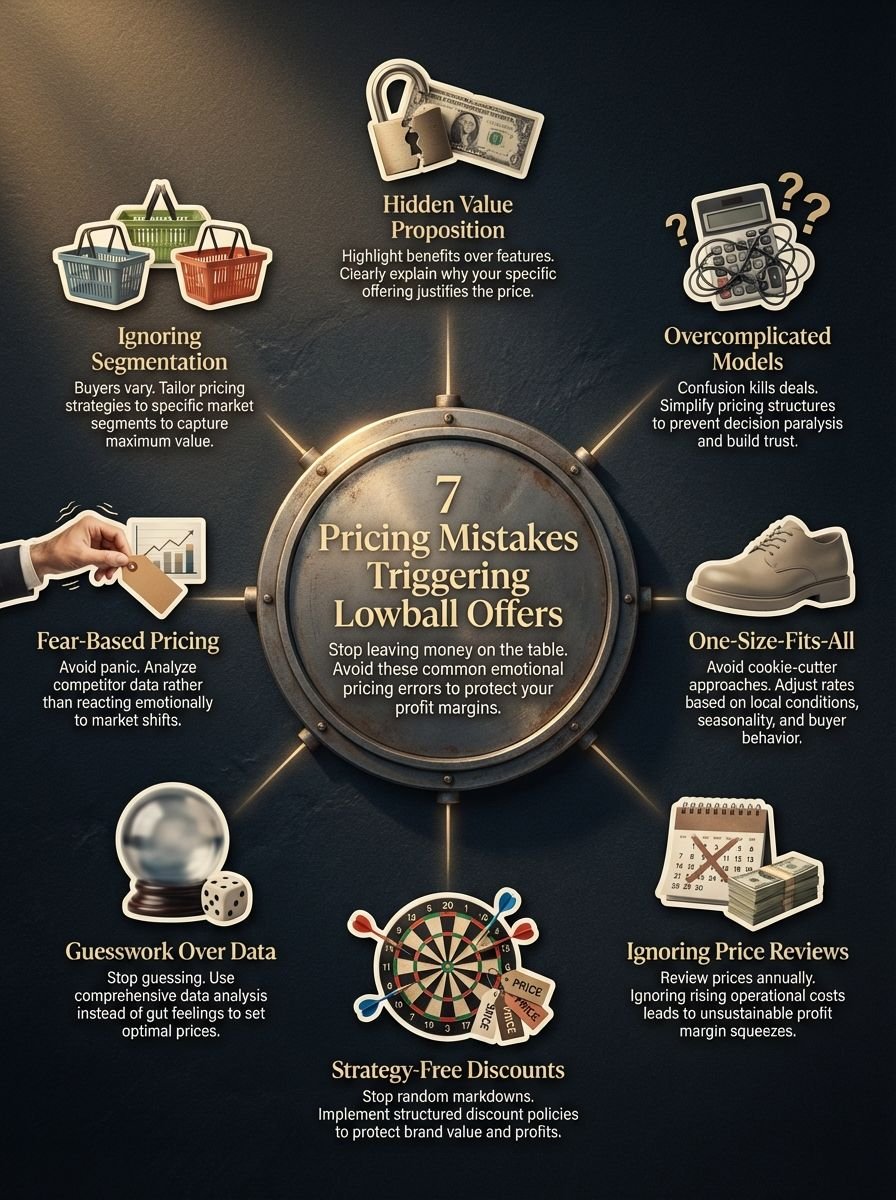
7 Pricing Mistakes That Trigger Price Cuts and Lowball Offers

Seven major pricing mistakes can trigger unnecessary price cuts and lowball offers, costing businesses millions in lost revenue and profit. These emotional pricing decisions create a dangerous cycle that damages your brand positioning and erodes profit margins.
- Setting prices based on fear instead of market research – Many businesses panic and slash prices without analyzing competitor data or understanding true market conditions, leading to a race to the bottom that destroys perceived value.
- Ignoring customer segmentation when pricing properties or services – Treating all buyers the same misses opportunities to capture maximum value from different market segments who have varying willingness to pay.
- Overcomplicating pricing models that confuse potential buyers – Complex pricing structures create decision paralysis and give buyers reasons to negotiate down or walk away entirely.
- Failing to communicate your unique value proposition clearly – When customers don’t understand what makes your offering special, they default to comparing prices alone, triggering lowball offers.
- Using one-size-fits-all pricing across different market dynamics – Cookie-cutter approaches ignore local market conditions, buyer behavior patterns, and seasonal demand fluctuations that affect pricing power.
- Avoiding regular price reviews despite rising operational costs – Many businesses haven’t raised prices in 2-3 years while expenses climbed, forcing them into unsustainable profit margin squeezes.
- Offering discounts without clear strategy or end dates – Random price cuts train customers to expect deals and devalue your brand, creating a cycle where buyers wait for markdowns before purchasing.
Assuming Lower Prices Always Drive Sales

You might think cutting your home’s price will bring buyers running to your door. This pricing strategy often backfires in spectacular ways. Lower prices do not always attract more customers and can reduce perceived value of products.
Real estate works differently than retail stores. Big box stores charge more due to higher overhead and brand recognition, yet they still thrive.
Slashing prices doesn’t always drive sales; successful pricing is complex and multi-factorial. Your property loses its appeal when priced too low. Buyers start questioning what’s wrong with the house.
Smart pricing strategies focus on the sweet spot between price and quality. Products should be priced based on customer value and a “sweet spot” on the price-quality matrix. Market dynamics play a bigger role than simple price cuts.
Consumer psychology tells us that rock-bottom prices signal poor quality or hidden problems.
Price is what you pay. Value is what you get. Smart sellers understand this difference and price accordingly. – Jay Hernandez, Licensed Real Estate Broker
Ignoring Customer Segmentation

Customer segmentation separates your buyers into distinct groups based on income level, behavior, preferences, and price sensitivity. Different customers have unique needs, making segmentation critical for tailored marketing and pricing strategies.
Studies show market segmentation directly impacts consumer purchasing behavior and pricing decisions. Real estate investors looking for rental properties have different priorities than first-time homebuyers searching for starter homes.
Each group responds to different value propositions and pricing approaches.
Lack of segmentation leads to missed opportunities for value-based pricing and creates confusion in the marketplace. Personalized strategies improve customer satisfaction and boost perceived product value across all customer segments.
Geographic price variations become essential when serving diverse markets with varying income levels and housing costs. Segmenting the audience increases engagement and conversion rates during property transactions.
CRM systems and analytics help identify these customer segments through data analysis rather than guesswork. Retailers in other industries have proven that targeted approaches generate higher profit margins than one-size-fits-all pricing models.
Overcomplicating Pricing Models

Complex pricing structures confuse buyers and kill deals faster than any market downturn. Real estate professionals who layer multiple fees, percentage tiers, and confusing commission splits create barriers that push clients toward competitors with clearer offers.
Simplified pricing presentations prove critical for customer comprehension and conversion, yet many agents still present buyers with spreadsheets full of variables, sliding scales, and conditional rates that require a calculator to understand.
Smart pricing automation tools can streamline these complicated models, but the real solution starts with recognizing that your target audience wants transparency, not complexity. Overly complex offers deter purchases and lower engagement across all customer segments, from first-time homebuyers to seasoned real estate investors.
Clear pricing accelerates decision-making processes and builds the trust that leads to referrals and repeat business. Straightforward models allow sales reps to communicate value without stumbling over confusing terms or getting lost in mathematical explanations that leave clients more confused than convinced.
Next, let’s examine how failing to showcase what makes your services valuable opens the door to price objections and discount demands.
Failing to Highlight Product Value

Your property sits on the market longer than expected because buyers can’t see its true worth. Most real estate professionals make the critical error of listing features without connecting them to buyer benefits.
You mention granite countertops, but fail to explain how they save money on maintenance and boost resale value. Smart sellers focus on perceived value rather than just square footage or amenities.
Some buyers will pay $50,000 extra for a home office that supports remote work, while others won’t budge on price without seeing clear value. Effective value communication prevents lowball offers and unnecessary price cuts that eat into profit margins.
Market data shows properties with strong value positioning sell 23% faster than those focusing solely on specifications. Your listing description becomes a powerful tool for brand positioning when it addresses specific buyer pain points.
Investment properties need different value messaging than family homes, proving customer segmentation drives pricing strategy success. Professional photography, virtual tours, and detailed benefit explanations create higher perceived value in today’s competitive market.
Value perception stays subjective across different buyer segments, making targeted messaging essential for optimal pricing outcomes. The next common mistake involves taking a rigid approach that ignores diverse buyer needs and market dynamics.
Sticking to a One-Size-Fits-All Pricing Approach

While failing to showcase product value creates confusion, applying uniform pricing across all customer segments compounds the problem. You miss significant revenue opportunities when treating every buyer the same way.
Customers have varying needs and willingness to pay, yet pricing must reflect these differences. One-size-fits-all pricing may result in overcharging some customers and undercharging others.
Real estate markets demonstrate this principle clearly. First-time homebuyers often need different financing options than seasoned investors. Luxury property buyers expect premium services that justify higher commission rates.
Uniform margin expectations can hurt innovation and reduce market prices for unique properties. Geographical and demographic variations require tailored pricing approaches that match local market conditions.
Failing to differentiate pricing leaves money on the table and can alienate key customer segments who feel their specific needs aren’t valued.
Avoiding Regular Price Reviews and Updates

Many businesses have not raised prices in 2-3 years despite rising costs, reducing profitability. This pricing mistake hits real estate professionals especially hard as market conditions shift rapidly.
Your brokerage faces increased payroll expenses, technology costs, and operational overhead that demand regular attention. Owners should review pricing at least once a year to keep up with costs and market changes.
Expenses change monthly, quarterly, or yearly, making regular budgeting necessary for sustainable profit margins. Holding prices steady for too long ignores market dynamics and rising operational costs that eat into your bottom line.
Not updating prices leads to owners absorbing increased costs, resulting in unintentional pay cuts. Annual price increases are recommended for proactive profit management that protects your real estate business from inflation and competitive pressures.
Price stagnation can result in significant long-term revenue losses that compound over time. Smart pricing automation tools help track these changes and alert you to necessary adjustments before profit margins shrink too far.
The next critical error involves offering discounts without a clear strategy behind them.
Offering Discounts Without a Clear Strategy

Discounting erodes profitability if not managed with a clear, structured policy. Your real estate business faces this exact challenge every day. Clients expect price cuts on commission rates.
Sellers demand reduced listing fees. Buyers want rebates on their purchases. Without a solid discount framework, you create chaos in your pricing strategy. Random price reductions confuse customers about your true value.
They start expecting deals on everything. Your profit margins shrink faster than ice cream on hot pavement. Smart real estate brokers know that effective discount strategies must balance short-term sales with long-term brand integrity.
They create rules about when discounts apply. They set clear limits on how much they’ll reduce prices. This approach protects their reputation while still attracting new clients.
Continuous discounts may lead to consumer discount fatigue and reluctance to pay full price. Real estate investors see this pattern constantly in their local markets. Properties that stay discounted too long lose their appeal.
Buyers start questioning what’s wrong with the deal. Your brand positioning suffers when discounts become the norm rather than the exception. Excessive discounting can undermine consumer trust in product value.
Clients wonder if your original prices were fair to begin with. They lose confidence in your market knowledge. A structured discount policy encourages desired customer behavior instead of creating dependency.
You can offer reduced commission rates for exclusive listings. You might provide buyer rebates for quick closings. These targeted incentives drive specific actions while maintaining your professional image.
Studies show that good discount strategies attract new customers while maintaining brand reputation across all market conditions.
Focusing Solely on Revenue Instead of Profit

Poor discount strategies often lead to an even bigger problem: chasing revenue while profit margins disappear. Sales incentives focused only on revenue can neglect margins and reduce overall profits.
Your real estate business suffers when commission structures reward salespeople for closing deals at any price point. Many owners set prices without accounting for true expenses, leading to financial strain across their operations.
Consider this example: a $100 sale with $50 cost of goods sold represents 50% of revenue, plus $25 in operational expenses equals 25% of sales, leaving just $25 for actual profit. Revenue-based incentives can lead to underpricing and profit erosion in your brokerage.
Sales teams should be incentivized to grow margins, not just top-line sales numbers. Margin-based sales incentives align team interests with business profitability and create sustainable growth for your real estate enterprise.
Neglecting Competitor and Market Analysis

Market dynamics shift constantly, yet many real estate professionals stick to outdated pricing strategies without checking what competitors charge. Research shows that 132 articles on competitive posted goods pricing revealed frequent gaps in market analysis, leaving agents and investors blind to critical market insights.
Your pricing strategy becomes misaligned with current market demands while competitors capture deals at better rates. Traditional real estate brokerages often skip competitor analysis due to manual processes that eat up time and resources.
High costs of thorough competitor analysis discourage many from understanding true market conditions. This creates missed opportunities for effective price capturing that could boost profit margins significantly.
Static pricing approaches ignore competitor variations and fail to address broader strategic objectives within the real estate marketplace. Low completion rates in competitive pricing programs result in high data error rates that hide valuable market insights.
Lack of alignment between pricing strategy and competitor intelligence blocks collaboration between agents and marketing teams. Tactical pricing methods miss the comprehensive analysis needed for value-based pricing in today’s dynamic market.
Real estate investors lose market share while competitors use pricing automation tools to stay ahead. Smart agents track competitor listings, analyze market trends, and adjust their approach based on solid data rather than gut feelings.
Moving forward, focusing solely on revenue instead of profit creates another dangerous trap.
Relying on Intuition Rather Than Data

Many managers base pricing on intuition or past experience rather than comprehensive data analysis. This approach might feel natural, but it creates serious problems for your real estate business.
Cognitive biases and psychological factors lead to suboptimal pricing outcomes that cost you money. Texas Tech pays 2.9 times more than University of Houston for journal and highly cited data due to unstandardized pricing decisions.
This pricing discrimination example shows what happens without data-driven analysis.
Intuitive pricing feels quick and easy, but it results in inconsistencies and errors that hurt your profit margins. Studies suggest training to recognize and correct cognitive biases improves pricing decisions significantly.
Analytical methods prove more effective than intuition for setting optimal prices in today’s competitive market. A balanced approach combining data analysis with market insights works best for real estate professionals.
Smart pricing automation tools can help eliminate guesswork from your pricing strategy. The next common mistake involves holding prices too low for extended periods.
Holding Prices Too Low for Too Long

Pricing managers routinely set prices too low, sapping their companies’ profits. Your real estate business faces the same trap that hurts countless companies across industries. Take sunglasses priced at $10 with a $7 cost as an example.
Lowering the price to $9.50 may increase sales to 1,250 units with an 80% probability, but a 20% chance exists of only 1,000 units selling. Keeping prices at $10 ensures sales of 1,000 units while maintaining higher profit margins.
This pricing strategy applies directly to your property listings and investment decisions.
Companies often fear customer backlash to price increases, maintaining low prices for extended periods. Holding prices steady for too long ignores inflation and cost increases that eat away at gross profit margin.
Your online store or real estate portfolio suffers when market conditions shift but pricing stays frozen. Underpricing over time leads to profit erosion and financial instability that threatens your brand positioning.
Regular price evaluations become necessary to avoid long-term underpricing that damages your competitive pricing advantage. Smart pricing automation tools help track market dynamics and suggest adjustments before profit margins disappear completely.
Underestimating the Importance of Customer Experience

Customer experience directly impacts willingness to pay premium prices, yet many real estate professionals underestimate this critical connection. You might think buyers and sellers only care about square footage or location, but studies show that customer satisfaction strongly links to the interplay between pricing strategies and service quality.
Your clients remember how you made them feel during the home buying or selling process. They recall whether you returned calls promptly, explained complex paperwork clearly, or went the extra mile to address their concerns.
This emotional connection influences their perception of your value and their willingness to accept your pricing structure.
Underestimating experience can result in pricing that fails to capture maximum value from your services. Smart real estate professionals understand that perceived value extends far beyond commission rates or listing fees.
Your expertise in market conditions, negotiation skills, and ability to guide clients through stressful transactions creates substantial worth. Empirical studies confirm a positive relationship between pricing strategies and customer retention in real estate markets.
Agents who focus on delivering exceptional customer experience build stronger brand positioning and can command higher fees. Your next challenge involves finding the right balance between testing new approaches and maintaining proven methods.
Not Testing and Adapting New Pricing Strategies

Most real estate professionals stick to the same pricing strategy for years without testing new approaches. This habit costs you money and market share. Regular A/B testing of pricing strategies helps you find what works best for your market conditions.
You might discover that value-based pricing attracts more qualified buyers than cost-plus pricing methods. Testing reveals which pricing models generate better profit margins and stronger customer loyalty.
Pricing automation tools make testing easier than ever before. These systems use market data to optimize prices and target specific customer segments. Real estate investors who postpone automation implementation limit their pricing effectiveness significantly.
Smart professionals compare new pricing tactics against established methods regularly. This approach uncovers opportunities for margin improvement while keeping pace with changing market dynamics.
Proactive adaptation of pricing strategies improves profitability and competitiveness in today’s fast-moving real estate market.
Moving beyond testing issues, many agents make another critical error with their discount strategies.
Conclusion

Pricing mistakes cost real estate professionals thousands in lost profits every year. Smart pricing strategies separate successful agents from those struggling with lowball offers.
Your brand positioning depends on getting these fundamentals right from day one.
Master competitive pricing through careful market analysis and customer segmentation. Test different approaches using data rather than gut feelings. Price correctly, and watch your profit margins grow while competitors scramble to match your success.
FAQs
1. What are the most common pricing mistakes that hurt businesses?
Companies often ignore market dynamics and set prices without proper customer segmentation. They skip A/B testing and fail to understand their product value, which leads to weak profit margins and poor brand positioning.
2. How do pricing mistakes trigger lowball offers from customers?
When businesses don’t use value-based pricing, customers see low perceived value and make cheap offers. Poor pricing strategy signals weakness, especially in competitive pricing situations where market conditions favor buyers.
3. Why do startups struggle with pricing automation and dynamic pricing?
Most startup companies lack the enterprise resource planning systems needed for smart pricing. They often rely on gut feelings instead of data from experiments and forecasts, missing key consumer behaviors that drive purchasing decisions.
4. How does psychological pricing affect customer experience in online marketplaces?
Smart psychological pricing tricks the brain and boosts sales on digital platforms. Brands that use tiered pricing and understand supply and demand create better customer experiences. This approach works like Netflix’s subscription tiers, where each level offers clear value.
5. What role does a salesperson play in avoiding pricing disasters?
A skilled salesperson reads market conditions and adjusts prices based on real customer feedback. They use metrics from their balanced scorecard to track what works, helping companies avoid the pricing mistakes that trigger desperate price cuts.
6. How can businesses improve their marketing strategy to support better pricing?
Companies should focus on building strong brand identity and creating memorable brand experiences. Banking on solid market research and productivity metrics helps businesses set prices that reflect true value, not just what competitors charge.
References
- https://www.intelligencenode.com/blog/7-pricing-mistakes-sure-avoid/
- https://www.businessnewsdaily.com/3455-cheap-prices-customers.html (2024-01-12)
- https://pricecop.net/en/blog/pomylky-tsinoutvoryuvannya/ (2025-04-21)
- https://www.mdpi.com/2227-7390/12/21/3364
- https://www.ijfmr.com/papers/2025/1/37267.pdf
- https://www.engage3.com/2018/01/7-challenges-modern-competitive-pricing/ (2018-01-22)
- https://pmc.ncbi.nlm.nih.gov/articles/PMC9194889/
- https://www.researchgate.net/publication/262490820_Pricing_by_intuition_Managerial_choices_with_limited_information
- https://katinamagazine.org/content/article/open-knowledge/2025/academic-databases-and-the-art-of-the-overcharge
- https://hbr.org/2001/10/are-your-prices-too-low
- https://www.linkedin.com/pulse/7-pricing-mistakes-avoid-costing-businesses-millions-neema-gray
- https://www.researchgate.net/publication/387403185_Pricing_Strategy_and_Service_Quality_Improvement_to_Optimize_Customer_Satisfaction_a_Systematic_Literature_Review