



You’ve built wealth through real estate investing, but now you face a tough choice. Selling your investment property means paying hefty capital gains taxes that could eat up thousands of your hard-earned profits.

The IRS takes a big bite out of your success, and you’re looking for a legal way to keep more money in your pocket.
Here’s a fact that might surprise you: Section 1031 exchanges allow real estate investors to defer capital gains taxes completely when done correctly. This powerful tax strategy has helped countless property owners reinvest their full sale proceeds into replacement property without immediate tax consequences.
Your guide covers the essential rules, critical deadlines, and costly mistakes that could make or break your 1031 exchange success.
You’ll discover the 45-day identification period, the 180-day exchange timeline, and why a qualified intermediary becomes your most important partner. We’ll show you how to avoid the common pitfalls that turn tax deferral dreams into expensive nightmares.
Ready to master the art of tax-smart real estate investing?
Key Takeaways
- 1031 exchanges allow real estate investors to defer capital gains taxes completely when selling investment properties and reinvesting proceeds into replacement properties.
- Investors must identify replacement properties within 45 days and complete the exchange within 180 days of selling their original property.
- A qualified intermediary must hold sale proceeds throughout the exchange process to prevent disqualification and immediate tax liability consequences.
- Replacement property value must equal or exceed the sold property’s value to achieve full tax deferral and avoid taxable boot.
- Missing either the 45-day identification deadline or 180-day completion timeline disqualifies the entire exchange and triggers immediate capital gains taxes.
1031 Exchange Basics: Rules, Timelines, and Common Mistakes

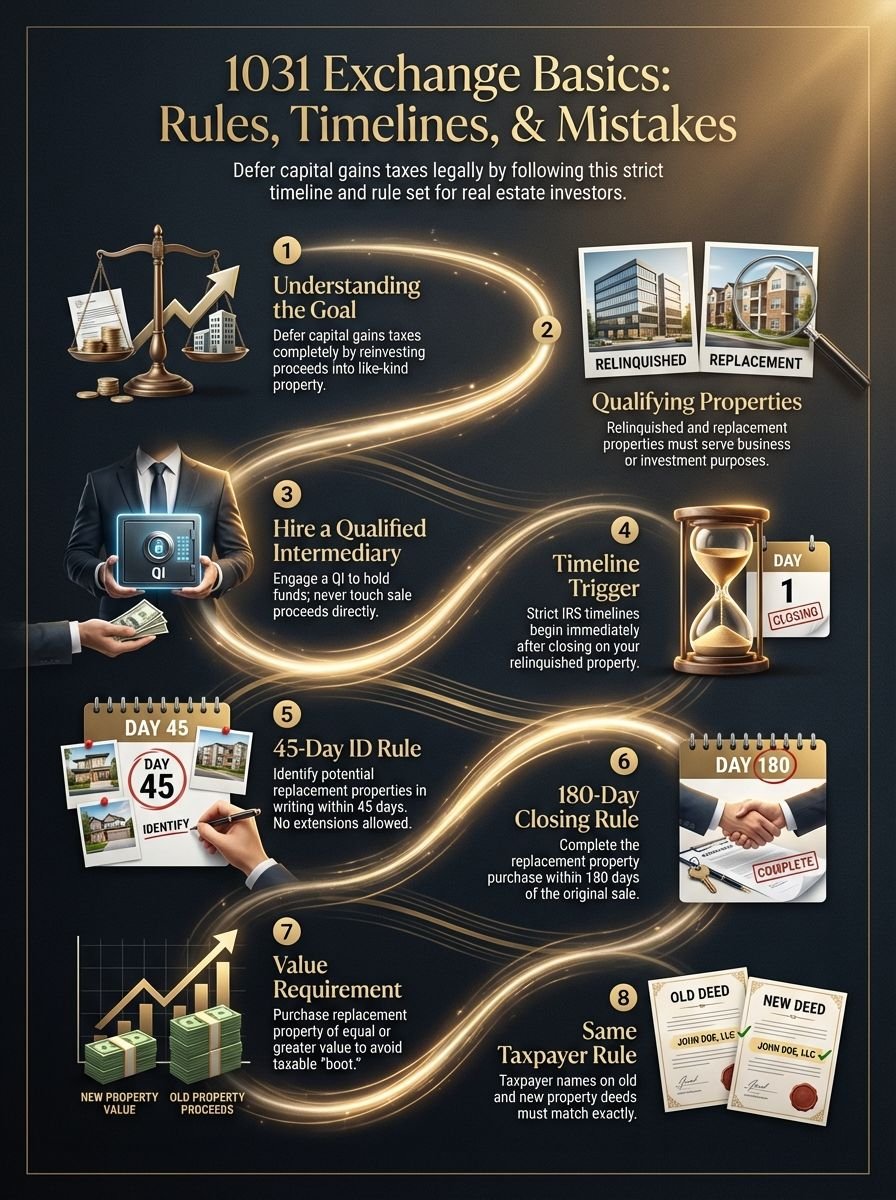
Real estate investors use 1031 exchanges to defer capital gains taxes while building wealth through strategic property swaps. This powerful tax strategy lets you sell your relinquished property and reinvest the proceeds into replacement property without triggering immediate tax liability.
The IRS requires both properties to qualify as like-kind property held for business or investment purposes. Your qualified intermediary holds the sale proceeds and facilitates the entire transaction according to strict IRS regulations.
Two critical deadlines control every successful like-kind exchange. The 45-day identification period starts the moment you close on your relinquished property, giving you exactly 45 days to identify potential replacement properties in writing.
The 180-day exchange timeline begins simultaneously, requiring you to complete the purchase of your replacement property within this window. Missing either deadline disqualifies your exchange and creates an immediate taxable event.
Real estate investors often stumble by failing to work with a qualified intermediary or attempting to handle the transaction proceeds directly.
Understanding these fundamental rules sets the foundation for exploring what exactly constitutes a 1031 exchange.
What is a 1031 Exchange?

A 1031 Exchange offers you a powerful tax strategy that lets you defer capital gains taxes on investment property sales. This legal provision allows you to sell your relinquished property and reinvest the proceeds into replacement property without paying immediate capital gains tax.
The IRS created this tax deferral mechanism to encourage real estate investment and economic growth. Since January 1, 2018, only real property qualifies for these exchanges, which means personal property and intangible assets no longer make the cut.
Your investment properties, commercial buildings, agricultural land, and vacation rentals all qualify as like-kind property under current IRS regulations. Primary residences don’t qualify because they lack the intent to hold for investment that the tax code requires.
A 1031 exchange is like hitting the pause button on your tax bill while your wealth keeps growing through strategic real estate investments. – Jay Hernandez, Licensed Real Estate Broker
The process works through a qualified intermediary who holds your sale proceeds and facilitates the exchange between properties. You can’t simply sell one property and buy another on your own, the QI prevents direct receipt of funds that would trigger a taxable event.
The term “like-kind” has a broad definition that doesn’t require identical properties. You can exchange an apartment building for raw land or swap commercial space for rental houses.
This flexibility gives real estate investors tremendous options for portfolio diversification while maintaining tax deferrals. The fair market value of your replacement property must equal or exceed your relinquished property’s sale price to achieve full tax deferral.
Partial exchanges still provide benefits but create some immediate tax liability on the difference.
Key Rules for a Successful 1031 Exchange

A successful 1031 exchange requires strict adherence to IRS regulations and specific property requirements. You must follow these essential rules to defer capital gains taxes and maximize your investment property benefits.
- Both your relinquished property and replacement property must serve business or investment purposes to qualify for like-kind exchange treatment under IRS rules.
- Your replacement property must have equal or greater value than the relinquished property to avoid creating taxable boot that triggers capital gains tax liability.
- All proceeds from the sale must be reinvested through your qualified intermediary to achieve full tax deferral on your real estate transactions.
- Debt levels on the replacement property must equal or exceed the debt on your relinquished property, or you must replace the difference with cash.
- Your qualified intermediary must remain independent and cannot have represented you as a taxpayer in any capacity during the previous two years.
- You must identify potential replacement properties in writing, sign the documentation, and deliver it to your qualified intermediary within the 45-day identification period.
- Complete your exchange within 180 days of selling your relinquished property to meet IRS deadlines and avoid losing tax deferral benefits.
- Maintain accurate basis calculations for your new property since the IRS defers taxable gains rather than eliminating them completely from your tax liability.
Understanding the 45-Day Identification Period

Following the key rules sets the foundation, but the 45-day identification period demands your immediate attention after closing on your relinquished property. This critical timeline starts the day after you sell your investment property, giving you exactly 45 calendar days to identify potential replacement properties in writing to your qualified intermediary.
Your identification must reach the qualified intermediary (QI) by midnight on the 45th day, including weekends and holidays with no extensions except for federally declared disasters.
The Three-Property Rule allows you to identify up to three properties regardless of their fair market value, while the 200% Rule permits identifying any number of properties as long as their total value stays under 200% of your relinquished property’s value.
The 95% Rule offers the most flexibility, letting you identify unlimited properties but requiring you to acquire at least 95% of the total identified value to maintain your tax deferral benefits and avoid capital gains taxes.
Navigating the 180-Day Exchange Timeline

The 180-day exchange period starts the day after you close on your relinquished property. This timeline runs at the same time as your 45-day identification period, not after it. You must complete your entire like-kind exchange within these 180 days, or face immediate capital gains tax liability on your investment property sale.
Your deadline stays firm regardless of weekends or holidays. The IRS rarely grants extensions unless a federally declared disaster occurs in your area. If your tax return filing date arrives before your 180th day expires, you must finish the exchange by the earlier date.
Missing this deadline by even one day disqualifies your entire 1031 exchange and triggers full taxation on your real estate transaction. Only replacement properties that close within this window qualify for tax deferral benefits.
The Role of the Qualified Intermediary in the Process

A qualified intermediary (QI) serves as your essential partner in completing a successful 1031 exchange. This licensed professional acts as a neutral third party who holds your sale proceeds in escrow during the entire exchange process.
Your QI must be independent, with no prior agency relationship with you in the last two years. They facilitate the identification and acquisition process to ensure IRS compliance while preparing all exchange documents.
Most importantly, your QI ensures you never receive or control the proceeds from your relinquished property, which prevents a taxable event that could disqualify your entire exchange.
Selecting a reputable qualified intermediary early in the process prevents significant tax consequences and helps mitigate risks like missing critical IRS deadlines. Your QI maintains segregated accounts for each exchange and keeps organized records that prove compliance with IRS regulations.
They guide you through both the 45-day identification period and the 180-day exchange timeline while coordinating with real estate agents, attorneys, and other professionals involved in your real estate transactions.
Communication with your QI remains vital throughout the process, as they protect your investment property exchange from costly mistakes that could trigger capital gains taxes.
Missing deadlines can create serious consequences that affect your entire tax deferral strategy.
Common Mistakes to Avoid in a 1031 Exchange

Real estate investors often make costly errors during like-kind exchanges that can destroy their tax deferral benefits. These mistakes can trigger immediate capital gains taxes and eliminate years of careful investment planning.
- Failing to engage a qualified intermediary before selling your relinquished property – You must hire a QI before closing on your current investment property to maintain exchange eligibility and avoid disqualification.
- Missing the 45-day identification deadline for replacement properties – The IRS requires written identification of potential replacement properties within 45 days of selling your relinquished property, with no extensions allowed.
- Exceeding the 180-day acquisition timeline for completing the exchange – You lose all tax deferral benefits if you fail to close on replacement property within this strict IRS deadline.
- Receiving sale proceeds directly instead of through the qualified intermediary – Direct receipt of funds from your relinquished property sale immediately disqualifies the entire 1031 exchange process.
- Inadequately documenting replacement property identification in writing – Verbal identification doesn’t satisfy IRS regulations; you need proper written documentation submitted to your qualified intermediary within the deadline.
- Purchasing replacement property with lower fair market value than the relinquished property – This creates taxable “boot” that triggers immediate capital gains tax liability on the difference.
- Skipping professional consultation with tax advisors and legal counsel – Real estate transactions require expert guidance to avoid costly mistakes and ensure compliance with complex IRS rules.
- Conducting insufficient due diligence on potential replacement properties – Rushed decisions can lead to poor investment choices that don’t meet your long-term financial goals.
Understanding these pitfalls helps you prepare for the critical deadlines and requirements that make or break your exchange success.
What Happens if You Miss a Deadline?

Avoiding common pitfalls sets you up for success, but understanding the consequences of missed deadlines protects your investment strategy. Missing the 45-day identification deadline makes your exchange ineligible for tax deferral, and the IRS treats your sale proceeds as taxable income.
Your capital gains taxes become due immediately, eliminating the financial benefits you sought through the like-kind exchange process.
Failure to complete the purchase of replacement property within 180 days triggers recognition of capital gains from your original sale. Both the 45-day and 180-day deadlines run concurrently, and the IRS strictly enforces these timeframes without exceptions for weekends or holidays.
Extensions only apply during federally declared disasters or under specific IRS guidance like Revenue Procedure 2018-58. Unused exchange funds after 180 days become taxable to you as the investor, creating immediate tax liability that could have been deferred.
A qualified intermediary helps prevent these costly deadline mistakes by managing your exchange timeline and protecting your investment property goals.
Legal Considerations and IRS Guidelines to Know

Missing deadlines creates serious tax consequences, but understanding the legal framework helps you avoid these pitfalls entirely. The Tax Cuts and Jobs Act changed everything on January 1, 2018, restricting Section 1031 exchanges to real property only.
This means you cannot exchange personal property, stocks, or partnership interests anymore. The Same Taxpayer Rule demands that the same person or entity owns both the relinquished property and replacement property.
Your name on the deed must match exactly, or the IRS will disqualify your entire exchange.
Form 8824 becomes your legal lifeline for reporting like-kind exchanges to the Internal Revenue Service. Cash or “boot” you receive during the exchange triggers immediate tax liability on that portion.
IRS regulations state that any reduction in mortgage debt counts as taxable boot. Certain properties face automatic exclusion, including inventory held for sale and securities. Mutual ditch, reservoir, or irrigation stock may qualify for special treatment under specific circumstances.
Capital gains taxes hit immediately if you violate these strict guidelines, making proper legal compliance essential for protecting your investment.
Proactive Strategies for Staying on Track

Understanding IRS regulations sets the foundation for success, but proactive planning keeps your 1031 exchange on track. Smart strategies prevent costly timing failures and ensure you meet all critical deadlines.
- Start collaborating with experienced 1031 specialists, tax advisors, and a qualified intermediary before listing your relinquished property. Early partnerships prevent timing failures and ensure all parties understand the exchange timeline from day one.
- Create a detailed timeline using calendars, spreadsheets, or specialized software to track the 45-day identification period and 180-day exchange deadline. Visual aids help monitor key milestones and provide buffer times for unexpected delays.
- Research potential replacement properties before the 45-day identification period begins. Pre-screening like-kind properties saves valuable time and reduces pressure during the critical identification window.
- Establish regular communication schedules with your qualified intermediary, real estate agents, lenders, and title companies. Weekly check-ins ensure everyone stays aware of approaching deadlines and potential roadblocks.
- Maintain accurate documentation of every exchange-related transaction and correspondence. Detailed records protect against IRS challenges and help track progress throughout the entire process.
- Secure financing pre-approval and conduct due diligence on target properties ahead of identification deadlines. Advance preparation eliminates last-minute scrambles that could derail your exchange timeline.
- Stay updated on current 1031 regulations, IRS guidance, and recent court rulings affecting like-kind exchanges. Tax laws change frequently, and staying informed protects your investment property transaction.
- Build contingency plans for multiple replacement property scenarios using the three-property rule. Having backup options prevents panic if your primary choice falls through during the exchange period.
Expert Tips for Maximizing 1031 Exchange Benefits

Building on the proactive strategies that keep your exchange on track, smart investors know that maximizing benefits requires expert-level tactics. These proven tips from seasoned professionals can help you squeeze every advantage from your like-kind exchange.
- Start your replacement property search before listing your relinquished property to gain a competitive edge in tight markets and avoid rushed decisions during the 45-day identification period.
- Engage a reputable qualified intermediary early in the process, as Jay Hernandez from Real Estate Rank IQ recommends, to ensure smooth facilitation and compliance with IRS regulations.
- Prepare your property selection plan using the Three-Property Rule, 200% Rule, or 95% Rule to maximize identification flexibility and create backup options for your investment strategy.
- Conduct thorough market research and due diligence on potential replacement properties to identify undervalued assets that offer strong appreciation potential and cash flow.
- Maintain open communication with your team of real estate agents, lenders, and legal advisors to coordinate timing and avoid costly delays that could jeopardize your exchange.
- Use technology platforms to organize documents, track IRS deadlines, and ensure compliance with the strict 180-day exchange timeline for seamless execution.
- Strategize your property selection to balance risk and opportunity within time constraints, focusing on properties with strong fundamentals and growth prospects in your target markets.
- Consider Delaware Statutory Trust options for fractional ownership opportunities that provide access to institutional-grade real estate investments without direct property management responsibilities.
- Consult with Jennifer French, CPA from PBMares Construction & Real Estate, to optimize tax deferral strategies and ensure your exchange structure maximizes capital gains tax benefits.
- Plan for depreciation recapture implications by selecting replacement properties that offer step-up in basis opportunities and long-term appreciation potential for your investment portfolio.
Conclusion

Mastering 1031 exchanges transforms your investment strategy like a well-executed financial movie plot. Smart real estate investors who follow IRS deadlines and work with qualified intermediaries build wealth while deferring capital gains taxes.
Missing the 45-day identification period or 180-day exchange timeline costs thousands in unexpected tax liability. Success depends on proper planning, choosing suitable like-kind properties, and avoiding common pitfalls that derail exchanges.
Start your next investment property transaction with confidence by applying these proven strategies to maximize tax deferral benefits.
FAQs
1. What exactly is a 1031 exchange and how does it work?
A 1031 exchange lets real estate investors swap one investment property for another like-kind property while deferring capital gains taxes. You must use a qualified intermediary to handle the transaction and follow strict IRS deadlines. Think of it like trading baseball cards, but with million-dollar properties and Uncle Sam watching the clock.
2. What are the key timelines I need to remember for a successful exchange?
You have 45 days to identify your replacement property after selling your relinquished property. Then you have 180 days total to complete the purchase of your new investment property. Missing these IRS deadlines means you’ll face immediate tax liability on your capital gains.
3. What’s the three-property rule and why should I care?
The three-property rule limits you to identifying up to three potential replacement properties during your 45-day window. Real estate agents often see investors get overwhelmed with choices, but this IRS regulation keeps things focused.
4. What are the biggest mistakes that trip up investors?
Many taxpayers forget about depreciation recapture taxes, which hit even in successful exchanges. Others fail to show clear intent to hold for investment, or they accidentally touch their escrow funds during the process.
5. Do I really need a qualified intermediary, and what do they actually do?
Yes, IRS rules require a qualified intermediary to hold your sale proceeds and handle the paperwork. They’re like the referee in this tax deferral game, making sure you don’t accidentally disqualify yourself by touching the monies.
6. Can I do a partial exchange if I can’t find property worth the same fair market value?
Absolutely, but you’ll pay capital gains tax on any cash you receive back. Real estate lawyers call this “boot,” and while it sounds like something from a Western movie, it’s just taxable income you’ll need to report.
References
- https://www.irs.gov/pub/irs-news/fs-08-18.pdf
- https://www.ipx1031.com/what-is-a-1031-exchange/
- https://www.1031specialists.com/blog-posts/the-role-of-the-qualified-intermediary-in-a-1031-exchange
- https://www.ipx1031.com/the-role-of-the-qualified-intermediary/
- https://www.1031specialists.com/blog-posts/common-mistakes-to-avoid-in-a-1031-exchange-50900
- https://www.northmarq.com/insights/knowledge-center/common-1031-exchange-mistakes-avoid (2024-01-16)
- https://www.firstexchange.com/learn/articles/1031-exchange-timeline
- https://www.deferred.com/1031-exchange-faqs/what-happens-if-i-miss-the-45-day-or-180-day-deadlines-in-a-1031-exchange
- https://www.irs.gov/businesses/small-businesses-self-employed/like-kind-exchanges-real-estate-tax-tips
- https://primior.com/why-most-1031-exchange-timing-strategies-fail-and-how-to-fix-them/